





























From the World War I Centennial News Podcast
Updates From the States: New Jersey
In September 7th's WW1 Centennial News Podcast, Episode 88, Host Theo Mayer spoke with Sarah Cureton and Veronica Calder about the New Jersey WW1 Centennial Committee. The following is a transcript of the interview:
Theo Mayer: This week for our 'Update from the States' we're headed to the Garden State, New Jersey. Joining us to tell us about the New Jersey World War One Centennial Committee, its origins, its projects and programs for the last few years and it's plans beyond the armistice are Sarah Cureton, executive director of the New Jersey Historical Commission and Veronica Calder, archivist at the New Jersey State Archives. Sarah, Veronica, it's great to have you in the show.
Sarah Cureton: Good to be here.
Veronica Calder: Thank you for having us.
Theo Mayer: We started working together and talking to each other several years ago when you came in to the New Jersey Centennial Commemoration process. You're both with the New Jersey government in an organization. How did New Jersey World War One Commemoration come about? How are the efforts structured?
Sarah Cureton: Well, this is Sarah and the agency I work with is the New Jersey Historical Commission and we are the state agency in New Jersey that is charged with organizing programs for major historical anniversaries so this was a natural way for us to get involved with. We then turned to our wonderful partners around the state and they happily came onboard. We were quickly joined by the New Jersey State Archives, the New Jersey State Museum, the New Jersey State Historic Preservation Office, Rutgers University Libraries and Special Collections and the New Jersey National Guard Militia Museum. We quickly formed a planning committee but then one of the great benefits we have here at the historical commission is that we have a grant program and through the grant program, we were able to provide funding to historical organizations all around the state to do their own World War One project.
Theo Mayer: That's great. Well, the state and its role in World War One was huge. You were full of industrial and agricultural production. You had training camps, you had ports. How would you summarize the state's role in World War One?
 Sarah Cureton: You've done an excellent job doing that right there! I think if we took one word to describe New Jersey's role, location is probably the critical word here. New Jersey's history is marked by many, many experiences and themes that do relate to our location on the eastern sea board right in between New York and Pennsylvania, and because of that, New Jersey already had tremendous industrial infrastructure in place when World War One started. Companies like Johnson & Johnson, which during World War One provided medical supplies. Actually, New Jersey companies were beginning to provide supplies to the European Allies long before the US entered the war. In fact by 1918, New Jersey was actually the largest supplier of munitions in America. Finally, I should add that New Jersey also provided significant numbers of troops to the war effort. Over 140,000 New Jerseyans served over the course of the war and we can boast that at least 80 congressional medals on our winners and arguably certainly one of the most famous Americans to serve and to die during World War One was New Jersey's own Joyce Kilmer.
Theo Mayer: Well, I wanted to give you guys a shout out in what you did in uncovering your local World War One memorials as well. You're one of the first publishing partners for the commission that really did a fairly detailed survey of where all your World War One memorials were and how did that come about?
Sarah Cureton: We have to give tremendous credit to our partners over at the New Jersey Historic Preservation Office. As I mentioned they became part of the team very, very quickly and they kept right up and took that particular project on. We've located through their good work about 200 sites in New Jersey that have a World War One connection. Many of them of course are memorial sites and we really will continue to promote that resource to schools and community groups in the years to come as focal points for future Veterans Day programming activities.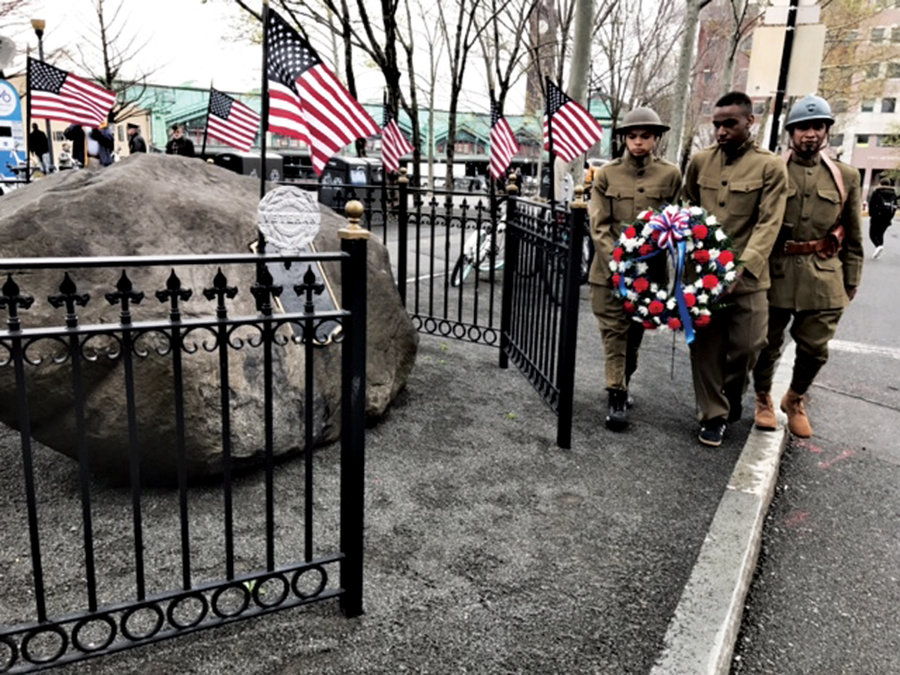 The American Expeditionary Forces Memorial Boulder, located in Hoboken, is one of many sites with WW1 significance in the state of NJ.
Theo Mayer: What are your plans for the armistice?
Sarah Cureton: Well, our governor will be issuing a proclamation calling upon New Jerseyans to participate in the Bells of Peace bell ringing on Armistice Day, and we have a wonderful relationship with the Department of Military and Veterans Affairs here in New Jersey and we are in the process of working with them to plan in their special aspects to their annual Veterans Day service and incorporating bell ringing into the ceremony as part of the Bells of Peace program, so we're excited about that.
Veronica Calder: Yeah. The State Archives is currently digitizing all their unofficial service records. There are no original copies of the service records. We only have microfilm copies so there is no archival quality image or anything of them, so we're currently digitizing them. It's taking a long time as there is over 140,000 of them. Then we're hoping to do a crowdsourcing project to allow the public to help us get the data element which is name, location, residence, place of birth into a database that will be accessible through our website.
Theo Mayer: That's a great project. As the audience may or may not know, in 1973 a fire destroyed 18 million veteran records so reconstituting that is really awesome. Okay- are there plans to keep the Centennial Committee going past the Armistice into '19 and '20?
Sarah Cureton: Luckily here in New Jersey, that group of partners works together on an ongoing basis so we certainly will continue to look for projects that will continue beyond there.
Theo Mayer: Well, New Jersey is very unusual in how you are structured and how you're collaborating with each other. Fantastic work. Thank you.
Sarah Cureton: Thank you.
Veronica Calder: Thank you.
Theo Mayer: Sarah Cureton and Veronica Calder from the New Jersey World War One Centennial Committee. Learn more about the committee and its projects and programs by visiting the links of the podcast notes.