





























From the World War I Centennial News Podcast
100 Cities, 100 Memorials:
Caswell Beach, North Carolina
 In September 7th's WW1 Centennial News Podcast, Episode 88, Ron and Dr. Norma Eckert of the Friends of Fort Caswell Rifle Range joined the show to discuss their project with host Theo Mayer. The following is a transcript of the interview:
Theo Mayer: Moving on to our 100 Cities/100 Memorials segment about the $200,000 matching grant challenge to rescue and focus on local World War One Memorials. This week, we're headed to Caswell Beach, North Carolina. Here to tell us about the project are Ron and Dr. Norma Eckart, speaking for the Friends of Fort Caswell Rifle Range. Welcome to the podcast.
Ron Eckart: Well, thank you very much and we are very, very honored to be selected long with the NC State Bell Tower and we thank you Theo and Katherine for this occasion.
Theo Mayer: Kind words. Thank you very much. I remember first seeing your grant application when it came through and your project was very different because you weren't a "memorial" per se, but rather a preservation project for a firing range in the middle of what today, I think, is an urban development. Can you tell us a bit about the project?
Ron Eckart: Oak Island is a 13-mile barrier island along the Atlantic Ocean and Caswell Beach is on the eastern three miles of the barrier island right at the mouth of Cape Fear River. The permanent population is 398. In the summer, the tourists come and we have 2,000 people. The new rifle range that we want to talk about was built during build-up for World War One. The existing rifle range within Fort Caswell had become too dangerous to continue as new troop facilities crowded the range. The project was quickly funded and finished by May 1918. After World War One, the land that contained the fort was sold and the remaining land was abandoned until the 1980s when construction on a golf course in Caswell Dunes residential community began. We're very fortunate that the developers saved the rifle range from the bulldozer.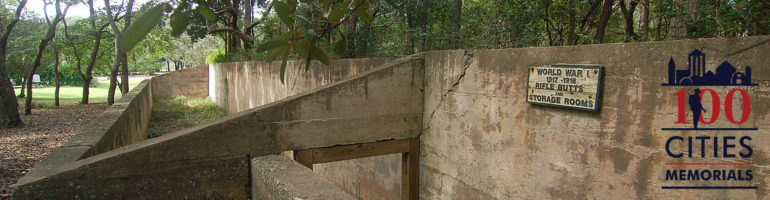
Theo Mayer: I was gonna ask you, how did that happen?
Ron Eckart: Well, according to an early resident of Caswell Dunes, they looked at the structure and said, “Wait a minute. I can't bulldoze this. I need to talk to somebody.” They talked to the authorities, whoever they might be, and the authorities said, “No, you can't bulldoze that.” They saved it for us and we're so excited. It's 100 years old and it needs a lot of TLC.
Theo Mayer: It's amazing looking. You created something called the Friends of the Fort Caswell Rifle Range. Who are you and what are your goals?
Norma Eckart: Well, the Friends of the Fort Caswell, it was recommended that we developed a nonprofit organization and so when we first looked at this structure, we were a volunteer's landscaping committee working on the common places within our development and it was a mess. You can imagine after 100 years [what it might look like] and so we decided to look into it and find out exactly what it was. We called one of the local historians from Brunswick Town, Fort Anderson and they came and looked at it as well as the State Historic Preservation Office up in Raleigh, North Carolina. They advised us on what to do to get started and then we began to look at getting this site on the Register of Historic Places. The whole community jumped in and helped and that's how we began back in 2011.
Theo Mayer: What stage is the project at? What have you done and what are you still gonna do?
Norma Eckart: We have temporary stabilization going on. We did the engineering study, we were told what to do and we had 17 trees removed and they're trying to use hydraulic jacks to move the middle wall that the troops walked through to get to the target range. After a hundred years of having nothing done to it, it was needy but it still in good condition and we thought that this structure needs to be the memorial itself. We can get it to where we can envision what was done 100 years ago.
Theo Mayer: Now, at one point your organization did a whole bunch of research on the local folks that served. Tell us a bit about that?
Ron Eckart: That is evolving. We decided maybe we ought to do a little bit with the people that trained here and our daughter has a master's degree in computer science. She put together a website for us and she found all the residents of Brunswick County that had served during WW1 and she's doing profiles and we're going to put a lot of those names on the plaque that we're getting ready to install in November.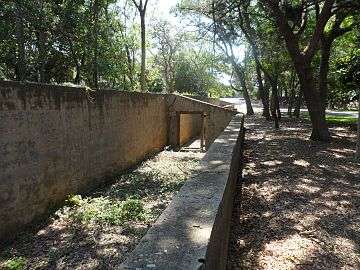 U.S. troops honed their rifle skills at the Fort Caswell Rifle Range.
Norma Eckart: So far this research has produced 724 men and women that served in World War One and France. 40 profiles so far posted on our website. We're hoping to publish a book in 2019 with all of these profiles.
Theo Mayer: World War One is a story about people and I just think you folks are brilliant. Thank you so much for doing the project.
Ron Eckart: Thank you very much. Your recognition makes it all worthwhile.
Norma Eckart: Thank you.
Theo Mayer: Ron and Dr. Norma Eckart are from the Friends of the Fort Caswell Rifle Range in Caswell, North Carolina. Learn more about the 100 Cities/100 Memorials program and the rifle range by following the links in the podcast notes.