































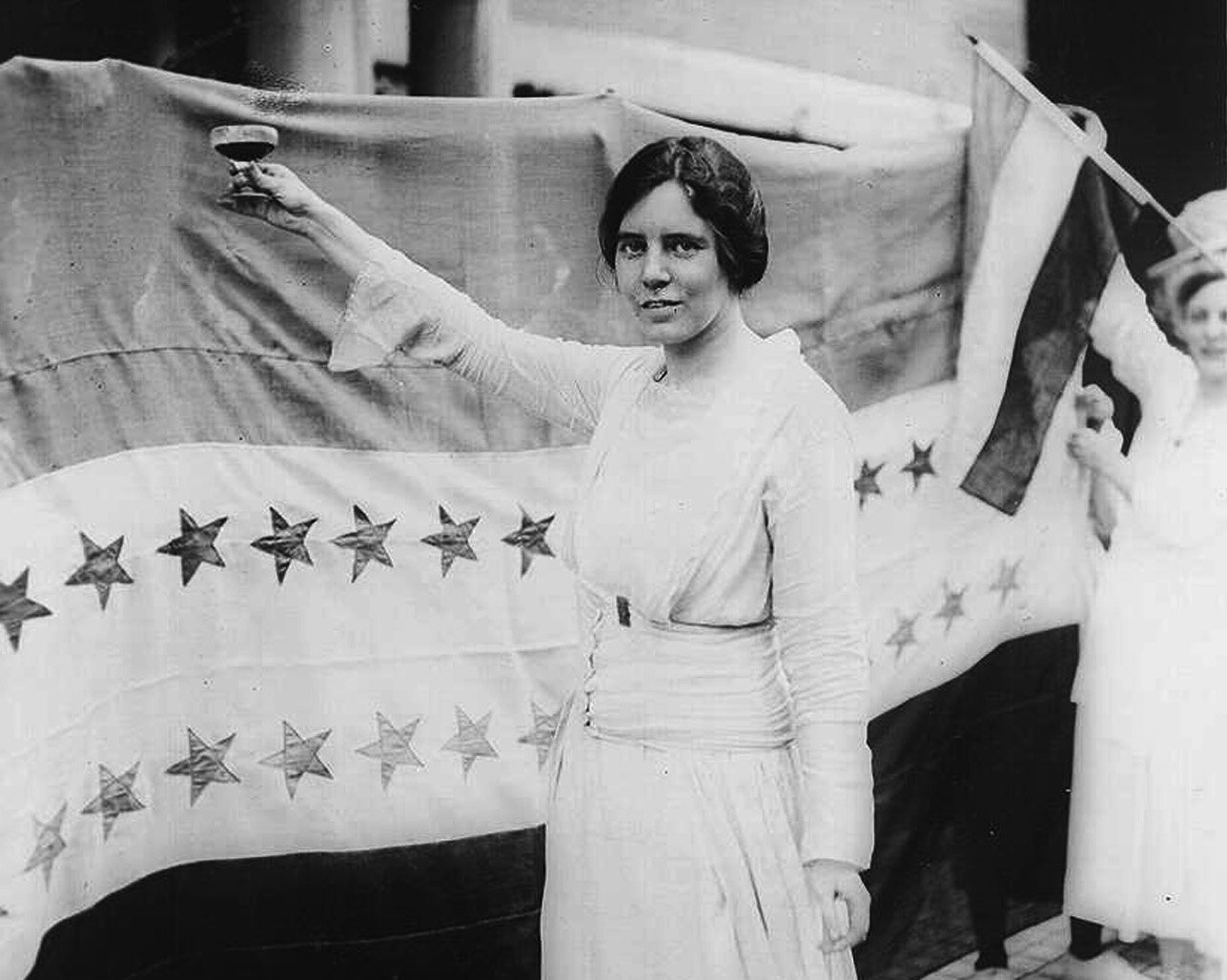
 Suffragette Alice Paul
Alice Paul and the Suffrage Movement during World War I
By Miranda Halpin
Staff Writer
Born into a Quaker family in 1895, Alice Paul was empowered with her beliefs that men and women were equal counterparts. After graduation with a degree in biology she traveled to England to help push the fight for women’s rights. While participating in the British suffrage movement she was able to meet her partner-in-crime, Lucy Burns. Together, the two would travel back to the United States with the goal of bringing both suffrage and equal rights to the United States.
"He kept us out of war? He kept us out of suffrage!"
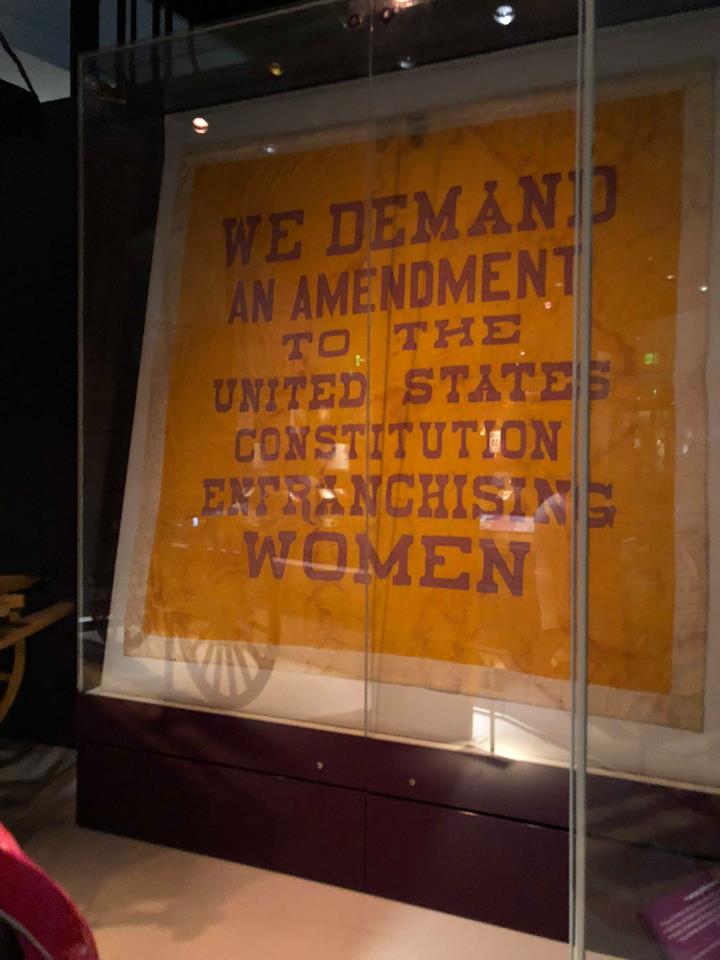 Women's Suffrage bannerAfter returning from England, Paul joined the National American Woman Suffrage Association (NAWSA) in 1912, there she obtained her first leadership role as the head of the District of Columbia chapter. The NAWSA did not want to petition for a national congressional movement, instead they focused on state-based amendments to the voting protocol, because of this Paul parted ways from the NAWSA after only one year. Paul believed it was better to achieve the movements goal via a congressional amendment. Paul and Burns, who shared the same congressional amendment aspirations, then founded the Congressional Union for Woman Suffrage; later on the group would be renamed to the National Women’s Party (NWP).
Equipping their learnt skills from England, the group was quick to enable militant tactics, such as hunger strikes, parades, pickets, and protests. Paul began speaking out about her tactics in newspapers as she was deemed the “inventor of the hunger strike”.[1] The first large NWP event came roughly a year later on March 3, 1913, the day before President Wilson’s inauguration. Congress, in order to protect the protesters, enacted a closure of the street from 3-5 o’clock to prevent injuries; much to the surprise of the NWP the action passed 199 to 51. The NWP lead over five-thousand women’s suffragettes down Pennsylvania Avenue. As they walked, thousands of male onlookers attacked them. Over 100 women had to be hospitalized due to the injuries sustained while marching.[2]
As the NAWSA frowned upon the militant tactics being used, they continued to attempt to disassociate themselves for Paul and Burns. At one point during the NWP’s protests the NAWSA even said they wished not to be associated with the NWP as they were acting like Britain.
"Mr. President, how long must women wait for liberty?"
A deterrent for some, the NWP saw this as a new found reason to continue their fight for women’s suffrage. While people such as President Wilson and other members of congress viewed suffrage as an issue for a later date, the NWP made it their top priority to ensure that women’s votes became a main priority[3].
In May of 1913, the United States Commission of Women's Suffrage held a vote, this is the first favorable vote for suffrage in 23 years. From there the NWP began petitioning around the country in order to gain signatures for votes. As the NWP continued to lobby and hold speaking events, President Wilson detained a former British suffragette Emmeline Pankhurst, who was in the United States to speak on the suffrage movement, on the “moral grounds” she was pro suffrage. Three days after continuous appeals, President Wilson would reluctantly allow her to enter the United States for her speaking tours.
"Mr. President, what will you do for woman suffrage?"
A banner that hung during Wilson’s second inaugural speech read the above, the banner would be torn down by others who were upset by it as his speech continued. In the last three years the NWP had faced defeat in their attempt to get an amendment ratified, eventually in early 1917 over 300 women present President Wilson with a draft resolution for a women’s suffrage federal amendment. He disagreed, once again leaving the NWP ready to fight. Even after the United States entered World War One the NWP continued to picket at the White House.[4] In the spring and summer of 1917, after months of silently protesting at the White House, the protests began to be arrested on the charge of blocking traffic. After a silent peaceful protest was attacked by angry citizens, little was done as police force stood back and watched the violence occur. Paul found the actions of Wilson and the service around the White House to be disgraceful and continued to protest outside of the White House.
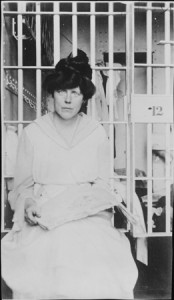 Lucy Burns during the "Night of Terror"Paul was arrested for blocking sidewalk traffic on October 20, 1917; she was then sentenced to seven months in prison, the longest sentence given to any suffragette. She along with Burns and other suffragettes petition to be considered “political prisoners” and if their demands were not met threatened with a hunger strike. Members of the NWP had even smuggled out the petition in hopes of gaining media attention, it did. All who had signed the petition were placed forcibly into solitary confinement. As Paul began her hunger strike officials had her committed to a psychiatric ward in order to both discredit her and to have her endure painful forced feedings once again. Officials hoped she would be to scared to continue out her protests, but she continued even after her release from the ward three weeks later.
During Paul’s stay in prison New York became the first state to ratify a state amendment that allows women to vote. November 5, 1917 other NWP women began to protest the conditions that Alice Paul was facing, leading to “The Night of Terror”. November 10th women were arrested while protesting, from there on the 15th of November the women were transferred. When transferred detainees, such as Burns, were beat relentlessly and mistreated by prison guards while the judge who had sentenced them looked on[5]. With sudden backlash from the community, Paul and Burns (as well as the others) were released from jail early on November 27th and 28th.
"We women of America tell you that America is not a democracy. Twenty million women are denied the right to vote."
On January 9, 1918 President Wilson finally showed support for the women who worked so hard to gain his attention in order to gain their amendment. Even though President Wilson showed his own support, it did not mean that the suffragettes had gotten the right to vote or even protected from arrest. Alice Paul once again was arrested on August 6 1918 while hosting an open air rally in Lafayette Square. She, as well as forty-seven other women, were released on bail the same time to continue their movement. August became a month of arrests, continuously for the movement, as arrests were made at every demonstration.[6]
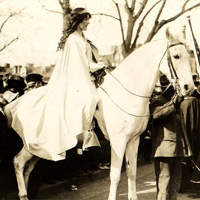 Alice Paul on horseback during a Suffrage ParadeAlice got to watch as the 19th amendment was once introduced to the senate, even having President Wilson call the passage of it to be critical for the success of the war. October 1, 1918 showed to be a major disappointment as the amendment does not pass, only two votes short of passing. Paul and the NWP once again begin their picketing outside of the White House in response to the failure to pass; the women get arrested daily, but no charges are ever filed. On November 11th, the Great War finally ended, but the right to vote was still not there. Alice Paul saw this as an opportunity, with people once saying the women should wait until after the war to have their moment. Wilson once again pleaded his case to Congress, this time during his annual address, requesting that they allow the amendment to have women to vote. Failure once again ensued for the NWP and in December the NWP began holding public demonstrations of burning President Wilson’s speeches.
On January 1, 1919 the demonstrators with the NWP began to burn President Wilson’s speeches in public, daily. The goal was to keep the fire burning at all hours to ensure the pressure could be felt by President Wilson, which they successfully were able to accomplish.[7] With pressure mounting, unease became very evident. After once again being denied by Senate for the amendment, the suffragettes meet President Wilson as he returns from Europe. As Paul and others urge Wilson to have senate ratify the amendment prior to the March 3rd recess which was scheduled, the last 28 demonstrators would be arrested and charged with crimes for the women’s suffrage movement.
"When you put your hand to the plow, you can’t put it down until you get to the end of the row."
Alice Paul, along with over 100 others whom were members of the NWP, traveled to New York City on March 4, 1919 to demonstrate outside of the Metropolitan Opera House President Wilson was speaking at. Like several protests prior, they were prepared for the worse, but during their silent demonstration they were attacked. The attack consisted of over 40 policemen, soldiers, and ordinary men who continued to beat the women. Alice Paul was among the six arrested at the scene, after the women had their clothes torn from their bodies, were in a disarray, and had several injuries from those who attacked them. At the police barrarics all the women simple wrote “Jane Doe” for their names and sat in a silence strike until their release. After their release, all of those who were arrested returned to the scene of the silent demonstration to burn one of President Wilson’s speeches.
With consistently passing the amendment in the House of Representatives and consistently losing in the Senate, did begin to bring concerns to the NWP. But on June 14, 1919 the Senate finally passes the 19th amendment, but the NWP had to make sure that at least 36 states ratified the amendment as a 3/4ths majority at the time was needed.
“I always feel the movement is a sort of a mosaic. Each of us puts one little stone, and then you get a great mosaic at the end.”
At the end of such a long fight congress finally made an amendment. Unlike others who could have had a sign of relief, their fight had been won right? Alice Paul instantly started off to ensure that each state would place it into effect, therefore ensuring that the amendment would stick. Paul and the NWP continued to push for ratification in each state, going on a country wide campaign in order to be successful.
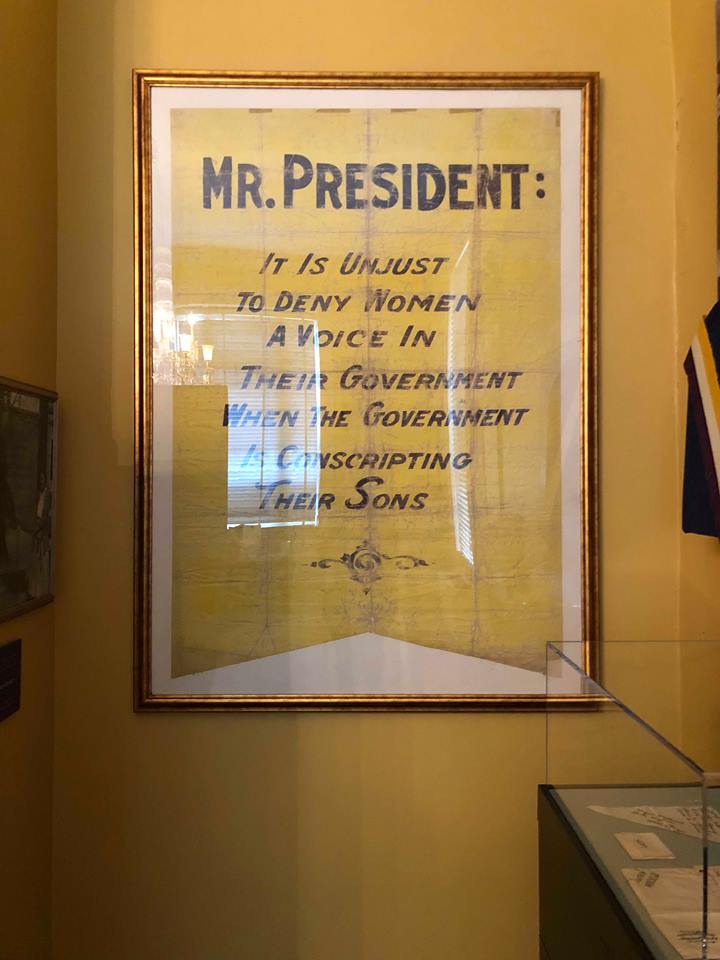 A "Mr. President..." banner With nation wide push-back, the Supreme Court ended up having to uphold the validity of the 19th amendment in two landmark cases: Fairchild v Hughes and Leser v Garnett. As the validity continued, the women of the NWP continued to work. With the last issue of Paul’s The Suffragist issued in February of 1921, but Paul was not done yet.
"I never doubted that equal rights was the right direction. Most reforms, most problems are complicated. But to me there is nothing complicated about ordinary equality."
Paul went on to earn a law degree in 1922 and a doctorate law degree in 1928. She wrote the equal rights amendment for the NWP in order to create equality for men and women. The federal equal rights amendment(ERA), otherwise known as the Lucretia Mott amendment, was proposed in 1923 by Paul to the NWP. The amendment, to this day, has never been ratified by the United States.[8]
The ERA was finally approved by congress in 1972, it just needed states to ratify it for it to become official. Alice Paul passed away on July 9, 1977; she believed the ERA would indeed become law. Unfortunately, it never hit the required amount of states to ratify it, coming to a stand still at thirty five states instead of the thirty eight needed for it to become a constitutional amendment. Alice Paul died unmarried and childless, the National Women’s Party always being both the love of her life and her child.
[1] In an interview after her return home from a 30-day jail stay in London, Paul described how they ensured she was fed during her hunger strike. She went into details about being held down while having tubes down her nostrils, twice the tube was placed wrong and she was able to get it with her teeth before a doctor physically opened her mouth.
[2] Indictment of police officers who purposely stepped back during the violence would be indicted 6 days later due to public outrage of their lack of intervention while attacks were occurring. The superintendent of the police department would eventually be let go over the lack of action.
[3] Paul and others from the NWP met with President Wilson in April of 1913, but he concluded it was not the time for women’s issues.
[4] Alice Paul begins to organize what are known as the “Silent Sentinels”, which were the peaceful and silent pickets at the White House.
[5] Women were thrown about the cells their first night after being sentenced in 1917, in all efforts to keep the women separated from Alice Paul the officials sent them to an all male prison. Women were denied access to their lawyers and were sentenced to hard labor during their hunger strikes in a cruel way to disband the protests. Burns and another party member were force fed, in Burns while placing a glass feeding tube it broke and caused significant bleeding. Another woman suffered from large ulcers and became very ill with a gallbladder infection from the force feeding as well. The women whom were in work encampments for male prisoners were able to obtain a writ of habeas corpus and were eventually brought back to a jail after being informed they must wait a “weeks time”. Though they did not know at the time, it was to prevent the world from seeing the state they were in at the time of habeas corpus; concern also was held as officials were unsure if some of the women would make it back in such a weakened state.
[6] Women throughout the month of august were continuously arrested and released on bail, often to return to the site of the demonstration to protest their own arrest. After sentenced to 15 days in jail many women now knew to demand to be treated like political prisoners and began hunger strikes if conditions were not met. Women were released after hunger strikes began, officials deciding not to have another night of terror incident occur or to have anymore serious bodily harm done to the women.
[7] After an initial push back from veterans, the NWP were able to continuously keep the fire burning for days on end. On January 4, during the push back, Paul along with others were arrested, but released, for starting fires. Women continue to be arrested throughout January and February, often being released once they began hunger strikes.
[8] The Equal Rights Amendment (ERA) continued to be introduced to every year to every single session of congress for the next 49 years, never passing. The only time the wording ever changed was by Alice Paul in 1943.
Miranda Halpin is a Summer 2018 Intern with the U.S. World War One Centennial Commission.
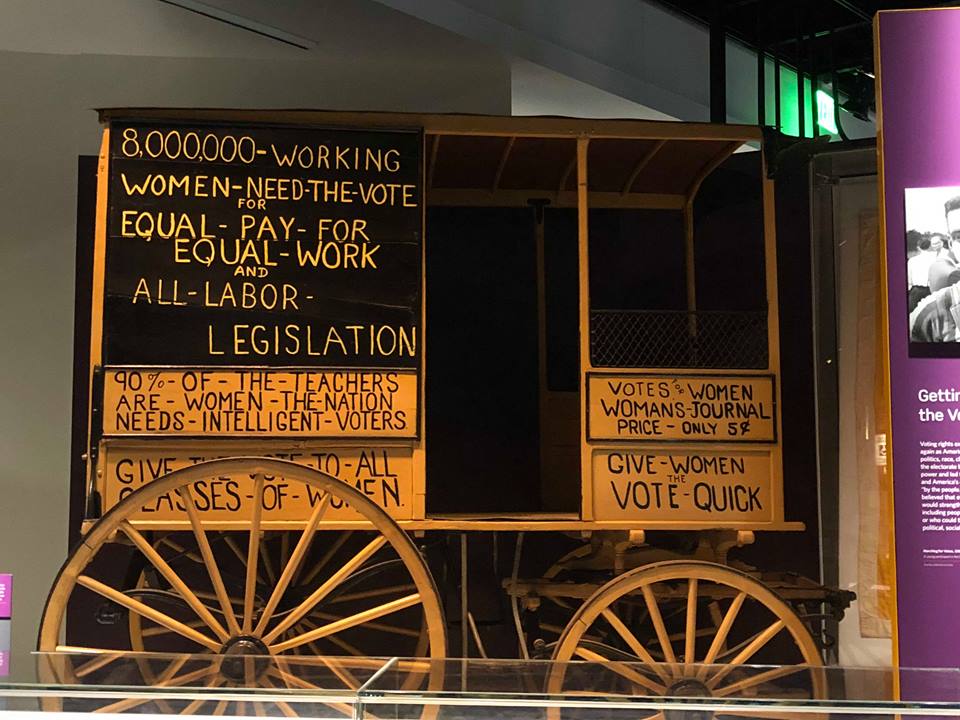 Suffrage cart