



































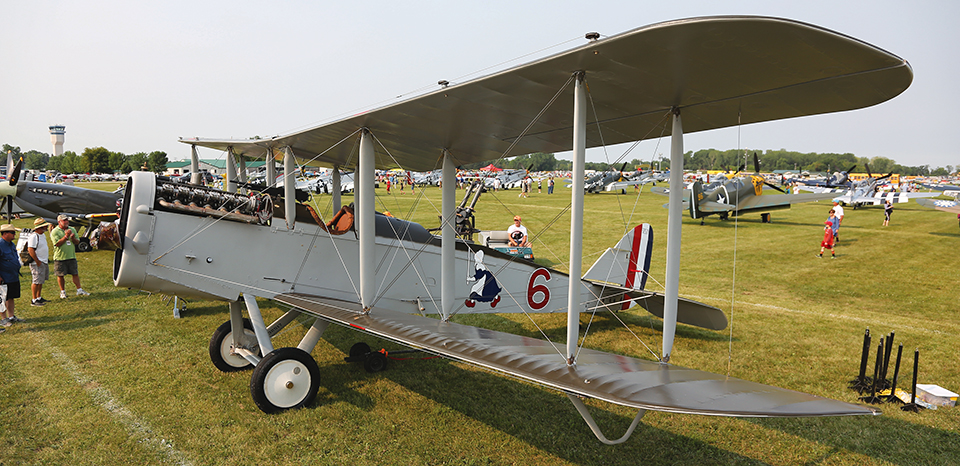
 The DH4 "Liberty Plane" on static display on the Experimental Aircraft Association AirVenture grounds last summer.
De Havilland DH-4 Set Tone for U.S. Military Aviation
By Frederick A. Johnsen
via the Experimental Aircraft Association (EAA) web site
Allied collaboration saw a miracle American engine and a durable British airframe combined to make the American-built DH-4 of 1918. Arguably the first American-made combat aircraft of any consequence, the DH-4 served into the 1920s (a few into the 1930s) and gave rise to mail plane derivatives.
In July, a DH-4 that is being groomed for flight in September is on static display at several prominent AirVenture venues. This rare biplane was the subject of a Warbirds in Review session Monday afternoon.
Geoffrey de Havilland’s 1916 design first saw service with the Royal Flying Corps in 1917. Powered by a variety of English engines, the DH-4 was a viable bomber of the day. When the U.S. entered the war, the need for combat aircraft was acute. The DH-4 was then selected for production in the U.S. The rapidly designed American V-12 liquid-cooled Liberty motor was chosen to power American DH-4s. This 400-hp engine proved so impressive that later British DH-9 versions employed the American engine.
In the 1950s, an era when too few people cared about the aging aircraft of World War I, movie pilots Paul Mantz and Frank Tallman scoured the countryside for examples they could put before Hollywood cameras. A Mantz DH-4 later found in Washington made its way to the Friends of Jenny organization in Tennessee, where new life was breathed into the vintage hardware in time for EAA AirVenture Oshkosh 2018.
Its original Liberty engine, built by Lincoln, once was part of the legendary Cole Palen’s Old Rhinebeck Aerodrome collection in upstate New York. The airframe is an unmodified example built by Dayton-Wright, but some other DH-4s received welded tube fuselages in the 1920s as upgrades.
Dorian Walker shepherds the DH-4, both in restoration and exhibition. He points out details like the original metal mounts for the ample wooden wing struts. They’re fine for static display, but new metal will afford a known margin of safety when this DH-4 tests its wings later this year. True to its history, this DH-4 has only a skid, not a wheel, under the tail. So it’s limited to flights starting and ending on grass fields. The group plans to truck the DH to show destinations, where it will be reassembled and rigged (they’ve done it in seven hours) before flying.
Read the entire article on the EAA web site here:
External Web Site Notice: This page contains information directly presented from an external source. The terms and conditions of this page may not be the same as those of this website. Click here to read the full disclaimer notice for external web sites. Thank you.