
































From the World War I Centennial News Podcast
Spotlight On The Media:
Filmmaker John Heinsen
 In September 21st's WW1 Centennial News Podcast, Episode 90, we focused our media spotlight on a new upcoming documentary about the German Air Service, a project born out of one individual's urge to reconnect with their grandfather. We were joined by John Heinsen, filmmaker and grandson of Walter Heinsen, a German aerial photograph in World War I. John is the producer of Return to Le Cateau, a multi-platform World War I project that also profiles the wartime activities of his grandfather.
Theo Mayer: John, welcome.
John Heinsen: Thank you. It's wonderful to be here!
Theo Mayer: John, I want to start by noting to our audience that when I heard about the interview, I was really happy because we haven't delved into the German story very much on the podcast. Would you please tell us about your grandfather and what his wartime service was and how the family ended up in the United States?  Filmmaker John Heinsen's (pictured above) grandfather was a photographer in the German Army. This connection to WW1 inspires his latest project, Return to Le Cateau
John Heinsen: I grew up in Chicago with my grandfather. He was basically like my father, so I was very close to him growing up and he came to the United States in 1925 and lived his whole life here. He very much considered himself an American. He was a very notable photographer in Chicago. His studio, Bunny Graph, was an institution in Chicago for 50 years, but he actually learned to be a photographer in the First World War.
In the last 18 months of World War I, the draft age was dropped to 16 years old. What happened was, his older brother was a photographer, and my grandfather was an apprentice to him when he was drafted. Because he had that practical skill, he was saved from the trenches and sent to France as an aerial observer, photographing and making maps of the trenches.
Theo Mayer: You're clearly inspired by finding a trove of pictures of your grandfather's images. Can you trace that back to us and how that became such a muse for your creative endeavor?
John Heinsen: By trade, I'm a producer and network executive in Los Angeles today. I have had my grandfather's pictures since he died in 1984 and I've gotten some of the stories from him and what not, and with the anniversary coming up, I decided I was going to try to find where some of the pictures were taken with very low expectations of finding anything.
My son, who is 15, and I were in Europe already and we went to Frankfurt. We were going to ride up through Belgium down to Paris trying to find where the pictures were taken. Unfortunately, we got to France the week of the terror in Paris, that horrible time in Paris, and so if you recall during that time, they had basically shut down Belgium looking for the bad guys. Because of that, my son and I had to change our entire itinerary, but it was only by that luck of fate that we found where the pictures were taken. And now since then it has become a two-year passion project of mine where I've been to France 10 times and have not only found where his pictures were taken, but also that they are very historically significant and original source material.
Theo Mayer: So you found this trove of pictures and that drove you to a story... How was it researching a military history particularly since the sources of your information were in Germany?
John Heinsen: The core group of historical photos I have are probably captured within a 10-day window. I have two or three blocks of photos, one of which regards the Battle of Cambrai, which was in November of 1917. My grandfather was stationed nearby at Bourg-Ceyzériat Airport, which is the famous airfield where the green tails were housed. There was a very famous event that has very little written about it where Kaiser Wilhelm had actually gone to in the midst of the Battle of Cambrai to talk about the German counterattack that eventually happened on November 30th and won the battle. I have pictures of that meeting that have never been seen before of the Kaiser and what's interesting was the handful of photos that were published from that day were actually images that were grabbed from movie cameras that were there. In one of those printed images, you can see my grandfather holding his camera, so it actually places him in the location.
Theo Mayer: I just want to mention to our listeners that as we've mentioned before, the Battle of Cambrai was really the first major application of tanks and we mentioned it in our recent tank episode. It really stunned the German forces, but then of course, as you mentioned, they came back and halted the offensive.
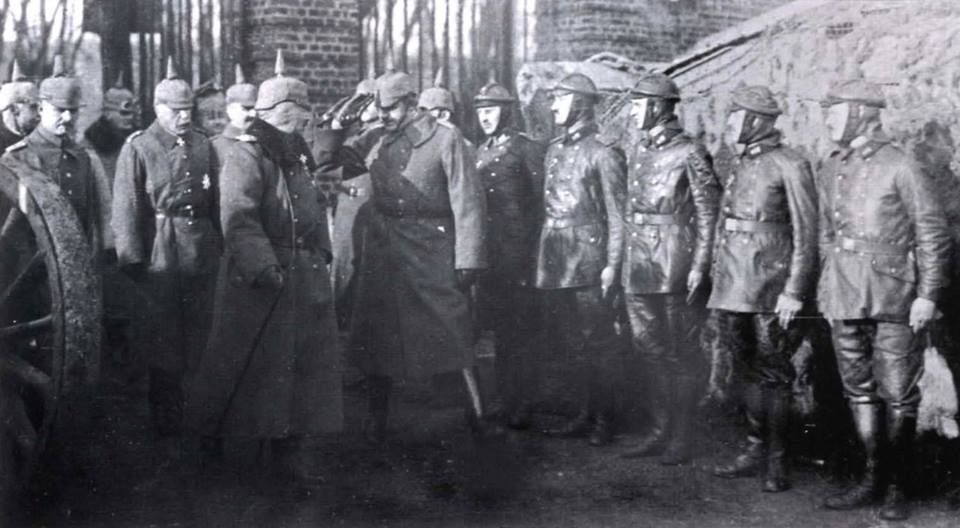 A photo of Kaiser Wilhelm II, dated to November 27th, 1917, during the German preparations for a counterattack at Cambrai (courtesy of Return to Le Cateau on Facebook)
John Heinsen: After the German counterattack of November 30th, the Germans were fascinated by these tanks and so they grabbed every photographer they could and sent them into the field to photograph the wrecks of these tanks and study them. The historians that I met on the ground in France, what they were able to validate for me was the fact that these photos had never been seen before. They can even date my photos between November 30th and December 4th because on December 5th, the battle ended when it snowed and none of my pictures have snow. Through this, I've been able to replicate literally where he spent those 10 days in the midst of this Battle of Cambrai. Last November, I was invited to actually speak as part of the Official Commemorations in Cambrai and that particular point is what led me now to my documentary film.
Theo Mayer: So we've dug a lot into the context, but can we know about the film?
John Heinsen: So the film is actually not about anything that I spoke about. Interestingly enough, in my search for a vision for the documentary, somebody gave me great advice: "Don't do documentaries about dead people. Do it about living people." And so one photograph of my grandfather taken during the German encounter attack of Cambrai is the source of this.
For my grandfather, like a lot of artists of his generation, they were pacifist. They were very antiwar. I really wanted to find a way to not only memorialize my grandfather but all the men of this generation. I mean if you spend time in the field, the one thing you realize is that there really were no winners. It was just horrible and so I have this one pictures of 30 British prisoners that were captured during this German counterattack. My goal with this photograph that's never been seen before is that it is going to be revealed the week of November 11th as a symbol of peace and forgiveness a hundred years later, the descendent of a German is going to bring these 30 men home with this photograph.
My grandfather was 17 years old when he took those photos. He was a child and so to imagine my 15-year-old today, playing video games about World War I, here's the opportunity to tell the story of a soldier not shooting with his gun but shooting with his camera. In terms of my project it really is a grassroots project. I'm funding it all myself and that's why I'm really putting this out there to the community because I think there would be a lot of interest. My documentary is going to actually be crowdsourced.
Theo Mayer: Thank you very much, sir.
John Heinsen: I really appreciate it.
Theo Mayer: John Heinsen is as filmmaker and the grandson of a photographer who at age 17 became a German aerial photographer in World War I. Learn more at the links in the podcast notes.