


































New play by Martin Casella
Premiere Stages at Kean University to present “Black Tom Island”
By Nicholas Orvis
Literary Assistant and Resident Dramaturg, Premiere Stages, Kean University
Premiere Stages, the professional theatre in residence at Kean University in Union, NJ, will present the world premiere of Black Tom Island by Martin Casella from October 11-21, 2018.
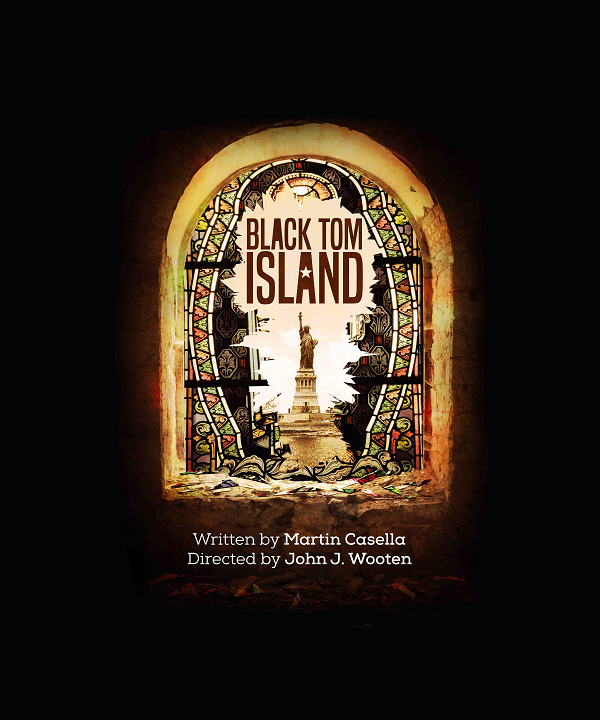 The play, which will be directed by Premiere’s Producing Artistic Director John J. Wooten, is the 2017-2018 winner of the Liberty Live Commission, a program of Premiere Stages and the Liberty Hall Museum that commissions New Jersey playwrights to create original plays about significant events in the history of the state. The play will be presented at the Carriage House on the grounds of the Liberty Hall Museum.
At the center of Black Tom Island is a piece of New Jersey history that many people have either forgotten or never heard about: the explosion at Black Tom Island. The explosion was an act of sabotage and international espionage, designed to disable the weapons of an enemy during a time of war.
The year was 1916, and on the docks of Jersey City the Lehigh Valley Company had stowed several trains’ worth of valuable and dangerous materials: explosives and ammunition bound for the Great War in Europe to which the United States was not yet a party. In the dead of night on July 30 - around 2:00 a.m. - several fires sprang up suddenly, in multiple places around the train cars parked on the causeway leading to the storage facility on Black Tom Island.
At 2:08 a.m., the train cars and the barge moored nearby exploded, setting off roughly 2 million pounds of explosives. The damage was catastrophic, and it’s hard to exaggerate its scope.
Estimates in the following days put the property damage alone at $20 million (roughly $450 million today), and the tremors from the explosion were felt in neighboring states. The New York Times said that the harbor was “raked by shrapnel for hours” and that nearby Ellis Island looked “like [a] war-swept town.”
Later that year, the trade journal Safety Engineering described the explosion as “not soon to be forgotten.” And yet, compared to other major catastrophes of that period - the sinking of the Lusitania, for example - that’s exactly what’s happened. Perhaps this is because the public did not learn the truth of what transpired there for some time after; perhaps it was simply overshadowed by the terrors and perils of the First World War. Whatever the reason, it is rarely taught in history classes, and there is little there to mark the spot (which is no longer an island, but part of Liberty State Park) beyond a small plaque.
Despite this silence, scars from Black Tom Island endure: in the clock tower at Journal Square in Jersey City, in the Statue of Liberty’s torch that was closed to the public after being pierced by shrapnel, and in myriad old buildings in New Jersey and lower Manhattan. At the heart of this memory are unanswerable questions about the person believed to have caused it: what made them do it? Why were they so regularly cast aside in their lifetime? How do we ensure that the American dream inspires, rather than alienates, the people who come to our shores? There are no easy answers to these questions, but Black Tom Island examines them in a compelling story of conflicting loyalties, immigration, espionage, and hope.
If you’re curious to explore the complicated answers to these questions, you still have time: the world premiere of Black Tom Island begins on October 11, and tickets are now on sale (it’s recommended you purchase in advance, as seating is limited). The play will feature Damian Buzzerio, Mason Hensley, Jenna Krasowski, and Bart Shatto. Tickets are $30 for full-price, $20 for senior citizens and staff and alumni of Kean University, and $15 for students and patrons with disabilities.
You can learn more about the production, and purchase tickets to attend, here: http://www.premierestagesatkean.com/current-shows.