


































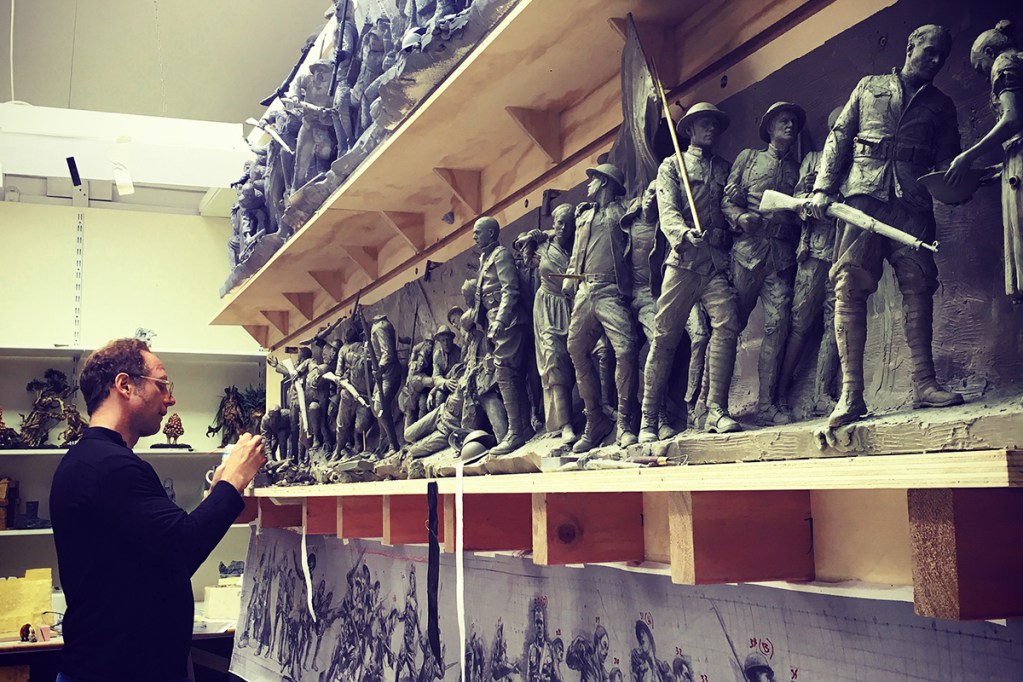
 Sabin Howard at work on the Memorial (photo courtesy of the author)
Art, Commerce, and Vision
By Traci L. Slatton
via the Quillette web site
I’m a novelist and my husband Sabin Howard is a classical figurative sculptor. Currently he’s the sculptor for the National World War I Memorial, which will be a 56 foot long bronze relief set in Pershing Park, Washington D.C.
Before Sabin forayed into public art, he sculpted from life models. Over the course of designing soldiers in combat and nurses tending the wounded for the WWI Memorial, he has evolved into an expressive humanist. But for decades he put clay over a steel armature while looking at a flesh-and-bones body in space, hiring models the way Canova or Rodin did. The model in Sabin’s studio was a vehicle both for an individual figure with psychological expression, and for an allegorical one that embodies a higher ideal.
Sabin has always been of the view that art elevates us. His body of work includes heroic scale sculptures, including the Aphrodite. Eight women posed for her: a flamenco dancer for the legs, a yoga teacher for the core. I can relate funny anecdotes about the responses from Craig’s List to his ad for a boob model. Sabin worked on Aphrodite for about a year. His work is slow art. Clay is painstakingly accreted to the high points of muscles spiraling over bone. One day he phoned from his studio. He said, “I have a chainsaw. Her gesture is wrong. I’m cutting off her left arm.”
It was months of work. Amputated.
When I tell this story, people smile and nod. This is the tale of an artist with an uncompromising vision of his art. It’s an archetype. They understand. But there’s another implication that they tend to miss. That is, Sabin had paid a dancer to stand and bear her arms aloft while he sculpted. When Sabin lopped off the goddess’s arm, we took a financial hit.
Art isn’t free to produce. Especially the kind of art Sabin makes. He buys steel and foam to make an armature; he lays out cash for clay and sculpting tools; he employs models, a photographer for reference images, a mold-maker, a foundry to pour bronze, and a finisher to weld the cast pieces together. He writes a check every month for his studio.
This is a business. A business driven by passion, but a business nevertheless. For nearly two decades, I’ve helped my husband run it. He moved away from the gallery system because galleries take a hefty 50 percent commission. My various literary agents take 15 percent for U.S. sales and 20 percent for international, so half the price for a sculpture strikes me as gouging the artist.
Read the entire article on the Quillette web site.
External Web Site Notice: This page contains information directly presented from an external source. The terms and conditions of this page may not be the same as those of this website. Click here to read the full disclaimer notice for external web sites. Thank you.