






























From the World War I Centennial News Podcast
American Battle Monuments Commission
 In December 14th's WW1 Centennial News Podcast, Episode 101, host Theo Mayer spoke with Mike Knapp, Chief of Historical Services for the ABMC. The conversation covered topics such as the origins of the ABMC, and America's approach to honoring its war dead following the cessation of hostilities. The following is a transcript of the interview, edited for clarity:
Theo Mayer: Last week, we were joined by Peter Francis and Dr Glyn Prysor of the Commonwealth War Graves Commission. We spoke about the history of the commission and its enduring responsibility to the fallen soldiers of the United Kingdom and Commonwealth. Now this week in part two of our Aftermath Special, we want to introduce you to the American Battle Monuments Commission and its responsibility to the US fallen. With us to explore this is Mike Knapp, the Chief of Historical Services from the Commission, also known as the ABMC. Mike, thank you for joining us. Welcome to the podcast.
Mike Knapp: Thank you for having me.
Theo Mayer: Mike, General of the Armies John J. Pershing, the man who led our forces during World War One, had a deep personal involvement in the establishment and direction of the ABMC. Could you tell us about that? 
Mike Knapp: Sure. As I'm sure everybody that follows the podcast knows Pershing leads the American Expeditionary Forces during the war and at the conclusion of the war, he ends up leading an agency whose name is a bit misleading if you look at us nowadays- we're known as the American Battle Monuments Commission. The reason that that's our name and it doesn't have cemetery anywhere in there is there's a little bit of a process. Following the war and almost before the end of the hostilities, certain American units were starting to put up impromptu memorials to their service. And these began to spring up all over Europe. And they ran the gamut in terms of quality and design: some were built out of rubble from the battlefield with rifles and bayonets and helmets stuck in them. In particular, is a somewhat apocryphal story about Pershing who complained that the fifth division, which has a lot of memorials in Europe, basically put one up everywhere a soldier from the fifth division stopped go to the bathroom. His intent was to not have Europe end up looking like Gettysburg with fields and fields covered with monuments and no real overall design.
So in 1921 they create the American Battle Monuments board to review design plans and recommendations for memorials, and in 1923 it becomes the American Battle Monuments Commission, and Pershing is named as the first leader of that. He is the first chairman of the ABMC and that's a position that he holds until his death in 1948. So we want to fast forward a little bit out of that into the '30s. There are something like 200 different cemeteries that have been established during the war and they start the process of consolidating these remains into what they call concentration cemeteries, and the decision is made that they're finally will be eight permanent World War One cemeteries. The ground that these cemeteries lie on is given to the US in perpetuity and at that point the ABMC is taking over helping design them with the Commission on Fine Arts and other agencies to make sure that these are respectful, symbolic and striking places. The ABMC is also chartered to build a non-denominational chapel at each one of the cemeteries. So as you can imagine General Pershing had very strong opinions on what campaigns would be memorialized, how and where. And then that just carried over into the cemeteries. 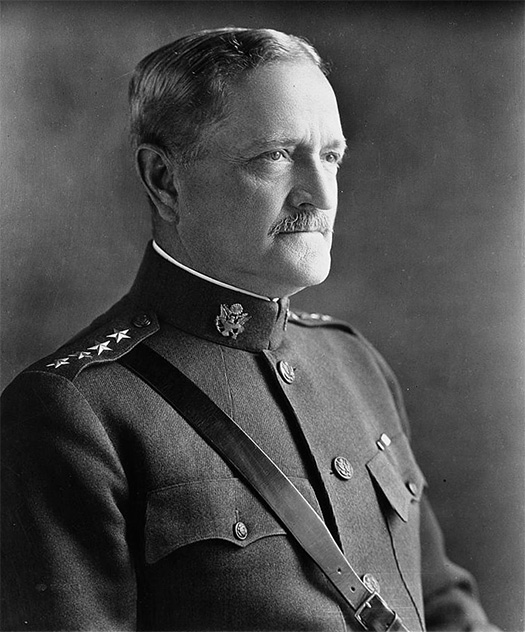 General John Pershing was very active in the Commission's formative days in the aftermath of WW1
Theo Mayer: Now in our interview with the UK last week, it struck me that both nations decided to take a very egalitarian approach to their war dead, seeking equal treatment of officers and enlisted men and so forth. Could you speak to that?
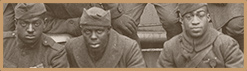
Mike Knapp: Yeah, I think we've taken pretty much exactly the same approach that they have done. What's interesting for us that I like to point out specifically, burials in our cemeteries where you have any of the African American units, the Pioneer infantry, or any other regiments of the 92nd, 93rd Division, they're not segregated. And at this time in the United States of course, and even in Arlington Cemetery, where there is a big World War One section, the graves are segregated by race, and they didn't do that in our cemeteries overseas. I think it probably became too problematic to say, "Okay, now we're ready to bury this body. But we know this is a guy from the 369, so he needs to go in the black section." So I don't know how much of that was by design, or how much of that was by necessity.
Theo Mayer: Interesting. I know that General Pershing's own grave was equal to that of his men.
Mike Knapp: Yeah, the only difference is he's in the center of them. But I think at the end of the day, there probably was a great deal of feeling on his part that, much like he fought throughout the period of our involvement in the war for the US to be a separate entity in a separate force, I think he probably felt the same way that these are the guys in this campaign, and they should all be here.
Theo Mayer: Okay. So, Mike, there was a debate in the UK about the repatriation of bodies. Was this also a discussion in the US?
Mike Knapp: Yeah, it actually was. I think if you look at US history prior to this, a lot of our conflicts are close to home. People can get brought back home or the families can go get them as more often the case. And then in instances where we have people that die on foreign shores, they've just been buried there. But World War One, as was already pointed out in this segment, the numbers are staggering. We've never had numbers like this before. It's a staggering chore to imagine bringing that many bodies back to the United States. So what they hit upon was they actually gave families the option of bringing their loved ones back. So in World War One, they were faced with three options that they were given the choice of, they could leave their loved ones in Europe at one of the permanent cemeteries, they could have them returned to the United States to be buried in a federal cemetery, such as Arlington or one of the cemeteries that existed at some of the different posts around at the time, or they could have them returned and be buried in a private cemetery.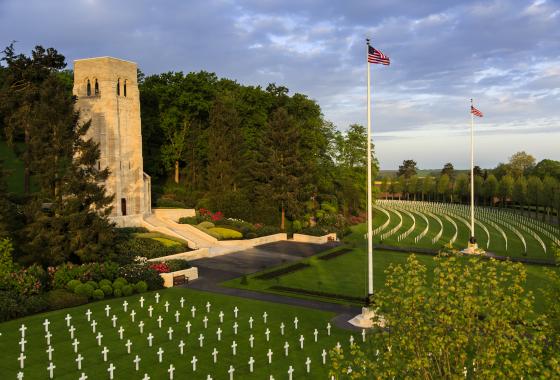 The Aisne-Marne American Cemetery, located adjacent to Belleau Wood in France, is the final resting place of over 2200 American servicement
Theo Mayer: Now, essentially later, has ABMC's responsibility and role evolved and changed?
Mike Knapp: I think the larger way that our role has changed is as you might imagine, up until now, there really wasn't any need to explain to people why we had cemeteries in Europe. But as we get to be 100 and 75 years in the case of World War Two removed from the events, there are a lot of people that have lost sight of this. So the way that our mission has changed a little bit is we now have to educate people and to keep ourselves relevant in the public eye, just so that they know. And that's primarily for the American audience, I would say, although younger generations of some Europeans have the same question, but in general, the Europeans still get it. I mean, to this day, with regard to World War I, there's still a great deal of gratitude for the Americans coming over and helping to win that war. We are no longer dealing with solely grieving families and people that all understand intimately and personally, why the cemeteries are there. Now, what we're doing is we're telling new generations of Americans and Europeans, "This is why the cemetery is here. This is the role that America played, and this is the cost of that role."
Theo Mayer: Great interview. Thank you, Mike.
Mike Knapp: You're very welcome. Thank you for having me.
Theo Mayer: Mike Knapp is the Chief of Historical services at the American Battle Monuments Commission. You can learn more about the commission by going to abmc.gov or by following the links in the podcast notes.