





























From the World War I Centennial News Podcast
A Discussion with Sir Hew Strachan
 In December 14th's WW1 Centennial News Podcast, Episode 101, host Theo Mayer spoke with Sir Hew Strachan, an esteemed professor of International Relations, renowned Great War expert, and prolific author from the United Kingdom. This detailed and engaging discussion delves into the global political consequences of the war, including the fate of several broken empires and the ascendancy of the United States on the world stage. The following is a transcript, edited for clarity:
Theo Mayer: Next, we're joined by Sir Hew Strachan, who some of you met in Episode Number 32 when we spoke about the incredible radio docudrama, Enter the Peace Broker. Sir Hew is one of the most respected World War I historians anywhere. He's the Professor of International Relations at the University of St. Andrews and Emeritus fellow of All Souls College, University of Oxford. Sir Hew, it's wonderful to have you back on the podcast. Thank you for taking the time.
Sir Hew S.: It's a great pleasure too. I'm delighted to be back on.
Theo Mayer: We've been calling it the War That Changed the World. Now, in your opinion, as one of the great subject matter experts on World War One, what would you pick as the top three changes that were brought about by the conflict?
Sir Hew S.: I suppose the first and most obvious thing if you look at it from the perspective of 1918, 1919, is that four of the major empires in the world have collapsed. The shift across Central and Eastern Europe and into Asia and into Central Asia, and down to the Middle East is massive. Here it's essentially a situation where there is a vacuum in terms of governance, in terms of what the successor states will be, all those going on. And possession is nine-tenths of the law. So while the peacemakers are meeting in Paris, these competing entities are fighting each other and the force of arms is deciding a great deal. So that's perhaps a long answer. But I think that's one of the most dramatic changes.
The second would be the entry of the United States into the world order, its role in shaping the international order, it's positioning of itself as a global power. So that will be my second point. And I think the third is that what emerges out of both those things is that our understanding of how states should be put together itself changes. So there's a consideration of power politics and in some ways Wilson pays no attention to those principles of power politics. He simply says, or he gives vent to the idea of national self determination. And that remains even today. Something we respect as a principle, but of course, has been a tremendous source of conflict in the 20th century world, not just in the short term in the run up to the Second World War, but also still today. 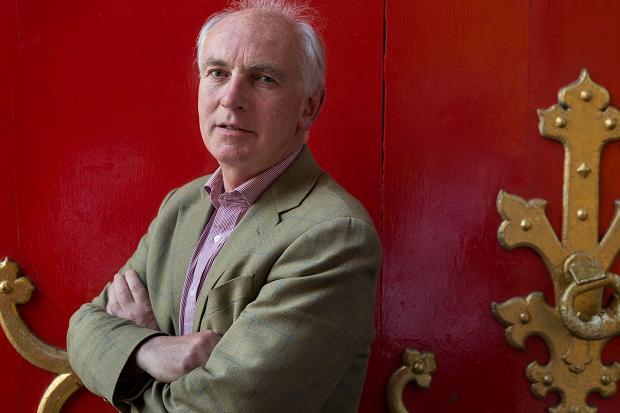 Professor Sir Hew Strachan
Theo Mayer: That's fascinating. So your biggest take on all of this is that the transformation from this was political?
Sir Hew S.: Yes, I think I would. I mean, if the implication of your question is, is it economic? Is it social? Well, of course, it's those things as well.
Theo Mayer: Sure, technological or social?
Sir Hew S.: There is a lot and I think I will put political, economic and social ahead of technological, because although the technologies of war are put on a new footing by the First World War, you can see the antecedents of much of that with industrialization, between 1850 in 1914, and perhaps most basic would be the notion that there are societies with mass popular press, with a very high level of literacy, with a degree of economic security, and with a genuine sense of progress, defined in all sorts of ways, which makes for the war being a surprise in that you'd expect Europe to have more sense than to go to war, and also makes this war so radically different so quickly. It becomes a major war involving whole societies from 1914 itself. And the collapse of the empires at the end of the war is something which all have realized is a possible implication of this war from 1914 itself. Change is there but change now is going to be in a much more radical form and in the revolution reform.
Theo Mayer: Now there are some who argue that World War II is simply a continuation of World War I. What are your thoughts on that subject?
Sir Hew S.: I've never bought that argument. I don't think I've ever bought it, I certainly don't buy it now. The aspiration that this is a war to end all wars, which is an aspiration expressed by socialists, particularly in France in 1914, and one, of course reflected by Woodrow Wilson after the US entry. That's one genuinely felt across Europe in 1919. But I think if you look at the situation across the world, from the perspective of 1924, let's say, with the Treaty of Lausanne, and with people returning from the war, I think there must then have been a sense of optimism and that whatever has happened in relation to the war and the experience of the war can begin to be put behind societies as they look forward. So I don't think you can jump from 1919 to 1939 or 1941. There's too much in between.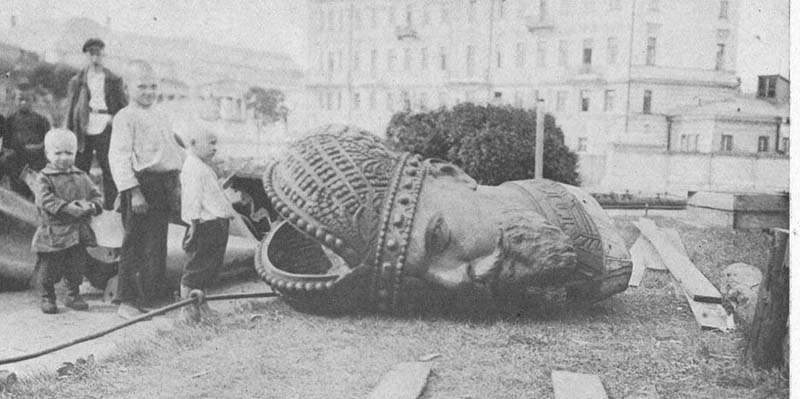 A statue of Tsar Alexander III, toppled during the Russian Revolution. The fall of four major empires, including Tsarist Russia, lead to a substantially altered political situation in many areas
Theo Mayer: You've written a lot of books and a lot of articles about World War One and you've done a lot of research and what are some of the key issues about this global catharsis that remain unknown, unknowable and unresolved?
Sir Hew S.: There are areas where I think research will still be done, which will leave us much better informed. In the Russian case, Russia's been neglected because at least up until the collapse of the Soviet Union, Russian history began in 1917. And so the first one was always looked at as a precursor to the revolution. And the same point in a slightly different way applies to the Ottoman Empire. But it has remained a story too dominated in some ways, by the fact that the easily accessible source material is in languages other than Turkish. In terms of what remain unknown, one is on hunger in the First World War. But what I think we will always struggle to identify is how much hunger across Europe in the First World War was the direct product of the war effort, and how much hunger was a product of maladministration, of the mobilization of peasant societies, of withdrawal of animals from agriculture for use in the armed forces. In other words, how much is hunger an indirect consequence of the war rather than direct consequence of military action, and this seems to be crucially important, because one of the things that I thought would happen but hasn't is, that we haven't the faintest idea what the total number of dead as a result of this war is. Most economic historians will say demographically the impact of the war is pretty short term, and most societies have recovered fairly quickly in the 1920s. But it would still, to my mind, be the great project actually to answer that question. So there's a lot to be done.
Theo Mayer: Thank you. Nice chatting with you.
Sir Hew S.: Thank you Theo.
Theo Mayer: Sir Hew Strachan is Professor of International Relations at the University of St. Andrews, and Emeritus fellow of All Souls College, University of Oxford and an author of many books and papers. Learn more about him and his work at the link in the podcast notes.