



































ASALH calls for papers on "Black Migrations" topic for 2019 program
By Chris Isleib
Director of Public Affairs, United States World War One Centennial Commission
The Association for the Study of African American Life and History (ASALH) has announced a new opportunity for scholars, especially those with interest in World War I, as it relates to the African-American community.
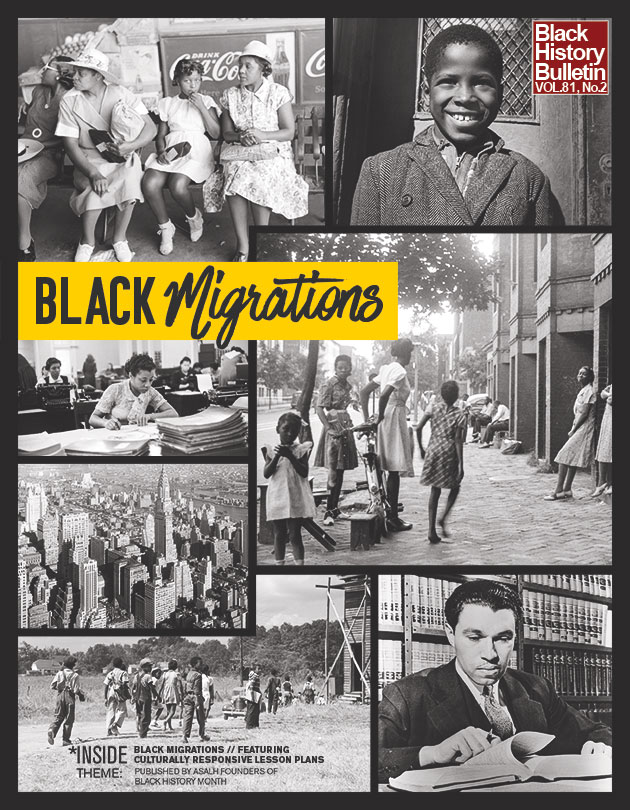 The 2019 ASALH Academic Program Committee invites comprehensive proposals for individual papers, panels, performances, films, round-tables, workshops, conversations, or alternative formats focused on the 2019 theme, “Black Migrations.”
“Black Migrations” spotlights movement to new destinations and subsequently changed social realities for people of African descent. While inclusive of earlier periods and global spaces, this theme centers on the American twentieth and twenty-first centuries. African American migration patterns included relocation from southern farms to southern cities; transition from the South to the Northeast, Midwest, and West and from the Caribbean to US cities; along with African American emigration to Africa and to European cities, such as Paris and London, in the post-world war periods.
These multifaceted migrations resulted in a more diverse and stratified interracial and intra-racial urban population amid a changing social milieu. Migrations cultivated Garvey movements in New York, Detroit, and New Orleans; the emergence of both black industrial workers and black entrepreneurs; the growing number and variety of urban churches and new religions; new music forms like ragtime, blues, and jazz; white backlash demonstrated in the 1919 Red Summer; the blossoming of visual and literary arts, as in New York, Washington, D.C., Chicago, and Paris in the 1910s and 1920s; and much more.
The theme Black Migrations equally lends itself to the exploration of other spatial and social perspectives, with attention to “new” African Americans because of the burgeoning African and Caribbean population in the US; African Americans’ return to the South; racial suburbanization; inner-city hyperghettoization; health and environment; civil rights and protest activism; electoral politics; mass incarceration; and dynamic cultural production.
2019 also marks the commemoration of 400 years of perseverance against enslavement. As such, we are looking for panels and papers that more fully interrogate this legacy of kidnapping and forced migration while honoring the resistance and resilience of black people throughout the diaspora.
The Program Committee seeks a diverse slate of presenters and panels representing a variety of professional and institutional backgrounds, perspectives, and voices. We are interested in detailed, comprehensive, and descriptive proposals that outline the theme, scope, and aim of participants.
The committee particularly seeks presentations that probe the traditional fields of economic, political, diplomatic, intellectual, and cultural history; the established fields of urban, race, ethnic, labor, and women’s/gender history as well as southern, Appalachian, and western history; along with the rapidly expanding fields of sexuality, LBGT, and queer history; environmental and public history; African American intellectual history; carceral state studies; and transnational and global studies across all fields, topics, and thematic emphases.
We encourage proposals from scholars working across a variety of temporal, geographical, thematic, and topical areas in Black history, life and culture. We seek to foster a space of inclusion in the ASALH program and encourage submissions from anyone interested in presenting including: historians, students, new professionals, first-time presenters, activists, and practitioners from allied professions.
Deadlines for submission of proposals are as follows: Submissions will be accepted up to Early Bird submission, which is March 1, 2019. After this date, the committee will accept all submissions until the deadline of April 1, 2019. All proposals must be received electronically to ASALH through the All Academic online system https://convention2.allacademic.com/one/asalh/asalh19/
More information can be found here: https://asalh.org/call-for-papers/?fbclid=IwAR3zX3gbLBTJaXaPsXvbK9W3zuYr2_7an22TnOLwpEUeNEBDb-X8ceyT6XI