







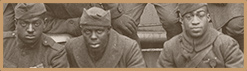























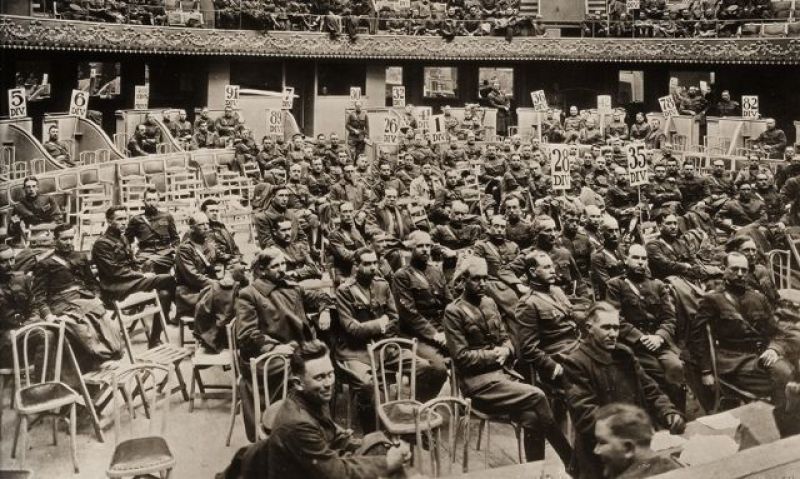
 Members of the American Expeditionary Forces gathered for a planned “morale conference” in Paris in 1919. The Paris Caucus led to the creation of what would become The American Legion.
The American Legion
It all began in Paris a century ago
By Jeff Stoffer
via the American Legion web site
The American Legion organization’s 55 departments and nearly 12,500 posts across the country and around the world are celebrating a century of service to community, state and nation that began in Paris March 15-17, 1919, when war-weary members of the American Expeditionary Forces gathered for a “morale conference” that led to the creation of what would become The American Legion. Only 300 troops were expected to attend. Officially, 463 registered. Some have estimated that more than 1,000 came and went, with or without orders, during the weekend that launched a century of accomplishments unforeseeable, if not unimaginable, at the time.
Lt. Col. Eric Fisher Wood, a leader in the prewar Preparedness Movement who was wounded fighting with the British before U.S. entry in the Great War and was later gassed during the Meuse-Argonne offensive while with the U.S. Army’s 88th Infantry Division, served as secretary of the Paris Caucus’ first session and called it to order nearly five hours after it was scheduled to start.
Fisher Wood, who originally wanted the new association to be named the Liberty League and later designed the emblem of The American Legion, was joined at the Paris Caucus by Col. William Donovan, who would go on to become the father of U.S. intelligence; future Secretary of the Treasury Capt. Ogden Mills; and fellow founder Lt. Col. George A. White, a former editor of the Portland Oregonian. But this caucus was not going to be about officers.
In a telegram to Lt. Col. Theodore Roosevelt, Jr., a week before the gathering, Fisher Wood stated simply: “Am inviting enlisted men.”
Pvt. George Munroe, who participated in the caucus, recalled in Thomas A. Rumer’s “The American Legion: An Official History, 1919-1989,” that he “saw no evidence of registration at the caucus. As far as I could see, anybody who happened to wander in could sit down and take part. It was somewhat of a madhouse. When I reported to the Cirque de Paris, I presented my travel orders to the soldier on duty at the door, and he looked me over, handed them back, and directed me to the section reserved for the 1st Division. After that, I came and went as I pleased.”
Amid the chaos, The American Legion formed its first four committees: Convention, Permanent Organization, Constitution and Name. Following the March 15 opening, the 15-member committees worked on their specific topics before reconvening March 17 before the entire group.
Read the entire article on the American Legion web site.
External Web Site Notice: This page contains information directly presented from an external source. The terms and conditions of this page may not be the same as those of this website. Click here to read the full disclaimer notice for external web sites. Thank you.