|
|
|
|
|
|

Members of the National Capital Planning Commission (NCPC) Thursday, July 13 reviewed plans for the new national World War I memorial at Pershing Park, questioning how the proposal could best complement the existing park's design. Joe Weishaar, the lead designer of the memorial, attended the hearing, where the challenge of building a new landmark on a historic piece of property in the nation's capital was intensely discussed by the NCPC Commissioners. Read more about the hearing here.
|
New York National Guard reported for World War I duty 100 years ago
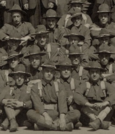
On July 15, 1917, 24,000 members of the New York National Guard began reporting for duty in what was then known as the World War. On July 12, President Woodrow Wilson had ordered all 112,000 National Guard Soldiers across the country to report for duty as part of the National Army which was being built to fight the Germans in France. New York's troops, along with those in Pennsylvania, Ohio, West Virginia, Michigan, Wisconsin, Minnesota, Iowa, North Dakota, South Dakota and Nebraska were instructed to report on July 15 to their armories and begin preparing to ship out. Read more about the New York National Guard's great mobilization here.
|

Engaging a new generation is absolutely vital for any field, history included. Popular history has found new formats in the age of the Internet. Podcasts, such as Dan Carlin's Hardcore History or Mike Duncan's History of Rome, as well as Youtube Channels, such as Extra Credits or Alternate History Hub or The Great War, reach a whole new demographic that television documentaries and books haven't been able to tap. This month we'll be introducing you to some of the dedicated content creators who work hard to create educational but exciting videos and podcasts. The first YouTube outlet we will introduce to you is Extra Credits. We were fortunate to spend some time with Lead Writer James Portnow, who told us about their vision for the show.
James Portnow will also be a guest on the WW1 Centennial News Podcast this week.
|
Who says World War I doesn't interest the youth of today?
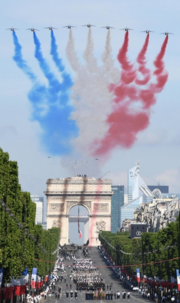
With a rapidly expanding following on her blog and Twitter feed, this is the question leading a young French journalist's work that strives to give a fresh face to WWI using social media. This week on WWrite, France24's Stéphanie Trouillard tells us about her personal and professional passions driving her innovative historical writing project. And a special bonus! She's shared part of her Twitter feed from Bastille Day in Paris, where she covered President Trump meeting French President Emmanuel Macron to commemorate the centenary of the United States' entry in WWI. Don't miss the up-close look at this important day!
|
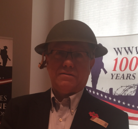
Every few weeks, we like to showcase the efforts of our remarkable Centennial Commission volunteers. Today, we bring you the story of Mike Masters, who is managing the WW1CC's exhibition booth activity. In his short time on board, Mike has told the Centennial Commission story to thousands of people at several convention events around the Washington DC area. Mike is a Foreign Service Retiree and WW1 history enthusiast. He is helping with events in the DC area, and staffed the Commission information booths at the Belgian Embassy Europe Day event, and the Daughters of the American Revolution Service to America night. Hear why Mike got involved in the Commission, and why the WWI Centennial is so important to him.
|
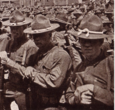
Sean Munger is a historian, teacher and author whose historical writing has appeared in a variety of national and international historical journals. In his meditation "Unfinished revolutions: Bastille Day and World War I," Munger posits that "to cement the ideals that the French people had risen up in 1789 to establish in their society,..the real test came in 1914, when France found itself in the midst of an existential military crisis: the French nation was threatened with literal destruction." To save France in 1917 came another nation whose own revolution was historically and symbolically intertwined with that of France: "On Bastille Day 1917, three months after U.S. entry into the war, those tanks and troops were visible marching down the central boulevards of Paris. One democratic country, with its own rocky and tumultuous history of trying (often imperfectly) to realize the ideals of its revolution, had come across the sea to rescue another." Read the entire thoughtful essay on the meaning of Bastille Day 2017 here.
|

The WW1 Centennial News Podcast is about WW1 THEN: 100 years ago this week and its about WW1 NOW: News and updates about the centennial and the commemoration.
Available on our web site, iTunes, Google Play, and TuneIn.
Highlight of Episode #28 include:
- We say farewell to Former Commissioner James Nutter: Dan Dayton |@ 00:30
- Poland in WW1 - Part 1: The Oath Crisis |@ 01:45
- Poland in WW1 - Part 2: What you probably did not know: Jan Lorys |@ 03:45
- The US government federalizes the shipbuilding industry |@ 10:45
- Women take up the fight in Europe: Mike Shuster |@ 19:15
- Americans who fought before America’s declaration: Richard Rubin & Jonathan Bratten |@ 23:30
- President Trump in Paris for Bastille Day WW1 Commemoration |@ 28:45
- Junior Master Gardener Poppy Project: Lisa Whittlesey |@ 29:30
- NYC museum exhibit: “Posters & Patriotism” |@ 35:45
- Utah grant program for WW1 events, research and memorials |@ 36:45
- “They Also Served” overlooked WW1 participants |@ 37:45
- Story about Star Spangled Banner widely picked up |@ 40:15
- The Buzz about gas:Katherine Akey |@ 42:15
|
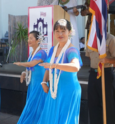
Honoring Hawaii’s First Casualties of WW1
Hawaii’s World War I Centennial Task Force held its inaugural event marking the 100th anniversary of “the war to end all wars”, April 2, at Aloha Tower. The ceremony honored the memory of six Hawaii men who died when the American merchant ship SS Aztec was torpedoed in the north Atlantic on April 1, 1917. The sinking of the SS Aztec by a German U-boat was one of several factors that led the United States to declare war on Germany and its allies and enter the war on April 6, 1917. Major General Arthur “Joe” Logan, state adjutant general, was selected as the keynote speaker because of the historic maritime connection the State of Hawaii, Department of Defense had with WW I. Read the entire article about the Hawaiian ceremony here.
|
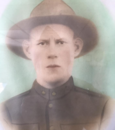
Bangor Park Rededicated in Honor of World War I Hero
On the night of July 17, 1918, U.S. Doughboys struggled through the dark eaves of Belleau Wood in a driving rainstorm. Thousands of troops were moving into position to attack at dawn the next morning, in what would begin the Aisne-Marne Offensive. One of these men was James W. Williams of Company G, 103rd Infantry Regiment.
Born and raised in Bangor, Maine, he had enlisted in the Maine National Guard's Company G, 2nd Infantry in June of 1916. He accompanied the regiment to the Mexican Border that year for a four month tour of guard duty. Now he was in France with the 2nd Infantry, except it had now been renamed the 103rd U.S. Infantry Regiment. Williams had already served on two fronts in the Great War: the Chemin des Dames and the Toul Sector. Now he was getting ready to go on his first attack.
As the Americans moved forward, the Germans caught sight of troops moving in the night and pounded Belleau Wood with artillery. Heavy shells shredded the trees into splinters and tossed great showers of earth into the air in ear-splitting explosions. Read the entire gripping article here.
|

Function and style are combined in this lightweight and compact Messenger Pouch. You can show your American pride while carrying this Made in the USA dark khaki pouch. Plenty of room for keys, wallet, tablet and documents. Outside flap features distressed “U.S.” imprint and an exclusive fabric garment label commemorates the U.S. Centennial of World War One.
Pouch features: Constructed of touch dyed canvas, with adjustable leather tab closure with collar button stud. Nylon adjustable strap. Two internal pockets. Dimensions: 15.5” W x 10.5” H x 2.5” D. A portion of the proceeds from the sale of this item will help fund the national WW1 Memorial in Washington, D.C.
This and many other items are available as Official Merchandise of the United States World War One Centennial.
|

|
|
|
A Story of Service from the Stories of Service section of ww1cc.org
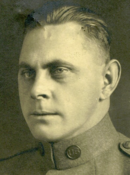
Submitted by: Marjorie Winslow-Kulba
Albert (Bob) Cornelius Peterson served in World War 1 with the United States Army. The dates of service are: Known September 18, 1917-April 19, 1919 & February 2, 1921-February 1, 1924.
Albert (Bob) Cornelius Peterson was born May 3, 1892 in Muskegon, Michigan.
He enlisted in the Army and trained at Fort Custer, Battle Creek, Michigan. He served in the 528th Field Artillery, 85th Division, Battery A, during World War One. He achieved the rank of corporal. He saw action in Toul Sector, France from Nov. 1-Nov. 11, 1918.
He wrote a letter home, describing the last two hours before the armistice was signed. It was published in the "Muskegon Chronicle" on January 11, 1919. He wrote:
"We returned from a little journey to the front last week. Fortunately we didn't have any casualties while there, although it was rather uncomfortable at times. While we were there, Fritzie started some of his hellish work each night at just about dusk. It would last three hours, then stop abruptly, and commence again just before dawn."
|
|
|
|
|






























 Signature Events Major Moments
 Video Streaming video resources
 Publications Dispatch, Sync-Call and more