|
|
|
|
|
|
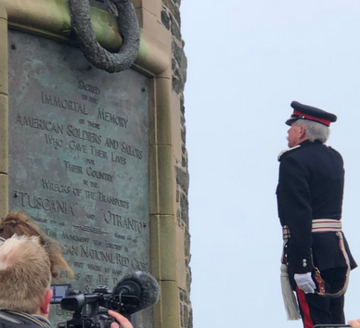
Islay ceremonies remember US war dead
Commemorations took place last Friday on island of Islay, Scotland to remember the 700 people who died in two separate World War I disasters nearby, including 200 American soldiers and sailors who died when the troop ship SS Tuscania was torpedoed by a German U-boat off Islay in February of 1918. Eight months later, another troop ship, the HMS Otranto, went down nearby after a collision in a storm. Read more about the international ceremonies here.
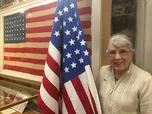
The American flag used in 1918 for the funerals of US troops drowned in the sinking of the SS Tuscania has made a 3500 mile journey back to Islay. Four local women and one man sewed it quickly to ensure that the US servicemen could be buried under their own flag. Sent to President Woodrow Wilson by Hugh Morrison, the Laird of Islay Estate, the flag is now in the Smithsonian Institution, but it is spending several months on display at the Museum of Islay Life in Port Charlotte before returning to Washington, DC. Read more about the historic flag here.
|
Poppies, flyover mark WWI Centenary at North Carolina State University
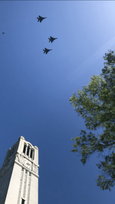
North Carolina’s main U.S. World War I Centennial Commission observance – and the only one of 100 worldwide events held on a college campus – took place last week, at the Memorial Tower, NC State’s iconic tribute to its students and alumni who served and died in the war. NC State Alumni Association executive director Benny Suggs and U.S. World War One Centennial Commissioner Jerry Hester, both military veterans and NC State graduates, were among the speakers at the event, held on the steps of the Belltower. Read more about the ceremony here.
|
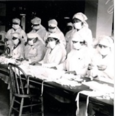
the Centers for Disease Control and Prevention (CDC) is commemorating the 1918 influenza pandemic and the many public health accomplishments that have occurred over the past 100 years. The centennial presents an opportunity to emphasize the continued threat influenza viruses pose, and the CDC's vital role in maintaining our nation’s capability to prepare for and respond to an influenza pandemic. Much of the 1918 flu pandemic can be related to the conditions of WWI. Read more about the CDC's commemoration activities.
Also listen to our Podcast interview this week @ 32:15 with Author Kenneth C. Davis, who shares the story of influenza in 1918 from his new book coming out May 15, 2018: "More Deadly Than War: The Hidden History of the Spanish Flu and the First World War"
|
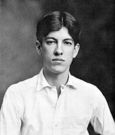
During his recent visit to the United States, France's President Emmanuel Macron underlined America's centuries-long history of special partnership, including several specific speech mentions related to World War I. One of the most significant World War I mentions was during his speech before the Joint Session of Congress, at the U.S. Capitol. There, President Macron told the story of Alan Seeger, an American poet who is venerated in France, to include a memorial statue in Paris. Who was Alan Seeger, and why is he such a powerful symbol? We decided to find out; our Intern Nicole Renna has the story.
|
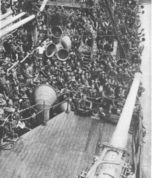
As April 1918 became May, the 27,000 Soldiers of the New York National Guard's 27th Division left Camp Wadsworth, South Carolina, and boarded trains and ships heading for France where World War I was raging. The 27th Division, which included all but two regiments of the New York National Guard, left New York in August and September 1917. There had been a massive parade down Fifth Avenue when the division left, and then eight months of training in South Carolina began. Led by Maj. Gen. John F. O' Ryan, the National Guard Soldiers built their own camp, dug practice trenches and lived in them, learned to shoot, and reorganized for war. Now they were headed for France. Read more about the 27th Division going to war here.
|
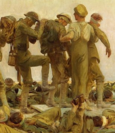
The Carnegie Council for Ethics in International Affairs recently presented a session of their Living Legacy of the First World War project titled "The Politics and Medicine of Treating Post-traumatic Stress (PTS) Since World War I." Tanisha Fazal, a professor at the University of Minnesota, is writing a book on how dramatic improvements in military medicine and also the expansion historically of veterans' benefits have increased the long-term, downstream costs of war for the United States. In this program, she discusses how World War I was a turning point in military medicine "in terms of acknowledging and starting to identify and treat what we call today post-traumatic stress." Read the entire Carnegie Council interview program here.
Also listen to our Podcast interview with Mark Wilkin @ 18:30, about his recently published article in the Smithsonian’s Air and Space magazine called “The Dark Side of Glory: An early glimpse of PTSD in the letters of World War I Aces.”
|
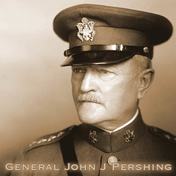
Episode #70
Highlights: General John J. Pershing
May 1918 Preview Roundtable - Ed Lengel, Katherine Akey, Theo Mayer | 02:50
General Rumblings - Mike Shuster | 18:00
War In The Sky - Eddie Rickenbacker | 21:45
Documentary: “Blackjack Pershing: Love and War” - Prof. Barney McCoy | 25:55
The big influenza pandemic - Kenneth C. Davis | 32:15
WW1 War Tech - Fed billions, killed millions: The tragic story of Fritz Haber | 39:25
100 Cities / 100 Memorials from Brownwood, Texas - Dr. Steve Kelly | 44:15
Speaking WW1: Binge | 50:00
Articles and Posts: Highlights from the Weekly Dispatch | 51:50
The Commemoration in Social Media - Katherine Akey | 54:15
|
War Isn’t the Only Hell: A New Reading of WWI American Literature by Keith Gandal
Unlike every other combatant nation in WWI, America's lasting literature on the conflict was written entirely by noncombatants –Hemingway, Dos Passos, Katherine Anne Porter. This week on WWrite, Keith Gandal discusses his work on the unknown yet vital role noncombatant writers, such as African Americans and women, played in shaping America's WWI memory. Don't miss this fascinating post!
|
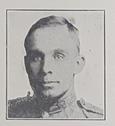
A man is only missing if he is forgotten.
Monday's MIA this week
Monday’s MIA for May 7th, 2018 is Private Harry M. Bohannon, who enlisted on May 8th, 1917 at his home of Logansport, Indiana. He trained at Fort Thomas, Kentucky and then Camp Greene, North Carolina, where he was assigned to the assembling 3rd Division. Designated a rifleman, he was sent to Company L, 38th Infantry, and embarked with them for overseas duty on March 30th, 1918. That summer, the 3rd Division stopped the German advance on Paris at the Marne River. The engagement spilled back and forth onto both banks of the river and in the heavy fighting Private Bohannon was severely wounded in action on July 1st, 1918 while trying to cross back over the river to the bank held by his regiment. In the process he drowned. It is unclear whether one of the bodies later pulled from the river was his or not. (Doughboy MIA has begun preliminary plans to launch a deeper investigation into this case.) The American Legion Post in Delphi, Indiana is named in his honor.
Can you spare just ten dollars? Give 'Ten For Them' to Doughboy MIA and help us make a full accounting of the 4,423 American service personnel still listed as missing in action from WW1. Make your tax deductible donation now, with our thanks.
|

World War One Custom Silk Tie - Great for Grads and Dads
$59.95
The 100% woven silk tie has been custom created for the World War One Centennial Commission.
The red silk tie features World War One era aircraft and the official logo of the Centennial Commission on the back. This beautiful tie also comes packaged in a 2 piece box with the Doughboy seal printed on the top, making a great gift for both Grad and Dads.
Proceeds from the sale of this item will help to fund the building of the national World War One Memorial in Washington, D.C.
This and many other items are available as Official Merchandise of the United States World War One Centennial.
|

|
|
|
|
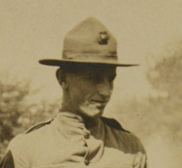
Submitted by: Robert G. Bullis {Son}
Everard J. Bullis, Sr. was born around 1896. Everard Bullis served in World War 1 with the United States Marine Corps. The enlistment was in 1917 and the service was completed in 1918.
Story of Service
Everard J. Bullis was my Dad, who enlisted in WW1 from St. Paul, Minn. He enlisted in the Marines and arrived in France on May 7, 1917.
June 8, 1918 he entered the fight in Belleau Wood. In July he went over the top with the 5th Marines in the St Mihiel Drive.
Later, during the battle on the Champagne front, he was wounded in his right lung. I, Robert G. Bullis, have that bullet, his medals and memorabilia, and most of the original letters to and from his parents and 4 sisters during his service.
My Dad wrote his memoirs in the 1950's, which were edited recently by David Bullis, my Nephew. This book is being published this spring entitled "Doing My Bit Over There".
|
|
|
|
|





























 Signature Events Major Moments
 Video Streaming video resources
 Publications Dispatch, Sync-Call and more