|
|
|
|
|
|
From the World War I Centennial News Podcast
An interview with Bells of Peace Program Coordinator Betsy Anderson

Bells of Peace, A World War I Remembrance is a collaborative program to bring the Centennial of the Armistice to communities and organizations across the nation, in a grassroots program to encourage the tolling of bells, and other commemorative activities, throughout the United States on Sunday, November 11th, 2018 at 11 a.m. local time. Bells of Peace brings attention to the end of the fighting in World War I at the 11th Hour of the 11th day of the 11th month in 1918, a hundred years ago. In June 29th's WW1 Centennial News Podcast, Episode 78, Program Coordinator Betsy Anderson spoke with host Theo Mayer about Bells of Peace, touching on the historical background and purpose of the initiative, as well as how people can participate. Read a transcript of this enlightening interview here.
|
How Doughboys in 1918 Celebrated Independence Day on July 4 in France
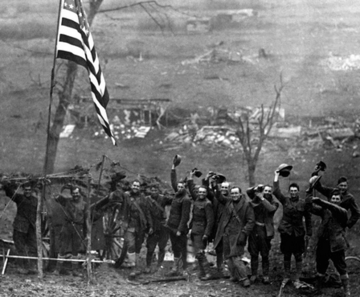
July 4th, 1918: Imagine yourself, an American, on the streets of Paris. Crowds bustle and cheer in excitement as you march past them. Even though you have yet to fight you feel triumphant, as if the battle has already been won. The American and French flags fly in unison high above you and in the air the scent of American food cooking smells delicious. A French child gives you a flower as you march by, a symbol of gratitude for fighting as an ally. Back home it is Independence Day, but in this foreign land you are joined in celebration. WW1CC intern Joseph Vesper takes a look back at how Doughboys all over France, in events large and small, observed American Independence on July 4, 1918.
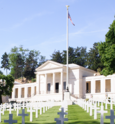
Suresnes American Cemetery, located just outside of Paris, is one of nine World War I cemeteries managed by the American Battle Monuments Commission (ABMC). Created due to its proximity to American Expeditionary Forces’ hospital centers in and near the Paris area, Suresnes American Cemetery includes the remains of many Americans who died from injury or illness during the war. ABMC has released a new video presentation titled "Suresnes American Cemetery: America’s WWI Cemetery Near Paris" to tell more about the cemetery and its history. Click here to learn more, and view the new ABMC video.
|

Author Patrick Gregory describes how he came to write the memoir An American on the Western Front with Elizabeth Nurser, and the bond he feels with the young man at its heart, a young man who carried his country’s first official flag to Europe in 1917 and served first in the ambulance corps and then as a fighter pilot, flying with both the French and US Air Services. Arthur Clifford Kimber was 21 when he set off for France in 1917 and just 22 when he died. Kimber agreed to write letters from the moment he left home, as often and as detailed as he could manage, and all 160 letters he sent survived the war--though Kimber did not. Through a family connection, Gregory has helped an absent Kimber give us a unique window on 1917 and 1918 in wartime Europe by combining his personal story with the bigger picture: the wider panorama of America’s war. Read more about how An American on the Western Front came to be written, and the profound messages it has for the 21st Century from a fallen American in WWI.
|
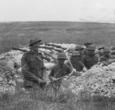
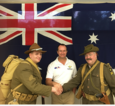
One hundred years ago last week, members of the Illinois National Guard’s 33rd Division were fighting side by side with Australian troops in the Battle of Hamel. The fight in northern France was the 33rd’s first offensive in World War I, and the combination of eager Guardsmen and experienced Australians proved to be a winning combination.Last week the Illinois State Military Museum held an educational event on the Battle of Hamel and World War I, with military re-enactors and a talk on the battle complete with historic pictures, and an Australian deputy consul-general in attendance. Read more about this commemorative event and the Illinois-Australia connection here.
|

Gordon C. Morse, writing in The Virginian-Pilot newspaper recently, makes the observation that "It may have happened 100 years ago, but the more time you spend with the first world war, the more it closes in on the present." Starting with a look at the issue of immigration in the early 20th century (which certainly has resonance in the early 21st), Morse comes to the clear understanding that "To grasp the war’s reality and its consequences is to learn that no sentient American should go about the day without understanding that WWI puts in motion the present role of the federal government, the responsibilities of global leadership, and the vast material cost of it all." Click here to read the entire thoughtful and informative article about the significance of WWI to the USA.
|
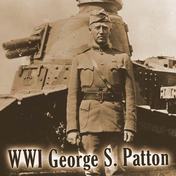
Episode #79
July 1918 Overview
100 Years ago: July 1918 overview - Theo Mayer, Katherine Akey & Dr. Edward Lengel | @02:10
Great War Project: Changing Landscape of the War - Mike Shuster | @18:15
Commission News: Armistice Centennial Participation App | @22:25
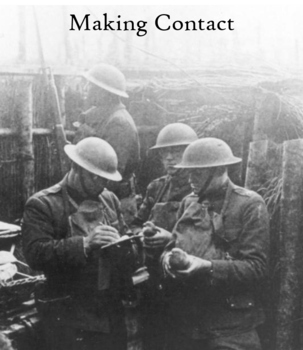
Remembering Veterans: Doughboy MIA - Rob Laplander | @ 23:35
Spotlight on the Media: Lost Voices - Michael Collins and Martin King | @31:05
Speaking WW1: Zero Hour | @36:20
100 Cities / 100 Memorials: Patton and the US Tank Corps Project - Karlen Morris & Sgt. Phil Wilburn | @ 38:05
WW1 Tech: Trench Club | @43:30
Articles & Posts from the Weekly Dispatch Newsletter | @45:35
The Buzz: The Centennial in Social Media - Katherine Akey | @48:20
|
Yoga and Animals: Inspiration for WWI Poetry
This week, Wrrite features the inspired poetry of Jane Satterfield, whose father is a Desert Storm veteran.
Satterfield’s poetry and prose have appeared in American Poetry Review, Antioch Review, The Common, Crazyhorse, North American Review, Notre Dame Review, Pleiades, and many more, as well as on Verse Daily and Poetry Daily. The daughter of an American airman and a British mother, she grew up near Andrews Air Force Base in suburban Maryland.
Don't miss this unique post about yoga as a space for reflection and creation about war. Namaste.
|
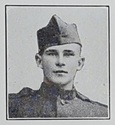
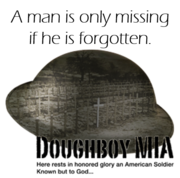
A man is only missing if he is forgotten.
Monday's MIA this week is Private Lee G. Winslow. Born August 21st, 1897, Private Winslow was a farmer in Fairmont, Indiana when he was drafted on March 28th, 1918. He was trained at Jefferson Barracks, Missouri and Washington Barracks, Washington, D.C. From there he went to Camp Merritt, New Jersey, where he received training with the Engineer Corps. Assigned to Company F, 1st Replacement Regiment, Engineers, and went to France in May, 1918. ‘Over There’ he was transferred to Company E, 2nd Engineers and was killed in action by shell fire on October 3rd, 1918 at Somme Py. His remains were never identified.
Would you like to help us solve this case? Give 'Ten For Them' to Doughboy MIA and help us make a full accounting of the 4,423 American service personnel still listed as missing in action from WW1. Make your tax deductible donation now, with our thanks.
|

The pieces of music you will hear on this disc are, in a sense, living artifacts of the WWI era, Despite the vast contrast in style among the various composers, almost every piece was composed within the ten-year period between 1912 and 1922. The poetry and the music itself is infused with the emotions of the war, from vengeful violence to solemn mourning, to desperate calls for peace. The Washington Post wrote of this collection that "This recital was so different - so refreshingly, marvelously different...The goal of a recital is not originality as much as making a statement as an artist. And at this, Brancy and Dugan succeeded superbly."
This and many other items are available as Official Merchandise of the United States World War One Centennial.
|

|
|
|
|
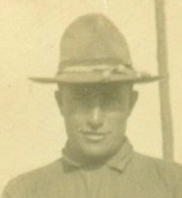
Submitted by: Harry L. James {Great Nephew}
Herbert James born around 1895. Herbert James served in World War 1 with the United States Army. The enlistment was in 1917 and the service was completed in 1919.
Story of Service
Herbert James was born on January 13th, 1895 in Bethlehem, Kentucky. In September of 1917 he was drafted into the Army at Camp Zachary Taylor, Louisville, Kentucky.
From September of 1917 to July of 1918 he passed through a series of training units starting at Camp Taylor then Camp Shelby in Mississippi as part of a Regular Army round out of a National Guard Division. At Camp Shelby Herbert along with 1000 other soldiers were then formed into Replacement Companies and transferred to Camp Merritt, New Jersey where they departed for France on the 11th of June, 1917 on the SS Corsican.
The Corsican docked in Liverpool, England on the 24th of June. From there Herbert and his fellow soldiers were sent on a troop train to Southhampton and finally to combat training at the Depot Division, St. Aignan France. Once he completed his final training he was assigned to the 4th Infantry Regiment, 5th Brigade, 3rd Infantry Division on the 26th of July, 1918.
|
|
|
|
|






























 Signature Events Major Moments
 Video Streaming video resources
 Publications Dispatch, Sync-Call and more