































The Great War - Prelude
Submarines: terror weapons of World War I. Two maritime disasters involving submarines bookend Hawaii’s pre-war experience. March 25, 1915: an accident off Pearl Harbor causes the loss of submarine USS F-4 with 21 crew. April 1, 1917: civilian vessel SS Aztec torpedoed off France with 5 Hawaii merchant mariners among those drowned.
As ‘Europe’s war’ began in 1914, Hawaii citizens focus on Kamehameha Day celebration plans, and charitable activity like the Elks 616 Lodge financial support for the Salvation Army July 4th children’s picnic. In the Atlantic, the ocean was the battlefield with both sides expecting a quick victory. Britain, the world’s oceanic super-power, threw up a total naval blockade of goods bound for Germany. Including food as contraband, Britain aimed to starve Germany into surrender. Without the surface vessels to break Britain’s blockade, Germany declared their own blockade enforced by German U-boats. At first war ships were “shot without warning", but unarmed merchantmen were allowed to put crew in lifeboats before torpedoes were loosed and the vessels sunk. Gentlemanly conduct soon ended as both sides took more drastic measures hoping to speed victory.
 Military Preparedness programs began in the US, including submarines, just in case. Among the experimental boats was the USS F-4, a 330-ton submarine. August 1909, her keel was laid down in Seattle. Launched January 1912, and commissioned May 3, 1913, the 24th submarine in the U.S. Navy. F-4 was first stationed on the west coast, and moved to Hawaii August 1914 with 3 sister subs as the 1st Submarine Group, Pacific Torpedo Flotilla.
The F-4 left the harbor in Hawaii March 25, 1915, for training maneuvers with the F-1 and F-3. When F-4 failed to return with the others, a search began. The sub was found in 51 fathoms, 1 1/2 miles off Oahu. As the waterfront learned of the search, crowds appeared waiting and watching. Next day, after repeat failed attempts to lift the boat, the Navy acknowledged the loss of 21 crewmen.
Life insurance for servicemen was unknown in 1915. Aware of the devastating impact the loss would have on the crew’s families, Hawaii’s civilian and military communities began an F-4 Relief Fund. The response of Elks Lodge 616 was typical of the community’s commitment: when a $100 donation to the Fund was proposed, and questions arose on how the Lodge could pay, Brother Thompson personally pledged $100, ending debate. Chagrin members made and carried a motion to donate $200 [$3650 in 2014]. That summer, 616 Elks ‘passed the hat’ among members to fund the Salvation Army July 4th picnic, with Lodge funds lowered by their F-4 charity.
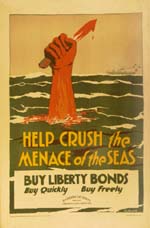 After the April 1915 Lusitania sinking with 1,198 people lost, Germany had an on/off policy of unrestricted U-boat attacks on merchant marine and passenger vessels. Hawaii newspaper stories began to favor the Allied countries. 1916 peace negotiations between the warring parties failed, and the submarine blockade was re-established, and then escalated early in 1917. Germany gambled Britain would sue for peace before American shipping losses lead to an American declaration of war. The British worked furiously diplomatically and with public opinion to draw in the Americans.
Shipping losses drove Britain close to surrender, but Germany lost the propaganda war. They became the hated Huns, the bloody hand of death, guilty of real and imagined brutality, solidifying Americans against Germany.
For Hawaii, the 1917 sinking of the Aztec would create an anger that swept away nearly all resistance to the US declaration of war and bound Hawaii citizens together in grief.
Anita Manning, Historian Elks Lodge 616
References: [unfortunately, these web sites have changed; info no longer posted]
www.history.navy.mil/photos/sh-usn/usnsh-f/ss23.htm
www.csp.navy.mil/
Elk Lodge Minutes 616: 1914 Jun 12, Jul 3; 1915 Apr 2, 9, 23
- Raised in August 1915, a report determined corrosion let excessive seawater flood the ballast tank, sinking F-4 deeply. Water pressure opened her seams. The incident revealed design flaws, leading to improved safety for other subs.