
























The Great War - War Relief becomes War Support
The Hawaii visitor industry markets Hawaii as a safe vacation destination in a time of conflict. 2014? Nope, 1914. Hawaii, in the neutral U. S., was marketed to upscale resort travelers who might previously have gone to the French Riviera as a safe-haven from war in Europe. The Hawaii Promotion Committee (HPC) and business community said this was “Hawaii’s Golden Opportunity.” The Ad Club and HPC, including Elks Lodge 616 charter member J. W. Jones, began raising funds for tourist advertising in August 1914.
Theodore Richards, editor of the religious monthly news magazine The Friend, also saw a golden opportunity. He chided Ad Club members for planning to benefit by others’ misfortune. Richards suggested collecting funds for both charity and business. The charitable fund would support European war relief, “peace propaganda” between Japan and America, and a reserve “in the event of a war in the Pacific.” Prophetically, Richards wrote, “the appalling nature of this calamity to the world has not come home to us yet…it is coming nearer to us all the time…”
September 1914, inspired by Richards, a War Relief Committee was formed with a multi-racial / multi-national membership. By October, the activity was territorial in scope and funds were being distributed in Europe. Groups formed to raise funds for British, German, Portuguese, French, and Belgian war victims.
Women of Honolulu, such as the wives of Elks Lodge 616 members, were involved in many Hawaiian Allied War Relief Committee projects. For example, the St. Andrew’s Cathedral Guild adopted a national program to send cheer to Europe’s children on a 1914 Christmas Ship. Mrs. W. L. Emory, wife of a 616 charter member, chaired the group collecting funds, books, and toys.
When the U. S. entered the war April 6, 1917, Elks 616 members and all Hawaii strengthened support. Elk J. W. Jones promoted participation in a campaign to quickly supply equipment to the U.S. Navy. In a February 1918 meeting, 616 members were exhorted to lend eyeglasses and telescopes “for the duration” through a national program.
Food conservation was an Elks Grand Lodge national priority. Elk C. G. Bockus, 616 charter member, served on the Territorial Food Commission and future Elk F. B. Cosgrove joined the formidable sounding Banana Consuming Propaganda Committee. Consuming food grown in Hawaii saved shipping fuel and freed crops to feed troops.
With the growth of women’s Red Cross work, Elk and Governor Lucius Pinkham offered use of the Throne Room at Iolani Palace for their work groups. Elk A. Richley oversaw removal of the thrones, carpet, and portraits to storage, and protecting of walls and chandeliers.
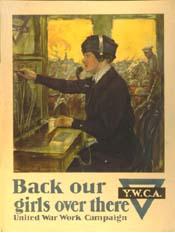 Yes, women sewed hospital gowns and rolled bandages, but official slogans sanctioned unusual roles for women: “For Every Fighter, a Woman Worker.”
Mrs. A. E. Murphy, Elk wife, served on the YWCA’s Women’s War Work Council: “Women of Honolulu! Your Country Needs Your Help.” Hawaii’s women took classes in signal corps work and semaphore, and wireless telegraphy. Schuman Carriage taught women driving and motor mechanics. Then radical jobs for women, their labor could free men for the front. Ladies, including Elk wives, hosted chaste “entertainments and dances” for military men. Hawaii women, notably Miss Mabel Wilcox of Kauai, served in European hospitals and with ambulances close to the front. They ran canteens and offices: “Stenographers! The Kaiser Is Afraid of You.” The YWCA may NOT have approved women entering smoke shops to fund soldiers’ tobacco, but news articles said “there is every justification” for women to enter these shops, the act being “just the same as entering the dry goods store.”
 In August 1917, Elks Grand Lodge requested Lodge 616 contributions for the Elks’ War Relief Commission goal of $1,000,000. The Lodge responded by assessing each member $2.00 [about $37 today]. Results: $366 [$6850] in 12 months. The Grand Lodge fund equipped base hospital units in France and a US rehabilitation hospital in Boston.
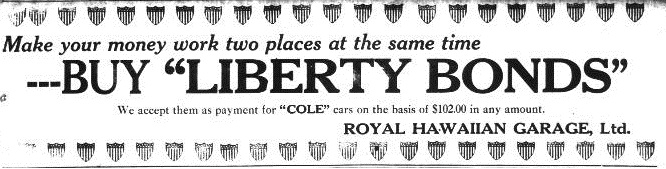
Liberty Loans funded the U.S. war. Cartoons showed “Prussian World Dominion” squeezed by the allies and pressed down by a bag of Liberty Bonds. Elks 616 shelved hopes for a new lodge building to invest their funds in Liberty Bonds: June 1917, $5000; Oct. 1917, $1000. With Bank of Hawaii paying 4% and the Anglo-French war loan 6.66%, the US Liberty Bond at 3.5% was a patriotic act. Ah, but Royal Hawaiian Garage Ltd. took Liberty Bonds as payment for a new Cole motor car!
 The April 1918 drive was scheduled on the U.S. war declaration 1 year anniversary and aided by convenient news stories. “Hun Spies in City Hinder Liberty Loan Campaign” warned one story. Elks invested $1200 [$224605] during a citywide rally.
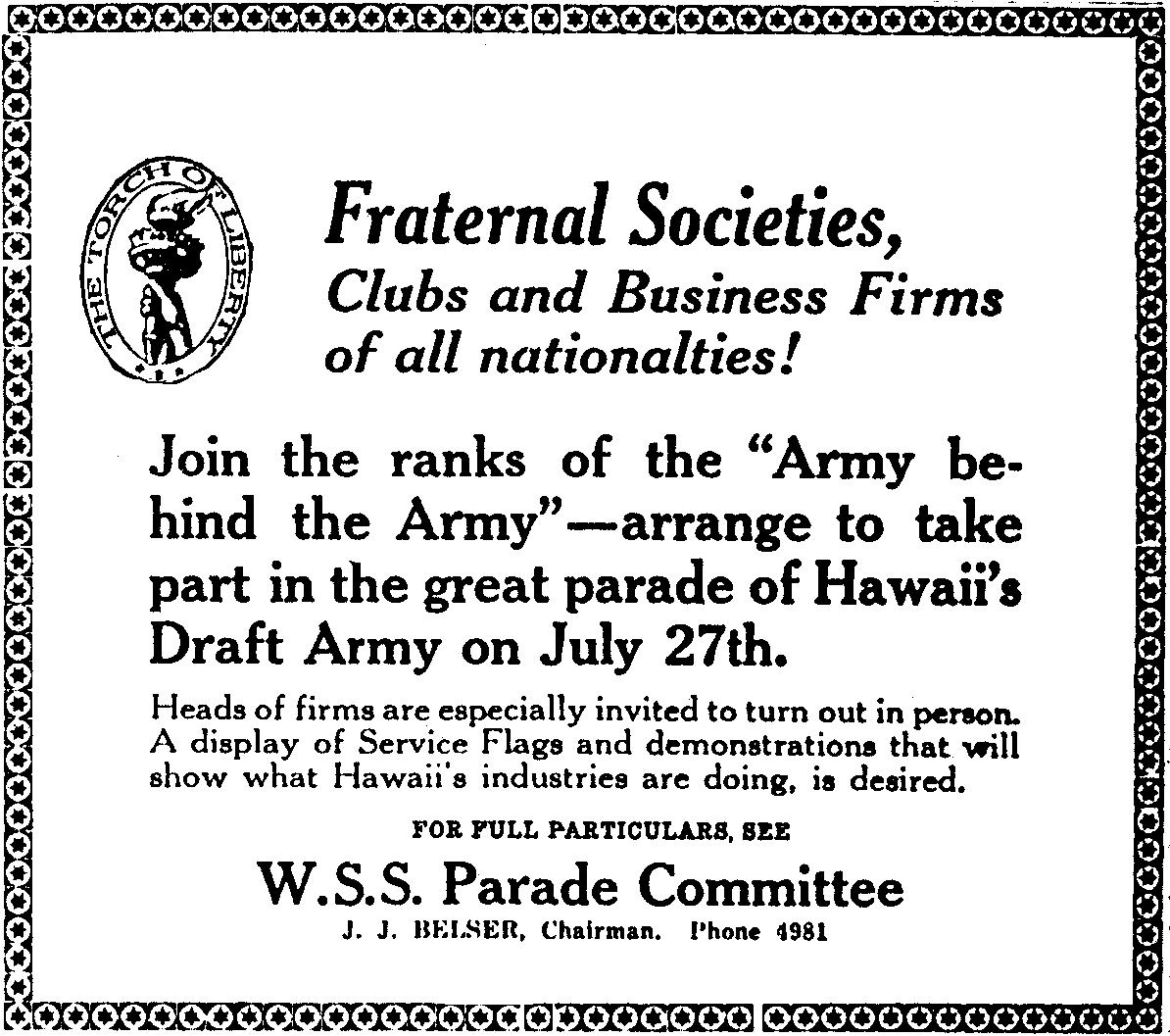
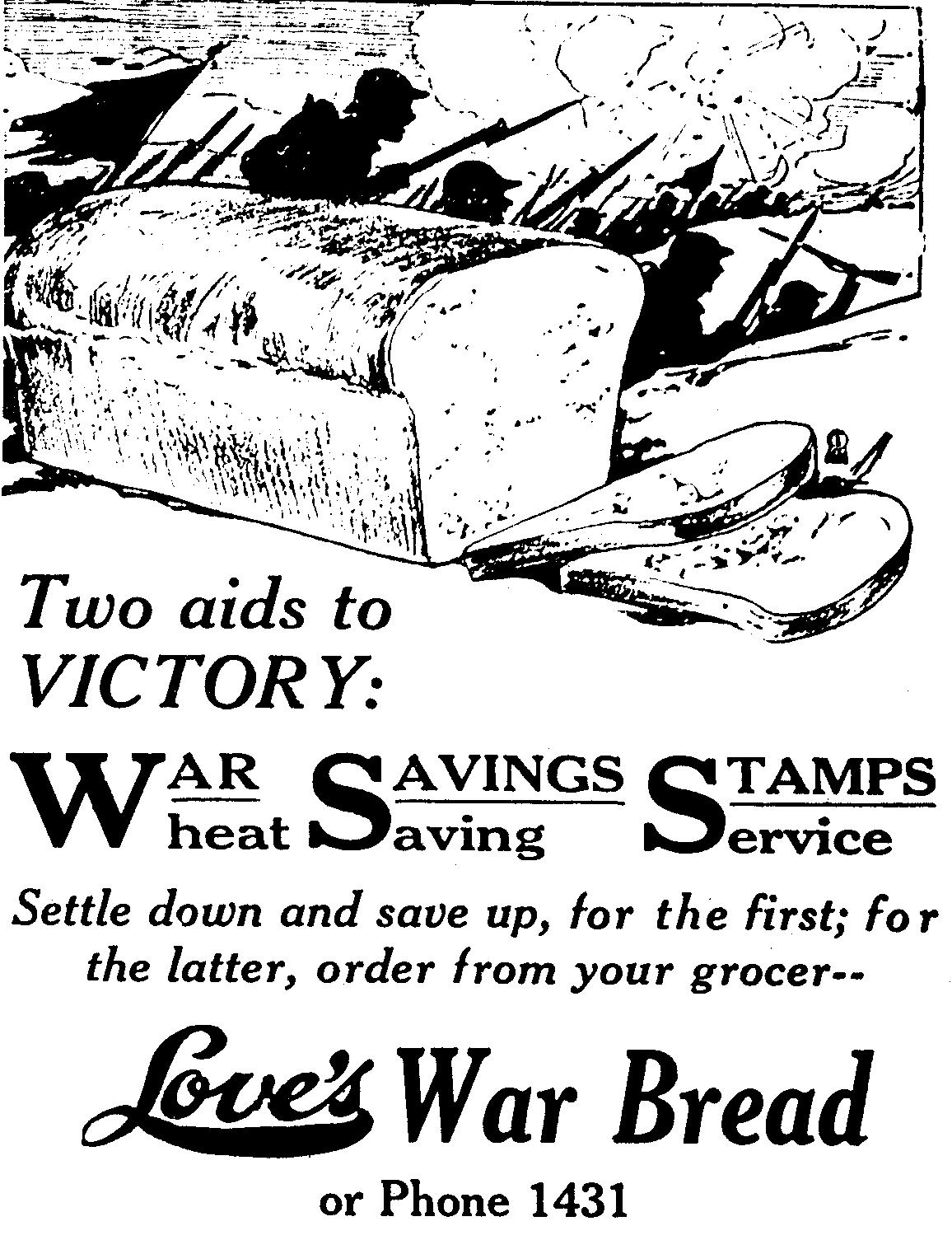 Thrift Stamps and War Savings Stamps targeted school children, housewives, and wage workers. Students should invest their pennies in War Stamps not buy treats like pineapple flavored Honolulu Fruit Chewing Gum “Pride of the Islands.” Ads targeted each ethnic group and posters urged immigrants to contribute: “Own Shares in the Country that Protects You.” In each language the unstated message was “Buy to show you are worthy to become an American.” Businesses sponsored ads while selling their products. War Savings Day, July 27, 1918, saw businesses close as crowds turned out for speakers, martial music, “moving pictures of the War Front”, and “mob singing”. Lodge 616 resolved to “buy the limit” of $1000, earning them a place in the public parade. Surely the band of demur, but pretty young saleswomen didn’t influence their decision?
Hawaii and 616 Elks responded with energy to their country’s call and showed compassion for war’s victims. The Ad Club found they could redefine Hawaii’s “Golden Opportunity” by advertising Hawaii in a special way. In January 1918, the Ad Club sponsored a comforting Gift of Aloha to French hospitals - 10,000 mini-jars of guava jelly.
Anita Manning, Lodge Historian
References:
Advertiser 1917 Apr 7, May 5-6, Jun 7, 1918 Feb 20, Apr 9, Jul 24-26
Kuykendall, R. Hawaii in the World War. 1928. Hist. Com. Terr of Hawaii
Grand Lodge. 1990. The Story of Elkdom.
Minutes 616 1917 Apr 6, May 11, Jun 28, 29, Jul 6, Aug 3, Oct 12, 19; 1918 Jan 25, Apr 5, Jul 19
Star-Bulletin 1917 Dec 15; 1918 July 24
- WRC became a Red Cross chapter Sept 12, 1917
- HAWRC became a Red Cross auxiliary
- Carpenter of the Exalted Ruler’s chair, he was Terr. Dept of Public Works Inspector at the time.
- Group singing of well-known songs