
































The Great War - Now It’s Personal
For Hawaii, the approaching war became real on April 1, 1917. Hawaii had sympathized when Belgium was invaded Germany, when French hospitals needed supplies, and when Americans were lost in torpedoed ships like the Lusitania. The community had sent relief aide. Individuals had volunteered as soldiers and ambulance drivers.
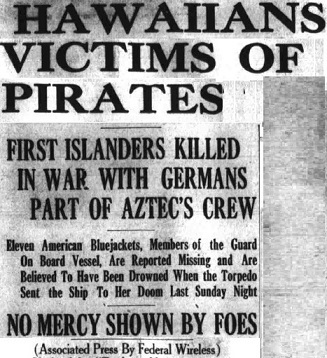
This was different. Six young Hawaii-born merchant mariners drowned in the Atlantic when their ship was torpedoed. They were civilians; they were young; they were ours. Now it was personal.
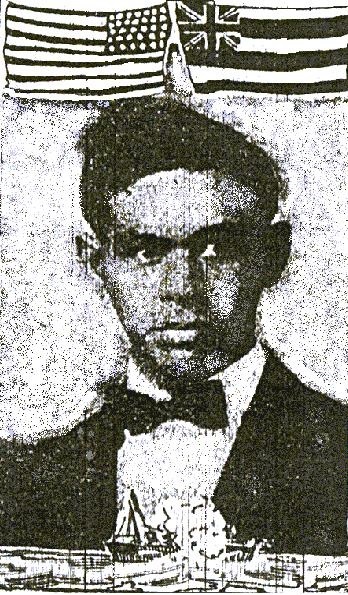 Julian R. Macomber remembered by Honolulu Advertiser April 4, 1917The civilian freighter SS Aztec was torpedoed and sunk by a U-boat off the northwest coast of France. The lost merchantmen were Chester T. Lee, a Hawaiian living in San Francisco, and 5 homeported in Hawaii.
- John Davis
- Charles Kanai
- Eleka Kaohi
- Julian R. Macomber
- Henry Rice
The attack also took 23 others. The press used fighting words in reporting the loss: victims, doom, murder, Prussian pirates, sea-sneak, no mercy. Here was proof Germany was, as Pres. Woodrow Wilson said in asking Congress to declare war, “a menace to the world.”
 Years of attacks brought American anger to a near-boil, and then Germany declared unrestricted U-boat warfare. Britain intercepted, deciphered, and passed on to the US government a German Foreign Office telegram to Germany’s liaison in Mexico. It suggested asking the liaison for Mexico’s help to invade the US and in return Germany would promise the eventual return to Mexico of lost territory (Arizona, New Mexico, Texas, and California).
Years of attacks brought American anger to a near-boil, and then Germany declared unrestricted U-boat warfare. Britain intercepted, deciphered, and passed on to the US government a German Foreign Office telegram to Germany’s liaison in Mexico. It suggested asking the liaison for Mexico’s help to invade the US and in return Germany would promise the eventual return to Mexico of lost territory (Arizona, New Mexico, Texas, and California).
Diplomatic relations with Germany were cut February 3, 1917 and April 2 the President asked Congress for a declaration of war. Details of the Aztec sinking took Honolulu’s front pages beside news of Pres. Wilson’s address to Congress.
Albeit with some opposition in both the House and Senate, Congress declared war April 6, 1917. The United States had joined the “Allied and Associated Powers” against the “Central Powers”. No waiting for news of the declaration with the original ‘cable news network’ the new undersea telegraphic cable. “Just 6 minutes after the Associated Press telegraphed ‘flash’ The Advertiser had an Extra on the street,” they bragged.
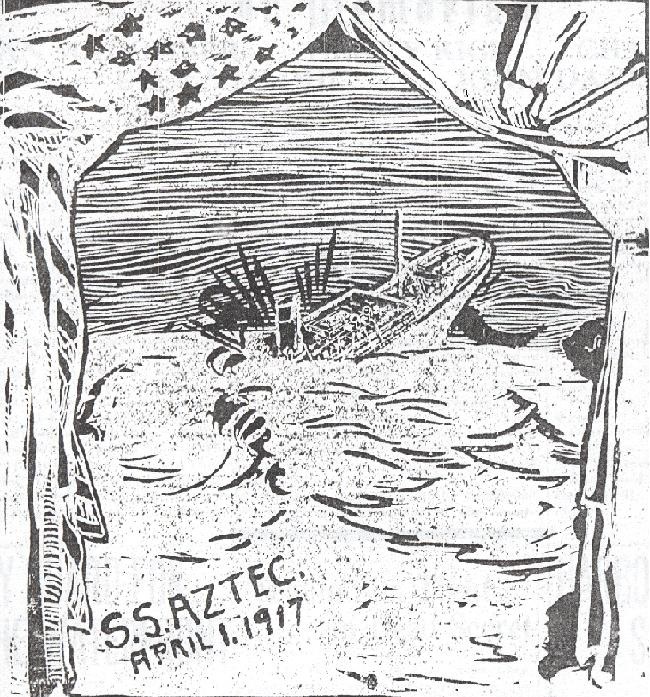 The sinking was memorialized at a public event April 22, 1917. Honolulu Advertiser drawingElks acted quickly, as did many Hawaii citizens. That night 616 Lodge members “reiterated the obligation taken when we became members and pledge ourselves anew to our country in its present peril.”
Support grew for an event to mourn the loss of Hawaii’s first war dead. On April 22 Gov. Lucius Pinkham, Mayor Lane, military officials, Territorial House and Senate members, ministers, choral singers, and the Hawaiian Band met at Iolani Palace to memorialize these first of many to die. Boy Scouts served as ushers to a crowd of thousands. From a made-to-order platform, the Normal School [teachers’ college] choir sang Hawaii Ponoi and Hail Columbia. PER Lorrin Andrews delivered an oration on what the American flag represents. Senator Stephen L. Desha, speaking in Hawaiian, eulogized the “brave men who died doing their duty.”
War measures hit Hawaii within hours of the congressional declaration. The Navy seized and silenced private cable offices, making uncensored communications impossible. Honolulu Harbor lights were extinguished. The National Guard patrolled the wharfs. Fear of shortages hiked freight rates and swept garden seeds from shelves.
Hawaii braced for the full impact of war. More restrictions followed: self-imposed, legislated, dictated. Within the week, Elks 616 without debate unanimously voted to adopt the community standard by closing their bar at 7pm ‘for the duration’. From this small beginning would come prohibitionist triumphs and real problems for Elks Lodge 616, those in Hawaii with German roots, and many others. Tests of resolve and mutual respect lay ahead for the community and Elks 616.
Anita Manning, Historian Elks Lodge 616
References:
Advertiser Apr 3, 4, 7, 20, 22, 23, 1917, Photo Apr 4; Drawing Apr 22, 1917
Minutes 616: Apr 6, 20, 1917
www.usmm.org/ww1merchant.html#anchor231034
- Allied Powers: 28 nations, including Britain, France, Italy, Japan, Russia, United States
Central Powers: Austria-Hungary, Bulgaria, Germany, Ottoman Empire (Turkey) - ER 1914-1915, Charter 616 member, and former Attorney General
- Pastor of Hilo’s Haili Church, Editor of the news weekly Ka Hoku of Hawaii, 1920s author Kamehameha and his Warrior Kekuhaupio, translated to English, 2000
- Many large businesses used private telegraphs and ‘coded’ messages to send / receive messages with mainland partners and so hide plans from competitors.