






























The Great War – Elks Attacked as Unpatriotic
By nature and necessity, war creates, then demands an Us vs. Them atmosphere. During war we often see a person’s ethnic origin, not the individual. The drive to be patriotic during any war leads citizens to do and say uncharacteristic things. As Elks Lodge 616 discovered, this is not academic when YOU are labeled unpatriotic.
Who is the enemy?
In 1917 Japan was America’s ally. US Army National Guardsmen and Japanese Imperial Navy seamen posed together for an Advertiser photographer. The State Dept. seized a film “insulting to Japan.” It was unpatriotic to demean Japan and the patriotism of Hawaii’s Japanese community was recognized and put forward as proof of the Territory’s readiness for statehood.
German-Americans were lumped with enemy Germans being vilified as “Huns”. Unlike the World War II Japanese-American experience, nationally a few naturalized German-Americans did commit acts of treason and sabotage. In eerie previews of World War II, American women married to German nationals lost their citizenship, Honolulu bandage rolling parties feared Lutheran ladies would sneak in ground glass, cartoons, slogans and catch phrases de-humanized Germans. Posters told potential Red Cross donors that German sisters (nurses) would not treat wounded Allied prisoners. After killing a German sympathizer, a Honolulu defendant excused his actions as “righteous patriotic wrath.” He was freed on a court finding of “self-defense.” The Territorial legislature petitioned the federal government to establish an internment camp for Germans to protect the community and for the safety Germans. No camps were established however.
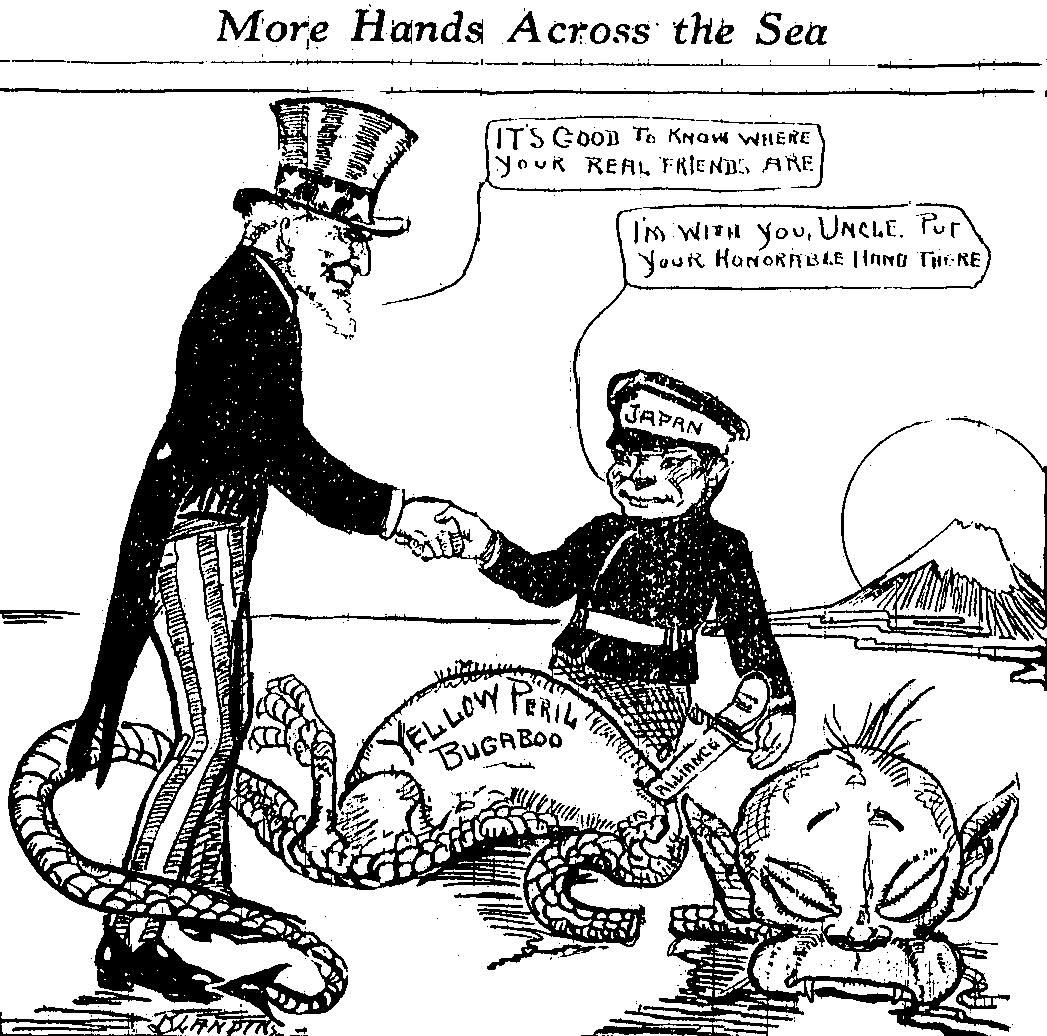 The U.S. and Japan join to slay the “Yellow Peril Bugaboo” to enable them to then fight Germany. The cartoon is packed with offensive stereotypes. You can’t miss the difference in size, for example. Advertiser Apr 6, 1917
Who is patriotic?
January 1918: the Hawaiian Vigilance Corps (HVC) of the national American Defense Society (ADS), including some members of Elks Lodge 616, decided to root out vestiges of “Kaiserism” in Hawaii. HVC promoted positive measures (food conservation) and questionable ones (removal from Iolani Palace display of German kings’ portraits gifted to Kamehameha III 90 years earlier). They gathered evidence of ‘treason’ against individuals HVC deemed Hun sympathizers, and asked teachers to sign pledges that “good American citizenship is more important than scholarship.” HVC forced an end to teaching German in schools. When ADS circulated a petition to make publication in German illegal, 616 Elks who were HVC supporters demanded that they “wait upon the members and secure signatures,” not that the petition be “posted in Club Rooms” for free-will signatures. Refusing to sign under such circumstances would have been nearly impossible and labeled you a “Hun sympathizer.”
In this atmosphere, the slightest question of one’s loyalty ruined a reputation, a business, a career.
Who defines patriotism?
Jan. 24, 1918: In a huge display ad Dixie Doolittle, a serial anonymous writer, attacked the 616 Elks as an unpatriotic “private booze joint.” Doolittle previously had attacked Queen’s Hospital staff, the National Guard members, and the Chamber of Commerce as ‘unpatriotic’.
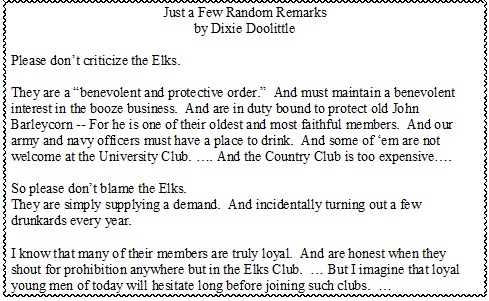
Lodge 616 Elks were the first to fight back. The Advertiser was charged with criminal libel. Doolittle was revealed as Richard H. Trent, powerful president of Trent Trust Co. At the war’s start in Europe, Trent Trust advertised their services to all parties as available to manage your financial affairs while you went off to fight for your home country. Later ads used war themes (“strategic steps in your financial battle”). Trent was named a U.S. Alien Property Custodian to manage assets seized from enemy aliens. He later was entangled in controversy himself. He ended up a director (and personally benefited from) the seized and reorganized German-held Hackfeld Co. (which became American Factors / AmFac and Liberty House).
In the resulting trial, in small town Honolulu, Elk members served on prosecution and defense legal teams and appeared as witness for both sides. With the Advertiser a defendant and rival Star-Bulletin the other major reporting source, an unbiased public record is lacking. News reports show that a trial inspires linguistic pretzeling. Trent insisted the words ‘booze’, and ‘joint’ were not injurious. He dismissed the 616 Elks patriotic efforts (war bonds, Red Cross, etc.) as “little more than their duty.” Though they tried mightily, testifying Elks failed to show the Lodge was harmed by Trent’s Dixie Doolittle story. Elks 616 lost: Trent was found Not Guilty. Elks 616 won: unmasked, Trent was accountable for all his attacks, and the attacks stopped.
What is patriotism? The definition will always cause debate and struggle. It is hard to divide good citizens from the enemy just by looking. When a junk yard dog attacks, you can freeze and hope the dog will bite someone else. Elks 616 members were the first Doolittle target to bite back, to rush the dog, and drive it off.
Could Hawaii citizens again be unfairly labeled as unpatriotic? If you do nothing when the dog bites others, you may be alone when the dog comes for you.
Anita Manning, Historian Elks Lodge 616
References: Advertiser May 6, 1917; 1918 Jan, 30, Feb 2-3, 7, 9-10, 13, 15, 20-21, 24, Apr 3-5, 9-12
Kuykendall. 1928. Hawaii in the World War. Minutes 616 1918 Feb 18, Mar 22, Apr 5, Jul 5
- Advertiser May 13, 1917 Ally’s Warship Visits Port
- Advertiser Sep 23, 1917 Objectionable Film Seized in California
- Wagner-Seavey, S. E. 1980. Effect of World War I on German Community in Hawaii, Hawn Journal of History, 14:109-140.
- Advertiser Jan 24, 1918
- Libel – false and malicious written material exposing to public ridicule or injury. Criminal libel carries the threat of jail time.