


























The Great War – Aloha to Alcohol, Aloha to War
Hawaii’s first alcohol came with British explorer Capt. Cook in 1778. Hawaii’s first moonshiner doubtlessly was lectured by the first prohibitionist soon thereafter! Hawaii was a good-time, wide-open town when the alii first tried to control liquor. The prohibition laws failed each time, but the bootleggers or blind piggers thrived. In Hawaii, distilling liquor illicitly was an equal opportunity transgression. As far back as the 1800s women and men of all races and classes were reported arrested. This was alcohol we hope no modern citizen would drink - booze made from things inedible, even in an end-of-pay-period mystery casserole. Recipes used banana peels, potato peels, husks of pineapples, kiawe beans, tobacco, and animal feed. The concoction was then ‘matured’ in casks used repeatedly without cleaning to speed fermentation.
A survey of Land Commission Award records and traveler reports shows mid-1800s Oahu with a whopping 45 public houses selling liquor! The damaging effects of the well named “rot gut” on sailors and residents of all races led to periodic unsuccessful attempts to control saloons – and to a couple of sailor riots.
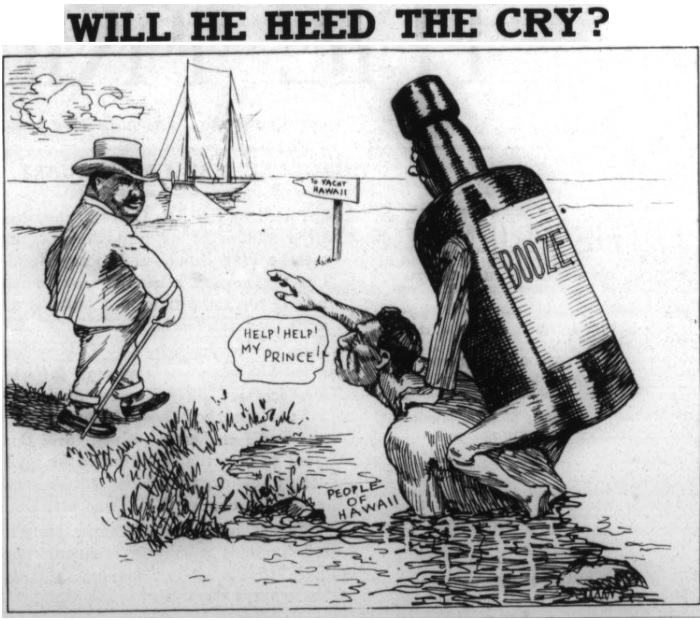 Hawaii’s people call out to Kuhio to save them from Booze (Help! Help! My Prince) The Friend, Feb 1918Lodge 616 Elks were the first to fight back. The Advertiser was charged with criminal libel. Doolittle was revealed as Richard H. Trent, powerful president of Trent Trust Co. At the war’s start in Europe, Trent Trust advertised their services to all parties as available to manage your financial affairs while you went off to fight for your home country. Later ads used war themes (“strategic steps in your financial battle”). Trent was named a U.S. Alien Property Custodian to manage assets seized from enemy aliens. He later was entangled in controversy himself. He ended up a director (and personally benefited from) the seized and reorganized German-held Hackfeld Co. (which became American Factors / AmFac and Liberty House).
In a chilly coincidence setting up future conflict, the Anti-Saloon League of Hawaii was formed in 1901, the same year Elks Lodge 616 opened. News reports drove home the wages of drink: “The cause of most of the stabbing affrays, murders and assaults can be readily traced to liquor...”; “Mr. H…, broken down by drink shot himself leaving debts and a large family”; “demented by long drunkenness, [the man] using a hatchet, nearly kills Ben Foster, cook at Makiki Fire station, and severely wounds 3 other men, 1 of whom shoots down the maniac.”
The movement to save humanity by eradicating liquor grew nationally. Women’s Christian Temperance Union and the Lincoln-Lee Legion joined the Anti-Saloon League of America waging battle against demon rum. Popular songs (“Father dear Father come home with me now”) and tearful stories repeated the message - liquor harmed the poor, women, and children.
In 1915, Hawaii’s Anti-Saloon League hired a full-time “Superintendent” and expanded their campaign. In 1916, the Superintendent moved to Washington, working full-time for federal imposition of prohibition in Hawaii. The League labored long, searching for a legal “gothcha” to allow imposition of prohibition on the Territory by Congressional or Presidential action.
Officially, Prince Jonah Kuhio Kalanianaole, Hawaii’s elected representative in Congress, backed ‘home rule.’ Washington should not dictate laws for the Territory, but allow Hawaii to decide most issues. Facing voter opposition, Territorial legislators repeatedly failed to enact prohibition. Dry advocates were skilled publicists and politicians. They defined the issue as war time Americanism vs. Kaiserism, then pummeled Kuhio with a barrage of criticism no politician could ignore. In a familiar political reality, many voters opposed prohibition, but Kuhio’s financial supporters (and newspapers) wanted it. Cornered, Rep. Kalanianaole became a supporter in Congress for federally imposed prohibition.
After much political pushing and shoving, March 1918, Pres. Woodrow Wilson signed a bill prohibiting liquor in Hawaii, effective August 20, 1918. Hawaii public and private food service operations including Elks 616 went dry. ‘Dries’ were sure relief of “poverty, sickness, hunger, misery, and unhappiness” would result. Unsurprisingly, those results were not forthcoming. The blind piggers began to work even more energetically. Early in 1919, the disillusioned Dries formed the Prohibition Law Enforcement League to “make Hawaii an outpost of American civilization.”
Peace came to the world in November 1918. Immediately the Territory was host to demobilizing soldiers and sailors passing through Hawaii on their way home. Others who’d been stationed in the islands during the war were leaving. Never missing a chance to advertise the islands’ charms, the business community promoted lavish events for transiting troops. Ice cream and lemonade were served; the Hawaiian Band played. Tours of the city, programs by the YMCA and Red Cross chastely hosted by ladies such as Elk wife Mrs. C. T. Wilder gave the men a warm and wonderful memory to relate to friends and family nationwide. To keep them company on the sea voyage to San Fran or Los Angeles, each man was given a fresh pineapple!
An end came to the fighting of World War on the 11th hour of the 11th day of the 11th month of 1918. Hawaii publicly toasted peace with guava juice, ice water, Rycroft’s Arctic Soda or Root Beer. Officially there was no wine, no beer, no Gin & Tonic, no Scotch on the Rocks used in toasts to peace.
Liquor didn’t flow again (legally) in Hawaii until prohibition’s 1933 repeal. At the first hour of the first day of repeal, Elks Lodge 616 immediately applied for a shiny new liquor license as did many other Hawaii establishments. Patriotism and the ‘spirit’ were coming back to the memorial 11 o’clock toast to deceased Lodge members.
Anita Manning, Historian Elks Lodge 616
References:
Kuykendall, R. 1928. Hawaii in the World War.
Wadman, J. W. Mar 1920. The History of Prohibition in Hawaii, Friend. p 62-3
Our water wagon has an inner tank, Paradise of the Pacific. 1919. 32(8):12
- Greer, Richard A. 1994 Grog shops and hotels, Hawn Journal History, 28: 35-67
- Swipes, The Friend, 1918, 31(11): 1
- Greer 1994 Grog shops and hotels, HJH
- Hawaiian almanac & annual for 1901
- Calendar, The Friend, Jun 1902
- Calendar, The Friend, Mar 1903
- The act allowed a referendum vote on the ban at war’s end. National prohibition, Article 18 of the US Constitution, effective Jan 16, 1920, blocked that vote.
- Not yet returned to name Royal Hawaiian Band of monarchy times
- The event was originally commemorated as Armistice Day, now remembered as Veteran’s Day.
- Rycroft had his bottling plant near today’s Rycroft Street, Honolulu.
- Article 21 repealed Article 18 of the U.S. Constitution.