




































Hawaii Marks the Centennial of the Battle of the Somme
By Arthur Tulak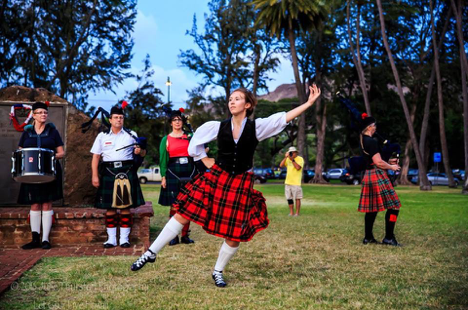 Dancer Fiona Brown performed a dance to “Battle of the Somme,” played by bagpipers and drummers of the Celtic Pipes and Drums of Hawaii, 30 May 2016. Photo courtesy of Julie Thurston Photography www.juliethurstonphotography.comWhile the centennial of America’s participation in WWI does not start until April 2017, the U.S. National Centennial Committee is coordinating and collaborating with the WWI commemoration efforts of other Nations. The WWI Centennial Commission webpage features links to the Centennial commemoration websites of four of our WWI Allies (U.K., Australia, New Zealand, Canada) and our present-day Ally Germany. The Hawaii World War One Centennial Task Force is following the same lead in joining in with commemoration efforts of our international partners, and reaching out to identify events we can commemorate together.
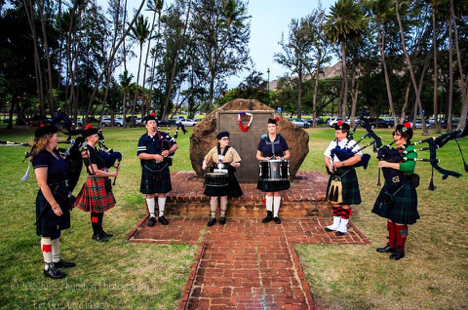 Members of the Celtic Pipes and Drums of Hawaii Commemorate the Centennial of the Battle of the Somme at Hawaii's WWI Memorial, 30 May 2016. Photo courtesy of Julie Thurston Photography www.juliethurstonphotography.comOn July 1, 2016 the Hawaii World War One Centennial Task Force partnered with the members of the Celtic Pipes and Drums of Hawaii to commemorate the 100th anniversary of the beginning of the Battle of the Somme. Dancer Fiona Brown performed a dance to “Battle of the Somme,” played by bagpipers Kim Greely, Theresa Bell, Melanie Brown, Warren Cone, and Kirk Sullivan, and drummers Elizabeth MacNeill and Tracy Burnham. The event was attended by Veterans groups, most notably by the Hawaii American Legion Post #11 (Kau Tom Post – named after two of Hawaii’s WWI Veterans), and the Post #11 Ladies Auxiliary. This is the kind of grassroots commemoration event that the Hawaii World War One Centennial Task Force seeks to facilitate. The very successful event was captured by Hawaii News Now. http://www.hawaiinewsnow.com/clip/12567047/city-discusses-new-alternatives-for-waikiki-natatorium-war-memorial .
The musical composition “Battle of the Somme,” was composed by William Lawrie, a British pipe-major and participant in the battle who died shortly afterwards of illness and injuries sustained in the trenches.
The Battle of the Somme saw the British and French armies pitted against the Imperial German forces from 1 July and 18 November 1916 on both sides of upper reaches of the River Somme in France. It was the largest battle of World War I on the Western Front. In all, more than 1 million soldiers would be killed or wounded. The Somme is considered by many to be the worst battle of all of WWI and one of the bloodiest battles in human history.
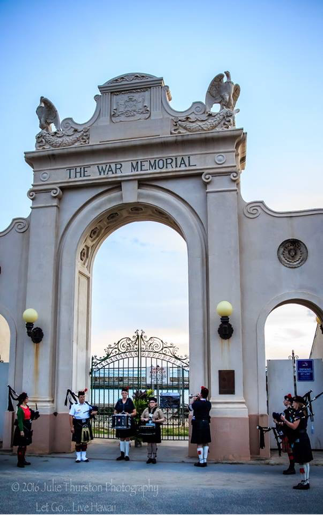 Celtic Pipes and Drums performing at the gates of the Natatorium to commemorate the centennial of the Battle of the Somme, 30 May 2016. Photo courtesy of Julie Thurston Photography, www.juliethurstonphotography.com .This battle has great significance for America’s Pacific Allies, Australia and New Zealand. Australian and New Zealand troops were a vital part of the British forces during the Battle of the Somme. On the first day of this protracted battle, the British Army experienced the greatest losses in its long history, as 20,000 British soldiers were killed and another 40,000 wounded. The overall losses on both sides for the Battle of the Somme was over 1 million men killed. The Australian and New Zealand Army Corps (ANZAC) suffered about 23,000 casualties in the few weeks of fighting around Pozieres. Of the 15,000 members of the New Zealand Division who fought in the Somme campaign, roughly one in seven was killed and four of 10 were wounded. The population of New Zealand at the time was just over a million. More than 100,000 served overseas during World War I, more than 18,000 were killed during the conflict and nearly 50,000 wounded.