


























Doughboy Foundation Home
transition01.jpg
transition03.jpg
Belvedere-Stone-View-3.jpg
Belvedere-to-Sculpture.jpg
Belvedere-Stone-View-1.jpg
Rendering-2.jpg
Rendering-3A.jpg
Rendering-4.jpg
Rendering-5.jpg
Terrace-Planters2.jpg
_P3_3855_250118-Edit_250118.jpg
_P3_3934_250118_250118.jpg
_P3_3941_250118_250118.jpg
previous arrow
next arrow

Memorial

Geolocalisation bp
51600 Sommepy-Tahure
Grand Est
France

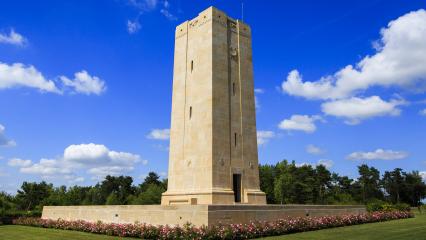
The World War I Sommepy American Monument, dedicated in 1937, commemorates the achievements of the American units that served in combat with the French Fourth Army during the summer and fall of 1918. More than 70,000 Americans served in the region during this time. The architect of the monument is Arthur Loomis Harmon of NY, NY.  

The monument, situated on Blanc Mont Ridge, is surrounded by vestiges of World War I trenches, dugouts and gun emplacements. It is essentially a tower of golden-yellow limestone with an observation tower on top affording an excellent view of the battlefields. Inside the entrance to the monument is an inscription describing American operations in the vicinity. The monument's site was captured by American troops. 

On the front of the monument:  "ERECTED BY THE UNITED STATES OF AMERICA TO COMMEMORATE THE ACHIEVEMENTS OF HER SOLDIERS AND THOSE OF FRANCE WHO FOUGHT IN THE REGION DURING THE WORLD WAR" 

Engraving on the inside of the monument:  "IN EARLY JULY 1918 THE 42D AMERICAN DIVISION ENTERED THE BATTLE LINES WITH THE 13TH AND 170TH FRENCH DIVISIONS NEAR SOUAIN.  THERE IT GALLANTLY ASSISTED IN REPELLING THE LAST GERMAN MAJOR OFFENSIVE OF THE WAR. WHEN THE ALLIES BEGAN THEIR GREAT CONVERGENT OFFENSIVE IN LATE SEPTEMBER, THE 2D AND 36TH AMERICAN DIVISIONS WERE ASSIGNED TO THE FRENCH FOURTH ARMY.  ON OCTOBER 3 THE 2D DIVISION, SUPPORTED ON THE LEFT BY THE 167TH, IN A BRILLIANT OPERATION CAPTURED BLANC MONT RIDGE ON WHICH THIS MONUMENT STANDS.  THE 36TH DIVISION RELIEVED THE 2D ON OCTOBER 10 AND CONTINUED THE ADVANCE NORTHWARD AS FAR AS THE AISNE RIVER.  THREE INFANTRY REGIMENTS OF THE 93D AMERICAN DIVISION, SERVING WITH THE 157TH AND 161ST FRENCH DIVISIONS, ENGAGED IN INTERMITTENT FIGHTING DURING SEPTEMBER AND OCTOBER TAKING PART IN THE CAPTURE OF RIPONT, SECHAULT AND TRIERES FARM."
 

Souilly Town Hall
55220 Souilly
Grand Est
France

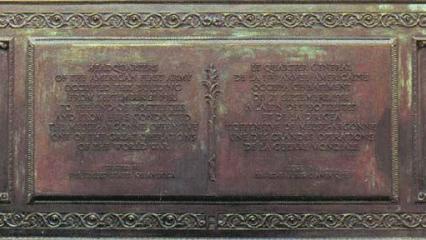
On the outside of the town hall of Souilly, France is a bronze tablet identifying this building as the headquarters of the American First Army towards the end of World War I. Inscribed in French and English is the following:

Headquarters of the American First Army
occupied this building from September 21, 1918
to the end of hostilities, and from here
conducted the Meuse-Argonne Offensive,
one of the greatest operations of the war.

  • Memorial Hunters Club Submission: Memorial Hunter: Robert Shay, PH3, USNR-R, 1964-70
South Bend Water Garden and Pond -- near corner of Memorial Drive and W Cowlitz St
98586 South Bend
WA
USA

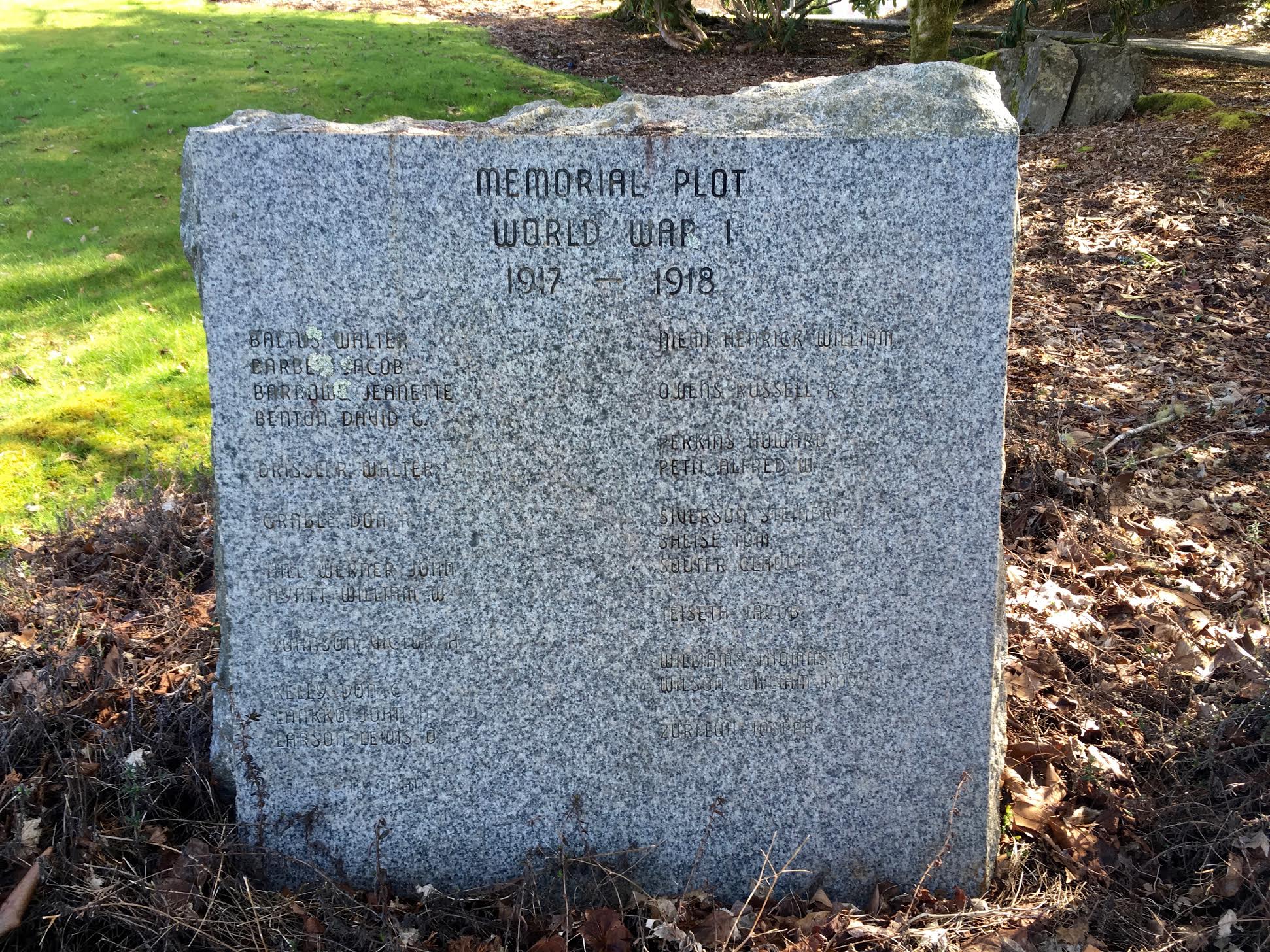
These memorial plots outside the historic Pacific County Courthouse are dedicated to the John C. Fremont Post No. 69 of the Grand Army of the Republic (GAR), a fraternal organization composed of veterans of the US Army, Navy, Marines, and now-defunct Revenue Cutter Service. One memorial honors service in WW1 and the other honors service in WW2.

  • The Boston Arts Commission is the responsible party of these portraits, although they are not actively maintained by them.
  • Bench
65 G Street.
02127 Boston
MA
USA

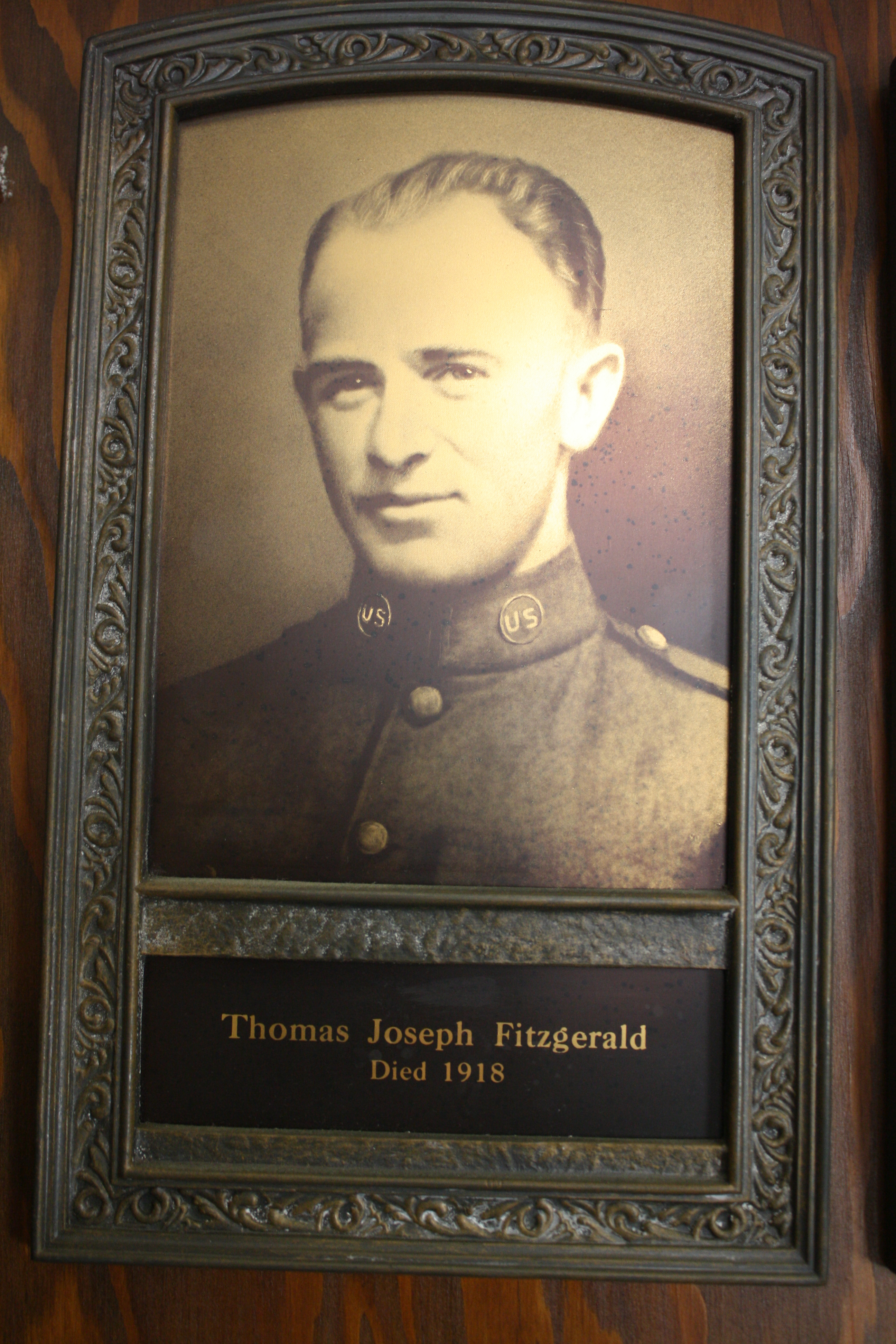
This Memorial consists of 99 gold-tone, etched portraits made from photographs of Boston men that died during World War I. These portraits are located inside the South Boston High School. They were commissioned by Mayor James Curley of Boston and dedicated on Nov. 11, 1932 to a crowd of 2000 people at South Boston High School. Originally, there were over 1100 of these portraits dedicated throughout various Boston public schools. Sadly, the whereabouts of the rest of the other 1000 portraits is unknown since most of the other schools where they resided have since closed. The portraits inside South Boston High School are the only known remaining surviving Memorial portraits to Boston men and women that lost their lives in WWI.
Contact information for responsible party: Anyone that wishes to view these portraits must do so during school hours, and it is advisable that one call the school in advance. Sgt George Machado is the JROTC director at the high school, and an excellent contact. He can be reached at 978-503-4421.
Questions or Additional Information:: 
Photo Credit: Mr. Kevin Conroy
License: Place these works in the public domain 

http://www.excelhigh.org/

  • 1931
  • Memorial Hunters Club Submission: thewanderer
57501 Pierre
SD
USA

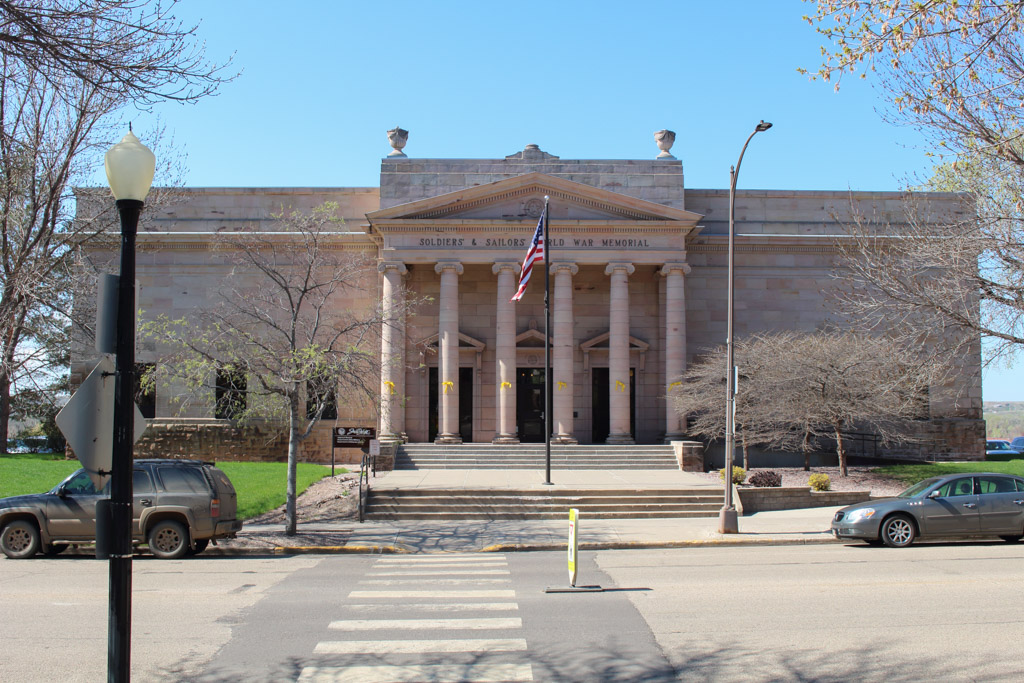
The Soldiers & Sailors World War Memorial is a rare and elegant example of the Neoclassical style of architecture and an illustration of what Americans have done to honor those who served the nation in the military.

The memorial is constructed of steel and has sandstone facing. The front of the building has an impressive entry pediment with dentil molding and six Ionic columns as well as individual pediments over each of the doors. The interior contains a central hallway that opens to the second floor and flanking galleries, which are on both the first and second floors.

The idea for the memorial came after World War I, and the first fund drive to build it was in May 1919. A. N. Walters directed the drive. When this drive failed, the plan lay dormant for 10 years until the Chicago and North Western Railroad Company made a gift of land to the State. The State accepted the land in 1931 with the sole purpose of erecting a Soldiers Memorial Building to house the South Dakota State Historical Society.

In 1930, the State hired the firm of Wilford F. Blatherwick and John C. Hugill to design the memorial building.

The Soldiers and Sailors World War Memorial building currently houses the South Dakota Department of Military and Veterans Affairs. It was also the home of the State Historical Society and Robinson Museum.

  • Dedication Date: August 1923
46795 Wolcottville
IN
USA
  • 1921
  • Dedication Date: 1921
  • South Pasadena's Register of Cultural Heritage Landmarks
  • Norman Foote Marsh
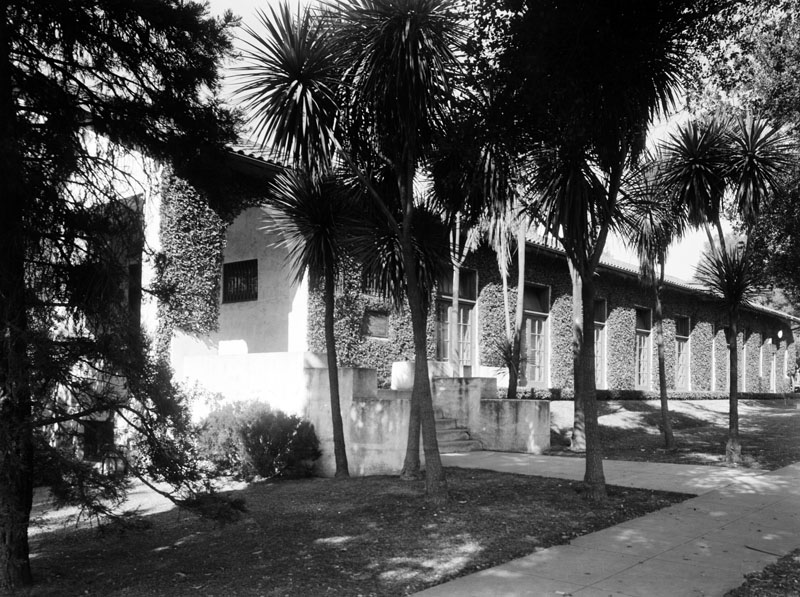
  • South Pasadena's War Memorial Building, designed by Norman Foote Marsh, has served both as a memorial to veterans and as a meeting place for South Pasadena's American Legion Post No. 140. In 1921, Marshal Ferdinand Foch laid the cornerstone of the building; in 1923, General John J. Pershing planted a redwood tree on the grounds. The building is #2 on South Pasadena's Register of Cultural Heritage Landmarks.
  • Memorial building

The two-acre War Memorial Park located on Fair Oaks Avenue provides a site for the two-story 12,000 square feet War Memorial building.

The War Memorial building was built in 1921 and is identified as a city cultural heritage landmark. The building was built on the former Oak Lawn Park with funding from city bonds and donations from the American Legion. The upper floor of the building includes a kitchen and a large multi-purpose room for dancing, meetings, banquets and other activities for groups up to 200 people. The lower consists of smaller rooms, storage and restroom facilities.

In 1921, Marshal Ferdinand Foch laid the cornerstone of the building. In 1923, General John J. Pershing planted a redwood tree on the grounds. The building is #2 on South Pasadena's Register of Cultural Heritage Landmarks. North of the building, grounds are dedicated for a landscaped memorial garden.

  • Memorial Hunters Club Submission: The Wanderer
01772 Common St.
01772 Southborough
MA
USA

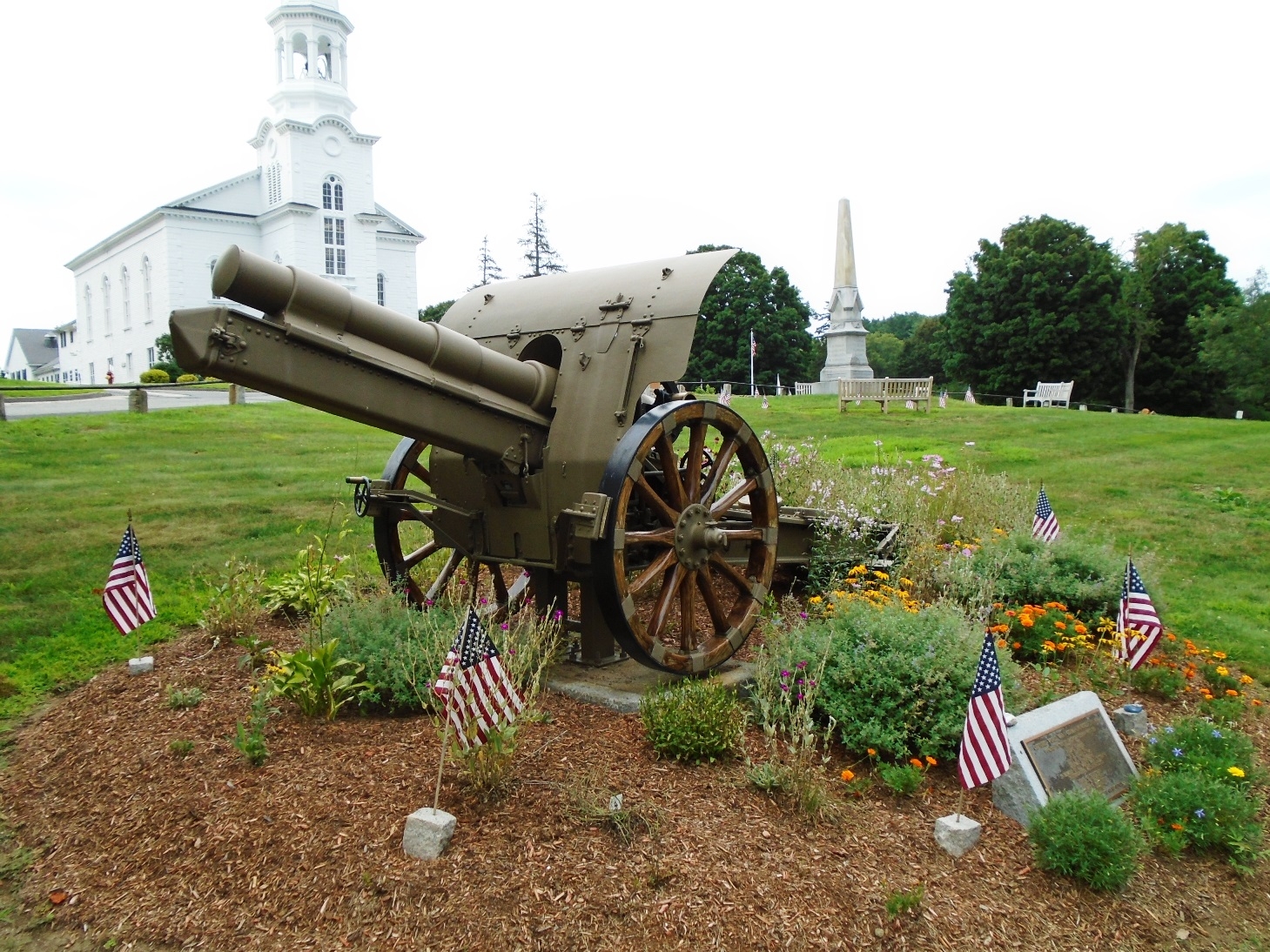
The inscription on this memorial reads:

Captured World War I German Howitzer 155 mm
Donated in 1919 by
American Legion Post 132
Restored 1991
In memory of
All World War I Veterans
Southborough, Massachusetts

  • Memorial Hunters Club Submission: The Wanderer
57 Elm St.
01550 Southbridge
MA
USA

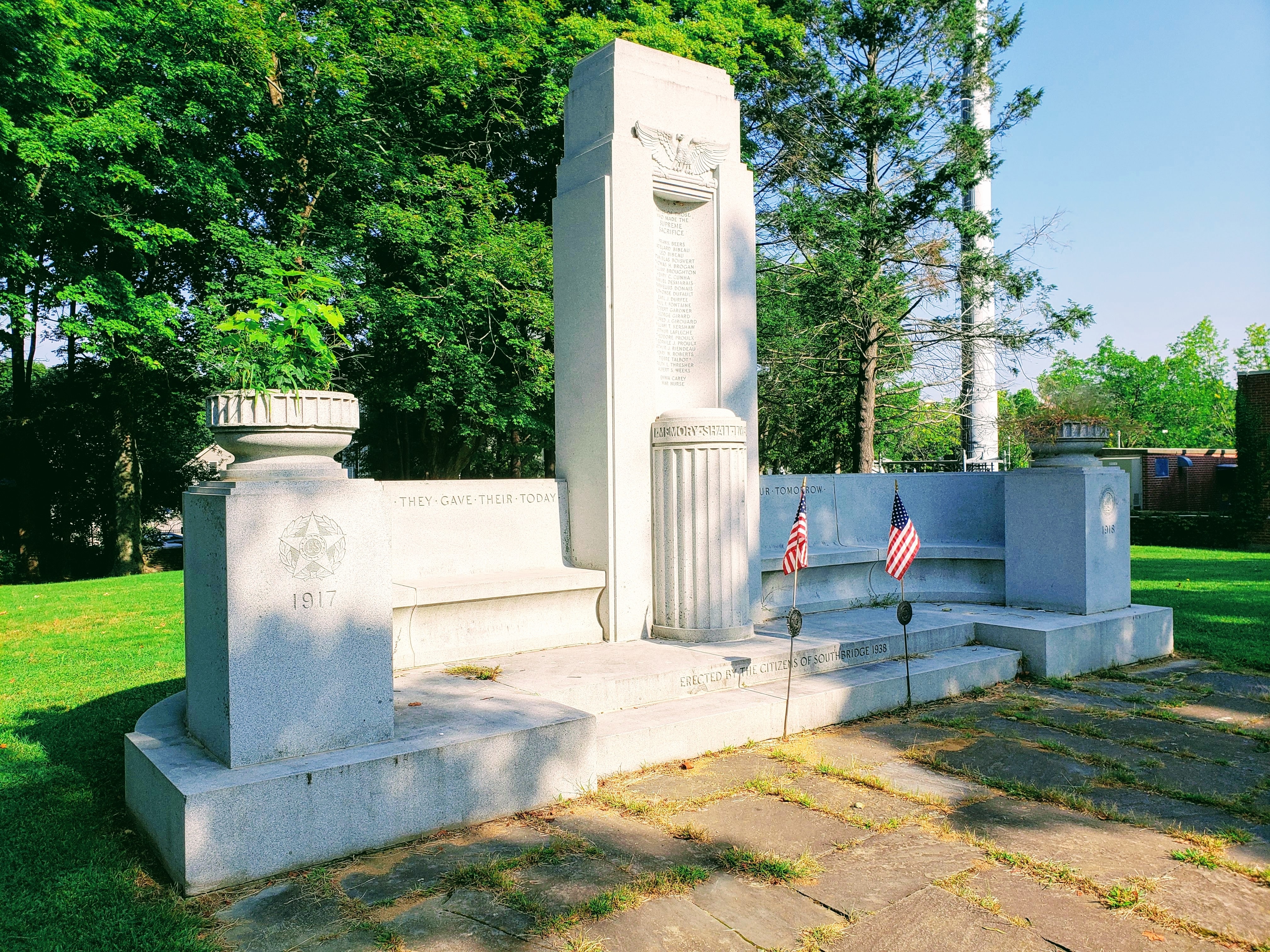
Dedicated on January 1, 1938, the inscription on this memorial reads:

Names of Those
Who Made The
Supreme
Sacrifice

Frank Beers
Adelard Bibeau
Leo Bibeau
Stanislas Boisvert
Thomas H. Brogan
William Broughton
Henry C. Cunha
Samuel Desmaris
Parmelius Donais
Alphonse Dufault
Earl J. Durfee
Paul F. Fontaine
Robert Gardner
George Girard
Wilfred J. Girouard
William T. Kershaw
Arthur Lafleche
Theodore Proulx
Theophile J. Proulx
Henry W. Roberts
Pierre Talbot
Ralph L. Thresher
Albert S. Weeks

Emma Carey
War Nurse

Glory Shall Live Forever

They Gave Their Today For Our Tomorrow

Erected By the Citizens of Southbridge 1938


Southern Ute Veterans Memorial Park
81137 Ignacio
CO
USA

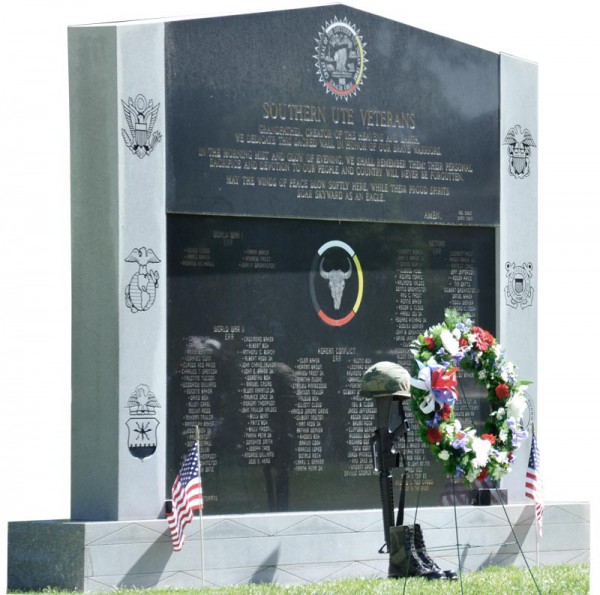
This memorial site is located within the Southern Ute Veterans Memorial Park. There are two particular memorials dedicated to soldiers who served in WWI: the “Tribal Wall” and the “WWI Monument.”

The Tribal Wall stands as the centerpiece of the park. Measuring 12 feet long and 10 feet high, it includes seven pieces of black and gray marble and features six military symbols, three on each side. At the top is the Southern Ute tribal seal with a starburst around it. Beneath the seal is an inscription which reads:

“Southern Ute Veterans

Grandfather creator of the heavens and earth.

We dedicate this sacred wall in honor of our brave warriors.

In the morning mist and glow of evening we shall remember their personal sacrifice and devotion to our people and country will never be forgotten.

May the winds of peace blow softly here while their proud spirits soar skyward as an eagle.

Amen.”

The center features the logo of the Southern Ute Veterans Association: a buffalo skull with the four direction colors around it. Below that are the names of the Korean veterans. On the east side of the logo are the names of Vietnam-era veterans, followed by the names of Persia Gulf-era and present veterans. The entire monument sits on a base measuring 12 feet by 2 feet It was donated by the Gaming Funds of the Southern Ute Indian Tribe and set in 1996. The names on the Tribal Wall are updated every April. The Tribal Wall was created by Family Craft Memorials of Durango.

Southern Ute Veterans Memorial Park
81137 Ignacio
CO
USA

This memorial site is located within the Southern Ute Veterans Memorial Park. There are two particular memorials dedicated to soldiers who served in WWI: the “Tribal Wall” and the “WWI Monument.”

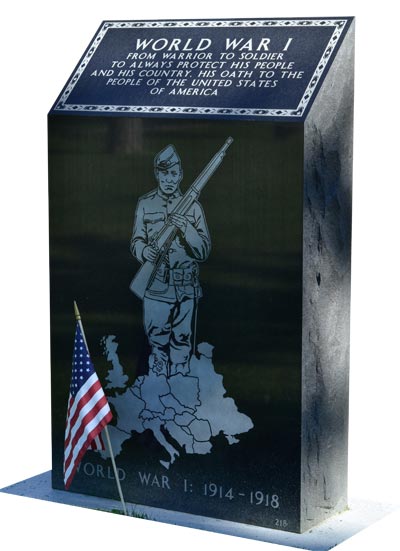
The World War I Memorial Monument is a tablet measuring 3 feet wide by 1 feet deep by 5 feet tall. It honors the veterans who joined the military to help the government of the United States fight in World War I. One of these soldiers was Julius Cloud. He returned to become Chairman of the Southern Ute Tribe; his picture is on the monument.

The text on the monument reads:

“World War I
From warrior to soldier to always protect his people and his country.
His oath to the people of the United States of America.”

  • Materials (select all that apply): Stained Glass
  • 47260009
  • In honor of those who served in the world wr from North Canaan
  • Single figure -- soldier
East Main St. at Granite Ave
North Canaan
CT
USA

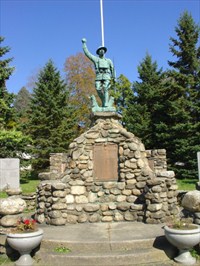
This is a life-sized bronze figure of a World War I Dougboy, designed by E.M Viquesney and dedicated in the summer of 1928 to honor the citizens of North Canaan who served in the War of 1812, the Civl War and World War I.  Plaques on the rear cobblestone wall honor named persons who served in World War II, and the Korean and Vietnam Wars. At one point, the left hand, rifle and bayonet were taken by vandals, but returned and replaced. The bayonet has been replaced several other times. Currently, the rifle sling is missing and the bayonet is partially wired in place, but the Doughboy is otherwise in relatively good condition.  When the original monument was built, there was no statue on it, but it was designed to accept one later. As might be expected, the townspeople soon decided they wanted a statue. But before they were to make a choice at a town meeting, Bethel veteran Bill Glass donned his old WWI uniform, obtained a rifle and climbed the monument to assume the same pose as "The Spirit of the American Doughboy" so everyone could see what it would look like. 

The photograph was furnished by North Canaan historian Fred Hall. Mr. Hall was very helpful in providing information and photos even though he was in his 90s at the time – summer 2001. There is a plaque honoring the late Mr. Hall at the base of the flagpole.

  • 1923
  • Dedication Date: 1923
  • 47260015
  • E. M. Viquesney
  • Single figure -- soldier
Marion Ave and North Davis St
31639 Nashville
GA
USA

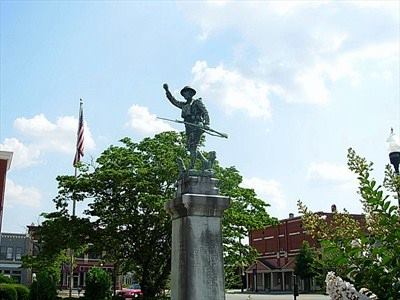
Berrien County commissioned the first Doughboy statue to honor the Berrien County soldiers who died in World War I. Sculpted by Ernest Moore Viquesney, a resident of Americus, Georgia, the statue was praised for its true portrayal of American soldiers during World War I. The statue stands seventeen feet tall, with a ten-foot-tall white Georgia marble base topped with a seven-foot-tall copper statue. The statue’s popularity grew, and Viquesney received orders from across the United States for replicas. There were over 140 statues created that can now be found in 39 states.

As Viquesney prepared to sculpt the first Doughboy statue he closely researched details of the soldiers’ uniforms and weapons to ensure that he created the best representation. He also asked two of his friends to model in their WWI uniforms, so he could study the folds of the uniform in his desired pose. As a result, the sculpture was praised for its demonstration of inspired confidence, showing an American soldier walking into No Man’s Land, holding a grenade in one hand above his head and a Springfield rifle in his other at his side. The soldier is also depicted carrying his mess kit, bedroll, and gas mask.

Berrien County lost more soldiers in proportion to its population in one event– the collision of the British transport ship the HMS Otranto with the HMS Kashmir–than any other county in the United States. The loss of life greatly affected the population of young men of rural Berrien County. The Spirit of the American Doughboy statue in Nashville, Georgia, represents those soldiers and others lost to disease or combat during WWI. The Nashville statue is known to community members as “Our Doughboy.”

The engraving on the front of the tall granite base reads:

ERECTED IN HONOR OF

THOSE WHO WENT FROM

BERRIEN COUNTY

TO SERVE OUR COUNTRY IN THE

WORLD WAR

1917-1919

LEST WE FORGET


An engraving on the Doughboy’s left side reads: 

HONOR ROLL

OTRANTO VICTIMS

(followed by a list of 25 county soldiers lost when the troop ship Otranto sank off the coast of Scotland following an October 1918 collision with the Kashmir during a storm.)

An engraving on the Doughboy’s right side reads:

HONOR ROLL

DIED FROM OTHER CAUSES

(followed by a list of 25 names)

  • Width: 3'
  • Depth: 4'
  • Other Measurements: Base: approx. H. 5 ft. 3 in. x Diam. 9 1/2 ft.
  • Dedication Date: November 11, 1927
  • 47260010
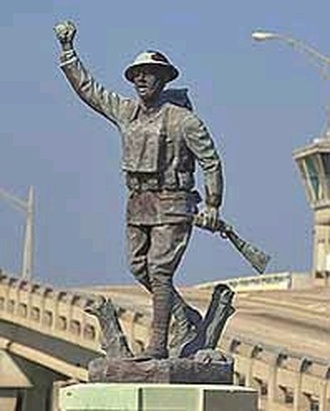
  • Figure of a World War I infantryman advancing through the stumps and barbed wire of No Man's Land. He holds a rifle in his proper left hand and a grenade in his upraised proper right hand.
  • Monument to World War I soldiers. In 1991, T. Perry Wesley reported base media as stone; in 1994, Save Outdoor Sculpture survey reported base media as concrete.
  • E. M. Viquesney
  • Clearwater Memorial Causeway Park, Clearwater, Florida
  • Single figure -- soldier
Memorial Causeway Bridge
33767 Clearwater
FL
USA

This bronze sculpture by E.M. Viquesney depicts a life-sized World War I infantryman advancing through the stumps and barbed wire on No Man's Land, holding a rifle in his left hand and a grenade in his upraised right hand.  A new plaque on the pedestal of the Doughboy reads:

Spirit of the American Doughboy
Artist: E.M. Viquesney (1876 - 1946)
Copyrighted in 1920  
Originally dedicated on November 11, 1927
at the opening ceremony
of the Memorial Causeway Bridge.
Donated by the American Legion Post 7
in memory of 38 local service men
who died in World War I.  Rededicated November 10, 2006
following the completion of the
new Memorial Causeway Bridge in 2005,
the statue was restored and reinstalled.
Considered Viquesney's greatest work of art,
132 original "Doughboys" are still in existence.  

A plaque with similar wording is mounted on the pedestal of the Sailor.  Although the plaque denotes 132 Doughboys, more have been found since.

  • Dedication Date: November 11, 1927
  • Figure of a World War I infantryman advancing through the stumps and barbed wire of No Man's Land. He holds a grenade in his upraised proper right hand. He used to hold a rifle in his proper left hand, but both the rifle and proper left hand are now missing.
  • One of four World War I figures located at the four corners of Memorial Park Bridge. The figures were originally mounted on the old Memorial Bridge completed in 1927. They were reinstalled at each end of the new bridge when it was completed in December 1976. The four World War I figures represent the three branches of the military service of that day; this figure represents the Doughboys (foot soldiers). IAS files contain copy of dedication program from the old bridge, transcription of article from Town & Country (published by Palatka Daily News) 3 (Aug. 1964), and newspaper articles from Palatka Daily News, Sept. 11, 1979 and Jan. 16, 1991.
  • E. M. Viquesney
  • Administered by City of Palatka, 201 North 2nd Street, Palatka, Florida 32177 Located Memorial Park Bridge, Northwest side, Palatka, Florida
  • Single figure -- soldier
N. 1st Street and Reid Street
32177 Palatka
FL
USA
1005 S. Hancock
80903 Colorado Springs
CO
USA

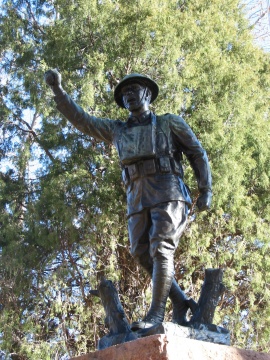
This is an E.M. Viquesney "Spirit of the American Doughboy" depicting a World War I infantryman advancing through the stumps and barbed wire of No Man's Land, carrying a grenade in his raised right hand. The left hand formerly held a rifle.  It was dedicated in 1922 by The Cemetery Aid Association.

  • Memorial Hunters Club Submission: Christopher Nay
8 North Main Street
26416 Philippi
WV
USA

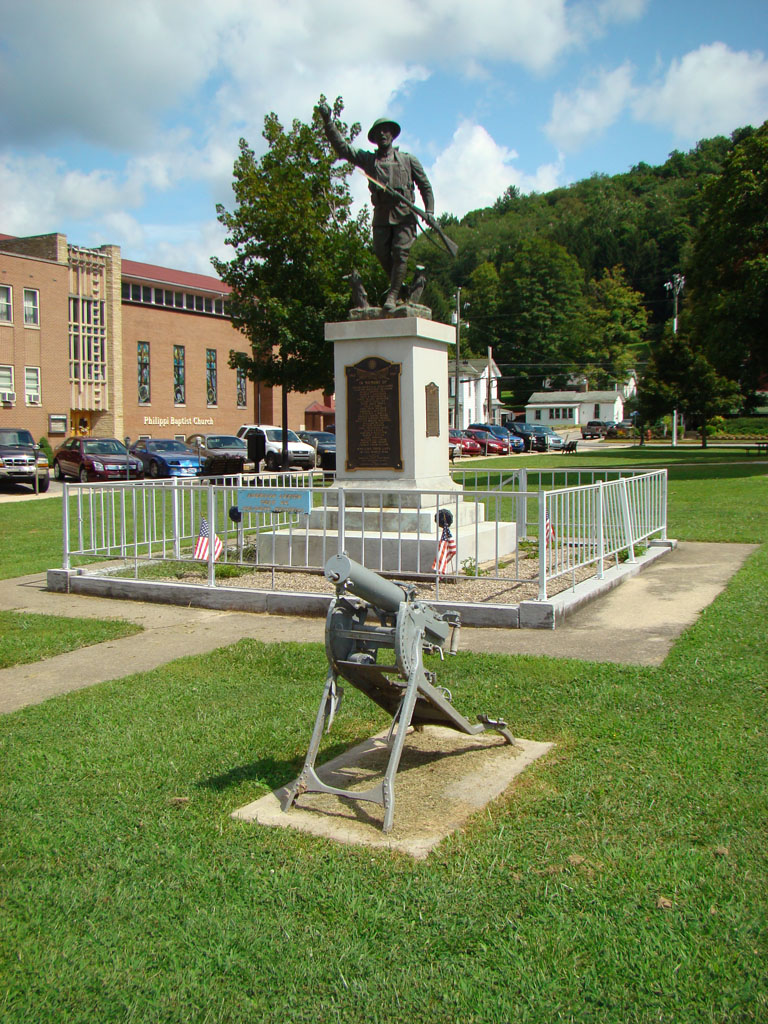
This E.M. Viquesney Spirit of the American Doughboy is located in front of the Historic Barbour County Courthouse. It is in excellent condition and has the original barbed wire still in place. It was dedicated November 11, 1923 to honor the men of Barbour County who died in World War I. It was erected by Barbour County Post No. 44 of the American Legion and the Citizens of Barbour County WV. Later plaques were added to honor the local citizens who died in the Korean and Vietnam Wars.