































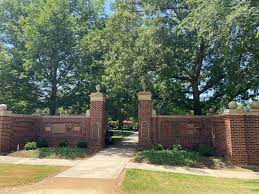
Memorial Gate was built in 1921, to honor Hampden-Sydney alumni who gave their lives for their country in the Great War. Queen Mary of England sent rosebushes to be planted behind it; they survived until the 1960s. Since the 1970s, the gate has become a memorial to alumni who had died in all the country's wars. It now includes plaques for fallen heroes of the Revolution, the War of 1812, the American Civil War, the Spanish-American War, World War I, World War II, the Korean War, the Vietnam Conflict, and September 11, 2001.
Memorial
- Details
- Dedication Date: June 11, 1919
- Bench
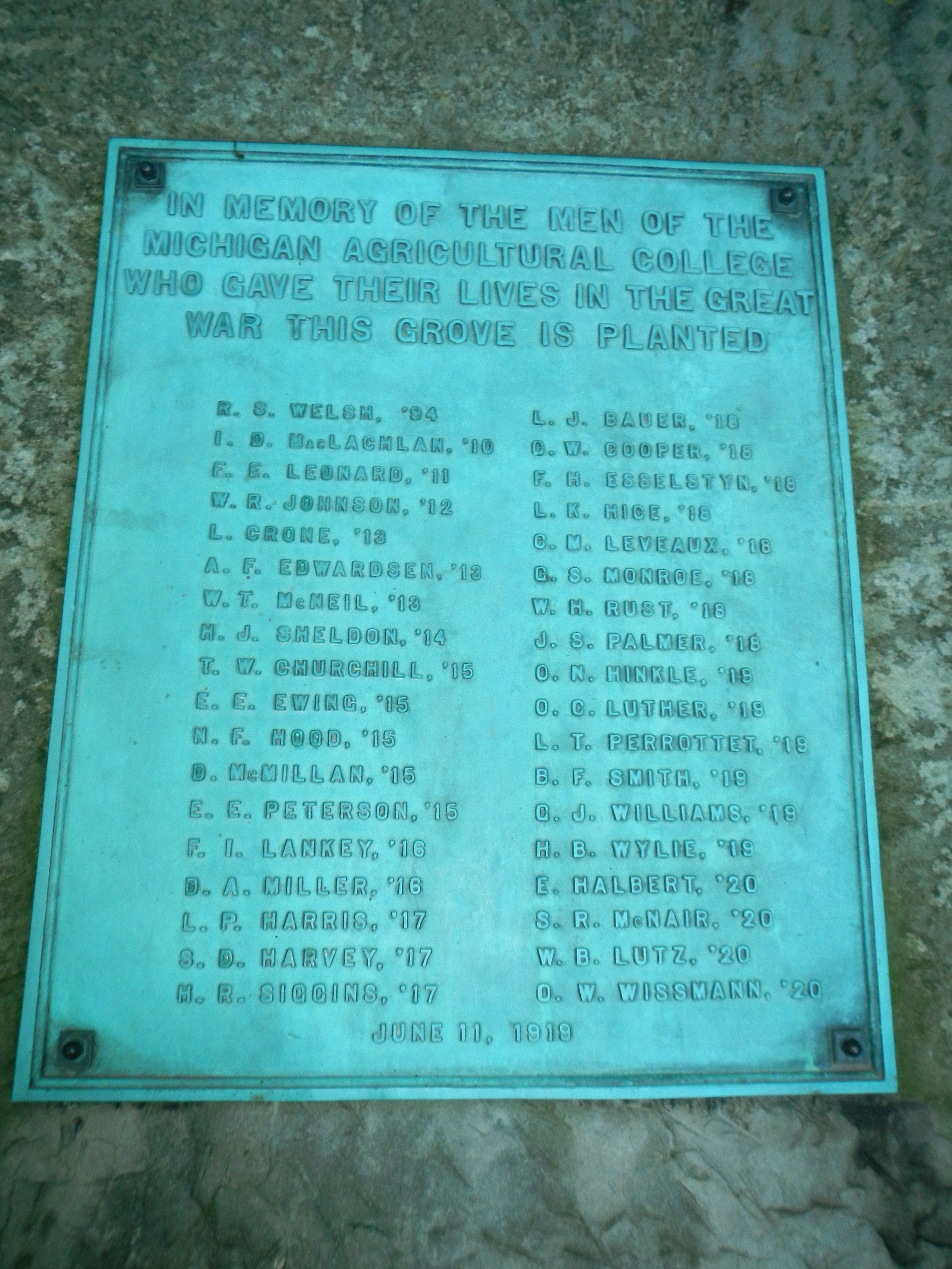
Memorial Grove of the Great War
The West Circle neighborhood is known for its beautiful Collegiate Gothic dorms, with beautifully sculpted gardens and peaceful stands of trees. One grove of trees though holds exceptional significance in the legacy of our university. Just east of Williams Hall is a grove of thirty-three oak trees overlooking Michigan Avenue. Few students notice the nondescript fieldstone slab nestled within the small park space.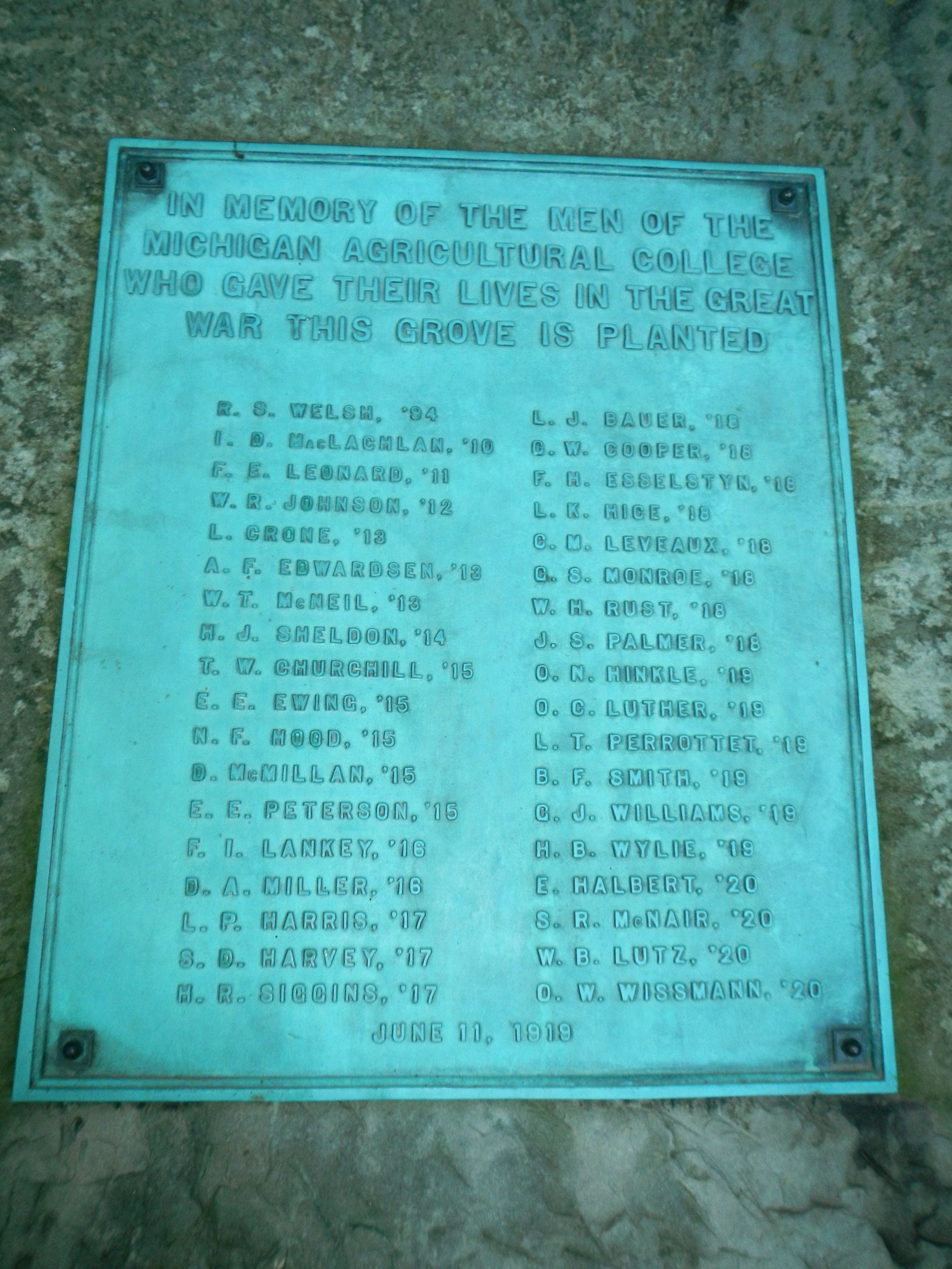
A brass plaque explains that this grove of trees is a memorial to the thirty-three students and graduates of the college who gave their lives in World War One. Back then our school was still the Michigan Agricultural College (M.A.C.), and contained few of the buildings that now dominate our campus. Next year will mark the hundredth anniversary of the start of what would become known as the Great War. The conflict exploded the world into the modern era, where industrialized warfare clashed with outdated military doctrine creating tragic consequences. In all some 8,500,000 soldiers would die in the conflict that pitted the Allied Powers (France, Russia, America, and the United Kingdom) against the might of the Central Powers (Germany, Austria-Hungary, and the Ottoman Empire).
America would not enter the war until 1917, when German U-boat attacks on commercial vessels would compel the nation to declare war on the Central Powers. America would mobilize over four million men to fight in Europe as part of the American Expeditionary Force. American soldiers would play a pivotal role in the battles of the Second Battle of the Marne and Meuse-Argonne Offensive. Ultimately America’s contribution would play a key part in bringing about the end of the war, but with a cost of 116,516 soldiers killed in action and a further 204,000 wounded.
Among the men who would never return home were students and alumni of the Michigan Agricultural College. In all thirty-three students and graduates of the college would give their lives in service to their country. Ten of the young men would never live to see their graduation from M.A.C. Their sacrifice would not be forgotten though.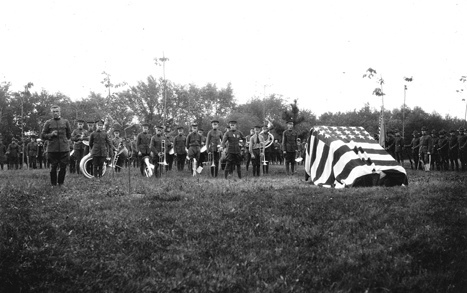
The college community decided a memorial grove overlooking the Red Cedar River and Michigan Avenue would be a fitting way to pay respect for their fallen brothers. The planning for the memorial was headed by the Forestry Department lead by faculty chair Professor Alfred K. Chittenden (for whom Chittenden Hall is named after). An oak tree would be planted for each of the soldiers and a large fieldstone would bear a plaque listing the soldier’s names.
The dedication took place on the college’s Commencement Day of 1919. Following a parade and a review of the college’s R.O.T.C. unit, Lieutenant Colonel A. H. Gansser of the 125th infantry formally dedicated the memorial grove. Gansser was well known in Michigan for the published letters he would send from the front, and was well regarded as a skilled speaker and critical analyst of politics and the war. The day was especially meaningful to Gansser, as many of the memorialized men were fellow members of the 125th infantry.
The thirty-three oak trees still shade the sidewalks west of Wilson Hall and the memorial is right off the sidewalk following Beal Street. This quite corner of MSU’s campus may remain largely unknown to the student body, but it remains a somber and beautiful reminder to the sacrifices made by our fellow Spartans.
- Details
- Single figure -- soldier
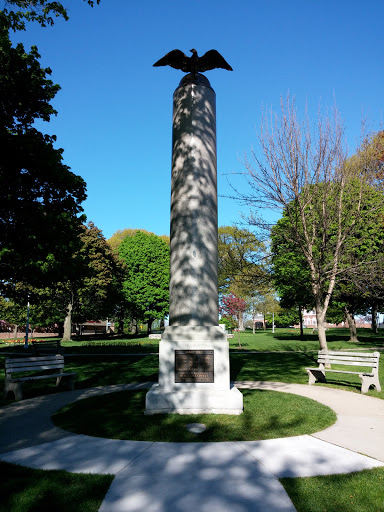
Memorial Honor Roll World War I
A bronze eagle with wings spread sits atop a 24 foot tall column of polished granite. Beneath is a three section base of unpolished granite with a plaque bearing the names of the 52 Ottawa County men who fought in WW1.
- Details
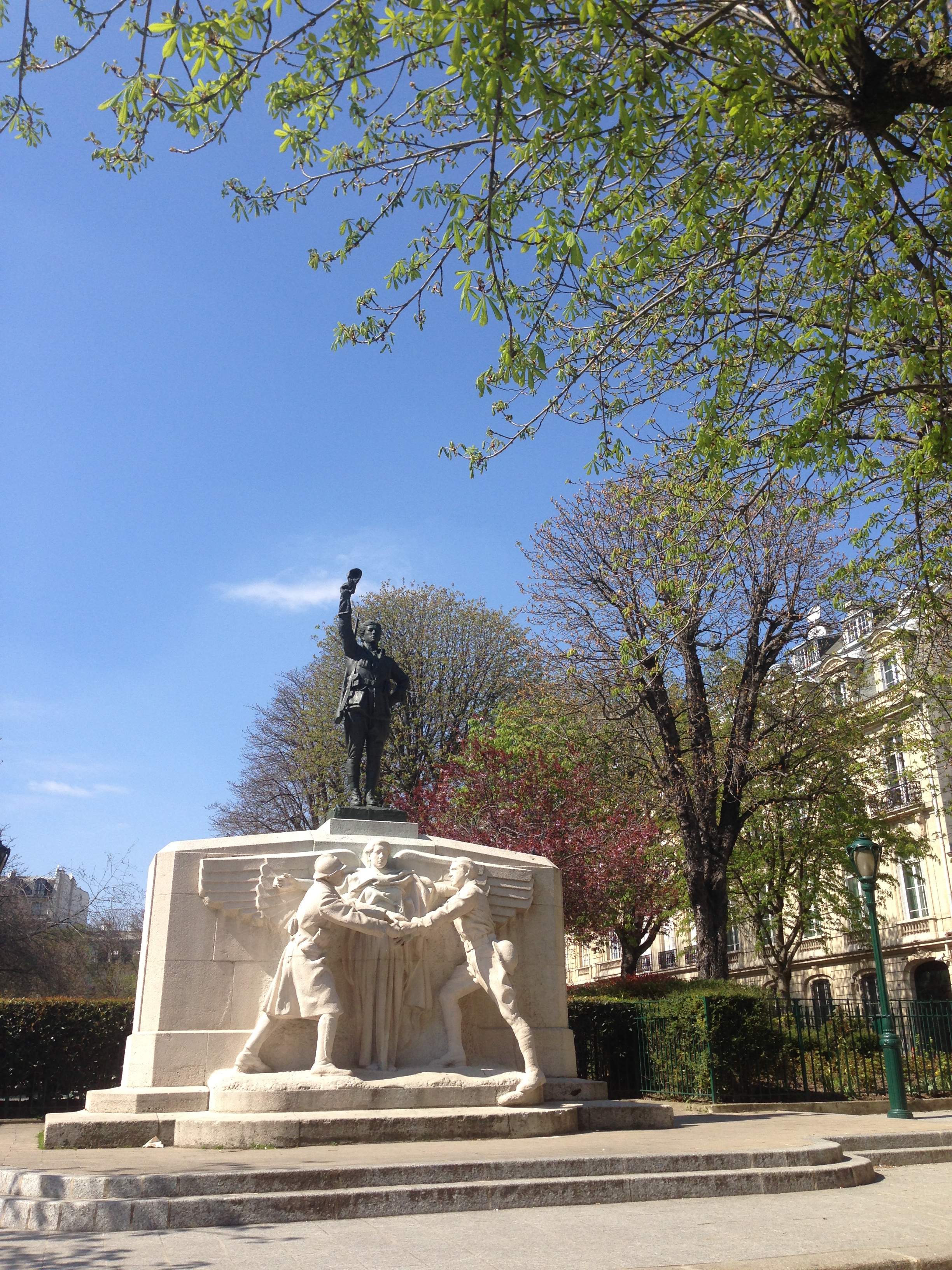
On 4 July 1923, the President of the French Council of State, Raymond Poincaré, dedicated this monument in the Place des États-Unis to the Americans who had volunteered to fight in World War I in the service of France. The monument, in the form of a bronze statue on a plinth, executed by Jean Boucher (1870–1939), was financed through a public subscription. Boucher used a photograph of the soldier and poet, Alan Seeger, as his inspiration, and Seeger's name can be found, among those of twenty-three others who had fallen in the ranks of the French Foreign Legion, on the back of the plinth. Also, on either side of the base of the statue, are two excerpts from Seeger's "Ode in Memory of the American Volunteers Fallen for France", a poem written shortly before his death on 4 July 1916. Seeger intended that his words should be read in Paris on 30 May of that year, at an observance of the American holiday, Decoration Day (later known as Memorial Day):
Yet sought they neither recompense nor praise,
Nor to be mentioned in another breath,
Than their blue coated comrades whose great days
It was their pride to share—ay, share even to the death! [...]
Hail, brothers, and farewell; you are twice blest, brave hearts.
Double your glory is who perished thus,
For you have died for France and vindicated us
- Details
- 1926
- Memorial Hunters Club Submission: thewanderer
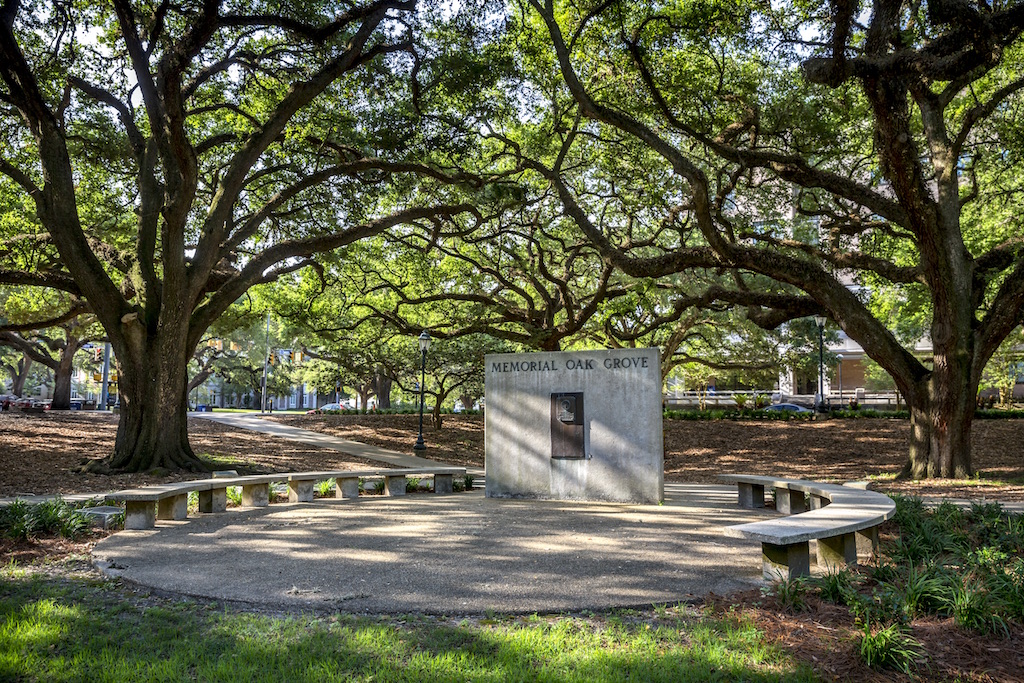
The Memorial Oak Grove was dedicated on March 12, 1926 to honor the 30 LSU men who lost their lives in the war. Thirty-one live oak trees were planted, one for each of the fallen and one for an unknown soldier, as a living reminder of their sacrifice and service to the country.
Plans have been in the works to improve the landscaping and to provide an educational component to tell the story of those who are memorialized, the grove itself, and the war.
- Details
- Dedication Date: 1924
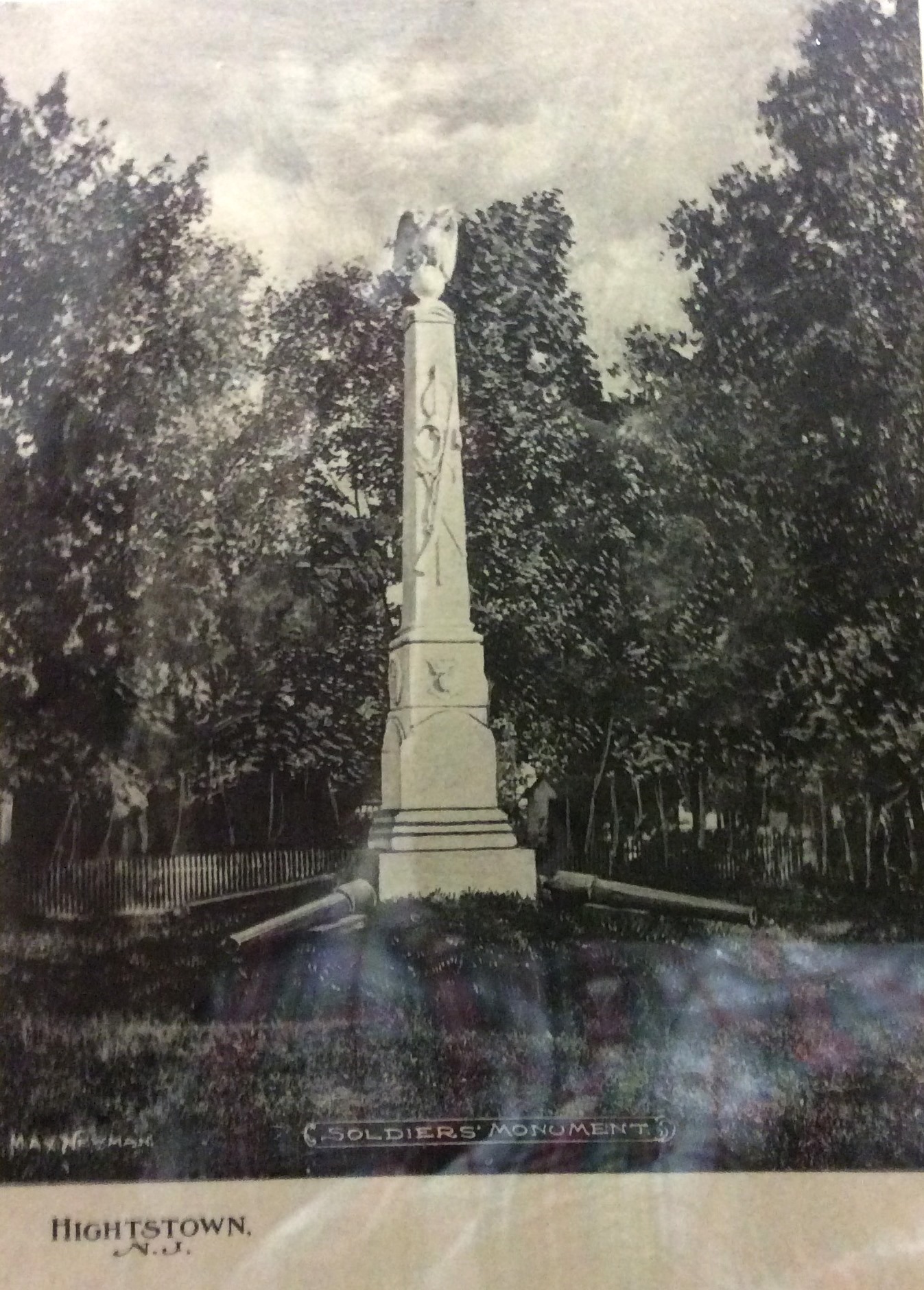
The lakeside Hightstown Memorial Park was dedicated on Armistice Day 1924, the result of a community fund drive to raise $25,000 to honor its veterans, following a $30,000 gift of the land by six local donors. A concrete dam, stone retaining walls, a walkway across the dam, a boat landing with steps & grading & landscaping were created.
Situated near the boat landing, a granite obelisk was placed by the American Legion Post #148 & the VFW Post 5700. The monument is dedicated to all who served in World War I.
Narrative adapted from "Reflections from the Shrine" by John W. Orr, Jr., 1998.
Vintage photo courtesy of: Rutgers University Libraries, Special Collections and University Archives
- Details
- Memorial Hunters Club Submission: Memorial Hunter: Weydan Flax
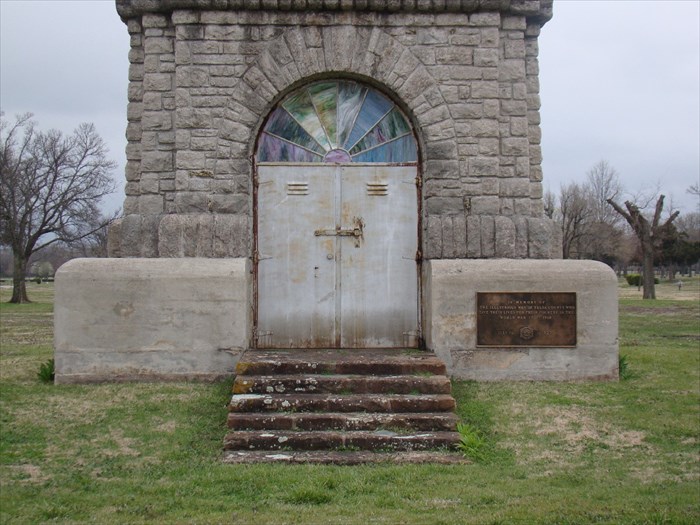
- Details
- Dedication Date: 1925
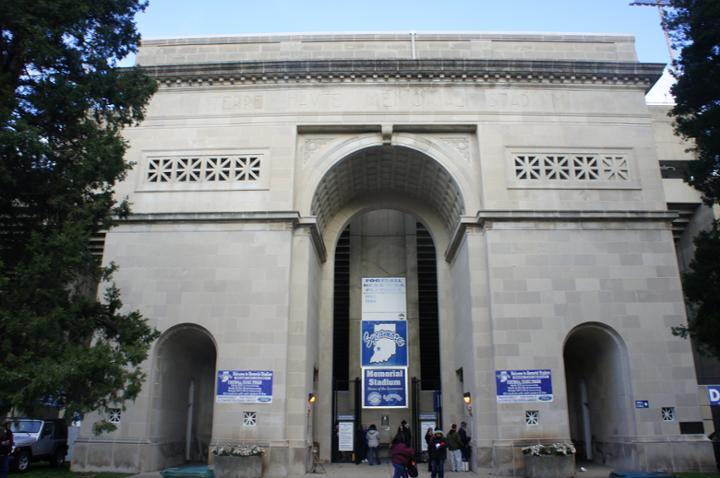
Now home to Indiana State University football games, the foundation for the stadium began after World War I, when city planners conceived of a stadium as a memorial to veterans. The entrance is modeled after the Arc de Triomphe in Paris, France. Construction was completed in 1925, and is located at 3300 Wabash Ave, Terre Haute, IN 47803.
Information submitted by: Mary Creamer, Fort Harrison Chapter DAR
Information submitted by: Mary Creamer, Fort Harrison Chapter DAR
- Details
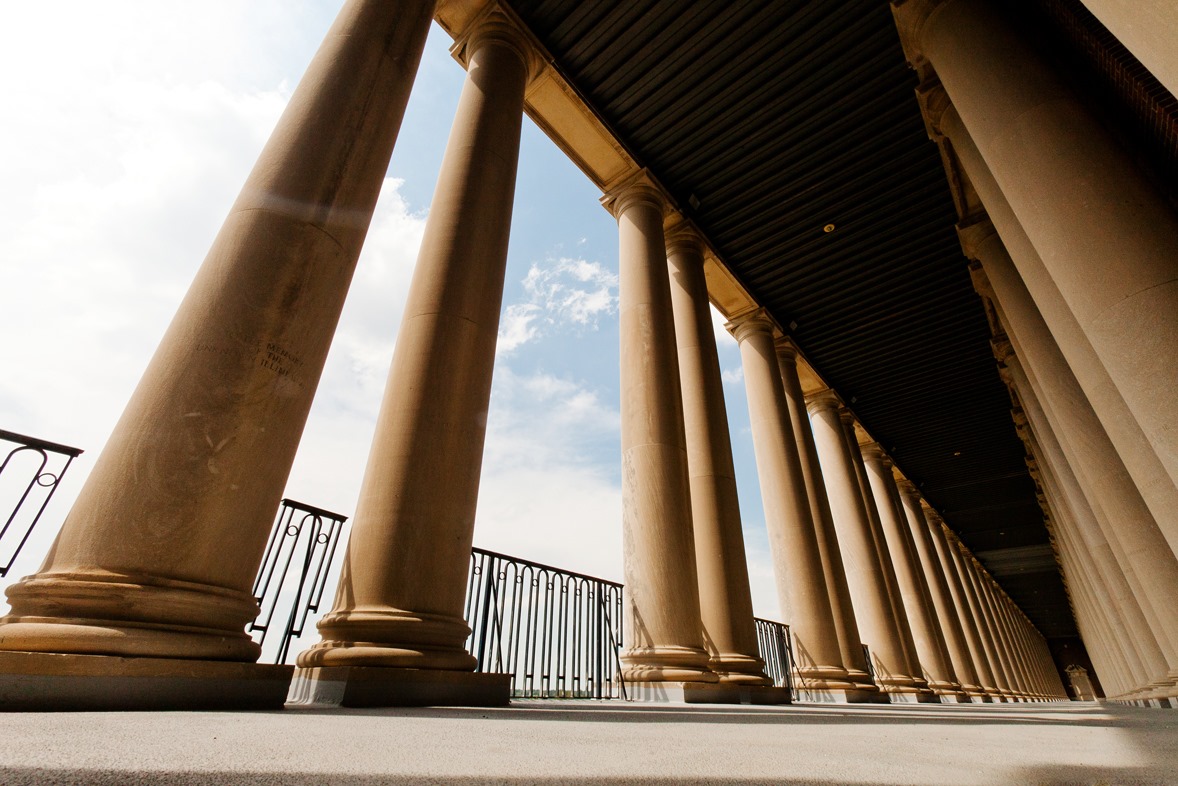
Memorial Stadium was built in 1923 to honor University of Illinois men and women who gave their lives serving in World War I. There are a total of 200 columns on the east and west sides of the stadium. 183 columns display one name of a University of Illinois student that lost their lives in the first war (182 men and 1 woman). In addition, carved stone panels were placed on the facility's exterior to commemorate the war and to honor athletic achievements. In 2002, the stadium dedication was extended to those who died in World War II. The stadium was officially dedicated on October 18, 1924, on which the university football team played a homecoming game against the University of Michigan. On way to a 39–14 Illini victory, Red Grange scored five touchdowns in one of the greatest single-game performances in football history.
- Details
- Plaque or tablet
Left Side of Statue:
The soldiers and sailors from Calvert County who lost their lives in the World War
George Armiger
Solomon Barnes
Wm T Dorsey
Arick L Lore
William Marquess
Thoms J Osborne
Reuben P Pitcher
Murray A Sherbert
Irving R Stallings
Harry Sunderland
Charles W. Tongue
Right Side of Statue:
Three hundred and fifteen patriots from the county answered the call for liberty and humanity
Alonza Brown
James Butler
Wallace Curtis
John Cross
Thornton Gormon
Joseph S. Jones
Benjamin Kent
- Details
- Dedication Date: August 2, 1920
- W.A. Sharp
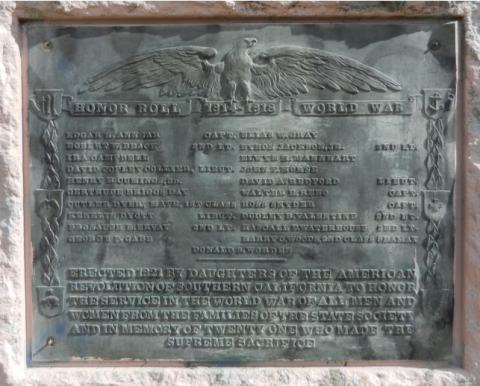
Memorial Tablet at Victory Memorial Grove
100 Cities / 100 Memorials
 Victory Memorial Grove, a 5-acre park within Elysian Park in Los Angeles, was established in 1920 as a World War I memorial with the planting of trees and a field of Flanders Poppies. It contains a bronze memorial tablet set into a 2-ton granite boulder, dedicated in 1921 to honor the 22 individuals who gave their lives during the Great War. The monument was restored and rededicated in June 2017.
- Details
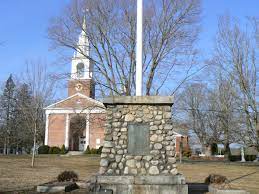
The Memorial to Five Wars, dedicated in 1922, is located in the center of Lebanon Green, in front of the Town Hall and across the street from the First Congregational Church. It consists of a cobblestone pedestal supporting a tall flagpole. A bronze plaque is recessed into each face of the pedestal. Three of the four 30" x 20" bronze plaques carry lettering relating to the Revolutionary War, the War of 1812, the Civil War, the Spanish-American War, and World War I. The lettering is in thoughtful narrative form, quite different from the standard memorial language often found on such plaques. The fourth plaque is a bas-relief by Bruce Wilder Saville depicting a composite of three soldiers, one from the Revolutionary War, one from the Civil War, and one from World War I, and a flag. The figure to the group's far right is from the Revolutionary War; he carries a musket on his shoulder. The central figure is a doughboy from World War I; he uses both hands to grasp his rifle. The third man is in Civil War uniform; he carries the colors. The flag opens out above the three soldiers; its staff continues to the group's left on the diagonal to the upper left corner of the plaque, distorting the right angle of the corner as the tip of the pole continues upward. A bronze plaque on a stone slab at the northeast corner of the Green lists names of those from Lebanon who served in World War I and World War II.
- Details
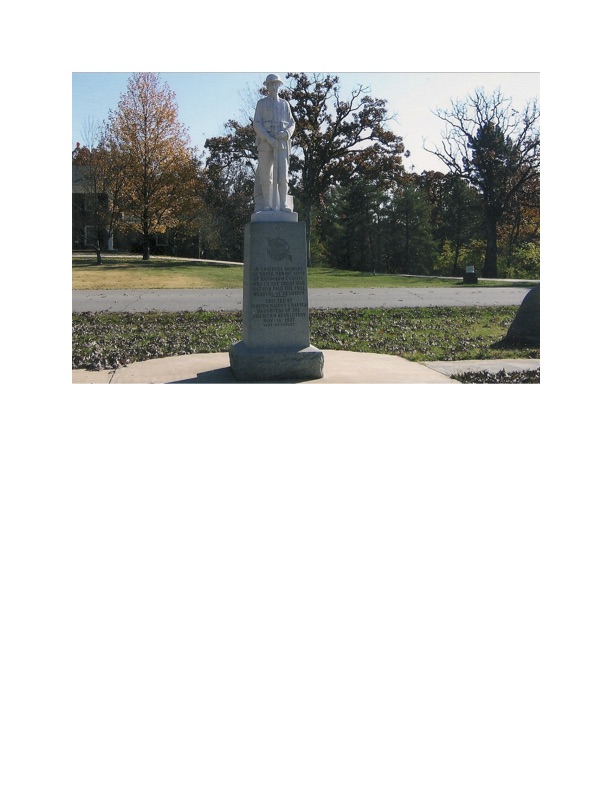
This is a white marble statue of a uniformed WWI soldier, standing and holding the barrel of his rifle with both hands. He wears a helmet and boots, and behind his left leg is a small rock-like formation. Beneath it all is a tall square granite base.
It was dedicated by the Tabitha Walton Chapter of the D.A.R. on November 11, 1927 in Tannehill Park to honor the WWI dead of Randolph County. When a post office was to be built there in 1966, the statue was relocated to its present site and rededicated on May 11 of that year.
- Details
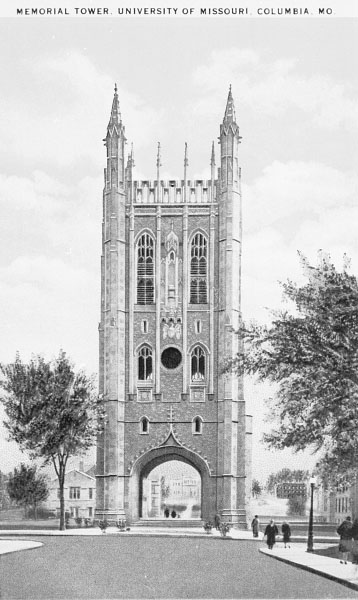
The Memorial Tower, now the Memorial Student Union, was conceived as a way to honor the students and alumni "who, during the Great War, just past, paid the full measure of devotion..."
The 142 foot tower is at the center of a 330 foot long building and was intended to provide a place of assembly, rest and recreation for students. The base of the tower is pierced by Gothic archways and a vaulted passage 32 feet wide. The tower was built of local stone. On the side walls of the passageway are the names of Missouri's sons whose memory the Memorial Union perpetuates. The building cost $500,000. The cornerstone was laid on November 30, 1922. Though the north wing of the building wasn't complete until 1952 and the South wing was completed in 1963.
Originally 117 names of soldiers from the Great War were carved into the tower. Later a plaque was added with the names of 338 MU men who lost their lives in WWII inscribed on it.
In a tradition that dates back to a time when most men wore hats, whenever one walks beneath the archway, they are to tip their hat as a sign of respect to their deceased brothers; in addition, every student speaks at a whisper under the archway.
- Details
- 1923
- 1923
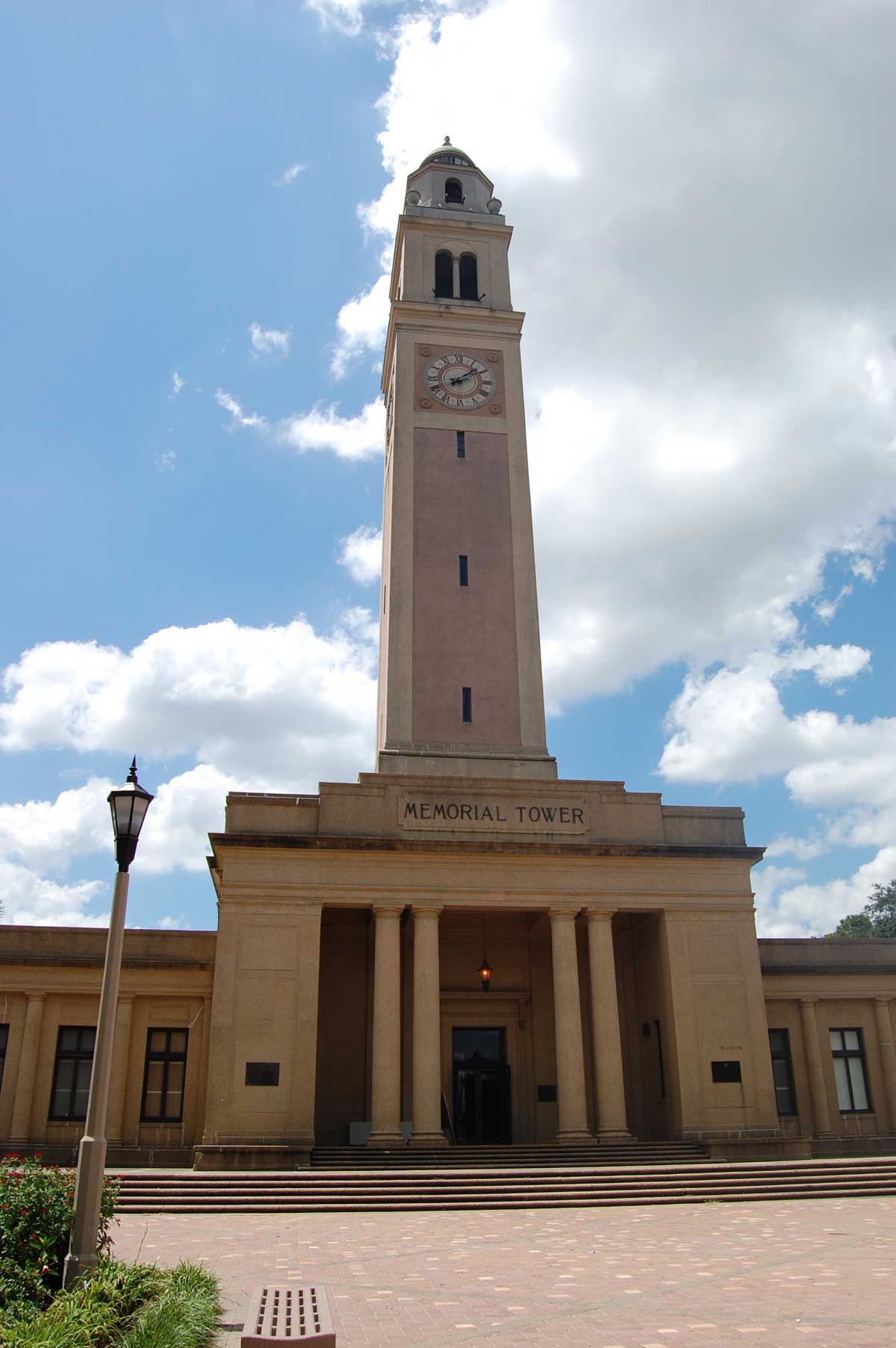
Memorial Tower, or the Campanile as it is sometimes called, is a 175-foot clock tower in the center of Louisiana State University's campus in Baton Rouge, Louisiana. Erected in 1923 and officially dedicated in 1926, it stands as a memorial to Louisianans who died in World War I.
Upon entering the tower, visitors find the rotunda of bronze plaques bearing the names of 1,447 fallen Louisiana World War I soldiers to whom the tower is dedicated. The inside of the tower is also home to a military museum.
- Details
- Memorial Hunters Club Submission: thewanderer
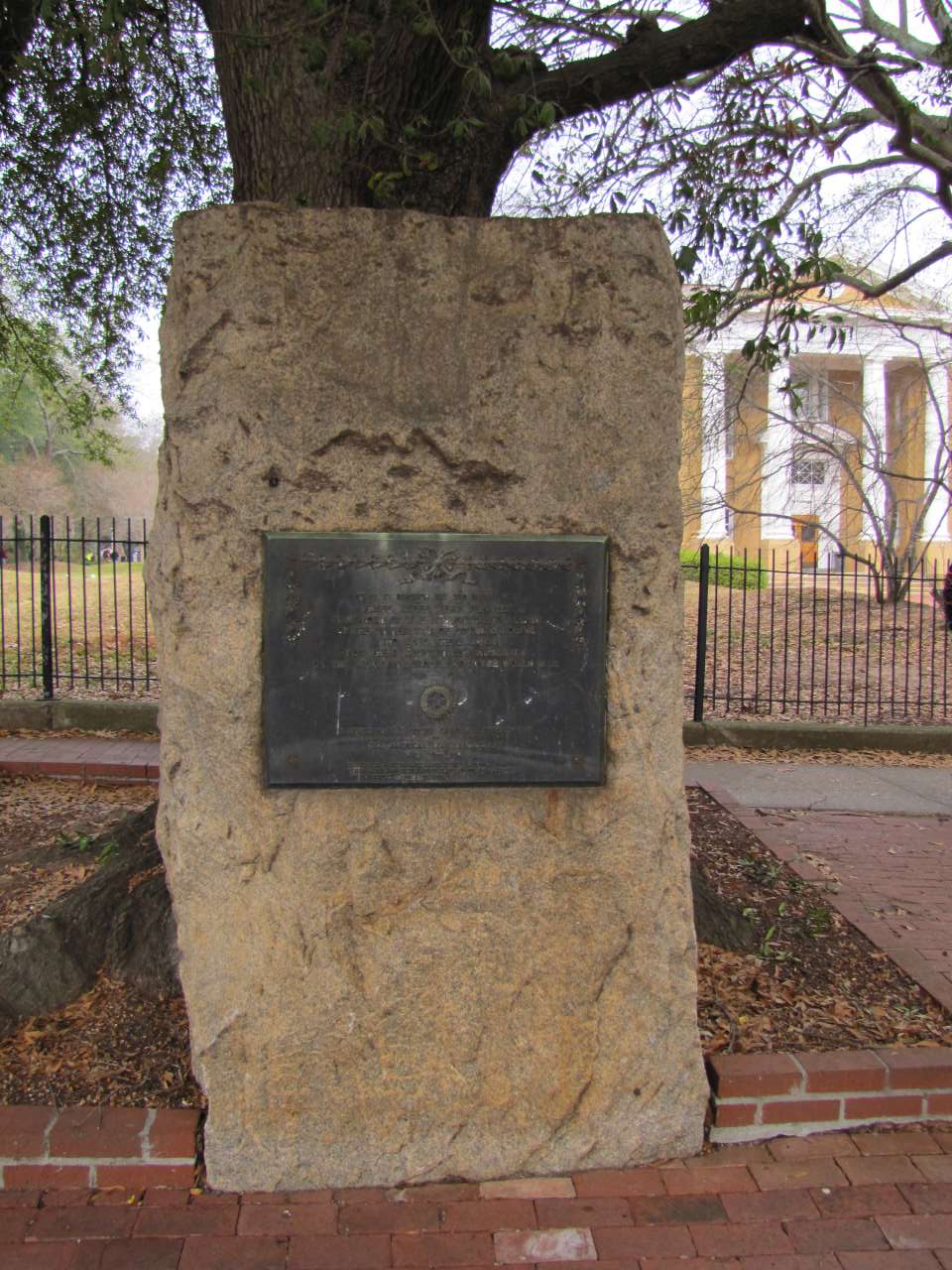
Trees planted in memory of students and alumni who gave their lives in World War I. Located on the campus of the University of South Carolina in Columbia, South Carolina.
- Details
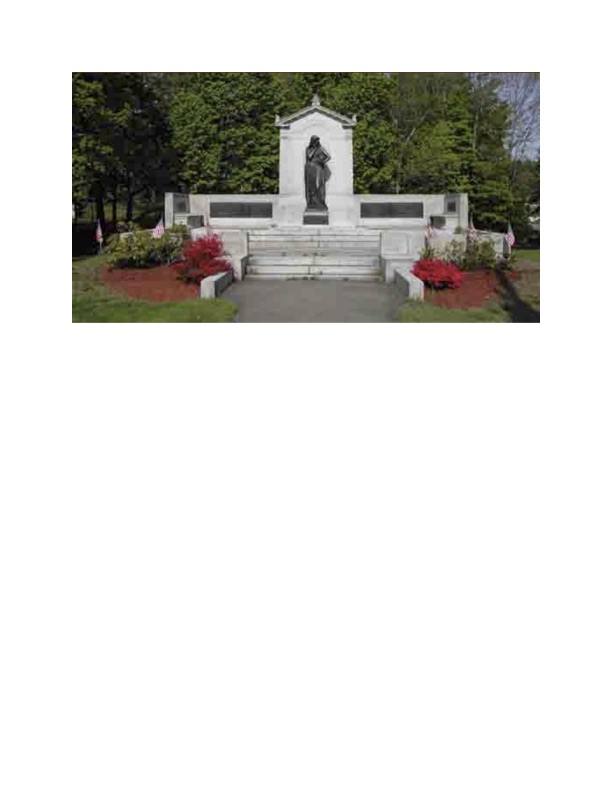
This bronze sculpture by Cyrus P.. Dallin depicts a female figure of Memory standing on a small granite base. Over her arm is draped a long robe and she holds a wreath and WWI helmet. Her right hand is held up to her cheek in contemplation. The sculpture is placed against a tall giant wall flanked by two low granite walls and two granite benches. On the low walls are six bronze plaques.
The work, and the architectural setting, were presented to the town, by William Bradford Home Dowse and dedicated on October 13. 1924, at the celebration of Sherborn's 250th anniversary of incorporation, It honors the local men who died in defense of their country from King Philip's War through WWI. Their names are on the bronze plaques on the low walls.
- Details
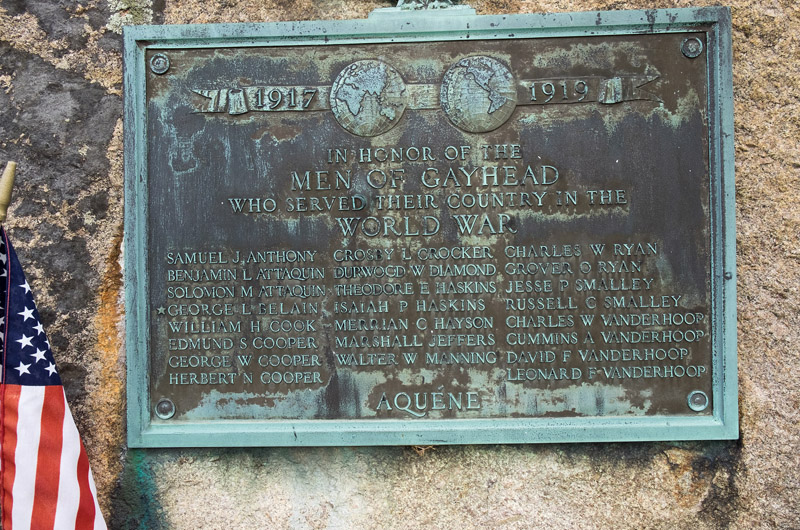
This memorial plaque is located in Aquinnah, Massachusetts, which was known as "Gayhead" until the name was changed in 1997.
The inscriptions on the plaque read:
In honor of the men of Gayhead who served their country in the World War
Samuel J. Anthony, Benjamin L. Attaquin, Solomon M. Attaquin, George L. Belain, William H. Cook, Edmund S. Cooper, George W. Cooper, Herbert N. Cooper, Crosby L. Crocker, Durwood W. Diamond, Theodore E. Haskins, Isaiah P. Haskins, Merrian C. Hayson, Marshall Jeffers, Walter W. Manning, Charles W. Ryan, Grover O. Ryan, Jesse P. Smalley, Russell C. Smalley, Charles W. Vanderhoop, Cummins A. Vanderhoop, David F. Vanderhoop, and Leonard D. Vanderhoop
Aquene