






























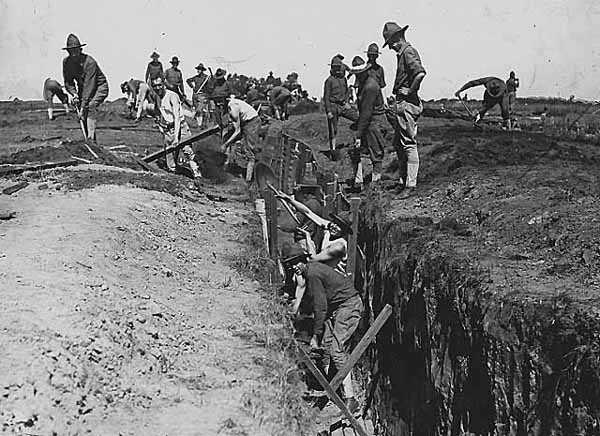
At camps held around the country during World War I, the U.S. Army quickly trained the officers it needed to grow from a small defensive force into one of millions, ready to step onto the world stage. Fort Snelling hosted two such camps in 1917: one between May 11 and August 15 and another between August 28 and November 27.
Minnesota
- Details
- 1891
- Frank Hutchinson Peavey
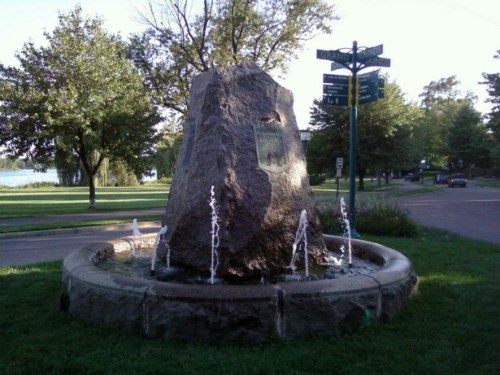
Peavey Fountain on the Lake of the Isles in Minneapolis was built in 1891 as a drinking fountain for horses and was later dedicated to the horses of the 151st Field Artillery, Minnesota National Guard who died during World War I.
The fountain was installed as a monument to the horses of the 151st Field Artillery from World War I. The 151st Field Artillery Regiment was originally organized in 1864 as the First Regiment of the Minnesota Heavy Artillery, was reorganized after the Civil War, became the First Battalion Field Artillery in 1893, was redesignated the First Field Artillery in 1900, was expanded to six batteries in 1903, served on the Mexican Border from 1916 to 1917, and then was drafted into Federal Service and subsequently was redesignated as the 151st Field Artillery.
- http://www.angelfire.com/mn/thursdaynighthikes/lakeisles_arch15.html
In 1891, Frank Hutchinson Peavey donated the fountain to the people of Minneapolis as a drinking fountain for horses. In 1917 it was rededicated as a memorial to the horses of the 151st Field Artillery Minnesota National Guard killed in action. Today, Peavey Fountain would be easy to miss standing in the middle of an island diverting car traffic between Kenwood Parkway and Lake of the Isles Parkway.
I recommend visiting the Minnesota Historical Society website to travel back in time to see what the fountain and neighborhood looked like in the early 1900s. I was curious about the fountain’s connection to Peavey Plaza in downtown Minneapolis and learned that the company Frank started in 1874, F.H. Peavey & Company (renamed Peavey Company) gave $600,000 towards the $2.5 million budget for the plaza which earned them naming rights. The gift was given in 1974, the company’s centennial year.
- http://www.southwestjournal.com/focus/2016/10/a-neighborhood-for-all-seasons/
- Details
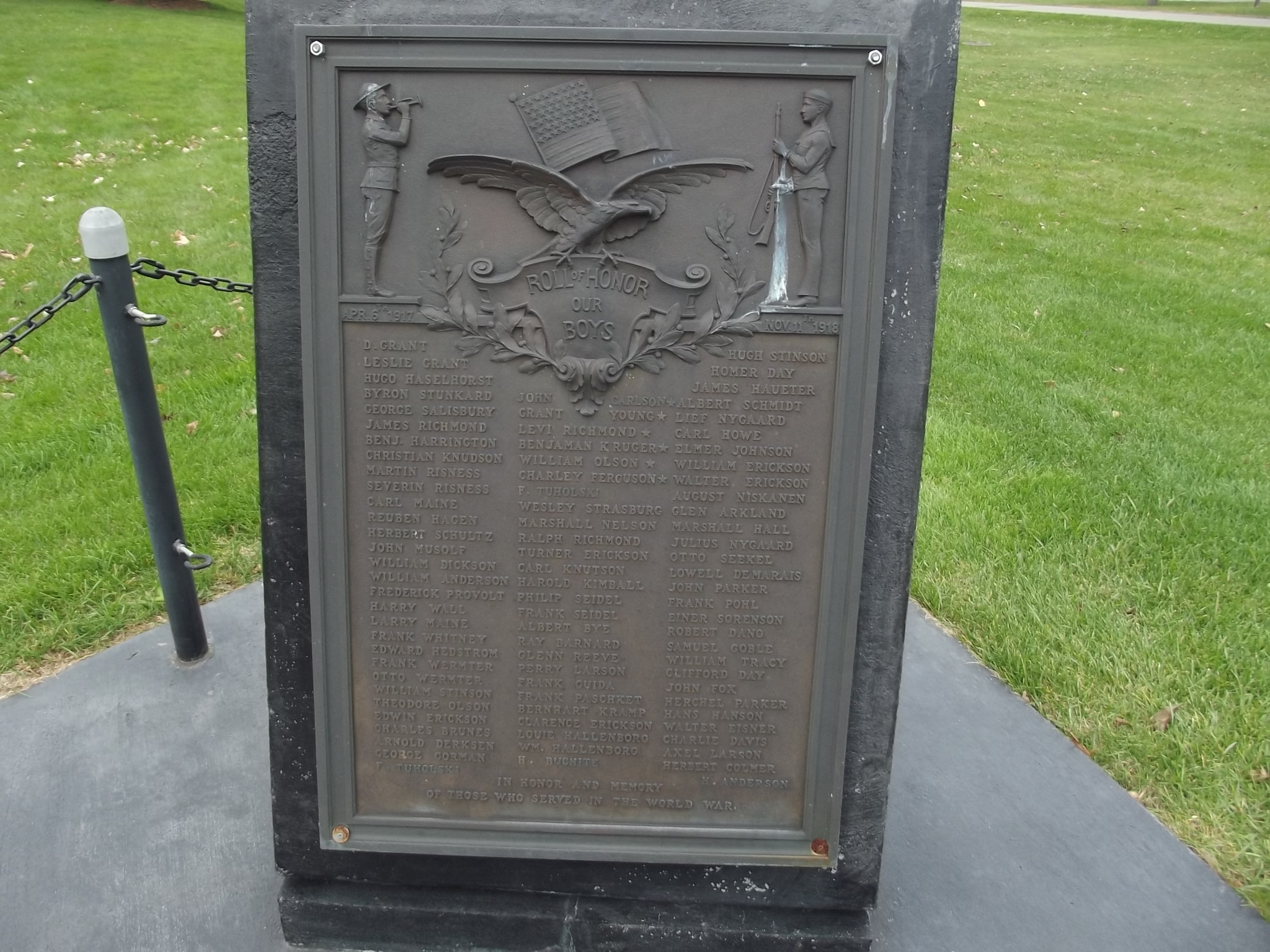
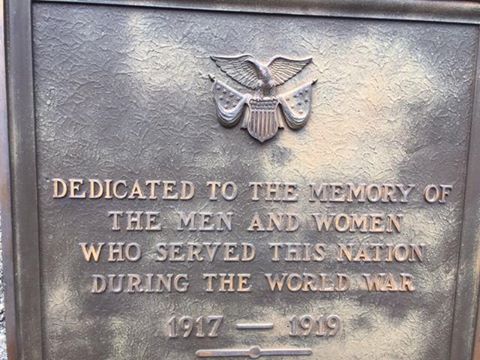
"Vintage marker honoring the area's boys, those who were lost in World War I. The brass marker is corroded with the years but still pays tribute to the fallen. The marker honors those from The World War, not World War I. As at the time, it was the only World War. An eagle is emblazoned on the marker and is flanked by two World War soldiers."
- Details
- 1935
- Dedication Date: 1935
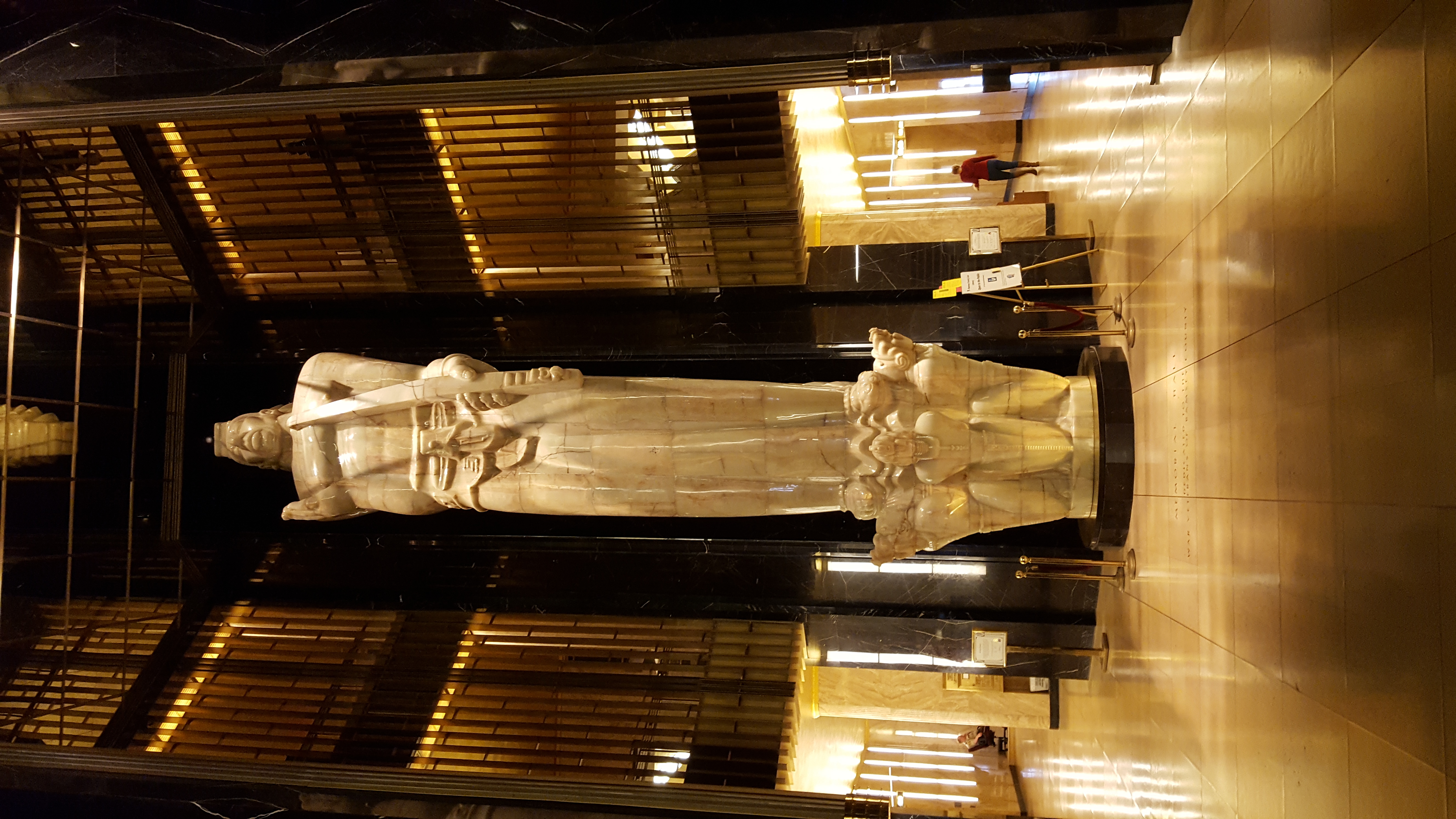
"I took this pic of the "God of Peace" statue dedicated to the memory of the fallen in the Great War. It was erected in 1935. Names of the fallen are listed on the walls. Like many other memorials dedicated to the "War to end all wars", this one has also had names added who have fallen while in service during other conflicts as well."
--Mr. Johannes R. Allert, M.A., CTL
- Details
- Armistice Day, 1923
- Dedication Date: Armistice Day, 1923
- Daughters of the American Revolution, St. Paul Chapter
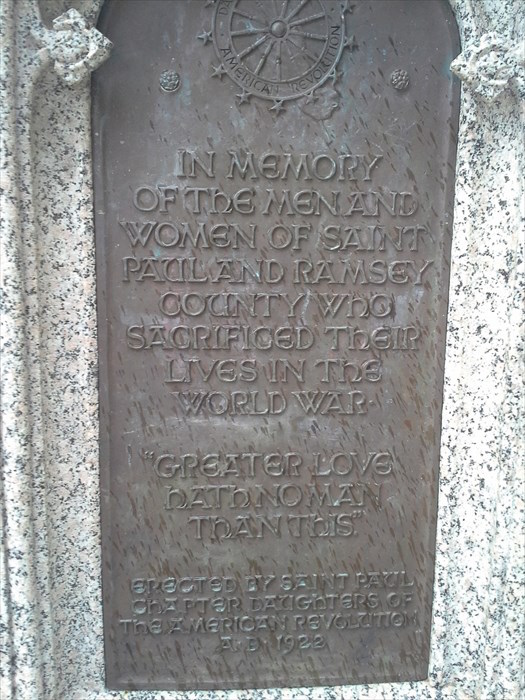
This large monument consists of a cross atop a tall stone spire overlooking the Mississippi River in St. Paul, MN. On the east face of the monument is a plaque reading: 'IN MEMORY OF THE MEN AND WOMEN OF SAINT PAUL AND RAMSEY COUNTY WHO SACRIFICED THEIR LIVES IN THIS WORLD WAR. "GREATER LOVE HATH NO MAN THAN THIS"' and 'ERECTED BY SAINT PAUL CHAPTER DAUGHTERS OF THE AMERICAN REVOLUTION A.D. 1922'
- Details
This is a chain saw-carved piece of wood, probably elm, depicting a standing WWI soldier. He wears an open-necked shirt and pants tucked into his boots, holds his rifle's barrel, and carries a helmet. It was carved in 1990 by Dennis Roghair to honor WWI veterans. Nearby is another Roghair carving, "Eagle," which may also be in honor of veterans.
- Details
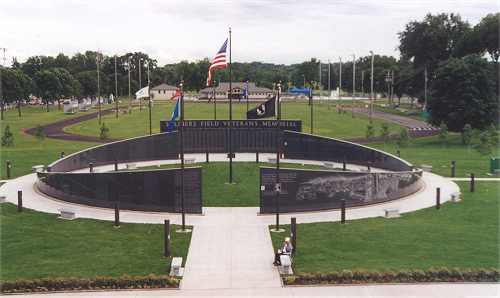
The Soldiers Field Veteran's Memorial was created to honor Veterans from Southeast Minnesota who died serving our country and dedicated to all who served our country to help keep us free. We remind future generations that we must not only protect ourselves from outside forces who would deny us our freedom, but we must understand that like the downfall of the Roman Empire, our freedom can also be lost from within if we allow our moral and ethical standards to decay. We can not tolerate bigotry or corruption in any form. Those who say they have no influence on our society have forgotten that we each control our own conduct, which then becomes part of our country's weakness or strength.
- Ken Zubay
- Details
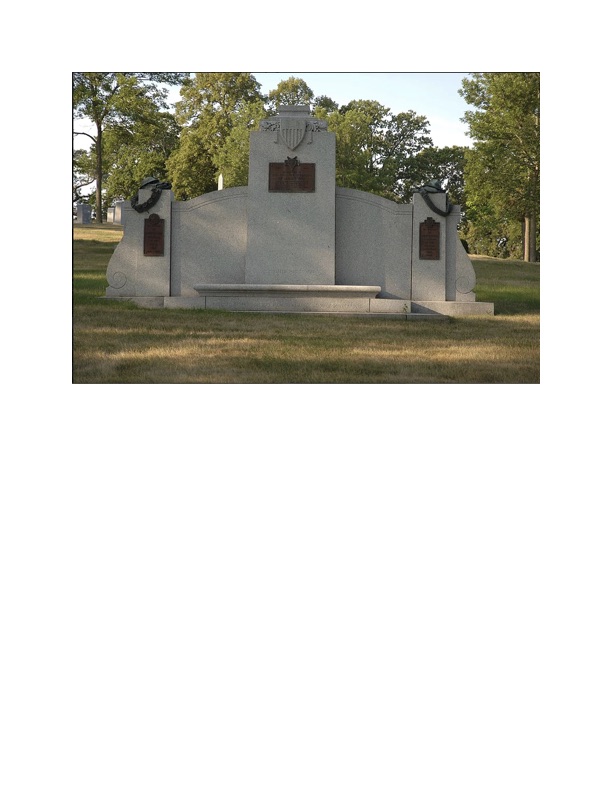
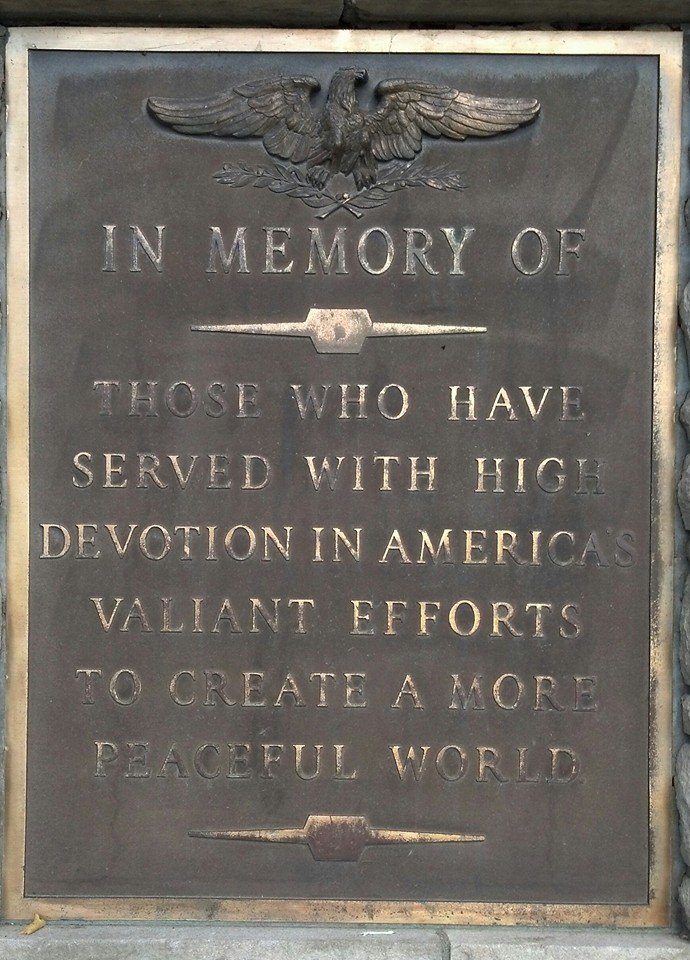
Manufactured of granite and bronze, this monument is composed of five sections which fit together, the nine fool tall center section being the tallest. On the ends are sculpted helmets, canteens, a gas mask, ammunition belts, a saddlebag and a bayonet. It also had medallions of the U.S., the Spanish-American War Veterans, and the Grand Army of the Republic. Atop the center section was a sculpted element, but it was stolen during the 1960s. The monument was dedicated on May 30, 1923, as a tribute to the Minnesota veterans of the Civil War, the Spanish-American War, and WWI.
- Details
- Plaque or tablet
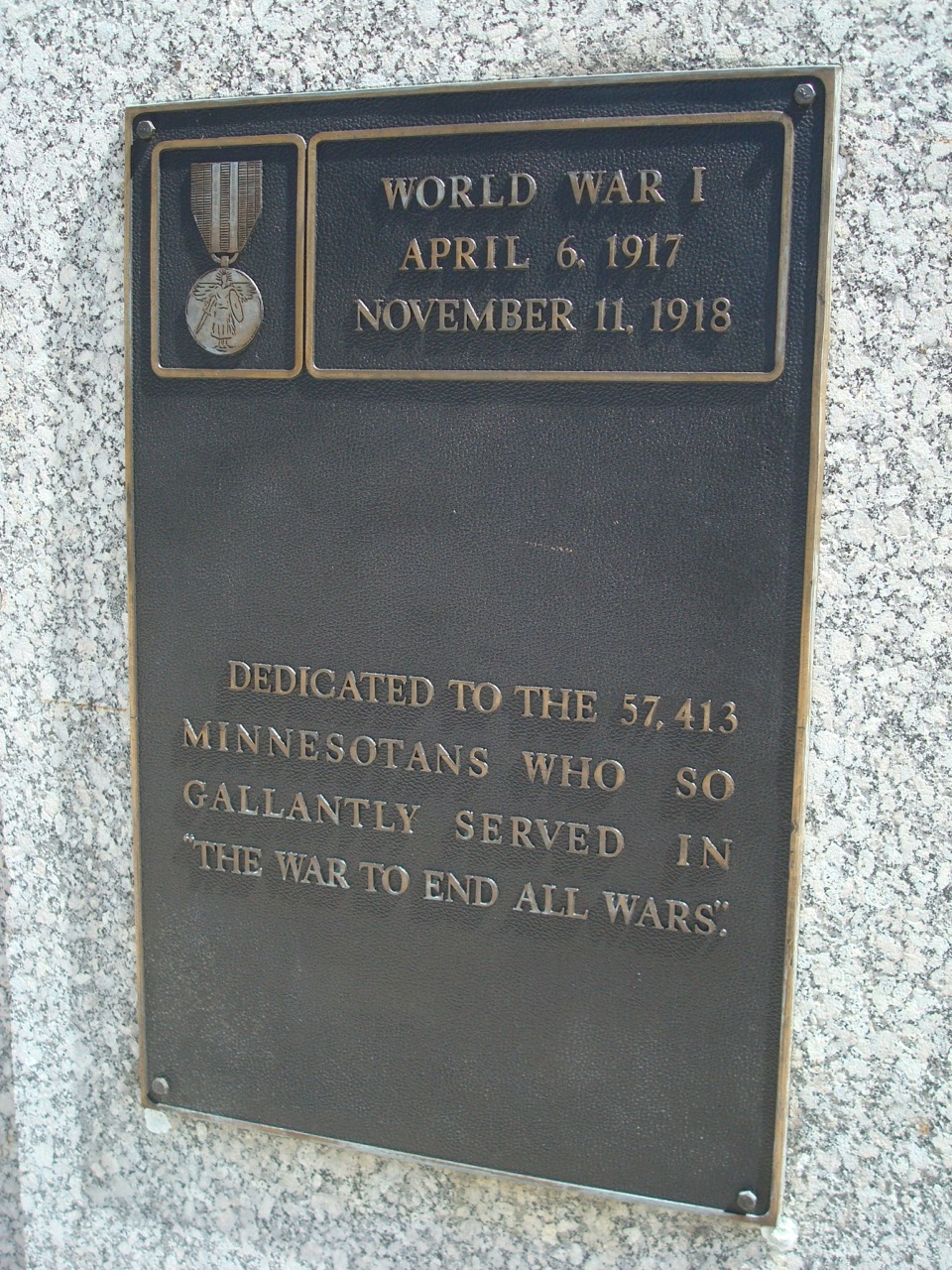
“Dedicated to the 57,413 Minnesotans who so gallantly served in ‘the war to end all wars.'”
- Details
- Other Measurements: The main pillar (with the plaques and sculpture) is 6' x 31
- August 1919
- May 31, 1920
- Dedication Date: May 31, 1920
- William E. Lee
- Individual
- E.M. Berg, County Auditor; C.A. Remillard, chair of county board: Charles J. Spieker, county board member
- Two eagles and two small bronze sculptures on it
- Clarence H. Johnston, John K. Daniels
- Column or pillar
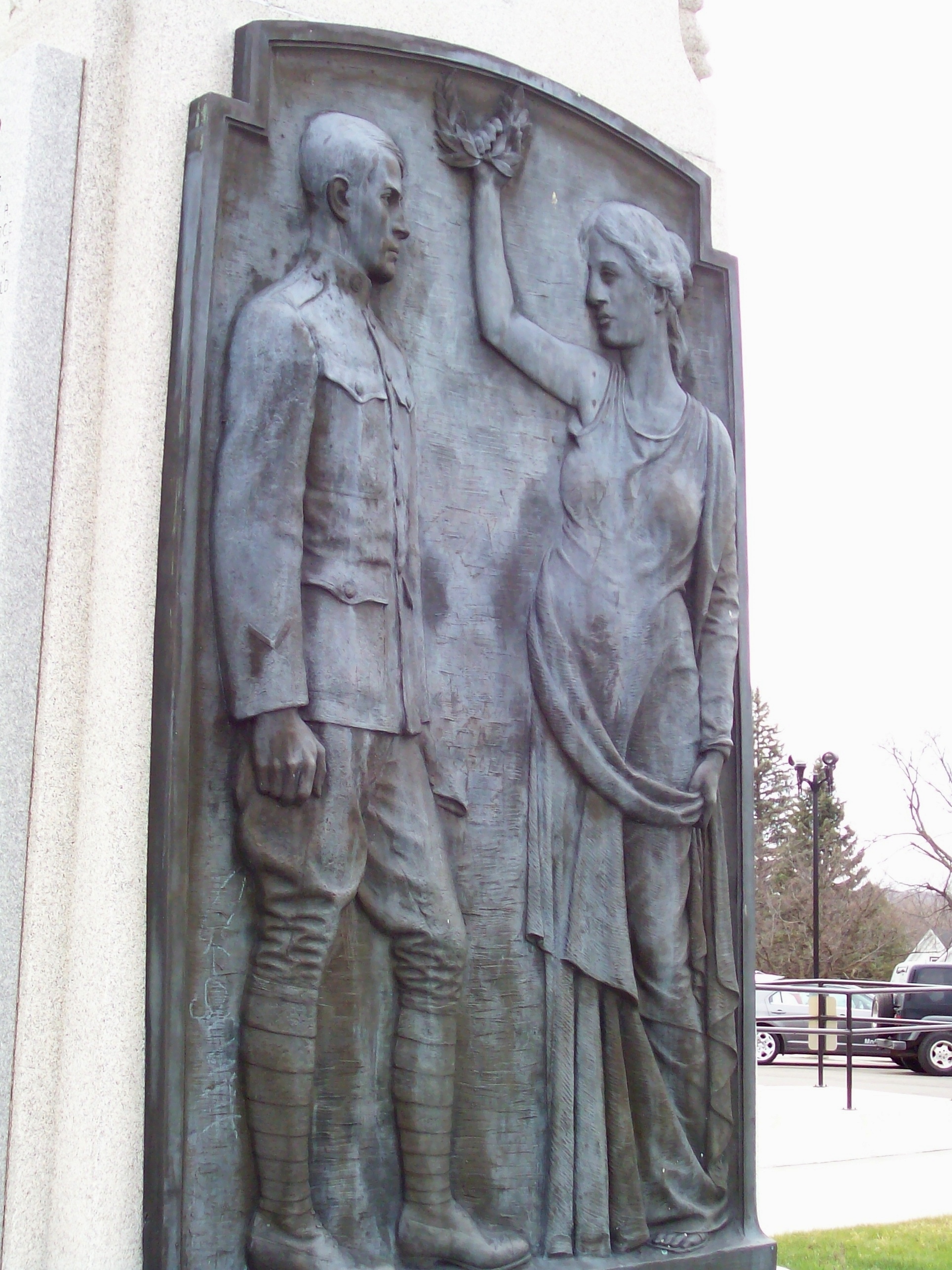
Directly in front of the historic Todd County Courthouse is a monument dedicated to the memory of the soldiers and sailors who died in the service of their country. In 1918 William E. Lee approached the county commissioners and offered to build the monument at his own personal expense. The specifications were drawn up by Clarence H. Johnston, architect; and the sculpture was done by John K. Daniels, St. Paul.
- Details
- 1917
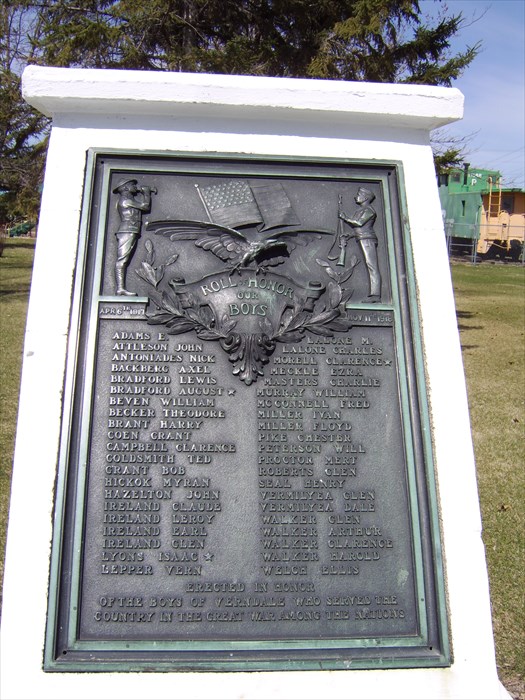
"This vintage art deco memorial is located in McNair City Park in Verndale, MN. The memorial is a bronze marker flanked by two vintage and art deco type lanterns. The memorial is dated April 6, 1917 and November 18, 1918. It lists all of the men from the Verndale area that served in World War I. There is also some artwork, flags, soldiers etc depicted on the bronze marker. This is a very nice memorial and very vintage."
- http://www.waymarking.com/waymarks/WMBCAF_Roll_of_Honor_Our_Boys_Verndale_MN
- Details
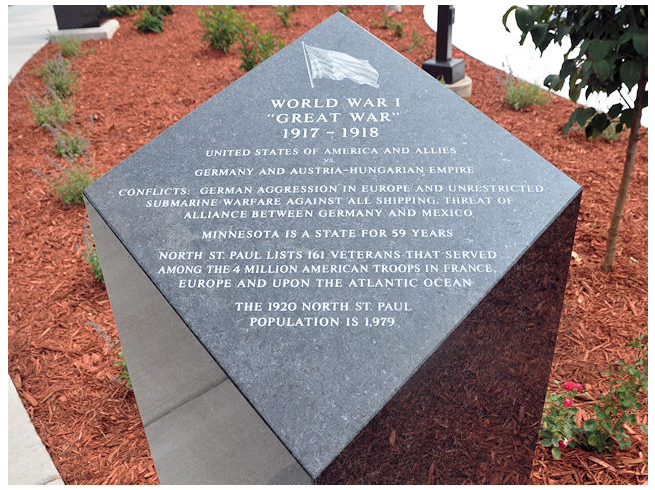
| Veterans Park recognizes the service and sacrifice of all veterans of the United States and those that paid the ultimate price for the freedom we all share. The Veterans Park History Path encircles the Memorial Wall, the flags and Star Plaza and features the historical moments of military conflict intertwined with the veteran history of North St. Paul, Minnesota. |
| Podiums are located around the path in a chronological sequence that mirrors the history of North St. Paul, Minnesota. Factual data of each conflict period are scribed upon the black granite face of each podium. Viewers may then understand the price paid by those who defend our nation and liberties. |
- Details
- Dedication Date: 1923
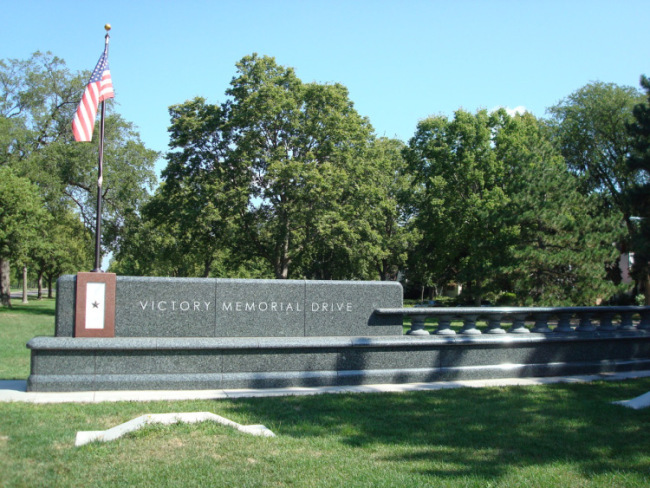
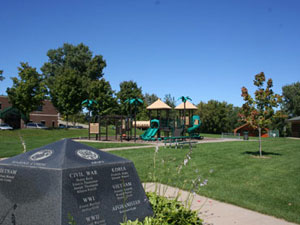
In 1921, the Minneapolis Parks and Recreation Board dedicated part of its Grand Rounds Scenic Byway to those from Hennepin County who gave their lives during the Great War. They renamed the section of the Byway that ran along the northwestern corner of Minneapolis as “Victory Memorial Parkway” (the road itself is called Victory Memorial Drive, as shown in photo).
- Details
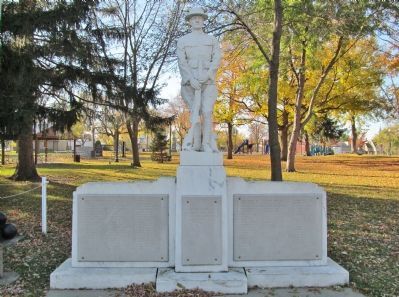
World War I Monument, a War Memorial
Erected in Memory
of Those Who Served
During the World War
1914 —— 1918
World War I Monument, a War Memorial
Allmann Andrew • Bade Ed. • Bade Henry • Beck Walter • Beiersdorf O.H. • Boettcher Otto • Boehmke Herb • Brandenburg Henry ☆ • Burfield Thom. • Buechner H. C. • Buelow George E. • Buelow Ben • Braun Gust. H. • Claesgens Geo. F. • Claesgens A. M. • Dallmann Will. • Dircks Frank ☆ • Eggers Arth. H. • Ehrenberg Will. • Eistein A. L. • Fischer Leo C. • Fois Rob. S. • Gast Ferd. • Gentz Arth. E. • Giesen Jake J. • Giesen Hub. • Goodman Jos. C. • Goethke Will. • Gust Will. A. • Harris A. W. • Hasse Jul. • Hauwiller Henry • Heidman E. H. • Heinen Adolph T. • Heinen Will. H. • Hedtke Ed. F. • Henke John • Henke Jos. • Heuer Fred A. • Huckenpoehler Ben. • Kaufold Aug. • Kelzer Chas. • Kirsch Jos. • Klatt John • Klein John M. • Knorr Paul • Knorr Albert J. • Krause Fred • Krueger Otto • Krueger Albert • Kranz Frank • Kunze Arth. • Kucepa Will. • Kunze John • Kuntz Alvin • Kuntz Clarence A. • Lahr Ed. • Lindner Phil. • Louis Math. J. • Louis Frank • Lobitz Henry O. • Lobitz Harry • Lobitz Theo. • Luebke Otto W. • Luebke Fred J.
Lundsten Clarence • Maiser Albert G. • Mayer Henry E. • Miller Jos. L. • Moy John • Mock F. H. • Meuffels John F. • Ollerman Max • Peitz Jos. • Peitz Casper • Petijohn Carl • Philippy Paul • Pofahl Roy C. • Pofahl Arth. • Radde Grover • Raether Arth. • Raether Walter • Rauen Frank J. • Rauen Edwin • Reinke Herman • Rohloff Aug. • Scheuble Alfred • Schmitz Nick • Schmidt Geo. • Schlechter Peter J. • Schlitzke Frank W. • Schutz Edwin J. • Schwalbe Herman E. • Schwalbe Ben. • Schwichtenberg Otto • Schoewe Ed. R. • Schneider Waldemar • Schneider Frank • Sicheneder Louis J. • Sicheneder Jos. • Sohns Louis • Spannaus A. C. • Strong Rufus • Stock W. J. • Stacken Henry • Steinhagen Jos. • Voight Otto • Wagener John • Wessale Geo. • Wessale A. C. • Wessbecker Will. • Wessbecker John • Wessbecker Ed. • Weber Robert • Weber Clement • Willems Will. • Willems Henry J. • Zeman Louis • Zeman Henry A. • Zoerb Geo. • Zoerb Will G. • Zrust Robert
- Details
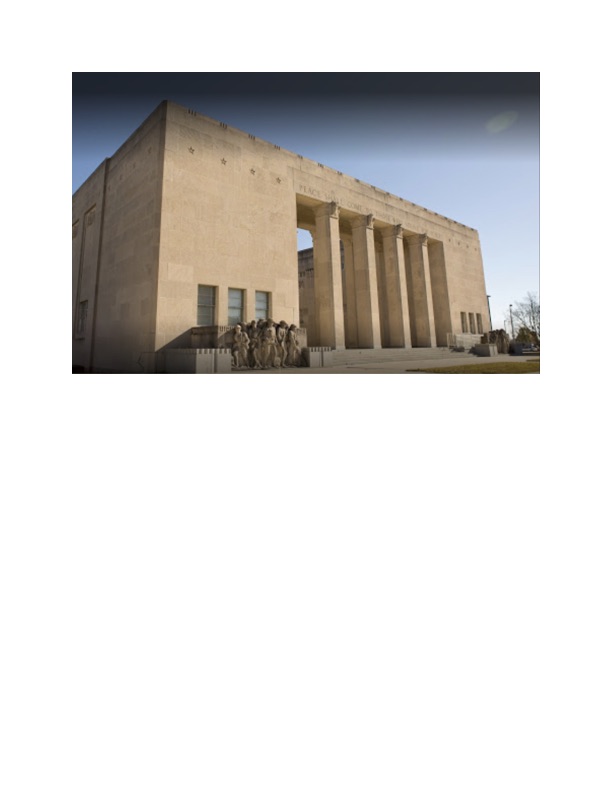
Constructed in 1939-40 and dedicated on July 8, 1940, this is a monument to the Mississippi soldiers from all wars. It is used as the state headquarters for several veterans organizations.

- Details
- Dedication Date: 05/23/1937
- city, state, federal
- government
- $185,000
- 4-wall mural in the building by Richard Haines, sponsored by WPA, completed 1938, includeds references to several wars, including WWI. Mural was restored in 1996.
- City paid for 53,500; state and federal paid the remainder.
- William M. Ingemann, architect
- Auditorium/hall/theater
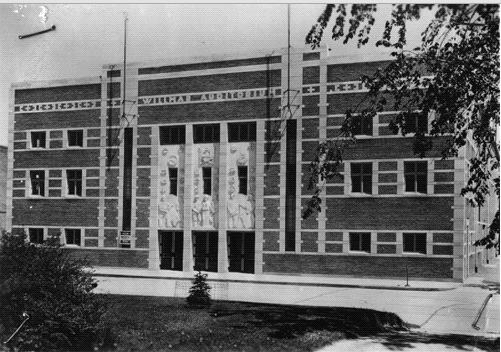
The Willmar Auditorium built by WPA is one of the most handsome auditoriums in Minnesota. It has two stories and a basement. In some sections of the building it has a third story. It was built at a cost of $160,000. The building has a concrete foundation, reinforced concrete slabs, steel roof trusses, and a wood roof. The walls are of brick with stone trim. The sculpture over the entrance was done by the Federal Art Project. The basement accommodates a band room, dressing rooms, showers, and mechanical equipment rooms. On the first floor are the auditorium, stage, and kitchen and war memorial room. The second floor has meeting rooms and a projection room.
PWA Moderne realized primarily through a pattern of contrasting stone
inlaid in the brick walls. Over the entrance are three relief panels in stone depicting the glories of agriculture, government, and transportation.
The Willmar War Memorial Auditorium features engraved stones from each state to honor Minnesota veterans. It was built between 1935 and 1938.