






























Benjamin Britten's Musical Masterpiece, War Requiem
Part 1: Interview with Tenor, Paul Groves
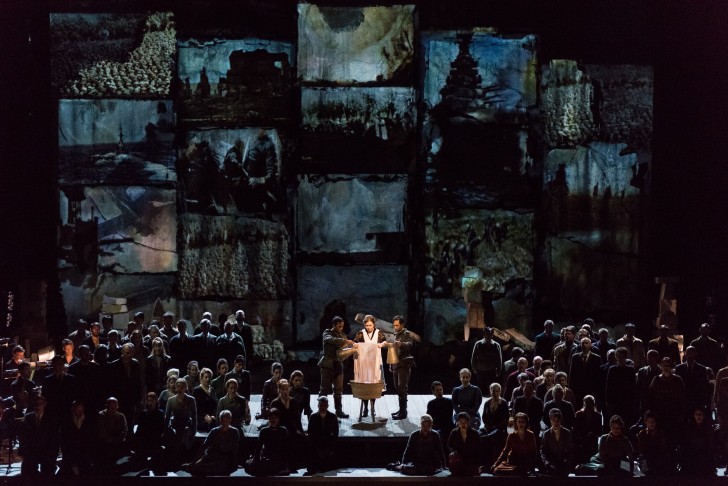 Scene from War Requiem, Lyon. Copyright @stofleth
The Lyon Opera House in France opened its 2017-2018 season by commemorating the WWI centennial with the powerful, intense WWI masterpiece War Requiem by British composer Benjamin Britten (1913-1976). A pacifist, Britten was deeply affected by the horrors of WWII, by the brutal destruction of Hiroshima and had always wanted to create a musical composition calling for peace among all humans. He finally got the chance in 1961 when he was commissioned to compose the dedication for the new Coventry Cathedral in England, which was reduced to ruins during the WWII bombings of November 1940. Known for both its traditional and innovative writing, Britten organized War Requiem in three layers: the conventional requiem of liturgical mass with a chorus, orchestra, and a soprano; the sound of individual human voices with a tenor and baritone reciting Wilfred Owen’s poetry, accompanied by a chamber orchestra; a chorus of children accompanied by an organ. In the middle of the Cold War, as Germans were building the Berlin Wall, Britten aimed to bring together soloists from three “belligerent” nations: a Russian soprano, an English tenor, and a German baritone.
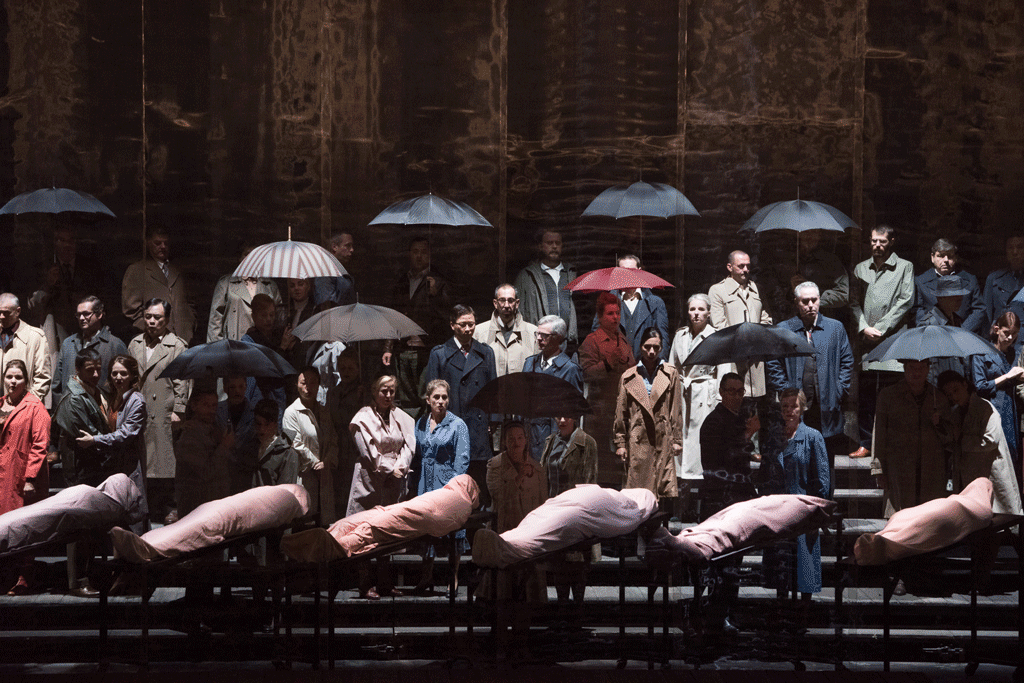 Scene from War Requiem, Lyon. Copyright @stofleth
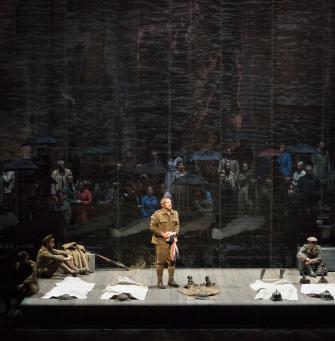
Britten is one of the greatest lyrical composers of the twentieth century and, and according to the director of the Lyon Opera, Serge Dorny, Britten's exceptional sense of narrative and drama demanded a theatrical performance. For the centennial performance in 2017, Lyon decided to invite the Japanese actor and director, Yoshi Oida, to lead the performance alongside Italian conductor, Daniele Rustioni. Oida claims that Britten’s War Requiem is not just about WWI; it is universal and speaks to him particularly since he witnessed the bombings of Nagasaki and Hiroshima during WWII. In talks and interviews, he encourages spectators to view the work through the eyes of children, who are not only strangers to adult conflicts, but also victims. He says that the young singers of the Lyon Opera play an enormous role in War Requiem’s staging. Unlike the other singers in the show, who wear WWI-era clothing and uniforms, the children who sit on the side of the stage during the whole performance are dressed in modern clothing. They act mostly as spectators as if watching a history lesson, but at times they get up to sing and interact with the soloists and the stage.
WWrite had the opportunity to sit down with Paul Groves, the tenor, and Yoshi Oida, the director to talk about the piece. We’ll hear this week from Groves. Next week’s WWrite’s blog post will feature Yoshi Oida’s interview. Here’s Paul Groves:
 WWrite: Britten’s War Requiem focuses on the British and German experience of WWI. What did director Yoshi Oida, a Japanese artist, bring to what appears to be a European-centered narrative?
Paul Groves: Yoshi Oida, occasionally, would tell us about Japan. He is from where they dropped the bomb at Hiroshima and Nagasaki, and he was 12 years old at the time, so he remembers it very well. He explained that after the war, “the Japanese Emperor just said ‘Ok, we lost the war, and now we're just going to everything the American way’ and there wasn’t ever a question. I never saw my mother or any of her friends blame the Americans. We never blamed them for anything. We immediately thought that we had lost and now we’re going to live this way.”
And I never even thought about this.
Native Americans: Soldiers Unknown
by Chag Lowry (Yurok/Maidu/Achumawi)
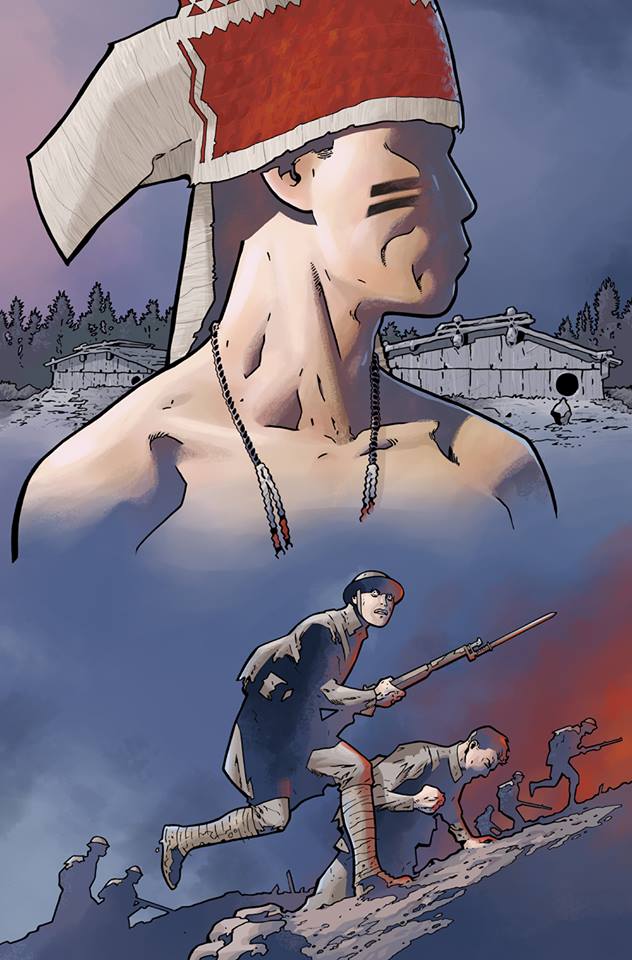 Soldiers Unknown Book Cover Drawing by Rahsan Ekedal
The World War I epic, Soldiers Unknown, is an original graphic novel written by Chag Lowry and illustrated by Rahsan Ekedal. This special project reveals the untold story of the native Yurok men who fought and died for the United States of America in the Great War. Conscripted from their tribal home in Northern California by a country they barely knew - to serve in a war they could hardly call their own - these young men nevertheless demonstrated immense courage and humanity on the battlefields of France in the Meuse-Argonne offensive. Chag Lowry is a historian and writer of Yurok and Maidu descent and has crafted a beautiful and poignant tale that Rahsan brings to life with images.
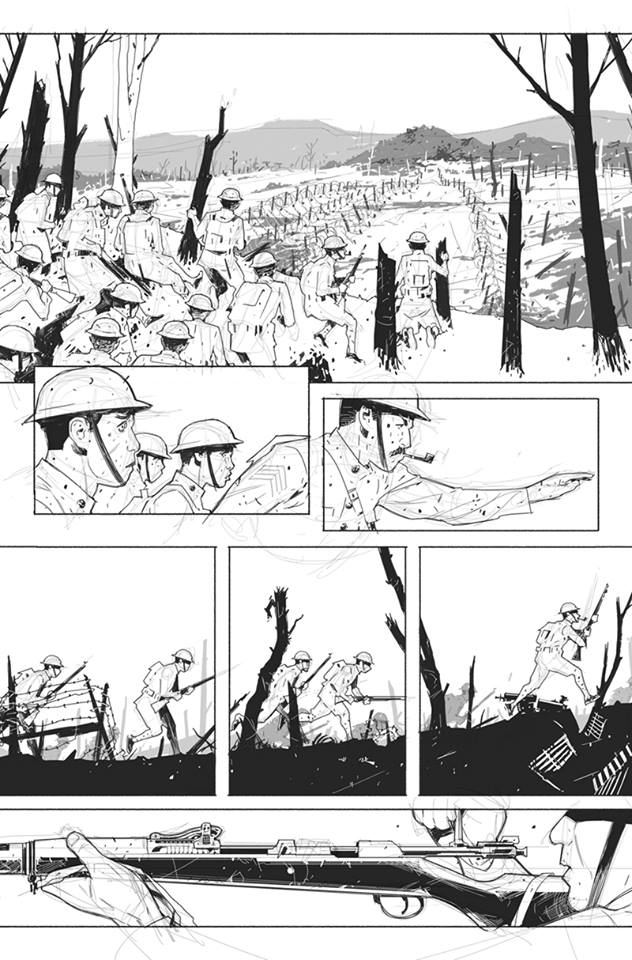 Frames from Soldiers Unknown. It will be published by Heyday in summer of 2018.
–Father, where did they go, and what did they see, these Yurok Native men who fought in World War One?
–The answers are there for us to find, son. But the more important questions are how did they return home, and when did they find peace?
Crafting a World War One story with the very talented artist Rahsan Ekedal has been an emotional journey. We’ve come a long, long way since I first discussed the concept with him back in 2016. I was raised with many Native veterans from both sides of my family in northern California. I always remembered the emotions of these men–many World War Two and Korean War veterans– when they told me about their fathers or uncles who had served in the Great War.
And that’s the story Rahsan and I try to tell– a story about emotions. As a Native American, I wanted to create a graphic novel that conveys the experiences of the Great War through the sentiments of my people. I had two Yurok great-great uncles who served in WWI and I’ve looked at their sepia-toned photographs for years wondering what they saw and felt.
The snippet of dialogue I shared at the beginning of this blog post encompasses the questions I’ve thought about regarding Native American veterans of WW1. Our story begins in contemporary times with a Father and Son as they begin to talk about their ancestor’s involvement in the Great War. Can culture help a combat veteran find peace and return to their homeland? That is another question I’ve thought about, and it’s one I hope readers will discuss after they see our work. We are using the lens of Yurok culture for this story to try to find an answer. I’m very grateful to have such a respectful partner in Rahsan for this book.
The beautiful part of being able to work with a talented artist like Rahsan is that his images allow me to feel the full range of emotions as a descendant of WW1 veterans. To teach young people about history we must first find ways to help them feel first and after lead them to discuss their emotions about what they are learning. The graphic novel with its sequential art and impactful dialogue can do just that. The act of breathing life into our characters in this story is meant to honor all WW1 veterans and their families. Rahsan will fully color his work and this means our soldiers will be as alive today as in 1917-18. We can share some of their journeys, and it does not matter what tribe or culture they are from. We can feel who they are. To most people, all World War One veterans are Soldiers Unknown. I hope this work helps changes this.
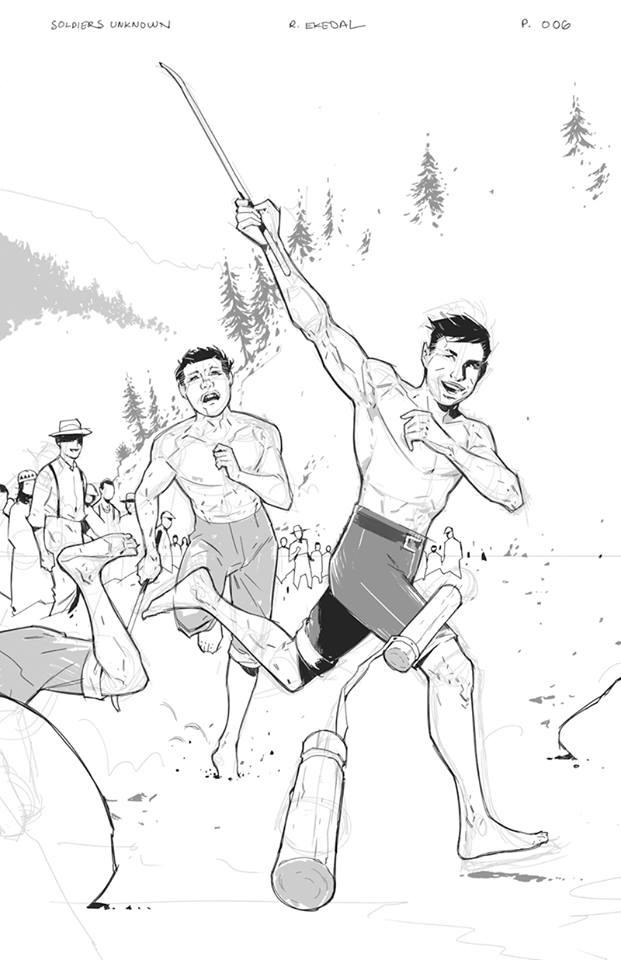 Frame from Soldiers Unknown.
To hear more from Chag about Soldiers Unknown, read his interview with WWI Centennial Commission Director of Public Affairs, Chris Islieb, or listen to his talk with Theo Mayer in this recent WWICC podcast.
Author's bio
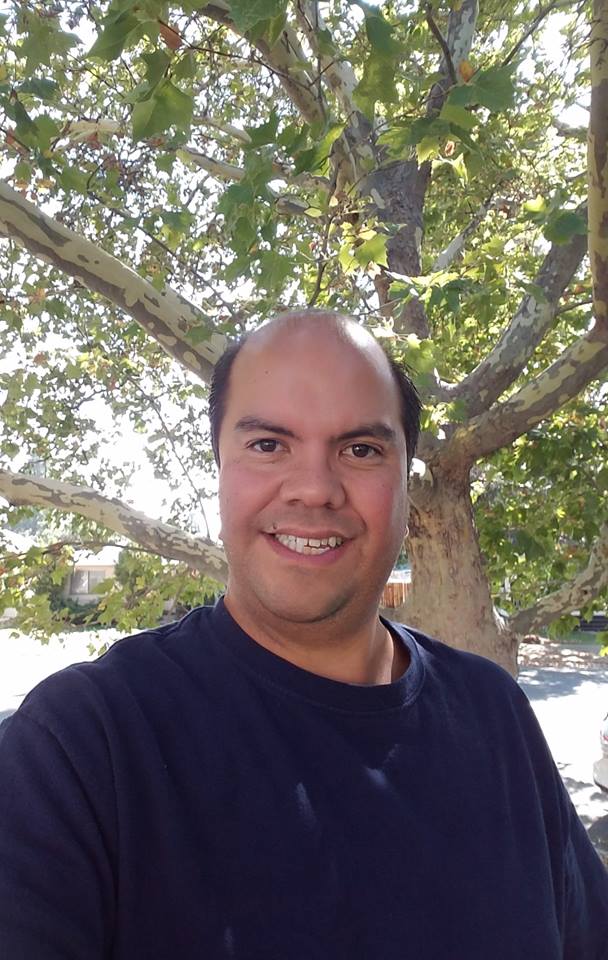 Chag Lowry is of Yurok, Maidu, and Achumawi Native American ancestry from northern California. He is the author of The Original Patriots: Northern California Indian Veterans of World War Two and has directed numerous PBS documentaries on Native veterans and cultures. He can be reached on Facebook.
In this photo, Chag is standing in his hometown of Susanville, California in front of a memorial tree that was planted in the 1920s to honor the late Thomas Tucker. Tucker was a Maidu man who died on September 28, 1918, in the Meuse-Argonne battle. He was in the 91st Infantry Division and was the first man from northeastern California to die in combat in WW1.
Christian Carion’s Film, Joyeux Noël: A Place of Memory
Winter 1914. WWI’s first major battles have stagnated in the trenches. In an icy field in the North of France, French, Scots, and Germans spy on each other until Christmas Eve when the nostalgic song of bagpipes escapes from the underground while the sound of a Berlin tenor’s Lied rises and spreads in the night. Soon the two melodies harmonize, and the soldiers from all sides emerge from the trenches and meet each other in No Man’s Land. Strategic enemies become war brothers.
French director, Christian Carion, captures this battlefield miracle in his 2005 film, Joyeux Noël, now a WWI classic. As the centennial approaches, WWI has made more recent, diversified appearances on the screen–Au revoir là-haut (The Great Swindle), Wonder Woman, The Light Between Oceans, (and soon Sgt. Stubby: An American Hero)–but Joyeux Noël remains the reference for appreciating and understanding the fraternal phenomenon of the 1914 Christmas Truce. In Carion’s film, scenes of fraternity overtake the less-joyous scenes of killing to the point that friendship among enemies appears almost normal; we forget the snow-covered, frozen corpses strewn about No Man’s Land and get lost in music, drink, and football. For the spectators, the return to battle on December 26th feels like a punch in the face, tunneling us back into the terrifying absurdity of this war. It’s no wonder the film was nominated “Best Foreign Language Film” for the 2006 Academy Awards and Golden Globes.
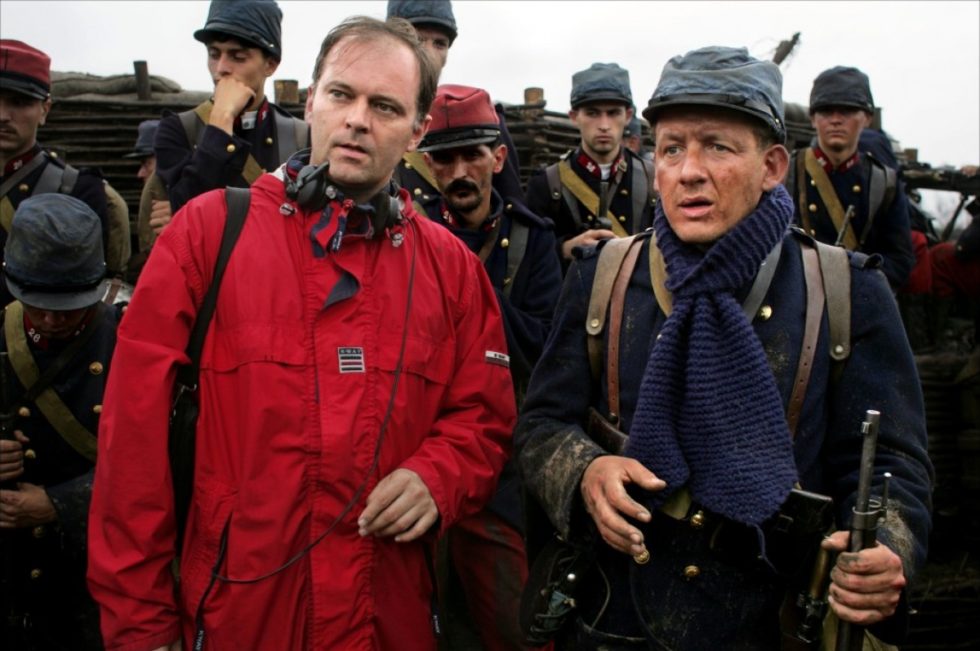 Christian Carion (left) on the set of Joyeux Noel. Photo courtesy critikat.com
The Balfour Declaration: An Alternative History
by Simone Zelitch
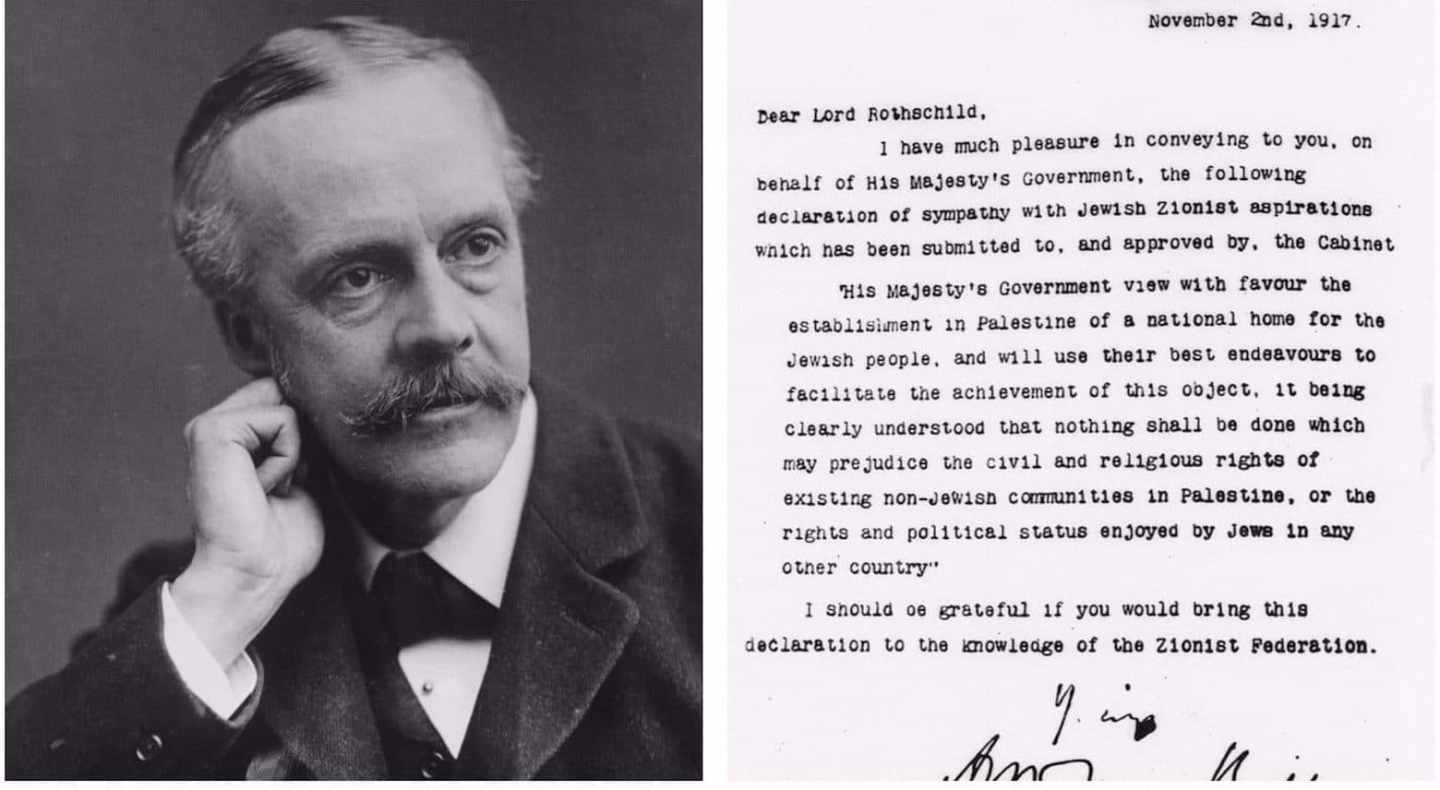 Left, Arthur Balfour. Right, the letter introducing the Balfour Declaration
As Mike Schuster, the curator for the blog, The Great War Project, explained to WWI Centennial News, on November 2, 1917, headlines featured the announcement of what became known as the Balfour Declaration. It is letter from the British foreign secretary, Lord Balfour, to the British Lord Rothschild, the de facto leader of the Jewish community of Britain, expressing support for a national home for the Jewish people in Palestine. (Click here for full podcast).
In the wake of President Trump’s recognition of Jerusalem as the capital of Israel, we return to the Balfour Declaration with one Jewish American writer, Simone Zelitch:
We’re living in an alternative-history moment. Given the current political and cultural climate, it’s no coincidence that many of us are in full flight from the present. Instead, we look over our shoulders, and endlessly revise the past.
Now, after President Trump’s recognition of Jerusalem as the capital of Israel, here’s one more revision: What if there had been no Balfour Declaration?
Soon, All Too Soon: British Musicians Bring Life and Melody to Exhumed Body of Forgotten WWI German Soldier Ernst Brockmann
by Patricia Hammond
When British musicians Patricia Hammond and Matt Redman found and performed German sheet music written by a soldier killed in Verdun, they had no idea the song would also lead to the discovery of the composer's body, which had been buried in an unmarked grave in France's Meuse-Argonne region.
Aug 29, 2017
Above: A short video describing how Patricia Hammond and Matt Redman found a melody in the grave of an unknown WW1 Soldier
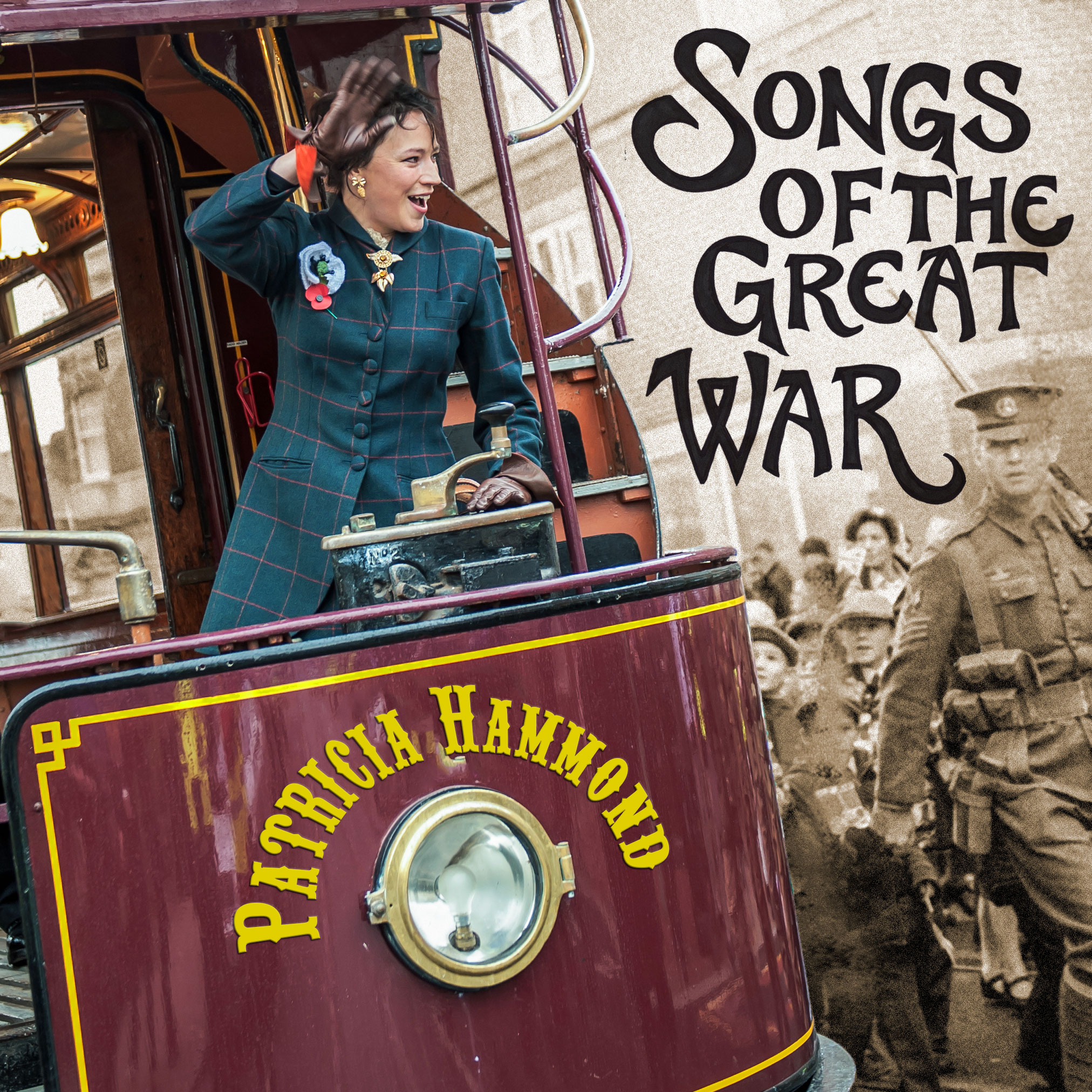 CD Cover for Songs of the Great WarDespite the fact that nobody seems to buy or own CDs anymore, I had to make a First World War recording. A hundred years rolls round only the once, and I specialize in singing Edwardian songs. So I collaborated with multi-instrumentalist, arranger and music historian Matt Redman, and made a seventeen-track recording in London, England. We chose many of the most well-known songs, but included all the original verses and only used the instruments of the time: Pack Up Your Troubles, Roses of Picardy, If You Were the Only Girl in the World, Over There…and Irving Berlin’s pacifist Stay Down Here Where You Belong from 1914. And also some that were well known in their day but more or less forgotten now: Somewhere In France, The Rose of No Man’s Land…and Canadian and French songs, and crucially, two songs from the German side.
Forgetting to Remember: Making America’s Great War Monumental Again
by Sarah Biegelsen
The ground breaks. As the new WWI Memorial materializes in D.C., it's fascinating to take a look at other war memorials and the narrative of their construction. Reading the "story" of the ways memorials are conceived plays an important role in the understanding of public, cultural memory. Delve into the subject this week with WWrite's blog post,"Forgetting to Remember: Making America's Great War Monumental Again," by WW1CC intern, Sarah Biegelsen.
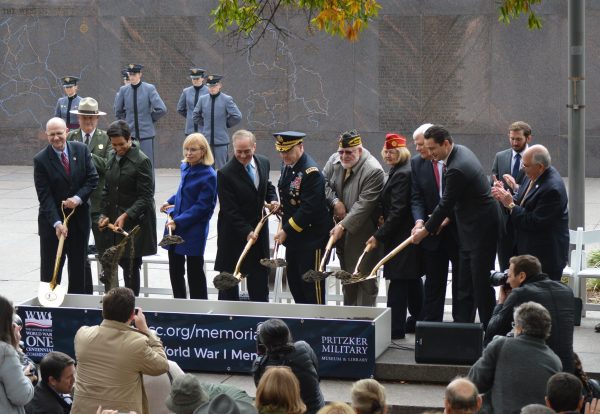 WWI Monument Groundbreaking Ceremony, Photo courtesy of TVCNews
Ignoring the First World War in the United States has been a century-long tradition that will either be rectified with the 100th anniversary of the U.S. entry into WWI or will endure through the collective amnesia of American society.For a paper I wrote my senior year of undergraduate college, I examined the memory of World War I in the United States through memorials and museums. I also compared and contrasted formal commemorative events of 1918-1939 with the ways they are commemorated in the twenty-first century. I was motivated to write this paper since I had taken a class my freshman year about British memorialization of the two world wars, a memory that has been flourishing in the past years, unlike in America. As I was curious to find out why Americans today have failed to give World War I its due attention, I decided to explore the emerging and declining American WWI memorialization over the past 100 years. Here in this post, I am going to briefly discuss some findings about the following memorials:
- The Liberty Memorial in Kansas City, Missouri
- The Listening Post in Lynchburg, Virginia
- The District of Columbia War Memorial on the National Mall
- The new national memorial at Pershing Park being built in Washington, D.C.