






























Special Bastille Day Edition! WWrite Weekend Update for July 16th
Latest Post: The latest post, Ernst Jünger: The Modern War Story, comes from critically-acclaimed veteran writer Elliot Ackerman. In an interesting flip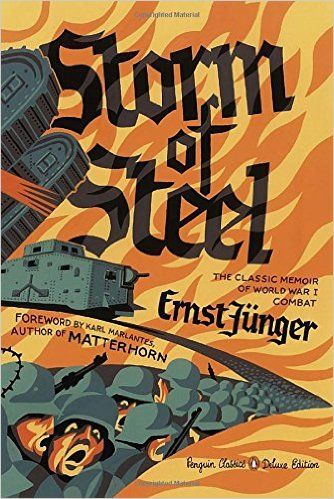 for convention, this WWrite post steps out of the current narrative in war literature to explore our culture's allure not to peace, but to violence. Rather than glorifying war, recent memoirs and books have concentrated on its debilitating and destructive effect on the returning soldier. In this post, Ackerman gives us his take on Ernst Jünger's seminal war memoir, Storm of Steel,, and the ways in which it assigns a redeeming quality to combat violence.
Next Week's Post: Journalist, writer, historian, and documentarist, Stéphanie Trouillard, who is the WWI Centenary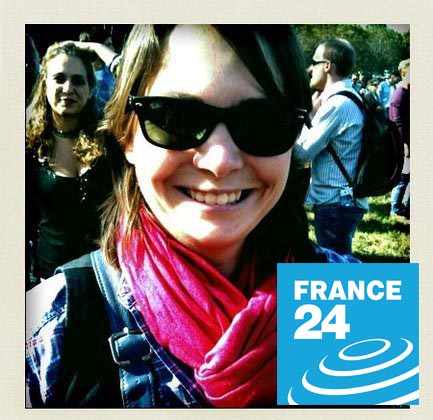 French journalist Stéphanie Trouillard for France24 Correspondent for main French news service, France 24, covered the Bastille Day parade in Paris and the meeting between President Trump and President Macron. She will share her live Twitter feed and commentary of the event with photos.
Macron, Bastille Day, and Force of Writing The President of France, Emmanuel Macron, who often cites poets, novelists, and philosophers in his interviews and speeches, relies on his strong literary background to talk about contemporary issues in French politics. At sixteen, he declared that he wanted to become a writer and was encouraged in his pursuit by his high school French literature teacher, Brigitte Trogneux, who later became his wife, Brigitte Macron. The couple even claims that writing a play was what brought them together.“It was at secondary school, through drama, that I met Brigitte. It was surreptitiously that things happened and that I fell in love. Through an intellectual bond, which day after day became ever closer. Then emerged a lasting passion” (1).
Macron tried two times to enter France's equivalent of America's Harvard for literature (l'Ecole Nationale Supérieure), but was never accepted. Despite having published several books and written three unpublished novels, Macron, in an interview with the French Le Nouvel Obs cultural editor, Jérôme Garcin, concedes to what he sees as his writerly shortcomings with a joke: "I might have had the vanity to become a writer," he said, "but not the humility." Perhaps it was his admiration for writers, and the writer that he claims to have never become that led him to select French novelist, Quentin Lafay, as his head speech writer. In almost all public discourse, Macron makes references not only to writers, but also to the act of writing itself. Recent speeches have featured, among others, writer and novelist, Emile Zola, poet Réné Char, and philosopher, Paul Ricoeur. In front of a group of college students, he described writing as a courageous act that can upset the seemingly smooth fabric of a society or people. He admitted "The people I admire most are writers, those who are a bit disruptive. It takes real courage to write. A lot more than for what I do. A lot more than for politics. If I were really courageous, I would write."
The speech he gave on Bastille Day commemorating America's 100th anniversary of its entrance into WWI was no exception. He began by describing France's national tripartite motto of Liberty, Egality, and Fraternity, which comes from the The French Revolution, a series of conflicts that gave birth to French modern democracy. He then declared that "the energy of the French people, the will of the French people wrote our history." Macron seems to configure France's history, not as a series of actions happening over a period of time, but as an act of writing—a deliberate, concerted effort by the French people, not spontaneous events colliding to form a makeshift national narrative. This is a history of words fitting together in complex ways to make sentences, paragraphs, books. And, in this writing project, each word, each part of history connects to another. Like in good literary analysis, examining one event means examining all variations and recurrences of that event throughout history to gain greater understanding.
Although the 14th of July commemorates an important day in the founding of the French nation, Macron spoke first Presidents Macron and Trump shaking hands at Bastille Day commemoration about the lasting friendship with the United States by thanking President Trump, who stood by his side, for America's entry into WWI on April 6, 1917, 100 years ago. "Nothing will ever separate us," he stated. He went on to thank the men and women who served France during times of conflict, a group including not only soldiers, but also firefighters, police, and civilians who played roles in helping with the terrorist attacks that have plagued France in recent years. (After the speech in Paris, Macron went to Nice to honor the victims of the terrorist attack that killed 86 people during a July 14th celebration there last year).
After the fanfare of the military parade that featured American soldiers in WWI uniforms and the display of WWI military vehicles, I expected Macron to close with another nod to President Trump and the 100th-year anniversary. However, his tributes ended by recognizing France's "pupilles," many of whom stood in front of Macron during the speech. "Pupilles de la nation", or "wards of France," are children who undergo an extraordinary legal process to become adopted by the nation. These children, who receive much more special attention than orphans, are those who have lost a parent to a fight or conflict protecting France. In 2015, more than 33 children received the "ward of France" status because one or both parents were killed in the November 13th terrorist attacks on Paris. The children are expected to carry the memory of their parent-hero with them until the end of their lives (2).
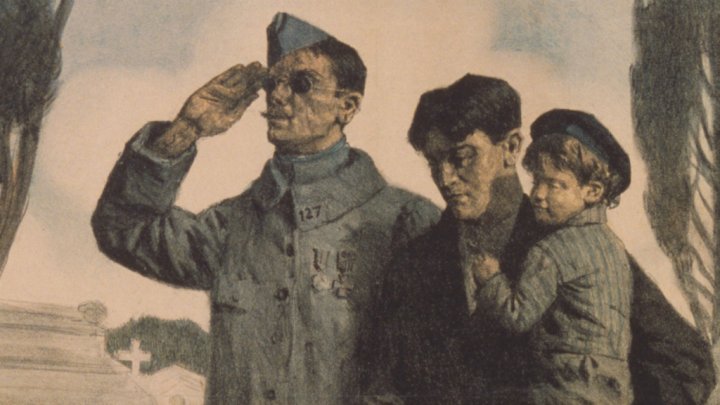 Library of Congress | Illustration from a poster dating back to 1917 advertising a charity event for World War I widows and orphansNot WWI, I said? In fact, the status of "wards of France" began in the wake of WWI and affected over a million French children who lost parents in the combat that mostly took place on their soil. French WWI historian, Olivier Faron, explained in in an interview with France 24's Stéphanie Trouillard (next week's featured blogger), that they were given financial, medical, and individual psychological support. Due to their trauma, they were allowed flexibility in their schooling. And, there were so many that special vacation spots were created just for them. The same status was adopted in WWII and was given to victims of terrorism in the 1990s.
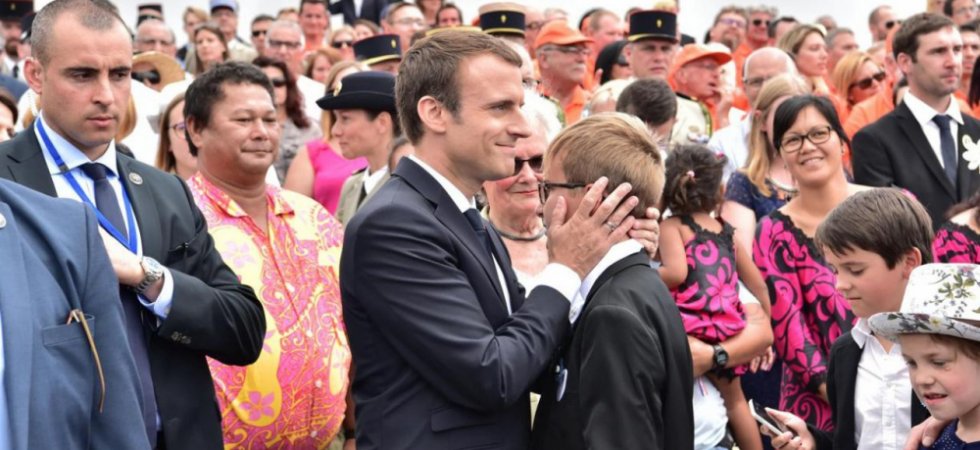 Macron consoles a "ward" in tears after Bastille Day speechWhile the "ward of France" status carries a great honor and inscribes a long-lasting place of remembrance for the dead parent, it also comes with a certain ambivalence. Faron describes a heartbreaking encounter with a WWI "ward" who expressed his frustration with his status: "What have I ever done? I was just sleeping next to my father when he died of tuberculosis."
President Macron not only came back to WWI at the end of his speech with an unexplicit historical reference; he  Book jacket for Camus' The First Manalso came back to with an unexplicit reference to writers and writing. French Nobel prize laureate, Albert Camus, author of The Stranger or The Outsider and The Plague, happens to be both a WWI "ward of France" and one of Macron's favorite writers. Camus, born and raised in French Algeria, lost his father to WWI combat in eastern France when he was just 2 years old. Camus spent his entire literary life avoiding the subject of his father, claiming that he had never known him. However, Camus' last autobiographical novel, The First Man, published posthumously, was a revelation of his life-long search for his hero-father's identity. He makes a pilgrimage to a WWI cemetery in France and realizes, at 40 years old, he is older than his father was when he was killed. The status of "ward of France" tied Camus to a France and a father he never knew well, leaving him with the mixed feelings of national pride and alienation that show up in much of his fictional, philosophical, and journalistic work.
WWI—For Macron, it is a history of friendship with the U.S., a history of honor, and a history of loss that he weaved through his Bastille Day speech as he cited both contemporary wounded veterans and the youngest victims of today's terrorism. Above all, it is a story of WWI's presence in today's world, one that will also write the future.
(1.) From an edited, translated extract from Emmanuel Macron: Un Jeune Homme Si Parfait by Anne Fulda, published by Plon, published in The Telegraph, May 8, 2017.
(2.) Text here adapted from Stéphanie Trouillard's interview with Olivier Faron.