




































John B. Kane
Submitted by: Gus and LaWanda Zimmerman {Grandson}
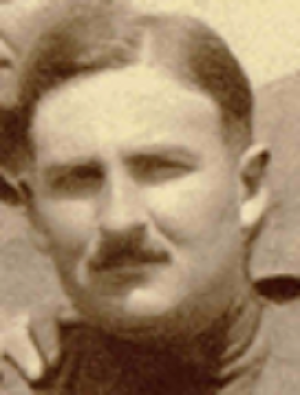
John B. Kane born around 1893. John Kane served in World War 1 with the United States Army. The enlistment was in 1917 and the service was completed in 1919.
Story of Service
The Khaki Road
My grandfather, John B. Kane, an architect who lived in the Philadelphia area, died when I was twelve years old. He never discussed his time in the service during WWI.
When my mother was an adult, she discovered a book he wrote to her when she was ten years old. The "little story" was typed on fragile onion skin paper, written as though he were telling his young daughter stories about his military service. We speculate that he wrote the book because WWII was just starting, and he couldn’t imagine how the leaders would allow such monumental sacrifice to occur again.
WWI was the first time Americans fought overseas, consequently resulting in the formation of the Graves Registration Service. His drafting experience was put to good use by designing and plotting the first of many American cemeteries in France.
John August Kiecker
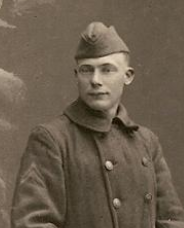 Submitted by: Janet L. Rajala {Grand Niece}
John August Kiecker born around 1890. John Kiecker served in World War 1 with the United States Army. The enlistment was in 1917 and the service was completed in 1917.
Story of Service
John August Kiecker served as a corporal in the American Expeditionary Force of the U.S. Army under General John J. Pershing. Although I have few records of his service, the following is an excerpt from a letter he wrote to his nephew, John Lietzau, (my uncle) on April 20, 1919 from Quernignyrot, France.
"Well, John, I am still in France but soon will leave for Germany where we'll enter the occupation troops and therefore have to hold our end down until everything is settled. The first peace treaty is supposed to be signed by the 25th. Inst. probably the soldiers will be lessened according to peace negotiations. Just think today it is Easter sunday and no eggs for today. Eggs, milk and sweet deserts you don't get in the army. Yesterday we had a beautiful day, sunshine all day, mind you. This occurs not often in France. I must tell you that I am teaching school here in the army and therefore am not drilling at present. Four boys from our company got a discharge from the Army and now be home or on their way home."
" I am feeling hale and hearty and would be ok if they send us back to the states. "
"The frogs are shearing their sheep now consequently they are looking for warmer weather in the near future. By frogs, I mean the french people. You can rest assured it will be a great day for us boys when they turn us loose with a honorable discharge from the services of the U.S."
Frank William Taylor
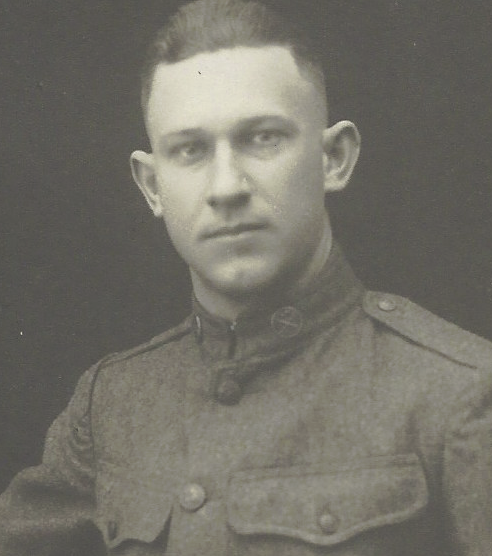 Submitted by: Janet L. Rajala {Granddaughter}
Frank William Taylor born around 1892. Frank Taylor served in World War 1 with the United States Army. The enlistment was in 1917 and the service was completed in 1919.
Story of Service
My grandfather never discussed his experiences in WWI. Further, all his military records were destroyed in a fire in Washington D.C. in the 1970s. However, I have his pocket Bible given to him before he was sent overseas. It indicates he was going to France.
He entered the Army in August 1917, soon after he married my grandmother. His picture of him in uniform displays an insignia that gave us a clue as to his service. Researching the insignia, we believe he was part of the 89th Infantry Division. Another insignia on his collar appears to denote his relationship to the artillery. If so, he most likely served with the 164th Artillery Regiment.
Further research indicates the 89th Infantry Division was sent to France in June of 1918. They were part of the campaigns at St. Mihiel and Meuse-Argonne. The 89th was given a Battle Honor for their major operations in these two battles.
Albert B. Replogle
Submitted by: Ramona Replogle {Daughter}
Albert B. Replogle born around 1893. Albert Replogle served in World War 1 with the United States Army. The enlistment was in 1917 and the service was completed in 1918.
Story of Service
Sgt. Albert B. Replogle
“L” Company, 362nd Infantry 91st Division “The Wild West Division”
Grass Range, Montana
We arrived in Tacoma in September, conscripts and a few enlisted men from,the nine Western states and Alaska territory. Montana had more recruits per capita than any other state.
Camp Lewis was prepared for us and we started drilling immediately. My division, the Wild West Division but officially known as the 91st, was given an insignia inspired by the Wild West: a green fir tree circled in red with a red 91 on center. We were proud to be the first American Army division formed in America and the first to be shooting in France.
We boys from Montana and Wyoming made up the 362nd Infantry Regiment, and we excelled at everything, We were the best in the mock trench battles, open warfare training, rifle fixed bayonets and hand to hand combat, and of course we were all expert marksmen and experienced shooters.
We needed some good Western passwords. We choose “Powder River”—a broad and dangerous looking stretch of wide water and coal-blackened sand running through Eastern Montana and Northern Wyoming. Not as formidable as believed at first sight, being actually only a few inches deep. A fitting thought while facing the Hun. It became our battle cry and we coupled it with “let ‘er buck”....the universal command of every ready-mounted Bro co Buster from corral to rodeo chute: Powder River - Let ‘er Buck became our war Whoop, our battle cry, our motto, our cheer. The motto of the French Army was, “they shall not pass”. We replaced that three year old watch word with our Wild West equivalent of let’s go...."Let’er Buck”
Charles C. Peterson
Submitted by: Charles David Rawls {Grandson}
Charles C Peterson born around 1900. Charles Peterson served in World War 1 with the United States Army. The enlistment was in 1917 and the service was completed in 1922.
Story of Service
Transcription: World War I Diaries of Pvt. Charles C. Peterson
Diary 1: black notebook, sewn binding
[inscription on front page]
Pvt Charles C. Peterson
Greenville
R #3 Alabama
[start of diary]
My Army Life
By Charles C. Peterson
On July 29th 1917 I intered the U.S.N.G. I was only a kid not old enough to belong to the Army, but I enlisted anyway in the 1st Ala. N.G. Co. D. from Fort Deposit Ala. Not knowing anything about the Army, I was put in a training camp at Camp Sheridan Montgomery, Ala. for 2 weeks training. After the 2 weeks training I was trained for a soldier and was then sent back to my company and was assigned to a squad of 7 pvts. And a corporal in charge. On Aug. 5 1917 the Ala. N.G. was mustered into the Federal service and about 75 men from Co. D. 1st Ala. N.G. was transferred to Co. D. of the 4th Ala. N.G. I happened to be one of the men in the 75 that were transferred. This made Co. D. 4th Ala. N.G. 250 war strength. The company was then divided into 4 Platoons. 1,2,3,4. Later the 4th Ala. N.G. was changed to the 167th Infantry and put in the 42nd Div. which was named the “Rainbow Division.”
George H. Ratterman
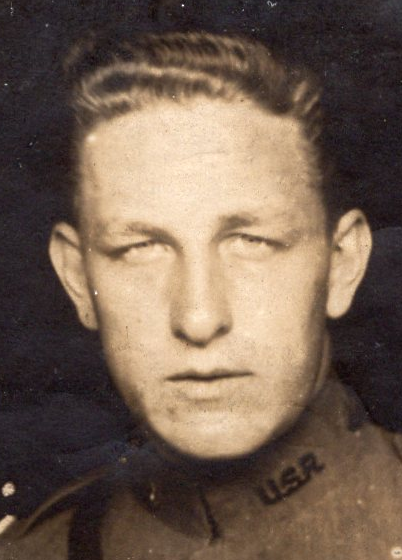 Submitted by: John L. Nolan {Great Nephew}
George H. Ratterman born around 1898. George Ratterman served in World War 1 with the United States Army Air Corps. The enlistment was in 1917 and the service was completed in 1918.
Story of Service
George H Ratterman joined the US Air Service and on 6/12/18 was assigned to the newly formed 96th Bombardment Squadron in the 1st Day Bombarment Group. This Squadron operated over the American Sector of the Front starting in mid May 1918.
When the St. Mihiel offensive began, the German railhead at Conflans was a frequent target for the 96th. On July 10th, 1918, the entire 1st Day Group was to make bombing attacks behind the German lines. The 96th’s target was Conflans. Due to very poor weather conditions, all units except the 96th decided not to fly. Six Breguet 14’s, each with their crew of two headed towards their target. Lt George Ratterman was in one of those bombers.
With no way to see the ground and primitive instrumentation they had no way to realize how strong the tail wind became, pushing them deeper into Germany than expected. Eventually the Squadron Commander, Major Brown realized they were not going to see their target and signaled for the Squad to turn back. Now the wind was in their face, slowing their progress back to the safety of France. One by one the Breguet’s began to run out of fuel. Each was forced to land. Each crew was unhurt, but all were captured.
Thomas J. Quayle
Submitted by: Tish Wells {Distant cousin}
Thomas J. Quayle born around 1886. Thomas Quayle served in World War 1 with the United States Army. The enlistment was in 1917 and the service was completed in 1918.
Story of Service
Some stories aren't about the soldier but who they leave behind. Lieutenant Thomas Quayle married 23 year old Sarah Webster in July 1917, and they moved from base to base as the U.S. went to war. Then he was sent to fight in Europe.
Sarah Webster, widow of World War I
By Tish Wells
On July 3, 1917, a tall brunette of 23 married a military officer named Thomas J. Quayle, 31, a 1st Lieutenant, U.S. Army.
Three months before, on April 6, the U. S. had declared war on Germany.
Out of a mass of family owned, dimly-penciled letters and stationary inscribed with sputtering ink, yellowing telegrams, worn scrapbooks of photos, and official documents, came her story told in letters to her close friend, Mildred Chapman, who had kept the correspondence, most in their original envelopes, for a century.
Sarah and Mildred had sung in the choir at Hiram College in Ohio. After Sarah graduated, she went to work at fashionable Halle Brothers department store in Cleveland. A year later, in 1914, she helped Mildred get her first job there as a telephone orders clerk.
Then, Sarah’s life went a different way. Her father died, and she went home.
George Warren Schantz
Submitted by: Tim Schantz {great nephew}
George Warren Schantz born around July 4th 1896. George Schantz served in World War 1 with the United States Army. The enlistment was in 1917 and the service was completed in 1918.
Story of Service
Corporal George Warren Schantz
Our great uncle George was born on Independence Day, 1896 and grew up in Allentown, Pennsylvania with our great grandparents, Adam and Lizzie, and his younger brother, Edwin, my grandfather (two other brothers, Llewellyn and William passed away as children). Family lore suggests that he also introduced brother Edwin to my grandmother, Carrie Stahley.
George enlisted at 21 on July 25th, 1917 with Company D, 4th Infantry of the Pennsylvania National Guard. This unit was reorganized at Camp Hancock, Georgia, and George became part of Company C, 109th Machine Gun Battalion of the 28th (Keystone) Battalion.
On May 7th, 1918, he left Camp Upton on Long Island for England, ultimately embarking from Folkstone for the British sector of the Western Front near Boulogne-sur-Mer. Company C and the 109th MGB went into direct action in France on George’s 22nd birthday to the south and west of Reims.
Otto C. Hardtke
Submitted by: Roy W Kessmann (Great Nephew)
Otto C Hardtke born around 1 Oct 1892. Otto Hardtke served in World War 1 with the United States Army. The enlistment was in 1917 and the service was completed in 1918.
Story of Service
Story of Otto C Hardtke, 1 OCT 1892—2 NOV 1918, Military ID 2833359
When I was five or six years old, I was sitting next to my Grandmother Sielaff in Oak Park while she was reading her German Bible. A news clipping fell out and landed on the floor. I picked it up and saw that it had a photo of a soldier in a uniform. I asked her who it was and with tears in her eyes she said that it was her Brother and he was killed in the war.
I asked her for some details and she said she had none. I asked my Mother if she knew anything about it but she said all she knew was what she overheard from her Uncle and Otto's Father. So I went through my entire life wondering what could have happened. Finally, six years ago I decided to begin researching the details. My findings so far are documented here.
Otto C Hardtke was born in Chicago, IL on 1 Oct 1892 to German immigrant parents Wilhem and Wilhelmina Jennerich Hardtke. Wilhem and Wilhelmina arrived in the United States separately from Prussia in the early 1880's. Wilhem arrived in 1882 and Wilhelmina in 1884. They met in Chicago, and were married on 1 January 1888. They lived in Ward 15 then 14 in Chicago.