




































Hugh Thomas Nelson, Jr.
Submitted by: Thomas P. Nelson, Jr. Grandson
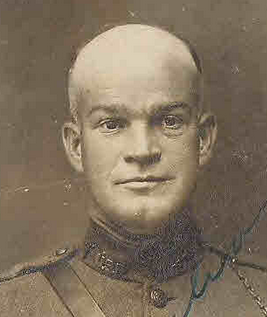 Hugh Thomas Nelson Jr. born around 1876. Hugh Nelson served in World War 1 with the United States Army. The enlistment was in 1917 and the service was completed in 1919.
Story of Service
During World War I, Hugh Thomas Nelson, Jr. was commissioned a Captain in the Medical Corps and ordered to Camp Lee, Virginia, where he was placed in charge of sanitation. He became the commanding officer of the 318th Field Hospital.
He was later commissioned a major and sailed overseas with the division on May 25, 1918 aboard the ship Mercury, returned to the States in the early 1919.
Among major engagements in which his service was rendered were the Argonne and Meuse Offensive.
Major Nelson would begin the effort to leave France on Christmas Day 1919 when he received word that Edith, his wife, was very ill. Edith, on October 15, 1918, gave birth to Hugh Thomas Nelson III in Charlottesville, who died two days later and is buried in the family cemetery plot at Riverview Cemetery in Charlottesville.
Henry Eugene Quinn
Submitted by: Diana Quinn Cotton {Granddaughter}
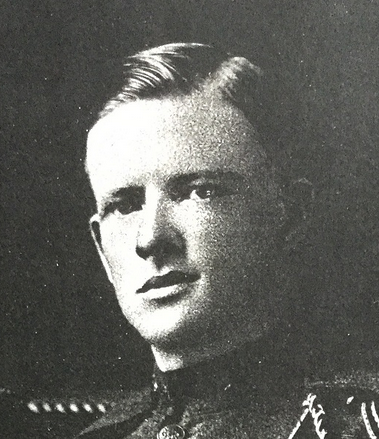
Henry Eugene Quinn born around 1899. Henry Quinn served in World War 1 with the United States Army. The enlistment was in 1917 and the service was completed in 1919.
Story of Service
PFC Henry E. Quinn served as a company runner in Co. F 28th Infantry 1st Division, American Expeditionary Forces, United States Army, during World War I and was awarded the Distinguished Service Cross, Silver Star, Purple Heart with Oak Leaf Cluster, Croix de Guerre, and Victory Medal with Five Battle Clasps.
My grandfather, Henry Eugene Quinn, was born in Anniston, Alabama, on January 31, 1899. He was the fourth of eleven children of William Eugene Quinn (1865-1945) and Emma Langdon (Fowler) Quinn (1873-1963). He stood 5’ 8” tall, had red hair, blue eyes, a fair complexion, and was covered in freckles. His nicknames were “Bud” (at home) and “Red” (in the Army).
In his World War I memoirs, written many years after the war, Henry wrote:
“March 1917—Applied for enlistment at Monroe (LA), was examined by a colonel Dr. who was rather rough in criticizing my physical condition, stated that I looked like a picked chicken, etc., account of being so skinny. I was not use to such criticism & talked rather rough to him in return. Sgt. was in the background motioning me to hush, etc., but I said my say. Col. flared up & stated, ‘He will do Sgt—I will get a waver on his weight tonight.’ I was 11 lbs. under weight.”
Henry briefly returned to Swartz, LA, to inform his family he had joined the Army and to tell them goodbye. His father “shook hands & told me that I had been my own boss for some time, but now I had a real boss.”
Elwyn J Frazier Sr.
Submitted by: Michael Owen Frazier {Grandson}
Elwyn J Frazier Sr. born around 1895. Elwyn Frazier served in World War 1 with the United States Arm . The enlistment was in 1917 and the service was completed in 1919.
Story of Service
Thomas F. Herron
Submitted by: Betty Perkins {Great Niece}
Thomas F. Herron born around 1880. Thomas Herron served in World War 1 with the United States Army. The enlistment was in 1917 and the service was completed in 1918.
Story of Service
Boyd Willard Stone
Submitted by: Donald Stone {Grandson}
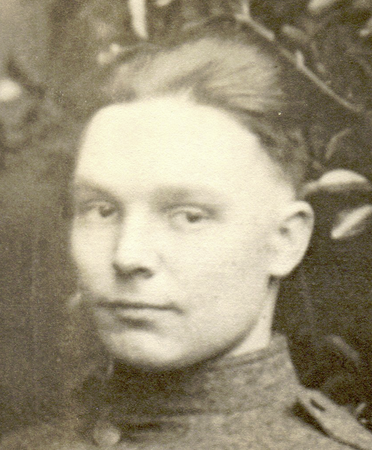
Boys Willard Stone born around 1901. Boyd Stone served in World War 1 with the United States Army. The enlistment was in 1917 and the service was completed in 1919.
Story of Service
My paternal grandpa, Boyd Willard Stone, enlisted as a private in the United States Army on September 17, 1917 at the age of 16 (yes, he fibbed about his age).
After basic training at Camp Colt in Gettysburg, PA he was ultimately assigned to Co. B, 5th Machine Gun Bn., 2nd Infantry Div.
His WW I Victory Medal shows service in the following engagements: AISNE, AISNE MARNE, ST. MIKIEL, MEUSE ARGONE, DEFENSIVE SECTOR and CHATEAU THIERRY. He received two "wound stripes": gassed in the Troyon Sector 3/27/18, and a shrapnel wound at Chateau Thierry. He was also awarded the Silver Star.
He was discharged August 14, 1919. After the war he moved to St. Louis, MO and married Olive E. Aldrich (Stone) and began work for the Terminal Railroad Assn.
During the '20's and '30's he and grandma had a daughter and son (my Dad), and in 1943 he enlisted in the Army once again (this time as a Captain) and was assigned to the 2nd Military Railway Service Unit and sent to England to prepare for the invasion of Europe.
Garland Langhorn Spain
Submitted by: Jacob Parks, Administrative Support Specialist, The Country Doctor Museum
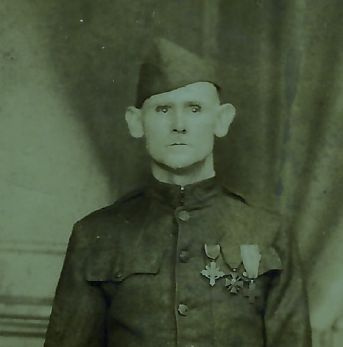
Garland Langhorn Spain born around 1890, Garland Spain served in World War 1 with the United States Army. The enlistment was in 1917 and the service was completed in 1919.
Story of Service
Garland Langhorn Spain was born on July 17, 1890 in the small community of Jarrett’s Depot in Sussex County, Virginia to Benjamin and Josephine Gates Spain. By 1910, Garland Spain continued living in Virginia and worked as a farmer to support his widowed mother.
For reasons that are unclear, Spain relocated to Rocky Mount, N.C., where he lived at the time of his registration for World War I on June 5, 1917.
Garland Spain was inducted into military service with the U.S. Army on September 20, 1917 and took up arms as a corporeal with Company E of the 322nd Infantry, 81st Division. After training, Spain set sail on the troop transport ship Helenus on July 31, 1918 from Brooklyn, New York to Europe.
Spain received severe wounds while fighting in the Great War. Either on November 9 or 11, 1918, Garland Spain was shot twice while advancing on six German machine guns that wounded the rest of Spain’s squadron near Moranville, France.
Jim Higgins
Submitted by: Jacob Parks, Administrative Support Specialist, The Country Doctor Museum
Jim Higgins born around 1896. Jim Higgins served in World War 1 with the United States Army. The enlistment was in 1918 and the service was completed in 1918.
Story of Service
The Influenza Pandemic of 1918-1919 accounted for more deaths than wartime casualties in World War I. Even though the war was ending in the fall of 1918, soldiers continued to die from complications from other diseases, not just from the flu. Three Nash County WWI soldiers contracted pneumonia and then died within a week of each other.
Little is known about Jim Higgins’ early life, but his military records indicate that he was an African-American soldier born on December 1, 1896 in Franklin County, N.C. At the time of his draft registration, on June 5, 1917, Higgins was a farmer near Spring Hope in Nash County.
Higgins enlisted in military service on July 29, 1918 and arrived at Camp Green, just like Henry Bullock. While in training, Higgins joined and served in Company D, 344th Labor Battalion.
Henry Bullock
Submitted by: Jacob Parks, Administrative Support Specialist, The Country Doctor Museum
Henry Bullock born around 1896. Henry Bullock served in World War 1 with the United States Army. The enlistment was in 1918 and the service was completed in 1918.
Story of Service
The Influenza Pandemic of 1918-1919 accounted for more deaths than wartime casualties in World War I. Even though the war was ending in the fall of 1918, soldiers continued to die from complications from other diseases, not just from the flu. Three Nash County WWI soldiers contracted pneumonia and then died within a week of each other.
Henry Bullock was born on June 1, 1896 in either Wilson or Nashville, N.C. to a large African-American family. Likely the son of a previous marriage, Henry Bullock’s mother was Louisa Bullock and by 1910 his step-father was Charles H. Bullock, a farmer. Many of Henry’s siblings worked on the family’s farm in Bailey.
Henry Bullock registered for the draft on June 2, 1917 and, at that time, worked with the Harris Granite Quarries Company as a quarry hand. Bullock was inducted into military service on July 31, 1918.
Homer Stonewall Proctor
Submitted by: Jacob Parks, Administrative Support Specialist, The Country Doctor Museum
Homer Stonewall Proctor born around 1894. Homer Proctor served in World War 1 with the United States Army. The enlistment was in 1918 and the service was completed in 1918.
Story of Service
The Influenza Pandemic of 1918-1919 accounted for more deaths than wartime casualties in World War I. Even though the war was ending in the fall of 1918, soldiers continued to die from complications from other diseases, not just from the flu. Three Nash County WWI soldiers contracted pneumonia and then died within a week of each other.
Homer Stonewall Proctor was born on October 2, 1894 to his parents William Henry and Minnie J. Moore Proctor. Homer was the eldest of at least five children born into this family, the others being John H., Henry C., Bertha V., and Mammie L. Proctor.
By 1900, William Proctor rented a home and worked as a farmer, but by 1910 he worked at a lumber yard in the area.
Homer Proctor was inducted into military service on May 24, 1918 and then reported for duty to Camp Jackson in South Carolina, where he served in the 17th Company, 5th Training Battalion, 156th Depot Brigade for one month. After this, Proctor served in Company H, 324th Infantry before shipping off to Europe on August 6, 1918.