






























William Anthony Hemmick
Submitted by: Patricia Daly-Lipe {great niece}
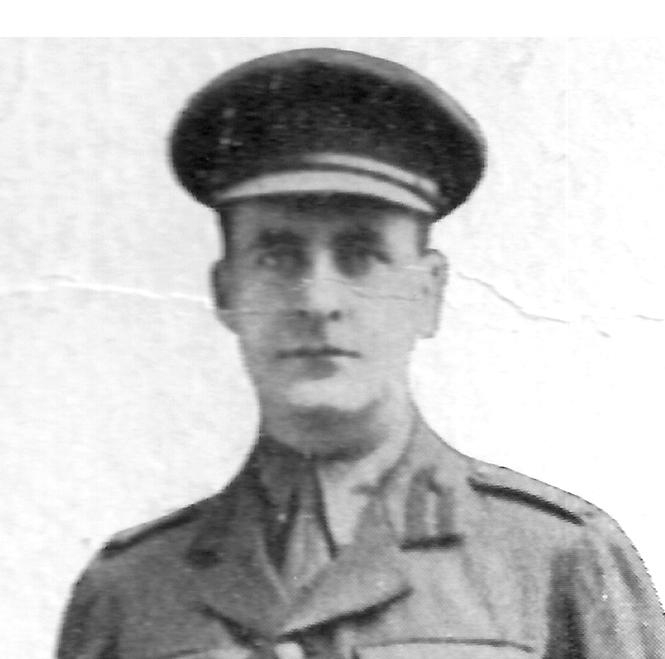 William Anthony Hemmick was born around 1886. William Hemmick served in World War 1 with a non-government service organization. The enlistment was in 1917 and the service was completed in 1919.
Story of Service
In 1917, the United States entered World War I. Cardinal Gibbons had been a chaplain in the Civil War and shared some of his experiences during that war with William. Thus, when William, who had by then been ordained, requested permission to serve the troops, Cardinal Gibbons agreed.
Father Hemmick arrived in Paris August, 1917, and became Captain in the "Croix Rouge." His sensitivity, his bravery, his compassion were felt by all who knew my great uncle. He served on the front lines at the battle of Picardy, giving last rights and burying the dead.
After the war, when he returned to Washington, great uncle William was proclaimed the "Patriot Priest of Picardy" by the Army and Navy. He returned to Paris and established the American Catholic Welfare Centre for all those who had been traumatized by the war.
Charles Emory Boykin
Submitted by: Johnette Brooks {GA WWI Troops of Color Historian}
Charles Emory Boykin born around 1896. Charles Brooks served in World War 1 with the United States Army. The enlistment was in 1917 and the service was completed in 1918.
Story of Service
WWI Corporal Charles Emory Boykin KIA: Argonne Forest
Charles Emory Boykin, Serial No. 1.974.564, was born the eldest of ten (10) children in Pool Mill District of Troup County, LaGrange, Georgia on November 17, 1896. His mulatto parents were Albert Sydney Boykin and Eunice Hill living at 307 Hamilton Street. Two years later, his brother, WWI Pvt. John Thomas, Sr. was born.
He was a student at (SATC) Georgia State Industrial College (the future Savannah State College) when he was inducted on July 1st and trained at Camp Hancock. His son was WWII Pvt. John T. Boykin, Jr.
When Charles E. registered for the Selective Service Draft on May 29, 1917, he was already a student at Morehouse College in Atlanta. He had a medium build, brown eyes, dark hair and he was single. Nine months later, he was inducted at a Chicago, IL Induction Office. He likely was entrained at Camp Meade. They arrived in Brest, France on June 19, 1918.
Their battalion proceeded to the French city of Vitrey, a four-day hike. Cpl Boykin was assigned to the the only negro signal corp in the American Army; the 325th Field Signal Corp, Company C. They were all colored college and high school males with expertise in radio/electrical engineering.
Clair Leo Shipler
Submitted by: Stephen Moore {great nephew)
Clair Leo Shipler born around 1896. Clair Shipler served in World War 1 with the United States Army. The enlistment was in 1918 and the service was completed in 1918.
Story of Service
Sergeant, U.S. Army
59th Infantry Regiment, 4th Infantry Division
St. Mihiel Offensive
For the St. Mihiel Campaign, the division moved into an area south of Verdun as part of the 1st American Army. Gen. Pershing, Commander of the American Expeditionary Force (AEF), had gotten the French and British to agree that the AEF would fight under its own organizational elements.
One of the first missions assigned to the AEF was the reduction of the St. Mihiel salient. The 4th Division, assigned to V Corps, was on the western face of the salient. The plan was for V Corps to push generally southeast and to meet IV Corps who was pushing northwest, thereby trapping the Germans in the St. Mihiel area.
The 59th Infantry Regiment moved into an area previously occupied by the French, deploying along a 9 kilometer front. On 12 September, the first patrols were sent forward by the 59th. The 4th Division attack began on 14 September with the 8th Brigade capturing the town of Manheulles. All along the front, the American forces pressed forward and closed the St. Mihiel salient.
Camille Louise O'Brien
Submitted by: Michael {Friend of family}
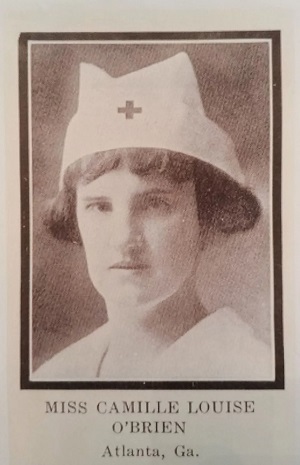
Camille Louise O'Brien born around 1883. Camille O'Brien served in World War 1 with the United States Army. The enlistment was in 1918 and the service was completed in 1919.
Story of Service
Emory Unit Nurse, Camille O'Brien, is the only Emory Unit nurse to died in France. Her family, in Roswell, Georgia, reached out to me to find a home for her personal effects. I am a retired police officer of 34 years and a historian so I agree to help. Happily, Camille's items are now at the Atlanta History Center. I decided to learn more about this nurse.
Unknown to the family, Camille's body was brought back to Georgia, in 1921 and placed in an unmarked grave, in Greenwood Cemetery, Atlanta. On April 18th, 2019, at 11am, I have put together a grave site memorial, for Camille. Thanks to Patterson & Son Funeral Home, Camille is going to finally have a beautiful gravestone. A WW1 Honor Guard will be present and a bugler, for Taps. Present at the site will be the grandson of Lt.Col. Edward Davis, the father of the Emory Unit, Ren Davis.
Who is Camille? She was born in 1883 in Warren County, Georgia. In 1900/1901, she attended the University of Georgia. In 1913, she attended the St. Joseph's Hospital School of Nursing, graduating in 1916.
Mary Darnaby Henton
Submitted by: Zack Austin
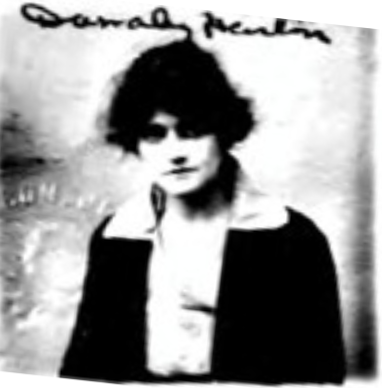
Mary Darnaby Henton born around 1894. Mary Henton served in World War 1 with the United States Army. The enlistment was in 1918 and the service was completed in 1919.
Story of Service
Darnaby (as she preferred to be called) was born the fifth child of farmers James Henton and Bettie Hampton in Versailles, Kentucky in 1894.
She was one of 7,600 women to volunteer for 100 positions advertised by the War Department in newspapers throughout the US calling for “patriotic women” to serve as “full-fledged soldier[s]” willing to face the dangers of submarine warfare and aerial bombardment. She followed her brother Sam, already serving as a Battalion Sergeant Major in the 326th Field Artillery Regiment, into the service, proud to be a member of America’s first unit of female soldiers outside of the Nurse Corps—the “Hello Girls”.
The first Hello Girls took the Army oath on January 15, 1918. By operating switchboards relaying orders and providing real-time translation from French to English, the women would “do as much to help win the war as the men in khaki who would go ‘over the top’” according to the War Department.
Darnaby is one of the 223 female telephone operators on wartime US Army Transport lists. She departed New York with the second group of women on March 29, 1918, aboard the armed ocean liner RMS Carmania. The Chief Operator overseeing her unit was Inez Crittenden from San Francisco.
Philip Martin
Submitted by: Michael Rauh {Grand Nephew}
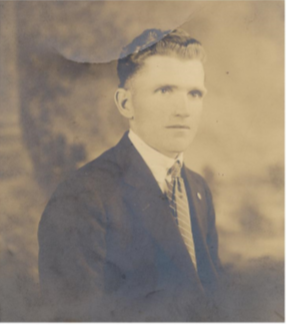
Philip Martin was born around 1892, Philip Martin served in World War 1 with the United States Army. The enlistment was in 1917 and the service was completed in 1919.
Story of Service
In 1958, I was a 5th grade student. While studying world history, my class learned about World War I, also known as the Great War. We read about the terrible battles where trench warfare, poison gas, and modern weaponry took many lives. I learned then that America had entered the war on April 6, 1917.
To help mark the 100th anniversary of these events, I want to tell my family the story I learned so many years ago.
At the end of the term where I learned about World War I, there was an old black & white movie on TV about the life of Sergeant Alvin York. He was one of the many American heroes who fought in the great war. For his actions, he received many awards and was the most decorated soldier of the war. I was very impressed with the movie and was surprised when my mother told me my great-uncle was a member of the same infantry unit as Sgt. York, and that he had fought in the same battles.
Ward Burgess, Sr.
Submitted by: Kate {great grand daughter}
Ward Burgess, Sr. served in World War 1 with the United States Marine Corps. The enlistment was in 1917 and the service was completed in 1917.
Story of Service
Ward served in world war one and 2. The rest is not known.
Vincent A. Luza
Submitted by: Lydia Luza Mousner {granddaughter}
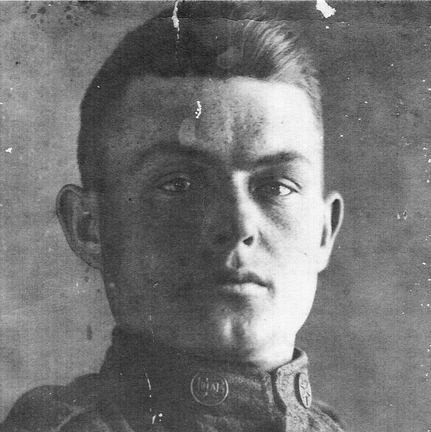
Vincent A. Luza was born in 1895. Vincent Luza served in World War 1 with the United States Army. The enlistment was in 1918 and the service was completed in 1920.
Story of Service
Vincent Aloysius Luza was born on May 2, 1895 in Bryan, Brazos County, Texas. His parents, Vincent and Mary Luza, and grandparents, Baltazar and Francis Gibble Luza, immigrated through the Port of Galveston in 1873 from Praha, Moravia. He was also the grandson of Frank and Angelina (Honozak) Luza. V.A.
Luza attended Allen Academy in Bryan, Texas. He was drafted into the army in 1918 and was assigned to the 344th Field Artillery in Battery F at Camp Travis, TX.
On March 4, 1918, the regiment with its two batteries of guns and six hundred-odd animals marched out to Camp Bullis (Leon Springs) for target practice. It was at Camp Bullis that reconnaissance gun squads were first able to put into practice their gun drill, which had in the beginning been executed on make-shift carriages of wood and later perfected by work on the eight three-inch pieces which had been assigned to the regiment.
Donald Morris McCallum
Submitted by: Sandra Dunlap {Granddaughter}
Donald Morris McCallum born around 1890. Donald McCallum served in World War 1 with the United States Navy. The enlistment was in 1908 and the service was completed in 1917.
Story of Service
My Grandfather's Service on the USS Tennesse (ACR-10)
The Tennessee was the receiving ship at the New York Navy Yard from 2 MAY 1914 until the outbreak of World War I in August of 1914.
At the outbreak the war, the Tennessee made a European deployment as part of the American Relief Expedition, leaving on 6 AUG 1914 on a rapid crossing to Falmouth, England. She arrived on 16 AUG.
When she left New York, the Tennessee was carrying US Treasury officials, banking officials, and $3 million in relief funds. Part of the gold went to London by train and then the Tennessee departed on 20 AUG for Holland to deliver the remainder to The Hague. She returned on 28 AUG to Falmouth.