


































Pvt. Ervin G. Dickson
Submitted by: Paul Burgholzer
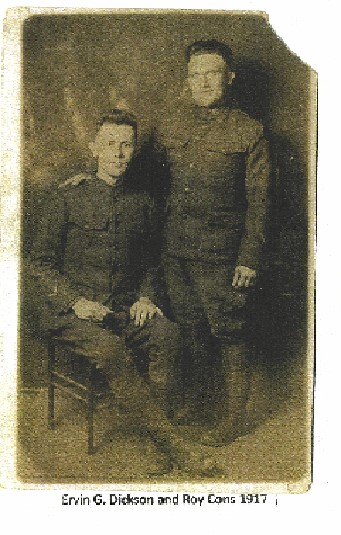
Pvt. Ervin G. Dickson served in World War 1 with the United States Army. The dates of service are: Known 1917-1919.
Pvt. Ervin George Dickson joined the Army in Mount Ayr, Iowa in September, 1917. Dickson was a farmer before he was sent to Europe as an infantryman for the US Army. He fought in the 38th infantry division while in France during 1918. He courageously fought at the Marne, St. Mihiel, the Verdun front line, and the Argonne Forest.
While fighting in the Argonne Forest, Dickson was shot in the hand, neck, and chest. German soldiers found him on the ground and moved him to a German field hospital where he received excellent treatment. his American comrades thought that he was dead and his death was recorded in US military records. His family was even notified of his death, yet he was recovering in a German Army hospital.
When the war ended he was brought to an American Army Hospital in France. Due to his wounds he could not write or speak. He managed to get someone in the hospital to write a letter to his family. the person misspelled his last name so the family was confused when they received this letter. One he recovered more, he went back to Iowa where he was welcomed as a hero.
Harry Malott
Submitted by: Gerri Brown
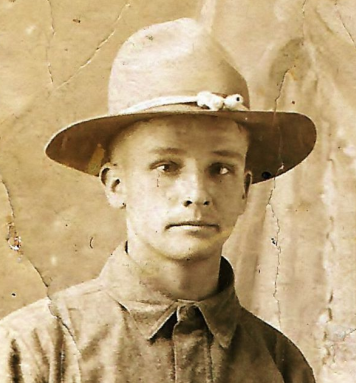 Photo submitted by Jody McDonald, 1st cousin 2x removed.Harry Malott served in World War 1 with the United States Army. The dates of service are: Known 04/03/1917-11/1918.
Story of Service
HARRY E. MALOTT, PFC
Veteran of World War 1
Enlisted - April 3, 1917 – Discharged-Nov. 1918
Landing in Hoboken, New Jersey
Paraded in New York City, N.Y.
On April 3, 1917 Harry Malott and his cousin Oliver Smith came to Canton, Illinois to enlist in the army in World War 1. Harry returned from the War In 1918. He had been wounded a couple times but never went to a doctor. His cousin Oliver was killed in battle in World War 1. Oliver is buried in France.
When applying for enlistment in the U. S. Army on April 3, 1917, when weighing in Harry was too light and they were going to reject him. He left and drank a lot of water to add weight and returned to weigh again. He was sworn in April 6, 1917, Company 1, 18th infantry as a Wagoner. He served overseas in Europe in World War 1 in France and Germany.
Returning home after the war ended. The troop ship was previously a cattle transport boat, & to keep down sea sickness he said that he ate onions that were kept in crate to feed the whales. Upon returning to U. S. soil the ship landed in Hoboken, New Jersey & the group of soldiers were transported to New York City where along with other soldiers they paraded through the center of New York City . When they landed thy left guns, mess kit, Cups, etc all in a large pile. He later was able to retrieve a mess kit and metal cup (not his own).
Lt. Perry Burke
Submitted by: Paul Burgholzer
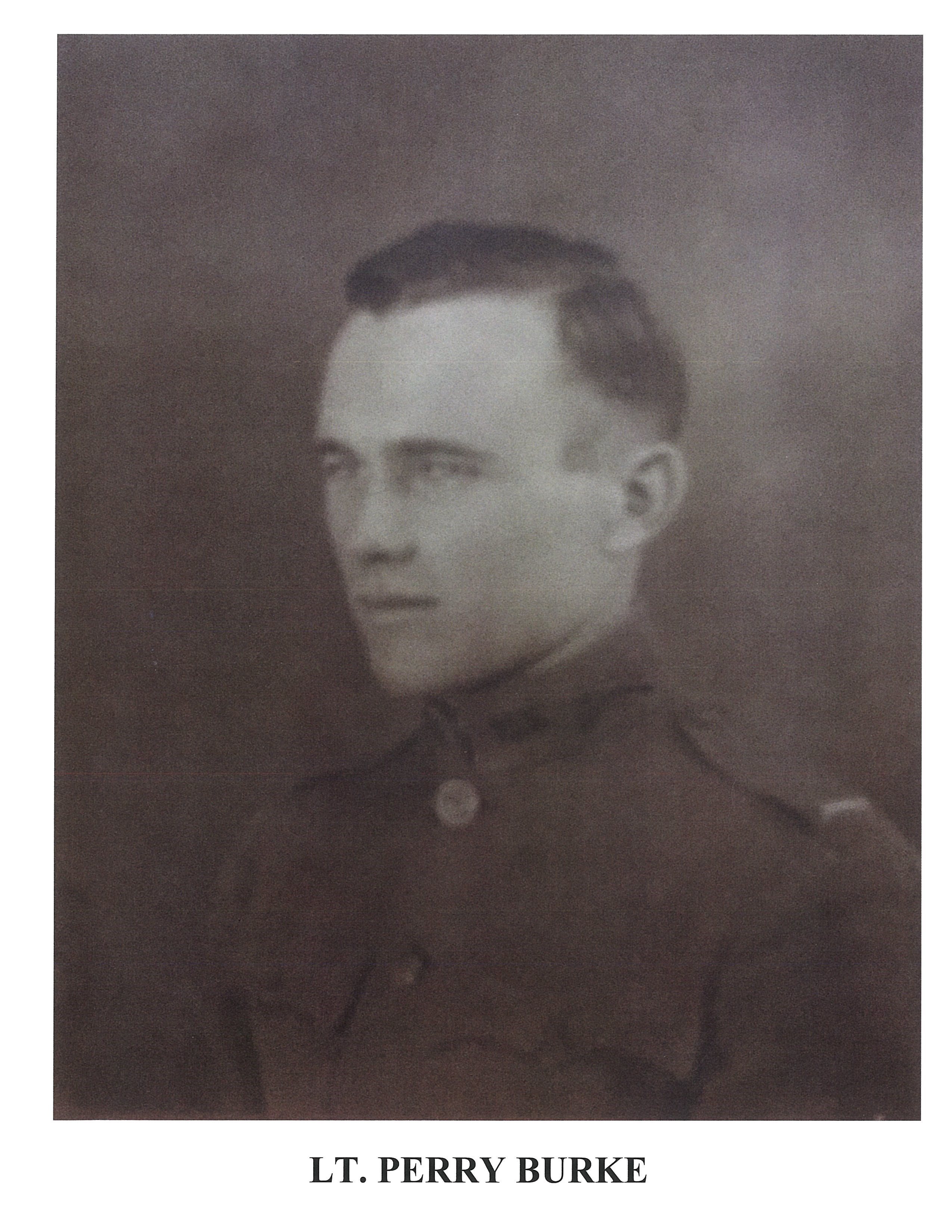
Lt. Perry Burke served in World War 1 with the United States Army. The dates of service are: Unknown.
Lt. Perry Burke was a rebellious young man. He attended Spring Hill College presumably for boarding purposes, which he ran away from twice. He eventually went to LSU which was a military school during that time. While attending the school as an underclassman he developed a strong dislike for an upperclassman officer. One day during a disagreement with the officer Perry threw a porcelain coffee cup at him. The officer was struck in the head and Perry’s days at LSU were finished.
Perry found work on a plantation where he would frequently need to be on horseback. Once America entered the war Perry and his friend named, Tom Jones, started a company of soldiers with the desire to go fight in Europe. Perry’s unit was turned into a Calvary company where he rode a horse and carried a saber. Perry's rebellious days were behind him as he became a family man and served as a Lieutenant for the US Army.
As Lt. Perry Burke looked like an officer from the previous century as he rode on horseback, his close cousin, Lt. David Ker, who flew as an observer in the Army Air Force was operating the newest military technology of 1918. Ker died in combat and Perry Burke kept a photo of him in his room for the rest of his life. Perry also kept the book “All Quiet on the Western Front” in his room and frequently read it.
Perry’s story was brought to the WWI Centennial Commission’s attention by his son, Porteus Richard Burke.
Lt. David Ker
Submitted by: Paul Burgholzer
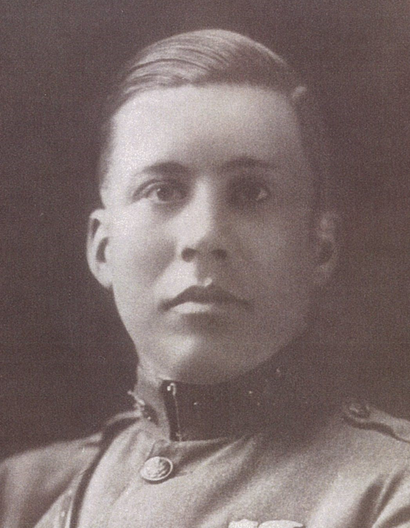 Lt. David Ker served in World War 1 with the United States Army Air Corps. The dates of service are: Known May 2nd 1917 - September 1918.
David Joined the US Army and was selected during training to be a part of the Army's Air Force. He was then honorably discharged so that he could properly enter the air service as a commissioned officer.
He spent the years before US entry in the war in New Iberia Louisiana. In New Iberia He loved dancing and fishing. He was full of life and was engaged to Mary Herbert when to left for the war.
In the Army Air Force he served as an observer meaning that he was responsible for photographing German positions and radioing strategic reconnaissance to Army ground forces. He was in charge of defending the plane as well. He was given a Lewis machine gun in case German planes attacked them in the air.
In a couple letters home to his mother he says that he has a grim premonition about his death. He writes that he is not terrified.
Cleve O. Sherrod
Submitted by: Marilyn Konruff {granddaughter}
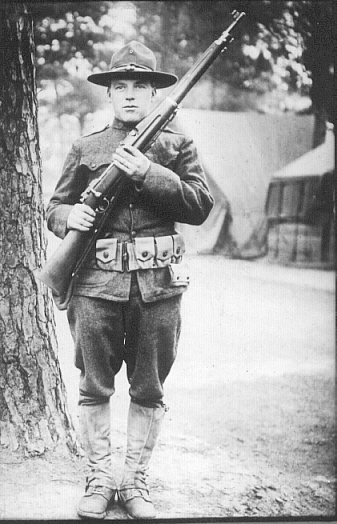
Cleve O. Sherrod served in World War 1 with the United States Army . The dates of service are: Known December 17, 1917-June 8, 1919.
On June 5, 1917, two weeks before his wedding, 29-year-old Cleve Sherrod filled out a Civilian Draft Registration card in Kilbourn, Wisconsin. He had tried to enlist in the U. S. Army before, but had been rejected due to height requirements (he was only 5’3”).
Cleve married Florence Wagner of St. Louis, Missouri, on June 26th. They honeymooned in Chicago before returning to Kilbourn, Wisconsin, where Cleve was employed by the railroad. Enlistment restrictions were suddenly lifted when the United States officially entered the war in France, so on December 14th, Cleve was able to enlist as a Private in the U. S. Army, 33rd Division, and dispatched to Camp Logan, Texas, for training. The 33rd Division, commanded by Major General George Bell, Jr., was composed of National Guard units from Illinois, prompting the name “Prairie” Division. As an electrician, Cleve was attached to the 108th Engineers, Company D under Col. Henry Allen.
Disembarking from a troop train at Camp Logan, Cleve Sherrod found a hastily built tent city. He slept on a cot in a cramped tent with eight others and was subjected to hot days, dust, mosquitoes, cold nights, disease, fatigue and hard days of physical activity and living outdoors. A typical day was about seven hours long and consisted of physical readiness exercises, marching drills, rifle maintenance and marksmanship, bayonet drills, and battlefield signaling. This short of stature, older Private kept up with the young ones!
Delta Lockhart
Submitted by: Ron Ostrander
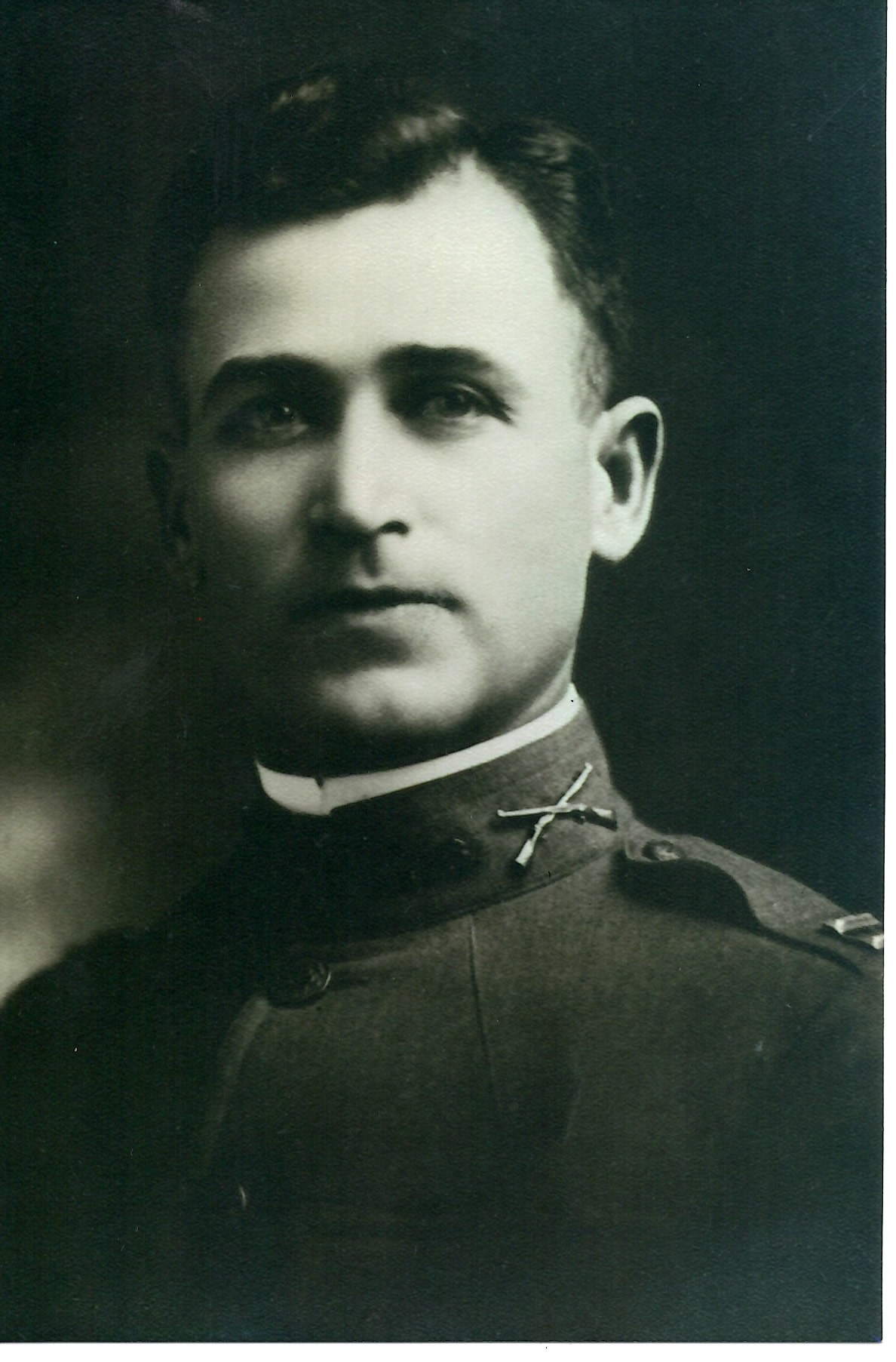
Delta Lockhart served in World War 1 with the the United States Army . The dates of service are: Known May 17, 1917 - May 19, 1919.
Delta Lockhart was a high school principle in Texas when the war broke out. He enlisted for officer's school at Camp Funston, Texas and was commissioned a 1st Lt. on August 15, 1917. Later, he was promoted to Captain, on December 31, 1917.
His main duty was to supervise the training of troops. His last duty station was Camp Taylor, Kentucky, where he was CO of Co. K, 5th Infantry Division
 Ben H. Ripperda
Submitted by: Thomas Ripperda {grandson}
Ben H. Ripperda served in World War 1 with the United States Army. The dates of service are: Known June 24, 1918 to June 7, 1919.
My grandfather, Ben H. Ripperda, was drafted into the Army on June 24, 1918 at the age of 25 and served in World War 1. Ben was born in the farmhouse that his grandfather built in Section 20 of Germantown, Illinois. His primary language was German and English was secondary.
Since he was a farmer, he took care of the horses in an Artillery unit (3rd Batt.). He arrived in France in October of 1918, by this time there were a lot of German prisoners were being moved to the rear, Ben was taken off stable duty and assigned to guarding the German Prisoners of War (POWs). My grandfather started asking in German if there were any Ripperdas among them. The other guards took his rifle and placed him with the German POWs.
After a few minutes, Ben’s company commander, Captain Adams, came walking by. My grandfather started yelling in broken English, “Captain Adams, Captain Adams, Captain Adams.” Adams stopped after hearing his name looked around and saw my grandfather with the POWs. Captain Adams got him out and forbid my grandfather from speaking German.
Fred Frank Carson
Submitted by: Kevin Loren Carson
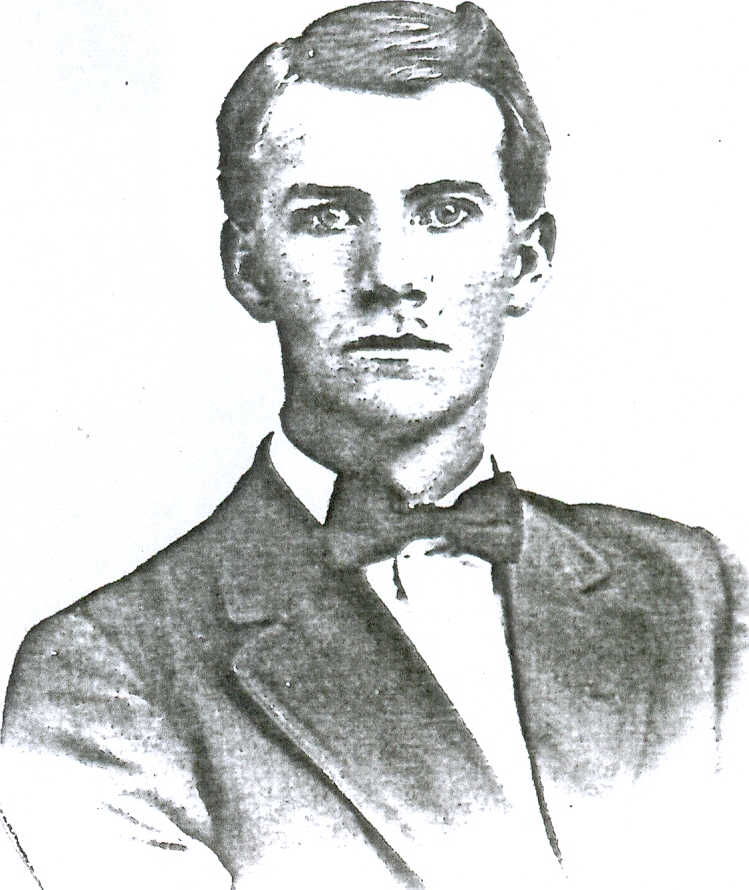
Fred Frank Carson served in World War 1 with the United States Army . The dates of service are: Known June 5, 1918 - Oct 1, 1918.
Fred Frank Carson’s journey from seminary student to the Battle of the Meuse Argonne was a brief one. Fred was born in Prescott, Washington near the Walla Walla River, June 5, 1897. He enjoyed the outdoors and was a fine runner, garnering awards for his speed in competitions.
Fred tried to enlist while he was at Spokane University but was initially rejected. Since he was a seminary student at the school, he was exempt from the draft. But Fred was determined, and he tried several venues until he was inducted into the Army at Camp Lewis, Washington, home of the 91st Division. It was his birthday, June 5th, 1918.
Fred’s Division was variously known as the Pine Tree Division, and the Wild West Division. Some called the soldiers ‘Westers’. The Division drew its strength of 22,000 soldiers from the western states.
George Kirbey Traylor
Submitted by: Patrick F. Huston
George Kirbey Traylor served in World War 1 with the United States Army . The dates of service are: Known 1917 - 1918.
Private. A veteran who served overseas in France. Assigned to an American army infantry division fighting on the western front lines. Awarded the WWI victory medal.