































World War I Centennial News
Four Questions for Robert Laplander of Doughboy MIA
"Chasing their stories in order to understand what happened to them."
By Chris Isleib
Director of Public Affairs, U.S. World War One Centennial Commission
This has been a big month for our friend Robert Laplander. He is the leader of a small group of volunteers called Doughboy MIA, a group that does research into the 4,224 missing service members from World War I. They try to bring accounting for those missing, as the U.S. Department of Defense is only able to support MIA research going back to World War II. Laplander had a breakthrough discovery on the case of Seaman Herbert Renshaw, a U.S. Navy sailor who was lost at sea during an anti-submarine combat patrol, off the coast of Virginia on 22 May 1917. In the Renshaw case, the seaman's name was evidently omitted from those MIA's named on the chapel wall at Brookwood Cemetery. The Brookwood chapel is an American Battle Monuments site, in the UK, which bears the names of missing US sailors, soldiers and Coast Guardsmen who died at sea during World War I combat operations. Laplander's success with the case has brought him significant media attention, which may help the Doughboy MIA group's efforts. Robert spoke to us about the efforts, and what this new attention means.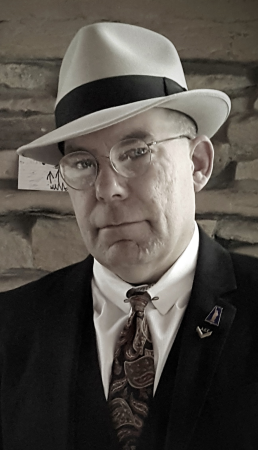 Robert Laplander
This week before Memorial Day has been a very busy week for you. Tell us about your news media activity.
The media interest has been extraordinary! I've had to take two days off from work just to cover everything on the heavy days, and spend a certain amount of time each day answering email, doing interviews and answering calls. It really has been amazing and humbling. I am very gratified as the response and at the level that people do care about what we're doing and these men. It really has been something.
The reporters seemed to really respond to the Doughboy MIA story. Were there any surprising questions, or surprising approached to the story from them?
I have been very struck at the depth of real interest that the reporters have shown; a genuine, deep desire to hear the story and understand the organization. No one has just been going through the emotions on this. They have all asked intelligent and meaningful questions with as much of a desire to know for themselves as to report to story to their listeners/readers/viewers. It's amazing to see.
What does this attention mean for Doughboy MIA? How does this change the game?
The attention the Renshaw case has brought us has enabled us to get the word to a much wider audience and all that brings possibility for more support. I've already been fielding inquiries from folks wanting to know how they can help.
What are your next steps? What else needs to happen for the Doughboy MIA efforts?
Moving forward, we continue walking the same path - chasing their stories in order to understand what happened to them. We are now looking closely at possible recovery attempts in France, as well as continuing to comb the government archives for the missing paperwork we've been seeking for 12 years now that will enable us to successfully at least one case.
Read more: Four Questions for Robert Laplander of Doughboy MIA
A Storyteller’s Memorial
Maryland Nurses fought death and despair in WWI France
By Diana Dinsick
via the Bay Weekly
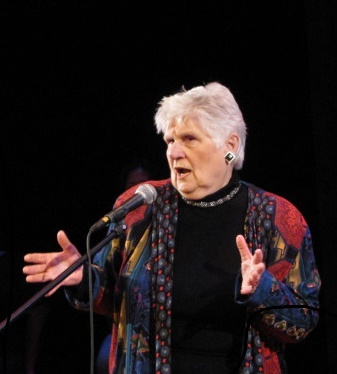 Ellouise SchoettlerAmid the horrors of World War I, battlefield nurses were angels of mercy. America’s battered and beleaguered Doughboys knew that for certain, and you will, too, after listening to Maryland storyteller Ellouise Schoettler recount Ready to Serve: Unknown Stories of 64 World War I Nurses from Maryland.
The town of Chesapeake Beach takes Memorial Day seriously, with this year’s Stars & Stripes Festival commemorating the centennial of The War to End All Wars, the most substantial yet. Schoettler’s stories and slide presentation combine with three days of patriotic honors, music, an American Legion picnic, outdoor fun and a hefty dose of patriotism and local pride.
“My love of genealogy led me into storytelling,” says Schoettler, who has spent more than 30 years seeking forgotten stories of everyday women, then painting pictures of their lives using only the spoken word. “I see my family tree as scaffolding. But I always try to flesh it out with stories.”
Schoettler heard her first storyteller years ago in a church basement. She was hooked. “That night,” she says, “I decided I was going to do that, and people are going to listen.”
She did, and they have.
In the early 1950s, Schoettler left her native North Carolina for nursing training at Johns Hopkins University Hospital. Love and marriage intervened. Later she earned an art degree.
As an Air Force doctor’s wife and mother of four, she moved around the world, learning to appreciate the sacrifice of service members and their families. Once her children were grown, she launched her career as a storyteller.
About four years ago, with the 100th anniversary of the Great War upon us, Schoettler began scouting for stories about women’s contributions to the war effort. At the Chesney Medical Library on the Johns Hopkins Medical Campus, she stumbled upon a treasure: 57 letters sent from France by a deployed unit of 64 World War I nurses, all graduates of the Johns Hopkins School of Nursing in Baltimore.
Schoettler was ecstatic.
Read more: Maryland Nurses fought death and despair in WWI France
World War I represented at 2017 National Memorial Day Parade
By Chris Isleib
Director of Public Affairs, U.S. World War One Centennial Commission
 Dave Lockard in his beautiful 1918 Packard military truck during the Washington, DC Memorial Day parade in 2014.Our nation’s largest Memorial Day event, The National Memorial Day Parade will take place along Constitution Avenue in Washington DC, from 2-4 PM this Memorial Day, Monday, May 29, 2017. The parade, held annually, is organized by the American Veterans Center & World War II Veterans Committee. It is now celebrating its 13th year.
For the fourth year in a row, the U.S. World War I Centennial Commission will be cheering on the volunteers who will represent the American veterans of World War I. These volunteers include:
- Dave Lockard, driving his beautiful 1918 Packard military truck.
- David Shuey, living history actor, portraying General John Pershing mounted on horseback.
- The Young Marines JROTC students of West Palm Beach FL, who will be dressed out in doughboy uniforms, carrying parade banners and flags.
The parade will be aired live on local televisions stations across the country, starting at Monday, May 29 at 2:00 PM Eastern / 11:00 AM Pacific. A full list of stations can be found here. The Parade will also be streamed live by Military.com and YouTube.
Read more: World War I represented at this year's National Memorial Day Parade
Four Questions for Edwin Fountain
"We remain committed to beginning construction by Armistice Day (Veterans Day) 2018"
By Chris Isleib
Director of Public Affairs, U.S. World War One Centennial Commission
On May 18, the U.S. Commission of Fine Arts (CFA) approved the U.S. World War I Centennial Commission’s design concept for a national World War I Memorial in the nation’s capital. Edwin Fountain, Vice Chair of the Commission, took some time to share his thoughts about the outcome of the hearing, and the way ahead for the Memorial.
May 18 was a significant milestone for this memorial project. Tell us about what happened.
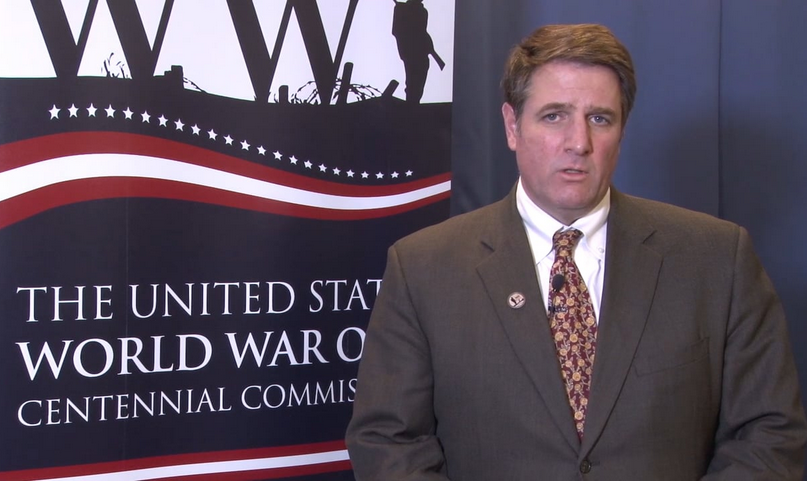 Edwin Fountain, Vice Chair of the U.S. World War I Centennial Commission.Thursday’s decision by the U.S. Commission of Fine Arts was a significant milestone for the WWI memorial project. Federal memorials in Washington, DC are subject to design approval by the CFA. On Thursday the CFA granted “concept approval” for the proposed memorial, which means the CFA endorsed our proposal to establish a memorial at Pershing Park in the form of a monumental work of bronze bas-relief sculpture. This sculpture will be the centerpiece of a trio of memorial elements, including the existing statue of General Pershing as well as a ceremonial flag stand that will offer additional opportunities for commemoration of the war.
It was said after the vote that "Now the real work begins". What do you mean by that?
Concept approval is just that – approval of a concept. The detailed work in designing the sculpture and the park as a whole remains to be done. Our sculptor, Sabin Howard, will continue to develop the sculptural themes and images, in consultation with the WWI Centennial Commission and CFA. The design team will continue to work on other aspects of the site design, including subsidiary commemorative elements, the fountain, lighting, seating, overall site engineering, and so on. And then of course fund-raising is still underway for the memorial.
Four Questions for David Hall
"Highlight the NOAA Corps' century of service to the nation"
By Chris Isleib
Director of Public Affairs, U.S. World War One Centennial Commission
With America’s entry into the World War I, a commissioned service of the Coast & Geodetic Survey (C&GS) was formed on May 22, 1917 to ensure the rapid assimilation of C&GS technical skills for defense purposes. During World War II, officers and civilians of the C&GS produced nautical and aeronautical charts, provided critical geospatial information to artillery units, and conducted reconnaissance surveys. Today, the work of the C&GS—and more—is conducted by the National Oceanic and Atmospheric Administration (NOAA) and the NOAA Commissioned Officer Corps—one of the seven uniformed services of the United States—are the direct descendants of the C&GS of WWI. David Hall, Public Affairs Officer of the Office of Marine and Aviation Operations unit of NOAA, talked with us about the centennial, and the roles and missions of NOAA today.
NOAA plays an important role as a uniformed service. Tell us about it.
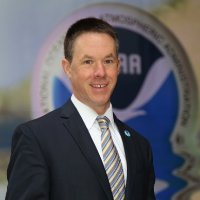 David L. Hall of NOAANOAA Corps officers are an integral part of the National Oceanic and Atmospheric Administration (NOAA), an agency of the U.S. Department of Commerce. The NOAA Corps traces its roots to the former U.S. Coast and Geodetic Survey, which dates back to 1807 and President Thomas Jefferson. Today, the NOAA Corps today provides a cadre of professionals trained in engineering, earth sciences, oceanography, meteorology, fisheries science, and other related disciplines.NOAA Corps officers command NOAA’s oceanographic and seafloor mapping ships, pilot the agency's environmental data-gathering aircraft (including "hurricane hunter" planes), manage research projects, conduct diving operations, and serve in staff positions throughout the agency.
NOAA and the NOAA Corps work every day on land, in the air, and on the sea to keep the nation secure and productive by providing products and services that support maritime domain awareness; help ensure safe passage of commercial and military traffic on our nation’s waterways; warn mariners, aviators, and the public of severe weather; aid search and rescue efforts; and conserve and protect our natural resources.
You played a major role in support if American efforts in WWI. Tell us what you did.
With the entry of the United States into the war in 1917, the commissioned service of the Coast and Geodetic Survey was formed. This allowed for the rapid assimilation of C&GS technical skills for defense purpose. Over half the commissioned officers of the C&GS served with the Army, Navy, or Marine Corps during World War I. They served as artillery orienteering officers, mine-laying officers in the North Sea, troop transport navigators, intelligence officers, and even on the staff to General "Black Jack" Pershing. Following World War I, the C&GS reverted to its role of peaceful surveyor and chart maker of the Nation. The young men who came into the Survey during this period spent years developing expertise in land surveying, sea floor and airways charting, coastline mapping, geophysics, and oceanography. This expertise was combined with the hardships of a lifestyle that was characterized by years in survey field assignments or attached to survey vessels.
Volunteer sleuths ensure WWI MIA receives just due 100 years after death
By Christopher Klein
via History.com
May 22, 2017 – One hundred years ago today, U.S. Navy Seaman Herbert Renshaw was Lost at Sea while serving his country during World War I. He then became lost to history, forgotten by the government he served, until an all-volunteer group hunting for World War I’s MIAs resurrected his memory and ensured he would receive the recognition he deserved a century after his death.
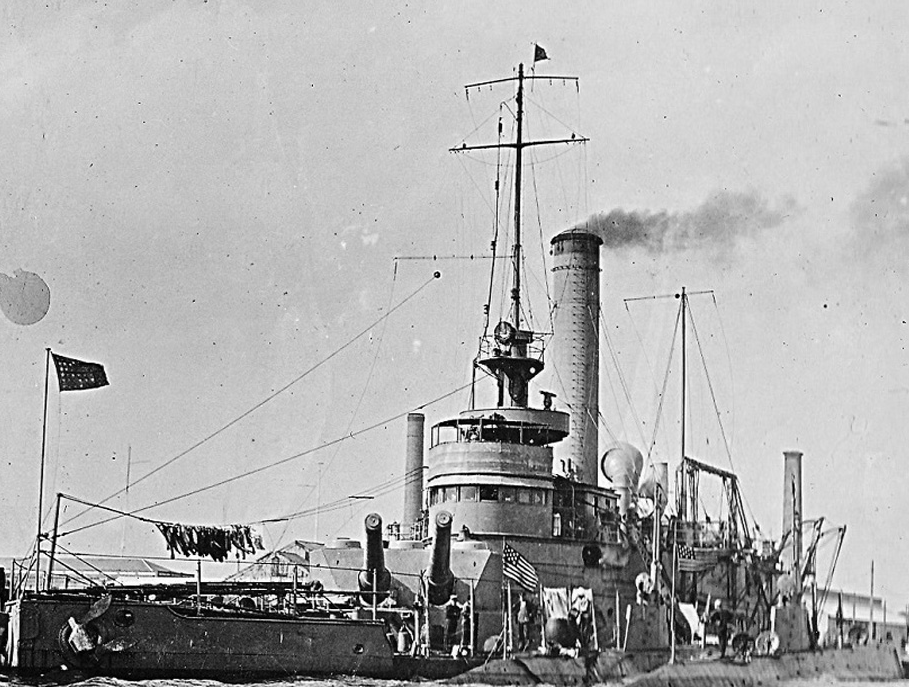 USS Ozark, from which Seaman Herbert Hammond Renshaw perished in a storm in 1917.Seaman Herbert Hammond Renshaw staggered to keep his balance as the Atlantic Ocean vented its fury upon the sub tender USS Ozark. The Salisbury, Maryland, native had enlisted in the U.S. Navy in February 1914—just weeks after his 17th birthday and months before World War I ignited in Europe.
By May 22, 1917, the world had become as violent as the waves that tossed around Renshaw’s ship as he attempted to signal the minesweeper USS Thornton just hours after both vessels had departed Charleston, South Carolina.
When the roiling sea gave USS Ozark a particularly hard kick, Renshaw lost his footing and fell overboard. With the Atlantic too rough to launch a lifeboat, the young sailor’s shipmates furiously threw him life belts and ropes, but even a good swimmer such as Renshaw had little chance of survival. The turbulent ocean swallowed the seaman.
The following day, Renshaw’s father received the notice that his son had been lost at sea, his body unrecovered.
Renshaw’s hometown newspaper noted that the sailor was the first Marylander to lose his life in defense of his country since the United States had entered World War I the previous month. “The fact that young Renshaw was the first Maryland boy to give his life for his country will not be overlooked, and his memory will be kept among the records of the Navy Department,” reported the Wicomico News.
Read more: Volunteer Sleuths Ensure World War I MIA Receives Just Due 100 Years After Death
Doughboy MIA makes sure missing WWI heroes get recognition
By Scott Calvert
via the Wall Street Journal
One of the earliest American casualties of World War I will soon have his name etched in stone at an overseas U.S. military cemetery, a century after the 20-year-old sailor’s death.
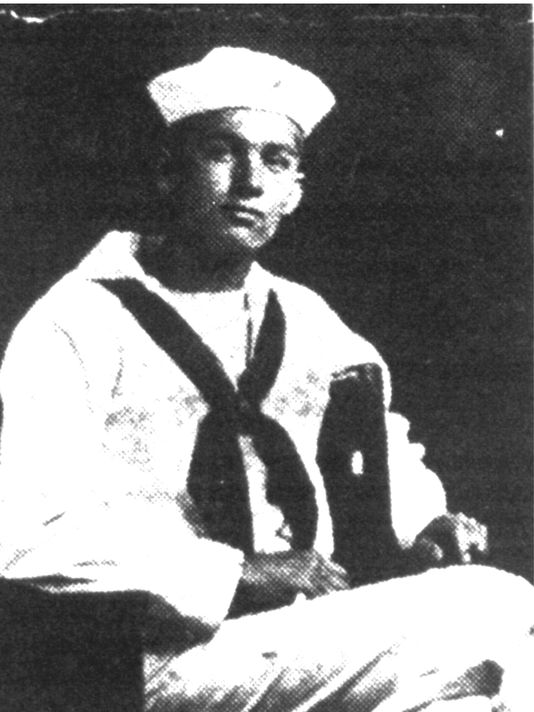 Herbert Hammond Renshaw (Wicomico News photo circa 1917, courtesy Stephen Gehnrich, Delmarvanow.com) Seaman Herbert Renshaw fell overboard off the coast of South Carolina during a naval patrol on May 22, 1917, weeks after the U.S. entered the war. But probably due to a clerical error by Navy officials, he was never listed on a monument to the missing at Brookwood American Cemetery in England.
That is about to change after Robert Laplander, a Wisconsin songwriter-turned-historian, documented the omission with help from a biology professor in Maryland. The Federal agency responsible for U.S. cemeteries and memorials overseas says it will correct the oversight.
 “We want to make sure every American is appropriately commemorated,” said Timothy Nosal, external affairs chief at the American Battle Monuments Commission. Its acting secretary last month approved engraving the seaman’s name, possibly this summer.
The Brookwood chapel’s interior walls are inscribed with the names of more than 560 U.S. soldiers, sailors and Coast Guardsmen lost at sea during World War I, many near the U.K. and France. Though Seaman Renshaw perished far from European shores, he died in “outside waters” in wartime and was technically on the battlefield.
Seaman Renshaw’s 70-year-old niece, Gail Renshaw Blackwell, was born 30 years after her uncle’s death and didn’t know there was a memorial to the missing in England. Still, she said she is grateful his name will be added. “I just really appreciate it,” she said.
For Mr. Laplander, this is the biggest success yet of the Doughboy MIA project, a citizen-led effort he launched in 2015 to investigate cases of the 4,223 service members listed as missing in World War I. About half died on the battlefield, the rest were lost at sea.
While the Defense Department has a unit dedicated to accounting for missing personnel, that effort applies only to conflicts since World War II. One goal of Doughboy MIA—doughboy was a common term for troops deployed to Europe—is to put a name to soldiers buried in graves marked unknown. In the Renshaw case, it instead found that one of the missing never received his due recognition.
Read more: Doughboy MIA makes sure missing WWI heroes get recognition
Four Questions for The Prima Vista Quartet
"To unveil the Great War through the eyes of the men, women and children who lived though it"
By Chris Isleib
Director of Public Affairs, U.S. World War One Centennial Commission
Many World War I commemoration events took place last month across the country, marking the April 6th centennial of the U.S. entry into the war. One that stood apart, as a very special and unique tribute, was a concert tour provided by the Prima Vista Quartet. The Prima Vista Quartet is a group of world-class musicians from France. To honor the Americans who served during the war, they employed their incredible musical talent to create a live score for the World War I-themed film WINGS. WINGS was the first film ever to win an Academy Award for Best Picture, and it was directed by William Wellman, a combat veteran pilot for the American Expeditionary Forces in France during the war. During April, Prima Vista performed their live-accompaniment for audiences in five locations in the United States.Baudime Jam is the founder, composer, artistic director and violist of Prima Vista. We talked to him about World War I, about the tour of the United States, and about Prima Vista's future efforts.
The Prima Vista Quartet performed a special series of World War I-themed shows in the United States. Tell us about them -- the film, the live accompaniment, the tour.
The silent film « Wings », produced in the USA in 1927, commemorates the Saint Mihiel battle which was the first fight on the French battleground of the US Army, placed under the command of General John J. Pershing. The film director, William Wellman, was a veteran himself, member of the famous Lafayette Escadrille, which adds to the historical signification of this film.
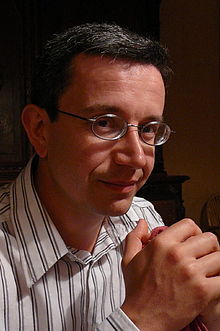 Baudime JamThe purpose of this project has been to allow a wide contemporary audience to discover a film which was shot ten years after the end of WWI and that evokes eloquently and dramatically the first US involvement in this war.
We saw a film concert “Wings”, therefore, as a unique occasion to illustrate and evoke a major historical event of WWI, while at the same time offering a rare artistic experience which blends film on screen and live music on stage.
Prima Vista Quartet toured the United States in April, starting in New York at the Florence Gould Hall at the French Institute Alliance Française (FIAF) on April 6. This date marked a historic occasion as on April 6, 1917, the United States officially entered into World War I.
The other cities where Prima Vista performed were: Chicago at the Music Box Theatre, Washington D.C. at the Maison Française at the Embassy of France, Saint Louis at the Winifred Moore Auditorium - Webster University, and Minneapolis at the Landmark's UptownTheatre.
Who is the Prima Vista Quartet? How did the group come together? What was your mission & vision as performing artists?
The Prima Vista Quartet is a French string quartet which was founded in 1997 and therefore celebrates their 20th anniversary this very year. During those two decades, we have had the opportunity to appear in many festivals and prestigious venues in France, Italy, Spain, Germany, England, Russia, Poland, Africa, China, and the USA.
Planned WWI Memorial in D.C. to use pool concept, restore park
By Michelle Goldchain
via Curbed
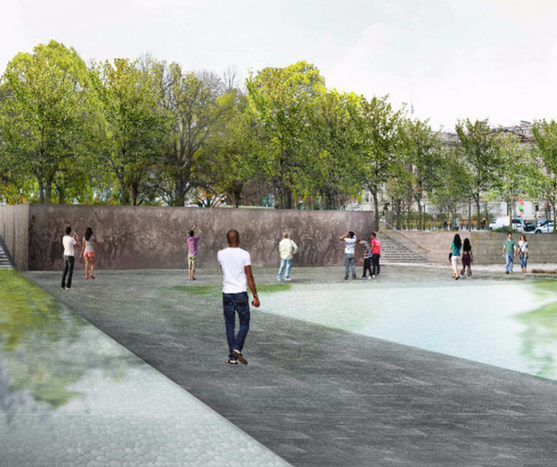 View toward the planned commemorative wall of the National World War One Memorial at Pershing Park in Washington, DC.On Thursday, May 18, the U.S. Commission of Fine Arts (CFA) evaluated the concept plan for the planned WWI Memorial in Washington, D.C.’s Pershing Park, a memorial plaza only blocks from the White House that for years has been neglected.
In the previous meeting in February 2017, there were two design concepts on the table: the Pool and Plaza Concept and the Scrim and Green Concept. At the latest CFA meeting, the WWI Commission revealed that they chose the Pool and Plaza Concept.
This concept proposes replacing the concession gazebo in the park with a ceremonial flag stand, restoring and enlarging the fountain, and inserting a walkway for access to a planned sculpture honoring General John J. "Blackjack" Pershing, who commanded U.S. forces during WWI, with inscriptions of text and maps describing his actions in the war. All other areas of the park will be preserved. The design, titled, “The Weight of Sacrifice,” also features a bronze, sunken wall, entitled, "The Wall of Remembrance," decorated with soldiers carved in bas-relief.
Members of the CFA commented that the designs have come a long way and are moving in a good direction.
Read more: Planned WWI Memorial in D.C. to use pool concept, restore park
Commission Vice Chair speaks at NYC "In Flanders Fields" event
By Chris Isleib
Director of Public Affairs, U.S. World War One Centennial Commission
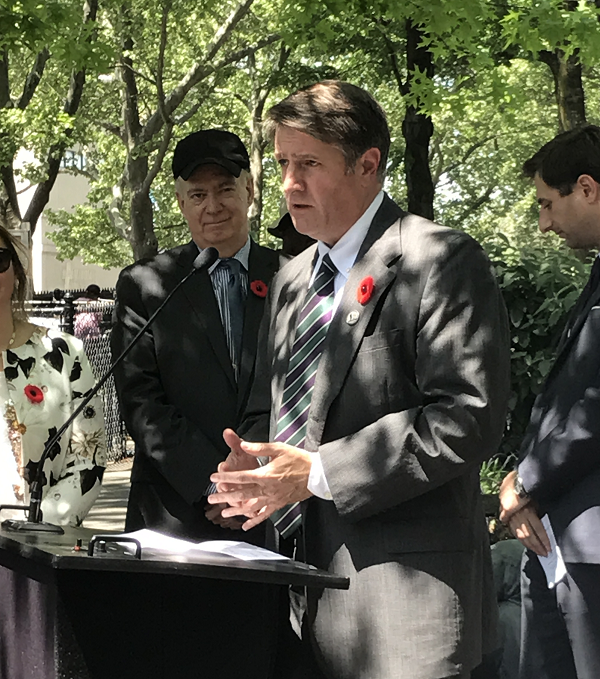 WW1CC Vice Chair Edwin Fountain speaks at the commemoration event in NYC's DeWitt Clinton Park hosted by the Government of Flanders.The U.S. World War I Centennial Commission, the NYC Parks Department, and the Government of Flanders honored local war heroes this week, as part of a series of events organized by the Government of Flanders, Belgium, through the General Delegation in the U.S., to commemorate the Centennial of World War I.
U.S. WW I Centennial Commission Vice Chair Edwin L. Fountain joined NYC Parks Manhattan Borough Commissioner William Castro; President of the Flemish Parliament Hon. Jan Peumans; Chair of the Committee on Foreign Policy Hon. Rik Daems; NYC Department of Veterans’ Services Assistant Commissioner Jamal Othman; United War Veterans Council President Dan McSweeney; relatives of sculptor Burt Johnson; and other dignitaries to place wreaths, and provide remarks, at the historic Clinton War Memorial in De Witt Clinton Park.
Located at the southeast corner of the park, the poignant monument is the work of sculptor Burt W. Johnson and architect Harvey Wiley Corbett. It was commissioned by the Clinton District Association as a memorial to a young man from the neighborhood who died in World War I.
The monument, dedicated in 1930, features a pensive infantryman known as a “Doughboy” holding poppies in his right hand and a rifle slung over his left shoulder. The granite pedestal is inscribed with a verse from John M. McCrae’s famous World War I poem, "In Flanders Field".
Every year around Memorial Day, the General Delegation of the Government of Flanders to the USA honors and remembers all those who fought "In Flanders Fields" during World War I at the memorial sculpture.The Government of Flanders is also providing $10,000 annually, for seven years, to support maintenance of the sculpture and its landscaped setting in De Witt Clinton Park.
CFA approves design concept for National World War I Memorial at Pershing Park in DC
By Chris Isleib
Director of Public Affairs, U.S. World War One Centennial Commission
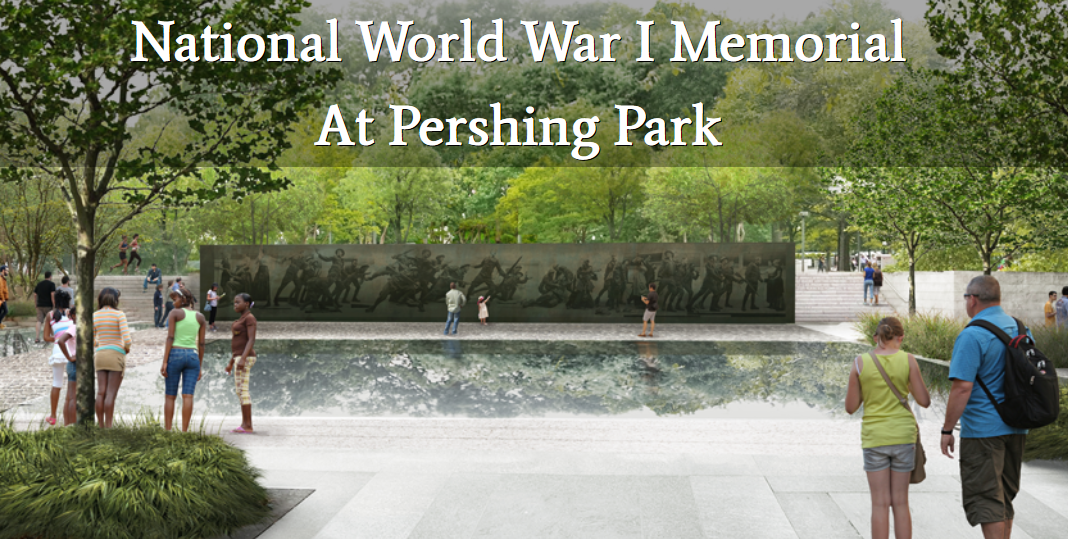 On May 18, the U.S. Commission of Fine Arts (CFA) approved the U.S. World War I Centennial Commission’s design concept for a national World War I Memorial in the nation’s capital.
The presentation was a significant milestone in the progress toward building the memorial, on a site authorized by Congress in 2014. CFA is one of the two federal agencies with responsibility for design approval of memorials in Washington, D.C., along with the National Capital Planning Commission.
Edwin L. Fountain, Vice Chair of the World War I Centennial Commission, said: "The concept for a national World War I memorial in Washington has been in the making for nine years. We are pleased the CFA endorsed our proposal to honor the service of 4.7 million Americans who served in World War I, and the sacrifice of the 116,516 who gave their lives. We look forward to working with the CFA, the public, and other stakeholders as we continue to develop the final design."
The memorial will be located on Pennsylvania Avenue at Pershing Park, a 2-acre site one block from the White House. The park currently features a statue honoring General John Pershing, the commander of American forces in World War I, and a pool of water set in a modernist landscape design by M. Paul Friedberg. The new memorial – developed by the design team of Joseph Weishaar, who won the design competition for the memorial project, along with John Gregg (GWWO Architecture), and Phoebe Lickwar (Forge Landscape) – will consist primarily of a 65-foot long bronze bas-relief sculpture by acclaimed American sculptor Sabin Howard that will be located along the western edge of the water feature, along with additional commemorative elements in the park.
Read more: CFA approves design concept for National World War I Memorial at Pershing Park in DC
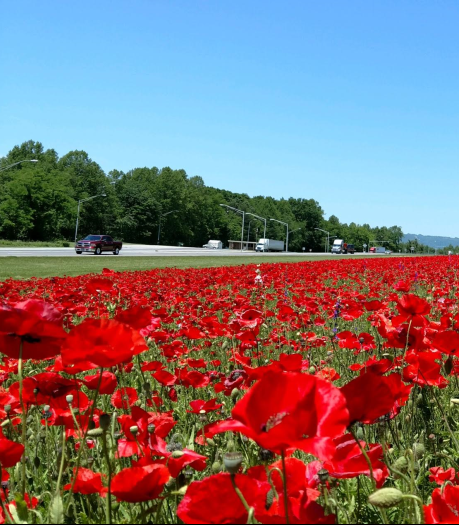 The North Carolina Department of Transportation has planted over 70 acres of Red Poppies along state highways, to honor World War I veterans.
North Carolina DOT plants acres of red poppies to honor WWI veterans
By Chris Isleib
Director of Public Affairs, U.S. World War One Centennial Commission
Red poppies are blooming along North Carolina highways in commemoration of the 100th anniversary of our nation’s entry into World War I.
To help honor those who served, NCDOT’s Roadside Environmental unit planted 70 acres of red poppies, an internationally recognized remembrance of sacrifice by our military veterans. The poppies are part of the U.S. World War I Commission’s nationwide efforts to raise awareness and give meaning to the events that took place 100 years ago.
“We want to honor those who have served and do it in a way that’s dignified as well as beautiful,” said Jerry Hester, a member of the U.S. World War One Commission. “People ask, ‘Why the poppies?’ It is to honor our servicemen and women, not only North Carolinians, but all over. We’ve had many international visitors who come and see these poppies and remark to us, ‘We’ve never seen anything like this in the world.’”
Read more: North Carolina DOT plants red poppies to honor World War I veterans
FDNY Commemorates 43 World War I and World War II Veterans
Special to the 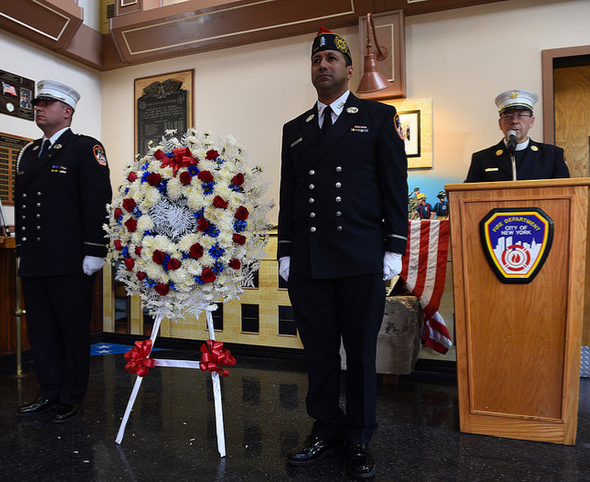 U.S. World War One Centennial Commission web site
NEW YORK — On Tuesday, May 9, New York City Fire Commissioner Daniel A. Nigro hosted an FDNY Commemoration ceremony for 43 FDNY members who made the Supreme Sacrifice in World War I and World War II at the FDNY Training Academy on Randall’s Island.
Veterans and families were in attendance as the FDNY rededicated a plaque honoring the 43 Veterans during the 100th anniversary of World War I and 75th anniversary of World War II. Of the 43 names on the plaque are eight men who died in 1917-1919 in World War I.
“The 43 heroes we honor today bravely wore the uniforms of the FDNY and the United States military, and shared one mission, protecting our country,” said Commissioner Nigro. “Their selfless acts of protecting life and property in our city, and defending our nation will never be forgotten.”
This year alone, 46 Veterans graduated as new Firefighters, EMTs, and Paramedics, joining more than 1,300 Veterans who currently serve the Department.