





























World War I Centennial News
Cape May theater production looks back at NJ in World War I
By Roy Steinberg
Special to the U.S. World War I Centennial Commission web site
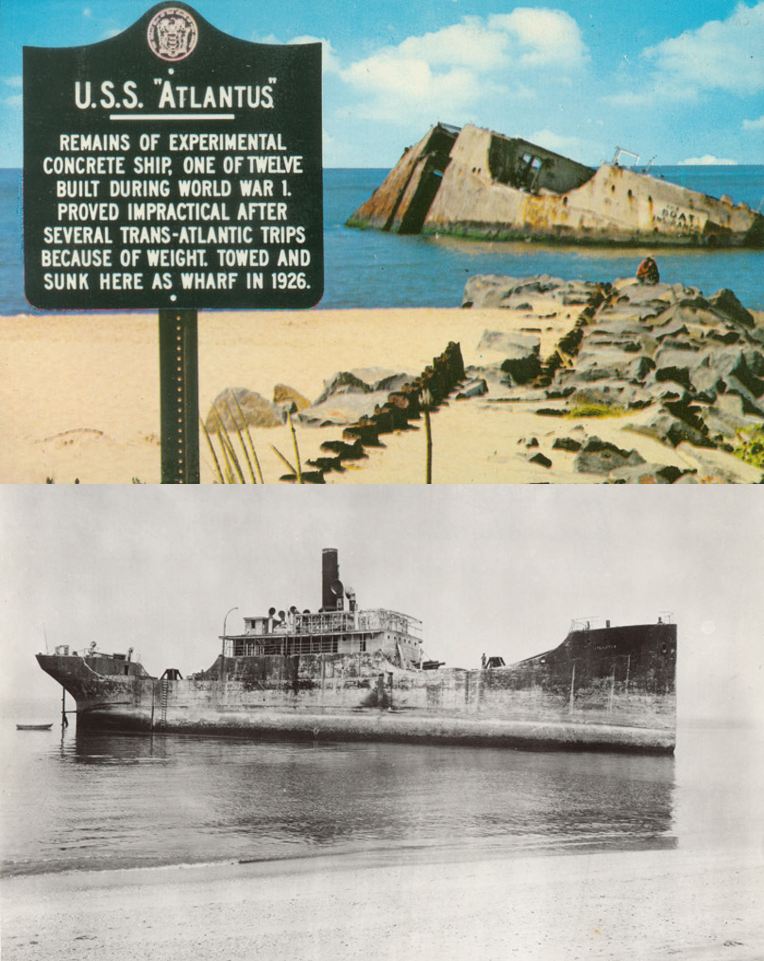 It was a hundred years ago that President Woodrow Wilson (who campaigned on an isolationist platform of peace) decided to bring the United State to the Great War – the “war to end all wars”. In May of 1917, the Selective Service was created to draft American men into the armed services. At Sunset Beach in Cape May, New Jersey the S.S. Atlantus still sits in the surf as a kind of memorial to the service men and women of World War I. The S.S. Atlantus is the most famous of the twelve concrete ships built by the Liberty Ship Building Company in Brunswick, Georgia and was used to transport American troops back home from Europe. It was later towed to Cape May as part of a ferry dock but a storm hit and the ship broke free of her moorings and ran aground 150 feet off the coast.
What does World War I have to do with New Jersey? In 1916 there were German attacks on a New Jersey munitions dump and a foundry. Our ship, the “Dorothy Barrett” was shelled and sunk by a German U-boat off the shore of Cape May. The decision was made to establish a naval base on the eastern tip of the island to provide defenses for the Delaware Bay. It was a training facility for aircraft and a submarine port.
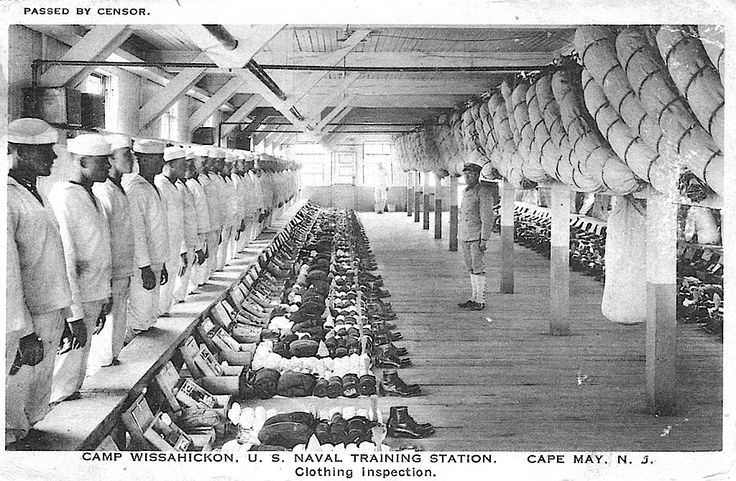 In 1917 the Navy built a base just north of Schellenger’s Landing called Camp Wissahickon. During the war, the war department leased the Hotel Cape May (aka The Christian Admiral Hotel) for use as a military hospital. The first army medical school for the reconstruction of defects of hearing and speech was opened in 1918. It treated soldiers who had lost hearing or the ability to speak during the war. Munitions were stored just outside of Cape May where the jug handle turn for Route 9 currently exists. Cape May has seen its share of conflicts from the very beginnings of this nation.
Cape May Stage exists to act as a catalyst for discussion about the moral, ethical and political issues of the day. There was no question that we would do some sort of recognition of the one hundredth anniversary of such an important event. The question was how to be true to our mission while entertaining our audience. “Billy Bishop Goes to War” is the perfect solution to that question.
Read more: Cape May theater production looks back at NJ in WWI
International League Baseball joins WW1 Centennial Commission to remember WW1 Veterans
By Chris Isleib
Director of Public Affairs, U.S. World War One Centennial Commission
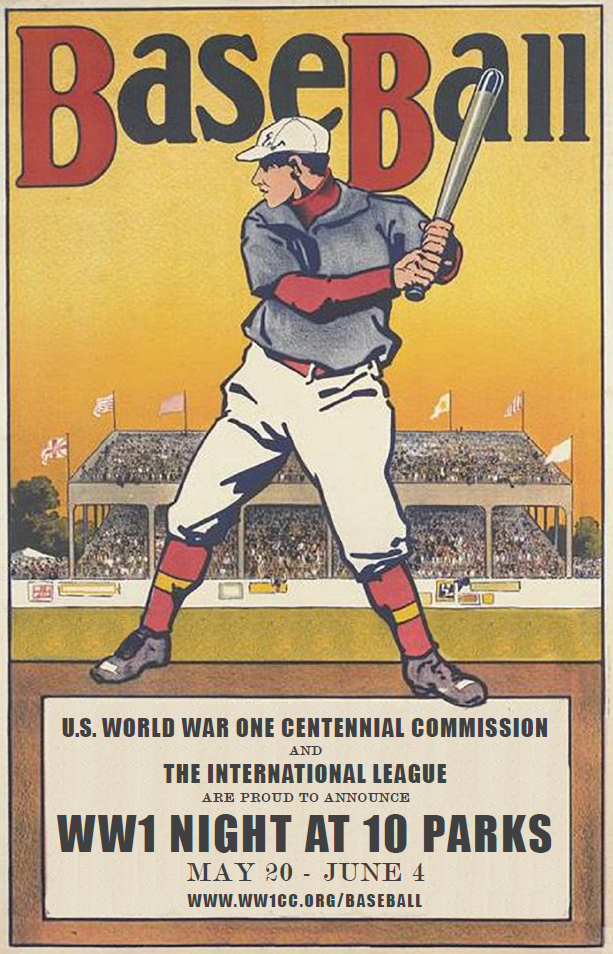
The U.S. World War I Centennial Commission (WW1CC) is proud to announce a broad national partnership between the US World War One Centennial Commission and the International League of Minor League Baseball.
The partnership includes a series of special game-nights, honoring local World War I heritage, in the hometowns where the games will be played.
The whole series can be found at ww1cc.org/baseball.
The 10-night series runs between May 20 (Armed Forces Day) on through Memorial Day, and ending on June 4th, in the communities listed below.
There will be give-aways, special presentations, trivia, and opportunities to support local veterans causes.
- May 20 - Scranton Rail Riders - PA
- May 20 - Indianapolis Indians - IN
- May 21 - Louisville Bats - KY
- May 21 - Durham Bulls - NC
- May 23 - Charlotte Knights - NC
- May 27 - Pawtucket Red Sox - RI
- May 29 - Columbus Clippers - OH
- May 29 - Gwinnett Braves - GA
- June 4 - Norfolk Tides - VA
- TBC - Buffalo Bisons - NY
This year marks the 100th anniversary of the U.S. entry into World War I.
The U.S. World War I Centennial Commission was created by Congress to mark the anniversary, with public outreach, commemorative events, and education programs.
Read more: International League Baseball joins WW1 Centennial Commission to remember WW1 Veterans
Five Questions for Tanveer Kalo
"We all came together when the call went out for war"
By Chris Isleib
Director of Public Affairs, U.S. World War One Centennial Commission
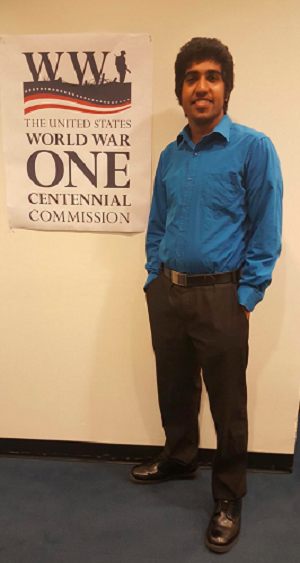 Tanveer KeloThe U.S. World War I Centennial Commission (WW1CC) is blessed to have a number of remarkable people. One of them is intern Tanveer Kalo, who comes to us from St. Lawrence University. Tanveer is a history buff, and also a talented researcher. During his internship period this spring, he decided to use his talents to create something that really didn't exist -- a collection of information on Asian Indian people who served in the U.S. military during World War I. These stories are being published on the WW1CC web site's Vande Mataram in the USA section, as well as in the Stories of Service section. We spoke to Tanveer about his project, and his motivations for creating this great new resource.
Tell us about your special WWI project. What information are you collecting?
My project is on Asian Indians who served in the U.S. military during World War One. I am collecting their World War One draft cards, enlistment records, U.S. military passenger lists, photographs, naturalization documents, and any other documents and any other information regarding their military service and life in the United States.
How did the idea come about? Was it through your activity as an intern with the Centennial Commission?
This project developed from a simple conversation for a special side project. The idea came up when I talked with WW1CC web site Publisher Chris Christopher about Dr. Bhagat Singh Thind, an Asian Indian and Sikh who served in the U.S Army during World War One. Mr. Christopher encouraged me to find other Indians served during the war. I dug through the web and found a journal and magazine called Young India on the South Asian American Digital Archive’s website. Young India’s October 1918 and August 1918 issues had images of Asian Indians who were serving overseas or in training camps during this time.How has the research process worked? What was your plan? Where did you go to find information?
After finding the names of the Indian soldiers from Young India, I used Ancestry Institution to find information on them. Finding information was easier because Dr. Bhagat Thind’s son, David Singh created a website to honor his father’s legacy and life. It was difficult at times to find information because some shared similar names or no information could be found. However, I kept moving forward and tried to find at least one piece of information. In total I have found information on 8 Asian Indians were served in the United States Army during World War One.
Dr. Isrea Butler to lead 369th Experience band’s historic re-creation
By Stephany B. Neal
via the 369th Experience
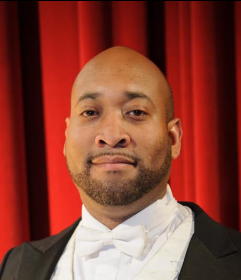 Dr. Isrea ButlerThe 369th Experience is pleased to announce Dr. Isrea Butler as band director for the re-creation of The 369th Experience World War I Centennial Band. Dr. Butler will lead the talented group of African American and Puerto Rican male music students who make up this historic tribute band.
 The 369th Experience is part of a series of events endorsed by the World War I Centennial Commission and sponsored in part by The Coca Cola Foundation to commemorate the 100th anniversary of World War I. A key component of this celebration is the re-creation of the 369th Regimental Band, which in its original form consisted of 65 African American and Puerto Rican gentlemen who charmed the hearts and minds of Americans and Europeans.
Dr. Butler will lead the band as they retrace the steps of the original band with performances at centennial celebrations in New York City; Brest and Paris, France; and a host of other historic locales. Dr. Butler brings a wealth of experience to the programs. He is currently the Director of Bands and music program coordinator at The University of Maryland Eastern Shore, a position he has held since 2014. He is also a member of the 287th National Guard Band.
Dr. Butler has a stellar repertoire of experience that includes performances in eight Broadway productions, touring and recording with many of the country’s leading jazz orchestras, and playing all four chairs in the world-famous Count Basie Orchestra. While living in New York, Dr. Butler played in the 319th Army Band from 2008 to 2012.
Read more: Dr. Isrea Butler to lead 369th Experience band’s historic re-creation
Cobh commemorates centenary of American Naval forces arrival during WWI
By Sean O’Riordan
via The Irish Examiner
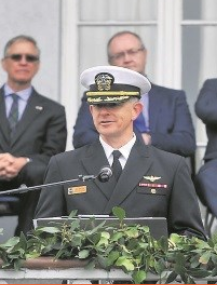 Captain Daniel Dwyer, USNSome descendants of those who served with the US Navy based in Cork during the First World War gathered in Cobh yesterday, along with a number of American military personnel, to commemorate the centenary of their arrival there on May 4, 1917.
They unveiled a plaque to mark the occasion at the former Admiralty House, which is now a Benedictine priory. The nuns, who are in an enclosed order, seemed to thoroughly enjoy the spectacle of a military remembrance, which included flagbearers, a lone piper, and bugler.
The plaque was unveiled by Elizabeth Helmer, great granddaughter of Commander Joseph Taussig, who led the first six US destroyers into the port.
Tim Forsyth, US deputy chief of mission at the American embassy, said that by the end of the war, 92 of his country’s navy ships had served out of Cork.
For the chief of staff of the US Naval Forces in Europe and Africa, Captain David Dwyer, the event brought back his Irish roots. He said he was very honoured to attend as his great, great, great grandfather emigrated to the US from Cork in 1847.
Read more: Cobh commemorates centenary of American Naval forces arrival during WWI
Remembering World War I
The U.S. Navy arrives in Europe
via The American Battle Monuments Commission
 On May 4, 1917 the USS Wadsworth, an American destroyer, arrived in Queenstown, Ireland to support the war effort. Image courtesy Naval History and Heritage Command.Not quite a month after the United States declared war, the first American warships arrived in Europe on May 4, 1917. The Germans had resumed unrestricted submarine warfare in early 1917, leading to more than 800 Allied ships being sunk in a matter of months. Without escorts, these ships served as easy prey for the Germans. This warfare had reduced British grain stores to a critical three week supply. The Royal Navy urgently requested more destroyers for hunting submarines.
The destroyers’ arrival was due in part to the presence in England of an American naval mission headed by Vice Adm. William Sims. A few years before, then Capt. Sims was President of the Naval War College at Newport. Appointed by the first Chief of Naval Operations (CNO), William Benson, together they anticipated a transatlantic naval war involving new challenges and technology. Ashore and in exercises of the “War College Afloat” they studied the role of the Navy in modern war.
By 1917 Benson anticipated a naval campaign in European waters that would require a naval headquarters in England. Sims, with established reputation throughout the Navy, proved the ideal officer for that mission. He traveled to London under an assumed name, in civilian guise, arriving on April 2, 1917 with the intention of establishing direct contact between the United States Chief of Naval Operations, the Royal Navy, and other Allied naval forces.
Read more: Remembering World War I: The U.S. Navy Arrives in Europe
When America joined WWI and became a global power
By Carlos Hamann
via MSN
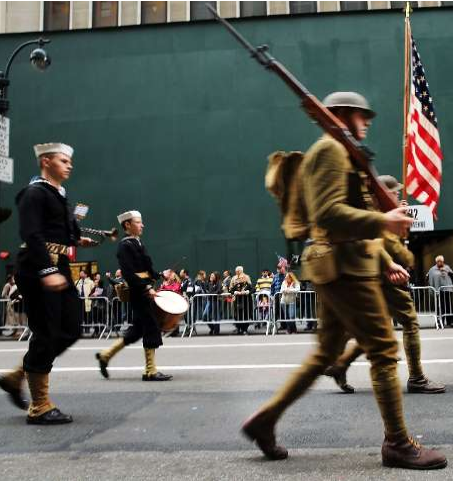 When America entered WWI, a century ago, its industrial might and vast manpower tipped the balance of the conflict and marked its own emergence as a global power. (AFP photo)When America entered World War I, a century ago this week, the European powers were bogged down in a grinding trench war that had killed millions and ravaged the European continent.
Swinging its industrial might and vast manpower behind France and Britain against Germany and its allies on April 6, 1917, the United States tipped the balance of the conflict and marked its own emergence as a global power.
"World War I was clearly the turning point for developing a new global role for the United States, ushering in a century of international engagement to promote democracy," said Jennifer Keene, a World War I expert at Chapman University in California.
Americans had been keenly following the war ever since it broke out in August 1914, showing broad support for neutrality.
But public opinion changed with the May 1915 sinking of the Lusitania.
The British ocean liner was en route from New York to Liverpool when a German submarine torpedoed it off the coast of Ireland, killing 1,201 passengers, including 128 Americans.
"It seems inconceivable that we should refrain from taking action on this manner, for we owe it not only to humanity but to our own national self-respect," former president Teddy Roosevelt, an influential pro-allied hawk, told the New York Tribune at the time.
Read more: When America joined WWI and became a global power
Doughboy MIA adds new name to missing list
By Robert J. Laplander
Directing Manager for Doughboy M.I.A. and Finding The Lost Battalion
A couple months ago or so we were contacted by Mr. Stephen Gehnrich, who alerted us to the fact that a sailor from his county in Maryland who was lost at sea and memorialized on a plaque to the soldiers and sailors who gave there lives from that county in the war was NOT listed on the official list of missing in action assembled following the war, as posted on the Doughboy MIA website.
We launched an intensive investigation, as the 100th anniversary of the loss of the sailor – Seaman Herbert H. Renshaw – was coming up fast (May 22nd), and prepared our case. If we could put this one to bed, we wanted to do so before that date got here, if we could.
Four Questions for Colin Williamson
"This is something that we should never, ever, forget."
By Chris Isleib
Director of Public Affairs, U.S. World War One Centennial Commission
There is a special partnership that we should all be aware of. It is taking place between our friends at the Blinded Veterans Association, here in the U.S., and the Blind Veterans UK. Both organizations are national charities for vision-impaired ex-Service men and women. Blind Veterans UK started during World War I, and BVA began during World War II.
The two groups have come together to help each other with exchange visits, in a program they call Project Gemini. These exchange visits center on joint U.S. and UK cooperation regarding military eye injuries, blind services, blast Shell Shock to TBI, and vision research today.
The first exchange visit took place last month in Washington DC, on the anniversary of WW I with the strong support of the American Embassy London, and British Embassy DC. The visit included meetings with senior DOD and VA officials, as well as meetings at British Embassy DC with Major General Richard Cripwell and his military staff, visits with U.S. Senator John Boozman, tour of Capitol, meetings at Walter Reed National Military Medical Center, and public education lectures on 100 year history war injuries, plus Shell Shock- verses Blast Concussions to Today’s TBI lecture from historian at Defense Center of Excellence (DCoE.) at National Medical and Science Museum.
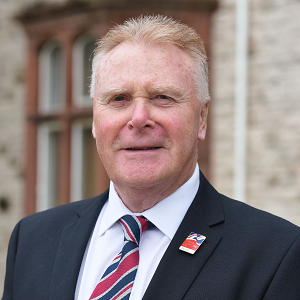 Colin WilliamsonThe group also toured Arlington National Cemetery with the Old Guard, and were able to present a Poppy Wreath at the Tomb of Unknown Soldier, as a nod to the Blind Veterans UK origins from World War I. The next exchange visit will take place in London, May 21st to May 28th. There will be public educational seminar which will include DOD military trauma vision ophthalmologists experts on TBI- Shell Shock then to blast concussions today, vision research, and history rehabilitation services 1917 to Today. Plus the UK Surgeon General is Opening Speaker for this seminar.
We caught up with one of the Project Gemini participants, Colin Williamson, to talk about this special program.
You are with the Blinded Veterans UK, an organization that has roots in World War I. Tell us about the work that your people do.
My name is Colin Williamson and I am member of the Blind Veterans UK. I was fortunate enough to have been invited to attend the week in DC as part of the Project Gemini group from Blind Veterans UK. Tom and I actually started the programme together back in 2011 and I’m really very passionate about this project and its objectives.
Four Questions for Teresa Van Hoy
"How fragile peace can be if prudent voices go unheeded"
By Chris Isleib
Director of Public Affairs, U.S. World War One Centennial Commission
You and your students have been putting together an amazing documentary mini-film series on World War I. Tell us about it.
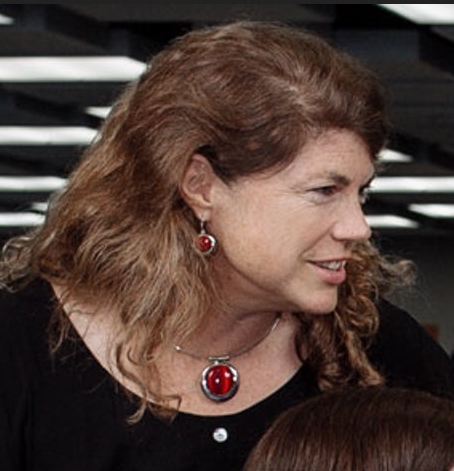 Professor Theresa Van HoyOur World War I films have become the signature of our MobileMural history initiative. Once again, for the fourth consecutive semester, each of my students is making a short "microdocumentary" film (5 minutes long) on any aspect of World War I that he or she chooses. These films produced "by and for the people" help move history from the classroom and archive into the streets and squares. Each new class of St. Mary's University students learns from the films produced in the preceding semesters and works to leave their own legacy in turn. Our last batch will be ceremoniously uploaded at the 11th minute of the 11th hour of the 11th day of the 11th month of 2018. On that centennial, all seven "generations" of students will gather to celebrate their collective opus and pray that the Great Hope of peace which ended the Great War may prevail.
How did this project come about? Was this part of scheduled curriculum, or was it a grand idea that someone was able to win support for? What challenges did you face -- What was your students reactions to this opportunity?
We have the World War I Centennial Commission to thank for the genesis of this project! Because the WWICC was listening, my students felt empowered to speak. The first to welcome their voices was General Alfred Valenzuela, thereafter, Monique Seefried and many others both at WWICC and TX WWICC. We also drew inspiration from two Frenchmen who made military history come alive for my students. Gerard Mignard and Michel Benoit helped transformed my students' microdocumentary films from course assignment to clarion call.
National Park Service shares forgotten WWI stories from Parks
By Nathan King
National Park Service
What do Homer Saint-Gaudens, women’s suffragettes, Theodore Roosevelt, the Gettysburg Battlefield, a copper mine in Michigan, and Irving Berlin have in common? They all have a connection to World War I through the national parks.
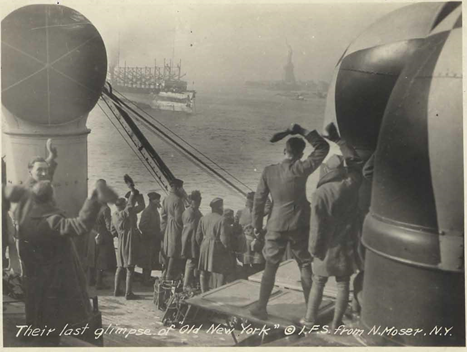 Departing soldiers wave to the Statue of Liberty, ca. 1917 (NPS).To tell these stories in honor of the WWI centennial, the National Park Service (NPS) launched an all-new NPS WWI website.
Park rangers, historians, and other subject matter experts contributed all new material, sharing untold stories from the parks. As the project developed, and more and more stories came to light, it was as though we had discovered an exciting new dimension to the parks, and we were eager to share it.
For example, many Civil War battlefields are now national parks. The Civil War was just fifty years before World War I, and many of the battlefields were still reserves that would not be transferred to the NPS until the New Deal era (the NPS was created in 1916). Many of these Civil War battlefields were used as training grounds for WWI. On the fields of Gettysburg, Maj. Dwight D. Eisenhower was training Americans to maneuver tanks in 1917. On the site of the Petersburg Battlefield, where Civil War entrenchment tactics reached their zenith, 20th-century Americans were digging trenches on the same ground to apply the knowledge of the nation’s bloody past to a new war. You can still walk these hallowed grounds.
Read more: National Park Service Shares Forgotten WWI Stories From Parks
Four Questions for Douglas Mudd
"A greater appreciation for how WWI has shaped our world"
By Chris Isleib
Director of Public Affairs, U.S. World War One Centennial Commission
You have a great new WWI-themed exhibit coming up. Tell us about it. How did it come about?
 Douglas MuddYes, we do have a great exhibit coming up! We starting planning for it about two years ago to commemorate the upcoming centennial of the U.S. entry into the war. Rod Gillis and I had been talking about World War I ever since he began work on the commemorative coin project - I believe 4 years ago. I personally have been interested in World War I since I was about 10 years old. I was fascinated by the airplanes and the aces who flew them and started scratch-building them with cardboard and toothpicks. Since then, I have studied the war avidly, so having the opportunity to do an exhibit on the topic was a natural.
My approach to exhibits at the Money Museum is to use history as the starting point - most people have some familiarity with history, but relatively few know much about money or medals. We can teach people of all ages more about money by showing them how money and medals are history in your hands - if you know how to interpret the words and images on them.
Remembering World War I
American Medical Units mobilize shortly after U.S. enters the War
via The American Battle Monuments Commission
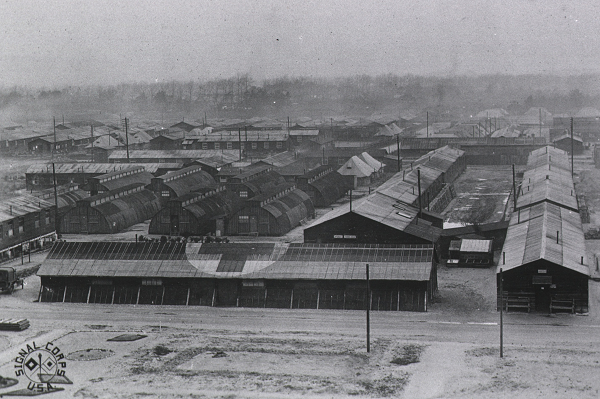 Base Hospital No. 4 during World War I. Image courtesy of the National Library of Medicine. Less than a month after the United States entered World War I, Maj. Harry L. Gilchrist with the U.S. Army Medical Corps received orders to move Base Hospital No. 4 to France. On May 8, 1917 the unit departed New York harbor for Europe, and within weeks it had replaced a British hospital and was receiving patients in Rouen, France. Base Hospital No. 4 was one of six mobilized immediately to assist the British Expeditionary Force in France.
While General of Armies John J. Pershing had not yet set foot in France, British forces could not delay in making an urgent plea for medical support. In total they requested sixteen base hospitals and additional medical staff to assist their forces. Because the British had been fighting for nearly three years, they were in desperate need of fresh staff and support. Fortunately, advanced preparation of the American Red Cross (ARC), the Army, and Allied transportation made an immediate response possible.
The Army had established reserves of medical supplies for 67 field, base, and evacuation hospitals, 41 ambulance companies, and 131 combat regiments. These supplies were distributed from medical depots around the United States, and coordinated by an established system of telegraph communication. Even though the United States had never fought in this type of global conflict, the country managed to mobilize resources in an efficient and quick manner based on the realities of the early 20th century.
The Army Nurse Corps, established in 1901, was supplemented by the ARC nursing reserve with around 8,000 trained nurses ready for overseas assignments. The ARC had been providing services in Europe since fall 1914. It worked closely with the Army and Navy, and other private American medical agencies, and it raised funds, trained reserve staff, and acquired supplies and equipment.