|
|
|
|
|
|

The Yanks of Seicheprey
On April 20th, 1918, in Seicheprey, France, near the St. Mihiel Salient, American soldiers engaged in their first significant infantry battle of World War I. The Battle of Seicheprey occurred on the southern side of the St. Mihiel salient. There, three companies of the Yankee Division's 102nd Regiment occupied a trench, known as the Sibille trench. On April 20th, the German Army attacked from the northeast, north, and northwest, arriving at the town simultaneously in three different groups. This attack outmaneuvered the Americans, and inflicted a number of U.S. battle casualties, but the Americans threw the Germans back. Read more about how this first significant battle demonstrated the mettle of the Doughboys.
VMI and VA Commission present WWI Commemorative Symposium April 27

As part of Virginia’s commemoration of the World Wars, a joint symposium by Virginia Military Institute and the Virginia WWI and WWII Commission marks the 100th Anniversary of America’s participation in World War I. In the historic setting of Virginia Military Institute in Virginia’s scenic Shenandoah Valley, conference attendees will hear from national and regional experts, who will explore the political and military leadership of World War I, the experiences of the soldiers and generals on the front, and the role that Virginians played in the Great War. Read more about this outstanding WWI conference here.
|

Today's U.S. Diplomatic Courier Service traces its founding to December 2, 1918, when Gen. Pershing directed the creation of a group of handpicked Army couriers to perform host of diplomatic duties. This first group of couriers -- known as the Silver Greyhounds -- was created. organized, and led by Army Major Amos J. Peaslee. After the war, Major Peaslee’s personal documents, and artifacts related to the Diplomatic Courier Service, including a personal engraved copy of the Treaty of Versailles, documents from his time in Russia during the Russian revolution, historic photos, travel documents from across Europe, and other unique items from his colorful career, began a multi-continent odyssey of their own that finally ended this year in Colorado Springs. Read more about the donation of Major Peaslee’s treasure trove of WWI to the State Department here, and check out the Denver Post's story about Peaslee "wellspring of history" here.
|

Many installations across the U.S. Army are marking or have marked the centennial of the construction of their posts, which occurred in the weeks and months following the U.S. declaration of war on Germany, April 6, 1917. Fort Benning was one of the last installations to be activated in October 1918, just a month before the armistice was declared on Nov. 11, 1918. To mark the occasion, the WWI history on display at the museum here has devoted a large exhibit to what is sometimes referred to as "the Great War." Read more about the new Ft. Benning WWI display here.
|

Writing for the Johns Hopkins University Press web site, scholar Keith Gandel asserts that "One hundred years after U.S. involvement in World War I, it is time to revisit our literature that came out of that conflict--because we are only now, finally, able to understand it in its actual historical context." Gandel has written a book to that end: War Isn't the Only Hell: A New Reading of World War I American Literature draws on military archives and cutting-edge research by social-military historians to "come to terms with the works of thirteen of our major writers, including some famous authors and some who were in their own time well-known but have been mostly forgotten." Gandel suggests that "until very recently, we had forgotten a tremendously important aspect of the U.S. experience" in the war "that eventually changed this country forever." Read Gandel's entire thoughtful essay here.
|

Max Beckmann, 1884–1950, was a painter and print-maker, primarily known for his self-portraits. Most commonly classified as an Expressionist artist, his work dramatically changed after his WWI experiences. Beckmann volunteered in the Medical Corps in Belgium as an orderly in 1914, but was discharged after having a nervous breakdown in 1915, which led to the dramatic transformation of how he depicted himself and humanity in his art. The National Institutes of Health's National Library of Medicine had a unique opportunity to acquire two original Beckmann prints which he created during his recuperation after he was discharged from service. Read more about these unique works of art that "emulate the crippling effects that the war had on Beckmann, his acquaintances, and his view of the world" here.
|

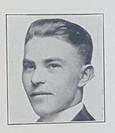
When Todd Woofenden discovered the cache of paperwork, photos, and other artifacts belonging to his great uncle, Lt. (jg) George S. Dole (left) after his service as commanding officer of a submarine chaser in WWI, he could see in these materials a fascinating, untold story of technical ingenuity, experimentation, and raw grit. This was the advent of antisubmarine warfare, and the men who served on the chasers were right in the middle of it. New technologies, quaint by modern standards but top secret innovations at the time, were being tested and adapted even as the chaser fleet was being built and deployed. Woofenden built a web site and has written a book to tell the amazing story of the U.S. Navy's Submarine Chasers of WWI. Read more about these "little ships that could" and "The Sub Chaser Archives" here.
|

Episode #67
Highlights: Financing WWI
Financing WWI - Reaching for the stars | 01:55
The 369th hits the front lines | 08:30
The British Struggle continues - Mike Shuster | 10:40
The Yankee Division learns at seicheprey - Dr. Edward Lengel | 15:10
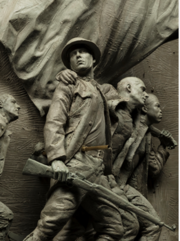
A century In the Making - The maquettes get busy | 21:00
“Lest We forget: The Great War” - Kenneth Clarke & Michael Robbins | 25:05
How to teach about WWI - Dr. Ian Isherwood | 32:30
Speaking WWI - Pilates | 38:25
100 Cities / 100 Memorial in Jackson, TN - Dr. Alice-Catherine Carls | 40:25
WWI War Tech - Carrel-Dakin Antiseptic | 45:55
The Weekly Dispatch Newsletter overview | 47:50
The Centennial In Social Media - Katherine Akey | 50:25
|
"Robert Frost: A poet for whom life and war were trials by existence."
When scholars write of war poets, few consider Robert Frost. If a war poet is one who has experienced the turmoil and vicissitudes of combat, Frost does not qualify. However, if one is willing to consider poets who offer insight into connections between war and the human condition, then Frost fits the bill. To learn more about Frost and WWI, don't miss week's WWrite post by Jim Dubinksy,
|

A man is only missing if he is forgotten.
Monday's MIA this week is probably the most well known American MIA of the war. John McGavock Grider was a fighter pilot and the supposed author behind the best-selling book ‘War Birds: Diary of an Unknown Aviator’, published by the famous American fighter ace Elliot White Springs in 1926. In truth, the book was only loosely based on Grider’s diaries from the war and highly embellished by Springs with his own experiences. Yet it is probably one of the most authentic illustrations of the American pilot experience to come out of the war and remains popular to this day. Born in Arkansas on May 28th, 1892, John Grider was a hard core southerner who enlisted in the Army Signal Corps in June, 1917 to be an aviator. Sent to England and trained by the British, afterwards he served with No. 85 Squadron of the RAF under the Canadian ace ‘Billy’ Bishop until America could field a large enough air service to accommodate all its flyers. Grider was the victor in at least four aerial combats before he disappeared near Houplines, France coming back from a patrol with Elliot Springs on June 18th, 1918. Despite some speculation, no one has ever positively found out exactly what happened to him. What is known is that he was buried by the Germans behind their lines. Following the war, the (then) British Imperial War Graves Commission recovered his remains and transferred them to the British military cemetery known as Motor Car Cemetery, but speculation exists as to whether the grave had been properly identified. When America set up the permanent Flanders Fields American Cemetery at Waregem, Belgium, it is believed that Grider’s remains were transferred there from Motor Car Cemetery along with several other Americans, but his identity was never confirmed and therefore he lies in one of the 21 ‘Unknown’ graves at Waregem and is commemorated on the Wall to the Missing there.
Can you spare just ten dollars? Give 'Ten For Them' to Doughboy MIA and help us make a full accounting of the 4,423 American service personnel still listed as missing in action from WW1. Make your tax deductible donation now, with our thanks.
|

"Lest We Forget: The Great War" is brand new way for you to help build America’s WWI Memorial, in Washington DC. At the same time, you get to enjoy a very special, colorful, inspiring and lasting souvenir of the centennial!
The book features nearly 350 high-quality images, an introduction by Sir Hew Strachan and text by historian Michael W. Robbins. The project is dedicated to the Centennial and produced by The Pritzker Military Museum and Library along with the WW1 Centennial Commission.
Importantly, when you get this visual remembrance of the "War that Changed The World" - a full ½ of the proceeds go to building the Memorial!
This and many other items are available as Official Merchandise of the United States World War One Centennial.
|

|
|
|

Submitted by: Mary Rohrer Dexter
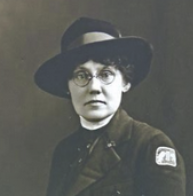
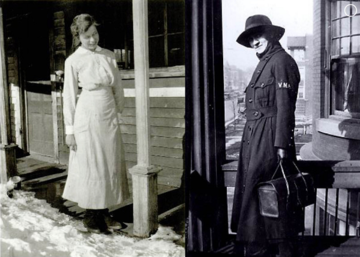
Mary Alice Lamb served in World War 1 with a non-government service organization. The dates of service are: Known 1918-1928.
“Those who go forth ministering to the wants and necessities of their fellow beings experience a rich return, their souls being as a watered garden, and a spring that faileth not…”
– Lucretia Mott
Tucked away in the South West corner of Miami County, Indiana is the small community of Amboy where in 1844, the first Friends Worship service was held in Miami County and six years later, a log church was erected at a location that would later be next to Amboy Friends Cemetery. Until a school was built in 1872, the church doubled as a school. In 1867, the Panhandle Railroad was completed through Miami County and the small town of Amboy was platted as the location of the train station.
When, in 1871, Benjamin B. Lamb laid an addition to the original Amboy platt, his son Ezra must have been living in the area, for on July 28, 1878, Ezra Lamb and his wife Eliza were holding a beautiful baby girl in their arms whom they named Mary Alice.
|
|
|
|
|