


























Doughboy Foundation Home
transition01.jpg
transition03.jpg
Belvedere-Stone-View-3.jpg
Belvedere-to-Sculpture.jpg
Belvedere-Stone-View-1.jpg
Rendering-2.jpg
Rendering-3A.jpg
Rendering-4.jpg
Rendering-5.jpg
Terrace-Planters2.jpg
_P3_3855_250118-Edit_250118.jpg
_P3_3934_250118_250118.jpg
_P3_3941_250118_250118.jpg
previous arrow
next arrow

Monuments & Memorials

"The centennial of World War One offers an opportunity for people in the United States
to learn about and commemorate the sacrifices of their predecessors."

from The World War One Centennial Commission Act, January 14, 2013

DCWorldWarMonumen 1World War One was a watershed in American history. The United States' decision to join the battle in 1917 "to make the world safe for democracy" proved pivotal in securing allied victory — a victory that would usher in the American Century.
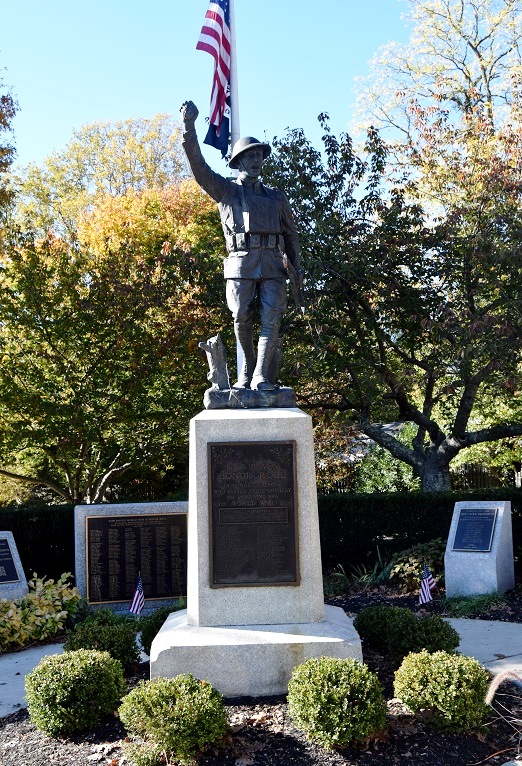
In the war's aftermath, individuals, towns, cities, counties, and states all felt compelled to mark the war, as did colleges, businesses, clubs, associations, veterans groups, and houses of worship. Thousands of memorials—from simple honor rolls, to Doughboy sculptures, to grandiose architectural ensembles—were erected throughout the US in the 1920s and 1930s, blanketing the American landscape.

Each of these memorials, regardless of size or expense, has a story. But sadly, as we enter the war's centennial period, these memorials and their very purpose—to honor in perpetuity the more than four million Americans who served in the war and the more than 116,000 who were killed—have largely been forgotten. And while many memorials are carefully tended, others have fallen into disrepair through neglect, vandalism, or theft. Some have been destroyed. Watch this CBS news video on the plight of these monuments.

The extant memorials are our most salient material links in the US to the war. They afford a vital window onto the conflict, its participants, and those determined to remember them. Rediscovering the memorials and the stories they tell will contribute to their physical and cultural rehabilitation—a fitting commemoration of the war and the sacrifices it entailed.

Memorial Hunters Club

We are building a US WW1 Memorial register through a program called the Memorials Hunters Club. If you locate a memorial that is not on the map we invite you to upload your treasure to be permanently archived in the national register.  You can include your choice of your real name, nickname or team name as the explorers who added that memorial to the register. We even have room for a selfie! Check the map, and if you don't see the your memorial CLICK THE LINK TO ADD IT.

100 Cities - 100 Memorials

Filters
Geolocalisation bp
  • Dedication Date: 1924
  • EM Viquesney
Memorial Park, Fair Haven & River Road
07704 Fair Haven
NJ
USA

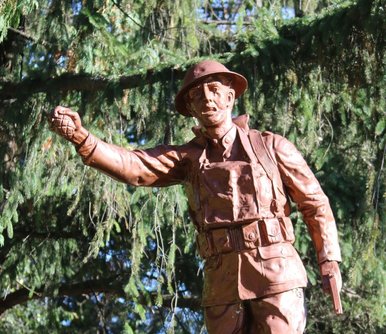
This sculpture is one of many casts made from EM Viquesney's doughboy design. Monuments using this design are scattered around NJ & the US.

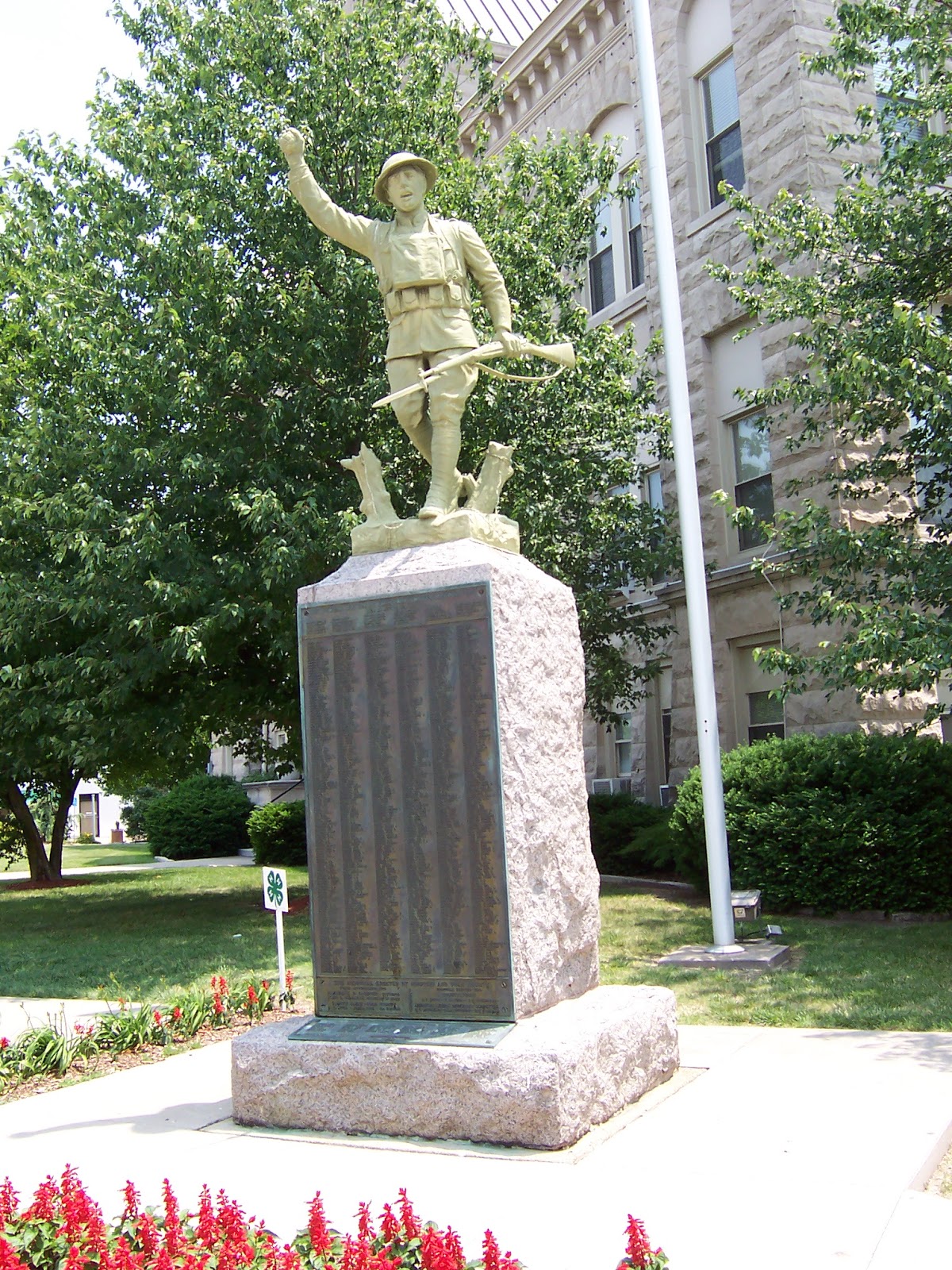
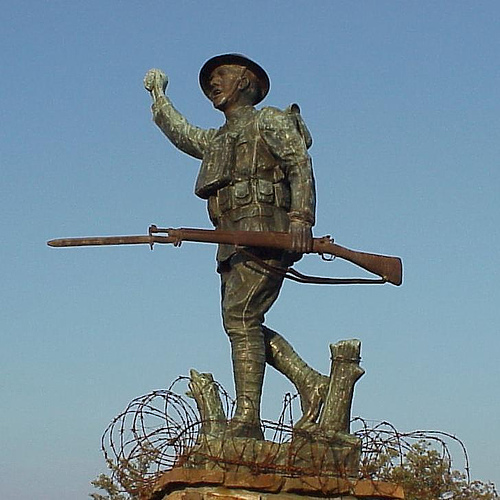
This copper cast sculpture, set upon a pink Maine granite base with beveled corners, depicts a World War I infantryman advancing through the stumps and barbed wire of "No Man's Land."  He holds a rifle in his left hand & a grenade in his raised right hand.

The monument was dedicated on August 16, 1924, in honor of Fair Haven residents who served in WWI. The base contains a bronze plaque with a Fair Haven World War I honor roll.  It cost approximately $1,000 with an undisclosed sum for the base. The Memorial Park Committee financed it by holding several events including a boxing tournament feature Gene Tunney.

In the late 1960s, vandals stole the rifle and broke the figure’s left hand.  In 1995, the sculpture was refurbished.

Narrative adapted from Smithsonian Institution Research Information System (SIRIS) inventory #NJ000436. 

Photos Credit:  NJ State Historic Preservation Office
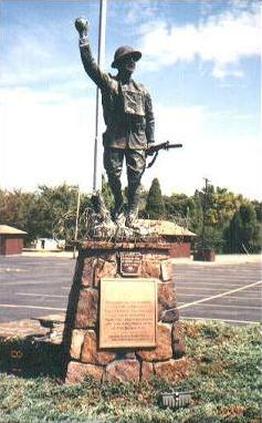
4901 Midland Street
72904 Fort Smith
AR
USA

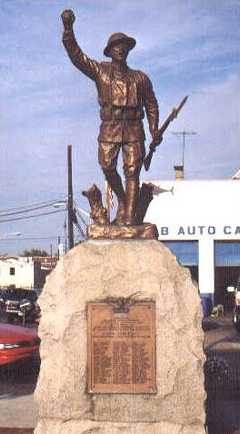
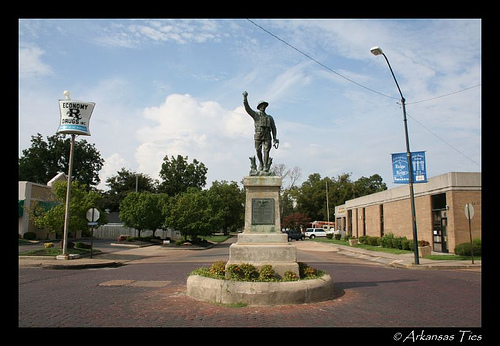
This is an E. M. Viquesney-sculpted pressed-copper figure of a WWI infantryman advancing through the stumps and barbed wire of No Man's Land, holding a rifle and grenade.  Originally located in Tillis Park, since approx. 1922, it was moved to the American Legion Post because of vandalism.  It is mounted on a fieldstone base and is dedicated to those who entered service from Fort Smith.

  • Dedication Date: 1926
  • EM Viquesney
Edith Ort Thomas Elementary School, 902 Harrison Street
08825 Frenchtown
NJ
USA

This sculpture is one of many casts made from EM Viquesney's doughboy design. Monuments using this design are scattered around NJ & the US.

This bronze cast sculpture, set upon a base, depicts a World War I infantryman advancing through the stumps and barbed wire of "No Man's Land."  He holds a rifle in his left hand & a grenade in his raised right hand.

The sculpture was erected in 1926 on the front lawn of Frenchtown High School (presently Edith Ort Thomas Elementary School) to honor Frenchtown & vicinity soldiers who served in World War I. The sculpture cost $2,700.

In the summer of 1995, the sculpture was refurbished and cleaned by the Easton Memorial Finishing Works of Easton, PA. The rifle end was refashioned and attached, and the sculpture was sandblasted and buffed. A new plaque honoring veterans of subsequent wars was added and the sculpture was rededicated on November 11, 1995.

Narrative adapted from Smithsonian Institution Research Infomration System (SIRIS) inventory #NJ000454. 

Photo courtesy of: Alan Edelson & Historical Marker Database

  • Memorial Hunters Club Submission: The Wanderer
Childers Plaza
29617 Greenville
SC
USA

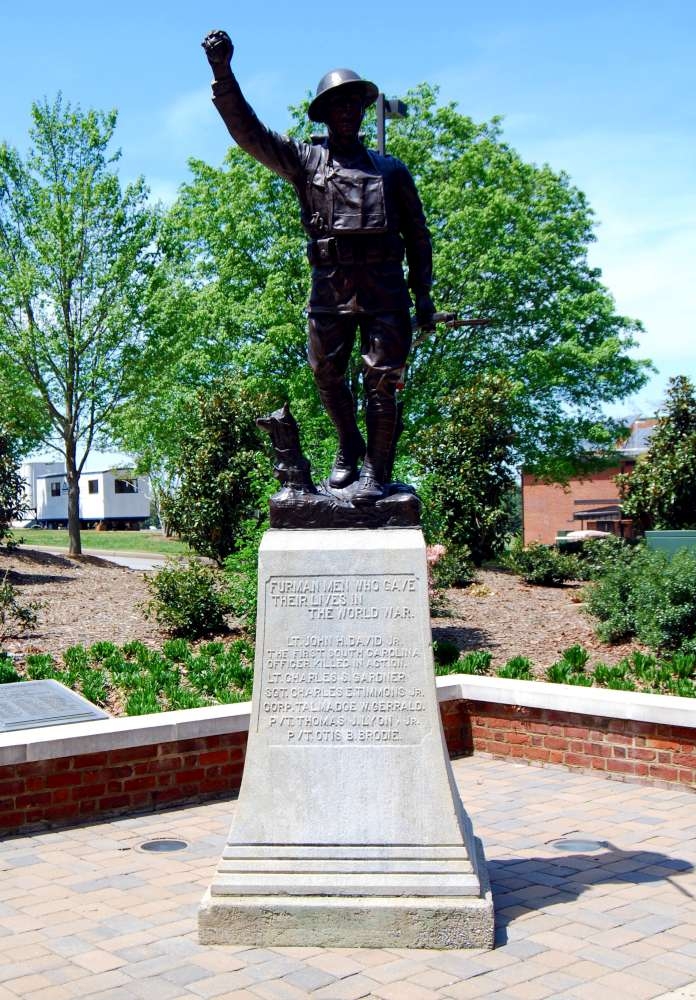
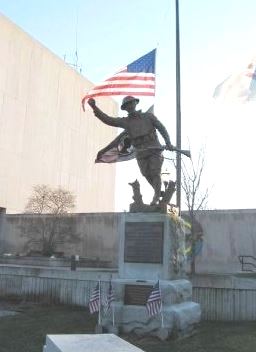
In 1921, three years after the Armistice was signed, Furman University and Greenville paid tribute to the university's World War I veterans in a moving ceremony that unveiled a memorial statue of a doughboy. The copper soldier was one of numerous doughboy statues designed by E.M Viquesney - depicting a soldier rushing into battle, wielding a grenade in one hand and a rifle in the other - dedicated to honor veterans of World War I.  When the Furman Doughboy was first dedicated, hundreds of area residents turned out at the old campus in downtown Greenville. A bugler played taps as Mrs. T.J. Lyons, the mother of a Furman student who died in France during the war, gently loosened the fastening of the American flag that shrouded the statue.

An article in the July 1921 issue of the Furman Bulletin reported that the "handsome statue with splashes of molten gold and the youthful figure of an American Doughboy in France, preserved in lasting metal and stone, stood revealed to the eyes of the expectant throng." When the statue was uncovered, "applause broke forth. Tears filled the eyes of beholders. The base's rear reads: "More than 500 Furman men served in the World War." and ex-service men wept as they saw the figure, so life-like, emerge."

Five hundred and forty Furman men, almost the entire student body of the then all-male college, volunteered for service during the Great War. Six of them died during the war: Pvt. Thomas J. Lyons Jr.; Pvt. Otis Brodie; Lt. John H. David (the first South Carolina officer killed in action); Lt. Charles S. Gardner (who, though seriously wounded, refused to be removed from the battle); Sgt. Charles E. Timmons Jr. (who "went to death beyond the call of duty, while aiding men from another company"); and Cpl. Talmadge W. Gerrald (who gave his life trying to save a wounded comrade). Their names are inscribed at the base of the Doughboy.

Since that dedication day, the Furman Doughboy has become one of the university's most enduring landmarks. When Furman moved to its current location, so did the Doughboy. It was erected near the south end of the lake in 1957 and is one of the few surviving remnants of the old campus.

Over the last forty years, the Doughboy has lost its luster. The weather has taken its toll, and on two occasions it has been vandalized. The statue was moved for refurbishing to the Upcountry History Museum and the Furman University Library, and in 2004 a completely new replacement was cast in bronze by sculptor Maria J. Kirby Smith and placed back on campus at Childers Plaza.

The plaques that were with the Doughboy at its former location were also moved to Childers Plaza.

Two new plaques read: (on the low left brick column)

DOUGHBOY
ARTIST: E. M. VIQUESNEY
STATUE ORIGINALLY INSTALLED IN 1921 AT
THE DOWNTOWN GRENVILLE MEN’S CAMPUS
AND RECONSTRUCTED IN 2004 BY ARTIST
MARIA KIRBY-SMITH.
THE DOUGHBOY FACES EAST TOWARD
THE BATTLEFIELDS OF FRANCE.   
and on the low right brick column:

CHILDERS PLAZA
PROVIDED BY
ELAINE DUFFY CHILDERS ’43
WACO F. CHILDERS, JR. ’47
AND
FRIENDS OF
FURMAN UNIVERSITY

  • Memorial Hunters Club Submission: The Wanderer
48 N. Main St. - Monument Square
42629 Jamestown
KY
USA

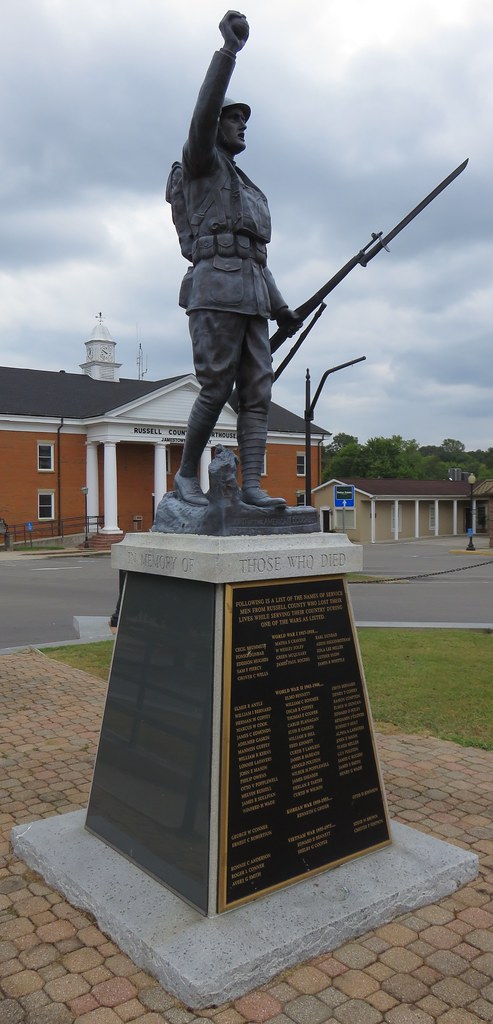
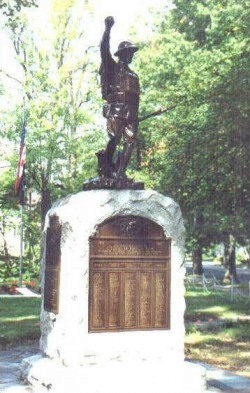
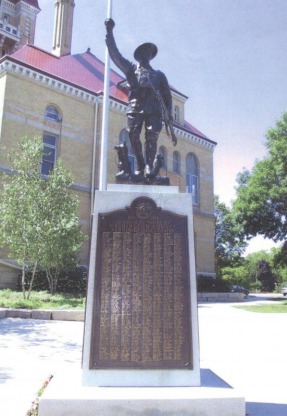
This E.M. Viquesney Doughboy, a life-sized figure of a WWI soldier advancing through No Man's Land, was dedicated on November 11, 1937.  The engraving across the left, front, and right ledge of the concrete base reads:

IN MEMORY OF THOSE WHO DIED FOR GOD AND COUNTRY 

A plaque inscription on the rear of the base reads:

DEDICATED TO THE MEMORY
OF THE PATRIOTIC CITIZENS
OF RUSSELL COUNTY, KENTUCKY
WHO ENTERED THE SERVICE
OF THE COUNTRY
DURING THE WORLD WAR
PRESENTED BY
RUSSELL POST NO. 133
AMERICAN LEGION
NOVEMBER 11, 1937

At some time a new plaque was added to the front of the base which reads:

FOLLOWING IS A LIST OF SERVICE
MEN FROM RUSSELL COUNTY WHO LOST THEIR
LIVES WHILE SERVING THEIR COUNTRY DURING
ONE OF THE WARS AS LISTED.

(Followed by 3 columns of names from WWI, WWII, and the Korean and Vietnam Wars)

On the night of February 19, 2008, the monument was struck and severely damaged by a pickup truck driven by an alleged drunk driver. The statue was knocked off its pedestal, and the right arm and left hand and rifle were broken off. The pieces of the statue were recovered and were housed inside the fire department for safekeeping. As the original zinc statue was considered too heavily damaged, replacement with a bronze duplicate was completed by Innocast Execuline, the same firm that replaced the New Ulm, Minnesota Doughboy in 1995. The insurance company that covered the vehicle involved in the accident contributed $25,000 to the cost of replacing the Doughboy. The new Doughboy was erected on September 19, 2008, and a rededication ceremony was held on November 11, the 71st anniversary of the original dedication. Sergeant Alvin York, the most decorated U.S. soldier in WWI, was present for the original dedication in 1937. His sons, Andrew and George York, were present at the 2008 rededication, with George York presenting some remarks. Sadly, in a virtual repeat of 2008, the statue was again hit by a vehicle on December 23, 2018, and once more knocked off its pedestal. 

  • Memorial Hunters Club Submission: The Wanderer
625 Campbellsville St.
42539 Liberty
KY
USA

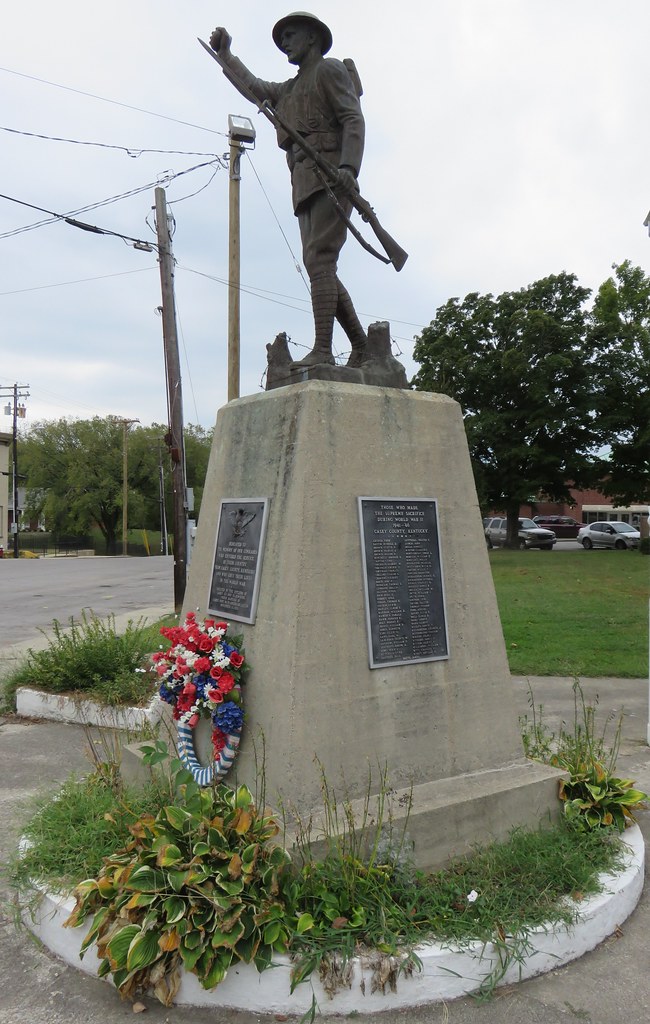
This statue was sculpted by E.M. Viquesney and dedicated on November 11, 1935.  It depicts a WWI infantryman advancing through the barbed wire and stumps of No Man's Land.  It was shattered on July 4, 1982 in a truck accident and recast the following year, and again dedicated on November 11, 1983. A 1935 plaque honors the memory of the citizens of Casey County who died in service in WWI.

The inscription on the plaque on the front of the concrete base reads:

DEDICATED TO
THE MEMORY OF OUR COMRADES
WHO ENTERED THE SERVICE
OF THEIR COUNTRY
FROM CASEY COUNTY, KENTUCKY
AND WHO GAVE THEIR LIVES
IN THE WORLD WAR.
ERECTED BY THE CITIZENS OF
CASEY CO. AND ELSEWHERE
UNDER AUSPICES OF
CASEY POST NO. 78, AMERICAN LEGION
NOVEMBER 11, 1935

An inscription on a plaque on the back of the base reads:

THOSE WHO MADE
THE SUPREME SACRIFICE
DURING THE WORLD WAR
1917-1918
CASEY COUNTY, KENTUCKY
(followed by list of 32 names in two columns)

The plaque on the near side honors, by name, those who made the supreme sacrifice in Vietnam (7) and Korea (6), and a plaque on the far side honors those who made the supreme sacrifice in World War II (75).

  • Dedication Date: 1927
  • EM Viquesney
Memorial Park, Main & Broad Streets
07747 Matawan
NJ
USA

This sculpture is one of many casts made from EM Viquesney's doughboy design. Monuments using this design are scattered around NJ & the US.

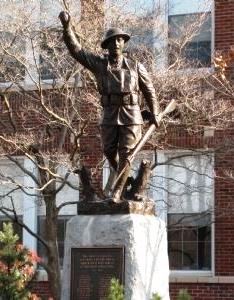
This bronze cast sculpture, set upon a granite base, depicts a World War I infantryman advancing through the stumps and barbed wire of "No Man's Land."  He holds a rifle in his left hand & a grenade in his raised right hand.

The monument was dedicated on Memorial Day 1927. The base contains a bronze plaque with a Matawan World War I honor roll.

Narrative adapted from Smithsonian Institution Research Information System (SIRIS) inventory #47260070. 

Photo courtesy of:  NJ State Historic Preservation Office
  • Memorial Hunters Club Submission: Mark Bardenwerper
McCoy Park
53538 Fort Atkinson
WI
USA

The inscription on the plaque on the ground reads:  

1898                    1917-1918
McCOY
PARK
Sponsored by
American Legion and
Spanish War Veterans
DEDICATED
to the
DEAD SOLDIERS

Dedicated along with the park on May 19, 1929. The left hand, bayonet and rifle were lost many years ago and the right arm was torn off in 1979. It was restored later that year in a little more forward position than it is on other Doughboys. After being lost again, the rifle was replaced by the pistol visible in the photograph to discourage people from swinging from it. The fence was also placed to discourage vandalism. The park was founded in a joint effort of the American Legion and Spanish-American War Veterans, but they could not agree on whether the statue should be of a soldier of the World War or the Spanish-American War. As a result, school children raised a small part of the cost, and a local physician paid $2,000 for the remainder of the monument’s costs from his own funds. An unsuccessful attempt was made in 1999 to have the Doughboy included in the National Register of Historic Places. 

  • Dedication Date: 1930
  • EM Viquesney
Arneson Square, Madison, Fayette & New Brunswick Avenue
08861 Perth Amboy
NJ
USA

This sculpture is one of many casts made from EM Viquesney's doughboy design. Monuments using this design are scattered around NJ & the US.

This bronze cast sculpture, set upon a granite base, depicts a World War I infantryman advancing through the stumps and barbed wire of "No Man's Land."  He holds a rifle in his left hand & a grenade in his raised right hand.

The monument was dedicated on Armistice Day 1930. The base contains a bronze plaque dedicating to Perth Amboy residents who served in wars prior to & including WWI. 

Originally installed on the corner of Amboy Avenue & Pfeiffer Boulevard, the statue was moved to its current site around 1979.

Narrative adapted from Smithsonian Institution Research Information System (SIRIS) inventory #47260070.

Photo courtesy of: EM Viquesney Doughboy Database & Perth Amboy Public Library

  • Dedication Date: 1923
  • EM Viquesney
Clay Avenue & Chestnut Street
07204 Roselle Park
NJ
USA

This sculpture is one of many casts made from EM Viquesney's doughboy design. Monuments using this design are scattered around NJ & the US.

This bronze cast sculpture, set upon a granite base, depicts a World War I infantryman advancing through the stumps and barbed wire of "No Man's Land."  He holds a rifle in his left hand & a grenade in his raised right hand.

The monument was dedicated on September 3, 1923. The base contains a WWI honor roll plaque on the front, & an honor roll for subsequent conflicts on other sides.

Narrative adapted from Smithsonian Institution Research Information System (SIRIS) inventory #47260071. 

Photo courtesy of:  EM Viquesney Doughboy Database & Nick Pagnetti

  • Dedication Date: 1927
  • EM Viquesney
Police Station, John Street & Paterson Plank Road
07094 Secaucus
NJ
USA

This sculpture is one of many casts made from EM Viquesney's doughboy design. Monuments using this design are scattered around NJ & the US.

This bronze cast sculpture, set upon a granite base, depicts a World War I infantryman advancing through the stumps and barbed wire of "No Man's Land."  He holds a rifle in his left hand & a grenade in his raised right hand.

The monument was erected in memory of Joseph Hassendorder, who made the supreme sacrifice, and in honor of the boys of Secaucus who served their country in the World War.

Narrative adapted from Smithsonian Institution Research Information System (SIRIS) inventory #NJ000238. 

Photo courtesy of:  Michael Herrick & Historical Marker Database

320 S. 5th Ave
53095 West Bend
WI
USA

The inscription on the plaque on the front of the pedestal reads:

1917 1918
IN HONOR OF THOSE  OF
WASHINGTON COUNTY
WHO SERVED THEIR COUNTRY

The inscription is followed by a listing of names that continues in multiple columns on all four sides. It includes 1,054 who served in the Civil War and 33 who served in the Spanish American War. There are 1,469 names of those who served in World War I – 1,337 Army, 114 Navy, 10, Marine, 8 Nurses.

The Doughboy was dedicated Sunday November 13, 1927 in an observation that included a major parade with veterans of the Civil and Spanish American Wars in autos, and walking veterans of the World War. National Commander of the American Legion, Edward E. Spafford, spoke at the dedication.

A nearby monument was placed in 1998 to recognize those who served in World War II, Korea and Vietnam. It names 79 who gave their lives in World War II, 21 in Korea and 28 in Vietnam. The area also has granite markers honoring 23 County veterans groups or organizations.

A major restoration project led by the Washington County Historical Society was performed by Tony Rajer of Fine Arts Conservation Services, Madison, Wisconsin, in 1999-2000, and the Doughboy was rededicated May 30, 2000. A time capsule placed in the Doughboy’s pedestal when it was erected, but of which there was no known record, was found during the restoration. Its contents included a list of about 4,000 school children, from over 100 county schools in several townships, who made small contributions totaling $253 of the $6,000 original cost of the sculpture, pedestal and site improvements (about $4,000 was paid by the County and the rest by popular subscription).

  • Materials (select all that apply): Stained Glass
  • Dedication Date: 11/11/1925
  • Missouri and Polk County
  • Ernest Moore Viquesney
  • Single figure -- soldier
  • Dedication Date: 1923
  • E.M. Viquesney
  • Single figure -- soldier
  • Memorial Hunters Club Submission: Memorial Hunter: John Ruberry
600 East 4th Street
28202 Charlotte
NC
USA

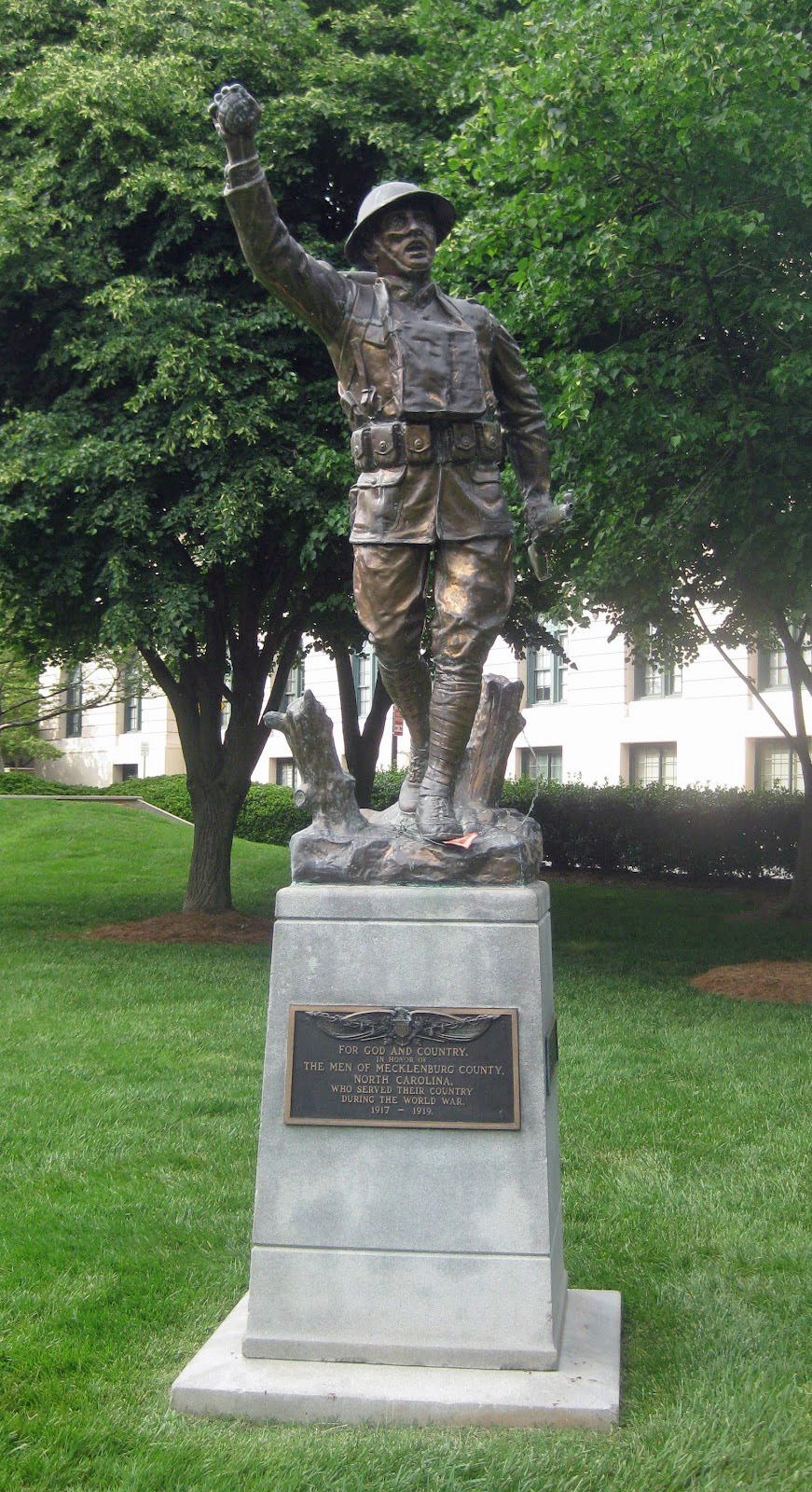
This E.M. Viquesney Doughboy statue is dedicated to servicemembers from Mecklenburg County who served in WWI. It is inscribed:

Front: FOR GOD AND COUNTRY / IN HONOR OF / THE MEN OF MECKLENBURG COUNTY, / NORTH CAROLINA / WHO SERVED THEIR COUNTY / DURING THE WORLD WAR / 1917-1919

Rear: THIS MEMORIAL / ERECTED BY / CITIZENS OF THIS COMMUNITY / IN APPRECIATION OF / WAR SERVICE IN THE CAUSE / OF WORLD-LIBERTY AND JUSTICE

Left side: THERE IS NO HIGHER SERVICE / TO ONE’S COUNTRY / THAN DUTY WITH THE FLAG

Right side: THEIR MANHOOD PREVAILED: / THEIR CAUSE TRIUMPHED.

  • Moore-Armstrong Post No. 138, American Legion Willie C. Lewis Post No. 156, American Legion Carter County Fiscal Court
  • Memorial Hunters Club Submission: thewanderer
41143 Grayson
KY
USA

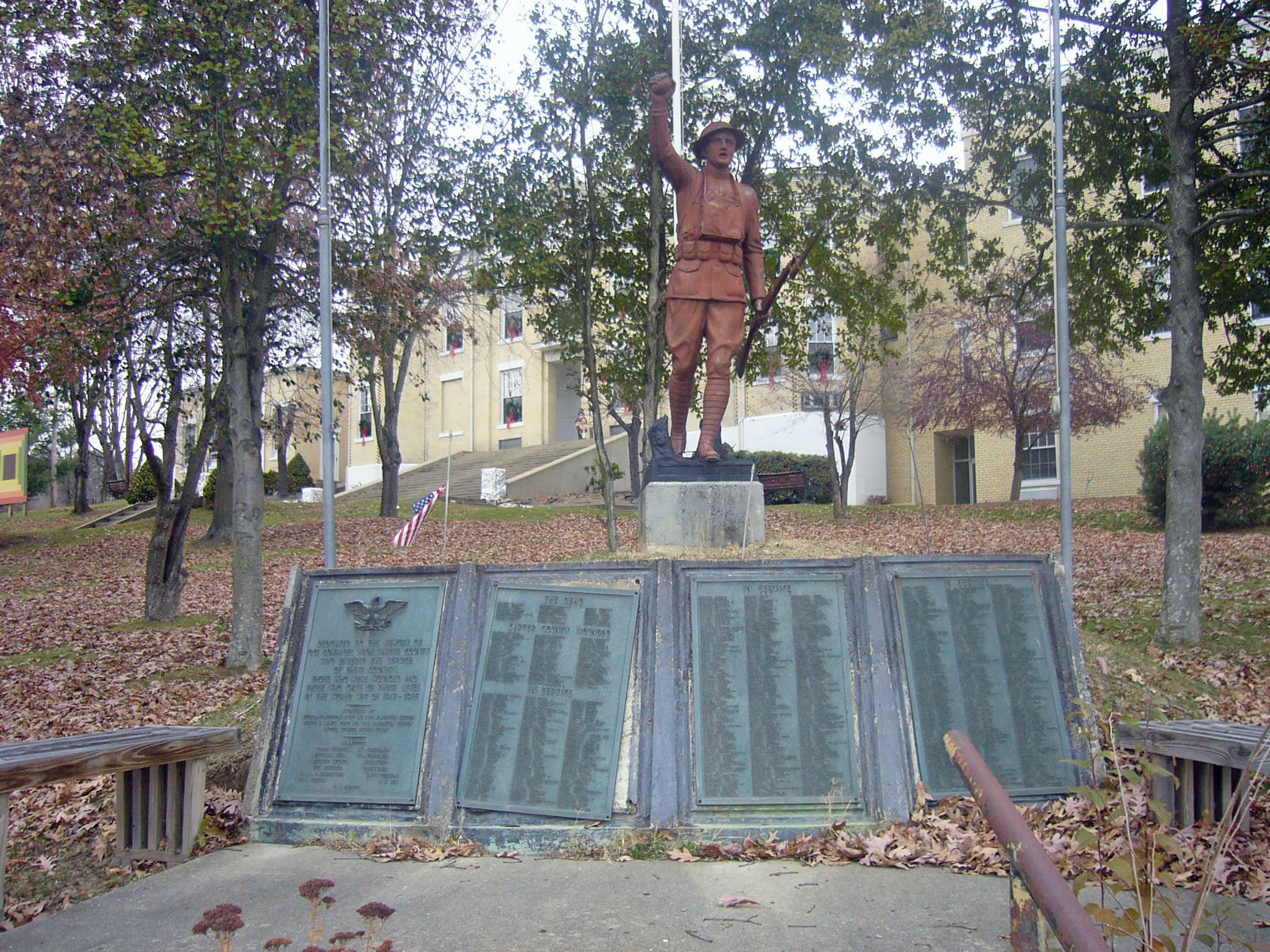
It honors the "Doughboy" and soldiers like him of World War I. The leftmost bronze plate beneath the Doughboy states as follows:

DEDICATED TO THE MEMORY OF
OUR COMRADES FROM CARTER COUNTY
WHO ENTERED THE SERVICE
OF THEIR COUNTRY.
THOSE WHO WERE WOUNDED AND
THOSE WHO GAVE THEIR LIVES
IN THE WORLD WAR OF 1917 - 1918

Sponsored by
Moore-Armstrong Post No. 138, American Legion
Willie C. Lewis Post No. 156, American Legion
Carter County Fiscal Court

Committee
Jerry Carroll, Co-Chairman
Richard Cox, Co-Chairman
Hubert Counts, Secretary
Joe Wheeler, Treasurer
James P. Carpenter, Owen Fielding
Bill Wollin, W. H. Roe
D. V. Kibbey

The 3 additional plates bear the names of the servicemen being honored

  • Materials (select all that apply): Stained Glass
  • Dedication Date: 11/11, 1921
  • 47260001
  • To The Calhoun County Men Who Served In The World War
  • Ernest Morre Viquesney
  • Single figure -- soldier
the center median of Quintard Avenue between 12th and 13th Steets
Anniston
AL
USA
Dedicated May 30, 1922.  Unveiled by Anniston's Gold Star Mothers, the event was hailed as "the crowning event" of the day, according to the Anniston Star, May 31, 1922. To buy the base for the statue, the local post of the American Legion raised money by sponsoring a minstrel show at the Lyric Theater on April 28, 1922. Lee Brothers Foundry donated the plaque, which was first displayed at Saks Clothing Company before being mounted on the base, probably on November 11, 1922 (estimation based on November 6, 1922 Anniston Star reference).

The bayonet and rifle sling are missing and the sculpture and base were both showing a lot of deterioration in this photo taken in 1999. In 2001, the City of Anniston launched an effort to have the monument restored, but that hadn’t taken place by the spring of 2004.

Update, July 13, 2011: The Anniston City Council has voted to request the City Manager look into what would be needed to repair and restore the statue.
  • Who is Memorialized?: Erected to the memory of 91 men and women of Franklin County, Pennsylvania who died in military service in World War One.
  • Memorial Inscription: Copyrighted by/E. M. Viquesney Sculptor/Americus, Georgia (On bronze plaque, right side of base:) They shall live/forevermore/our/glorious dead. / 1917 / 1919 / Erected to the memory of the/men and women of/Franklin County/who gave their lives in the World War./(list of names)/Erected by the citizens of/Franklin County/Greater Love Hath No Man Than That a Man Lay Down His Life for His Friends. signed
  • Materials (select all that apply): Stained Glass
  • Width: 53 in.
  • Depth: 18 in.
  • Other Measurements: Base: approx. 75 x 64 x 82 in.
  • In original location
  • 1923
  • Dedication Date: November 12, 1923
  • Citizens of Franklin County
  • 47260094
  • Plaque with names
  • Names 1; name 2; name 3; name 4
  • E.M. Viquesney, sculptor
  • Single figure -- allegorical
In small triangular memorial area known as “East Point” at the intersection of East Queen and Lincoln Way (U. S. Highway 30).
Chambersburg
PA
USA

The memorial acquisition had its beginnings as early as March 1920 when a successful campaign was conducted to raise funds to acquire the plaque by public subscription. The original plan was to place it on a large boulder at the Franklin County Courthouse, but a state art commission rejected that plan. After considerable delay, the base shown in the above photograph was built and the Doughboy was dedicated at the current location on a rainy November 12, 1923 – Armistice (November 11) was on Sunday that year. The parade paused for a minute of silence at 11 a. m. to recognize the effective time of the armistice five years earlier. Numerous organizations, bands and speakers participated in the ceremony.

  • Materials (select all that apply): Stained Glass
  • Dedication Date: 07/04/1930
  • 47260004
  • Dedicated to the memory of our comrades who entered the service of their country form Fort Smith, Arkansas and who gave their lives in the world war
  • Ernest Morre Viquesney
  • Single figure -- soldier
4901 Midland Blvd
72904 Fort Smith/Sebastian County
AR
USA
Originally dedicated July 4, 1930 at the entrance to Lewis Tilles Park, but placed in storage in 1979 after substantial vandalism, including destruction of the rifle. After refurbishment by Ralph Irwin of Van Buren, Arkansas, it was rededicated at its current location on Memorial Day, 1998.

The Fort Smith Doughboy is one of only two specifically designated Viquesney Doughboys on the National Register of Historical Places.  The other is at Helena, Arkansas. However, at least three more Viquesney Doughboys (Spencer, Indiana, Meridian, Mississippi, and Columbia Falls, Montana) are on the grounds of locations included on the Register (close, but no cigar, as they say).

There is a very substantial roll of coiled razor-wire placed around the feet to discourage attempts to climb the monument.
The following history of Post 31's involvement with the acquisition, placement, and dedication of the Ft. Smith Doughboy was kindly provided by Flickr.com member sunnybrook100 (she has also logged an entry for this sculpture at the Historical Marker Database):

Ellig-Stoufer American Legion Post 31 (named in part after Victor Ellig, the first soldier from Fort Smith, Arkansas to be killed in WWI) was always heavily involved with creating and promoting parks and playgrounds in Fort Smith. In 1928, the Commander Henry Armstrong was named permanent chairman of the city's parks and playgrounds commission. A committee was formed then, "investigating the immediate needs of Lewis Tilles children's park."
It was at about this time that the post began a drive to install a World War I memorial at Tilles Park. That effort came near fruition in April of 1930, when the Arkansas Legionnaire announced that an "announcement has been made that with the city park board paying $500 of the $1,000 necessary, a lifesize bronze statue of a Doughboy will be erected at the entrance to the Lewis Tilles Children's park, Grand Avenue, as a memorial to the men who served in the World War." The statue had already been ordered, and dedication was planned that summer.

Appropriately, the dedication was scheduled for July 4, 1930. More than 2,000 people gathered at Tilles Park that evening for a ceremony that "including the unveiling and dedication of 'The Spirit of the American Doughboy', the first night tennis match ever held in the city, and a band concert." Mr. and Mrs. O.C. Ellig, Victor Ellig's parents, and several Gold Star mothers were in attendance. Dr. W.R. Brooksher, who led the committee that since 1928 had worked to acquire a World War I memorial, presented the statue to Post 31 Commander John Coley, who in turn presented it to Henry Armstrong of the parks and playgrounds commission. Armstrong then formally presented the monument to Mayor Fagan Bourland. The statue was unveiled by "two little misses," Jo Ann Carroll and Nancy Mae Connor, and the ceremony ended with the singing of "America". The sculpture was described by the Helena World as "the only true representation of the real Doughboy and his indomitable spirit."

  • Materials (select all that apply): Stained Glass
  • Dedication Date: 07/10/1927
  • 47260005
  • Erected in honor of the men and women of Phillips county who served in the world war 1917-1918
  • Ernest Morre Viquesney
  • Single figure -- soldier
in the middle of the intersection of Cherry and Perry Streets
72342 Helena-West Helena
AR
USA

This memorial was dedicated July 10, 1927, sponsored by the Phillips County Memorial Association, the 7-Generals Chapter of the UDC, and the City of Helena.  It is a E.M. Viquesney-designed doughboy, depicting a WWI infantryman advancing through the stumps and barbed wire of No Man's Land, holding a broken rifle and grenade.  The Helena Doughboy is one of only two specifically designated Viquesney Doughboys on the National Register of Historic Places.  The other is at Fort Smith, Arkansas. 

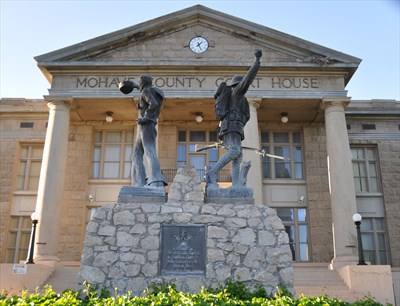
  • Dedication Date: 05/30/1928
  • 47260002
  • In memory of the men and women of Mohave county who served in the world war 1917-1918
  • Ernest Moore Viquesney
  • Single figure -- soldier
  • Memorial Hunters Club Submission: Memorial Hunter: Janet Logan

Dedicated May 30, 1928.  A goldfish pond that was once at the base is now filled in and planted with flowers. A machine gun was originally mounted on the raised part of the base between the two figures. Its disappearance has been the subject of news articles containing speculations about when it vanished. While it was missing in a 1997 picture that appeared in the Daily Miner, it was reported as being present at the time of a 1993 survey of outdoor sculptures.

The color picture at the left above is included to show more details of the sailor, who appears to be standing on a dock by a rope enwrapped stanchion (between his feet) as he waves his small round cap at some offshore object. Other metal "Spirit of the American Navy" sculptures accompany Doughboys at Clearwater
, Florida; Naperville, Illinois; Fort Wayne, Indiana; Granite and Hobart, Oklahoma; and a stone version at Crowell, Texas. A similar Viquesney tribute to the Navy, titled "Sailor", occurs at Palatka, Florida. 

Kingman, Arizona is the only known location where two Viquesney statues occur on the same pedestal (Fort Worth, Texas has a Viquesney Doughboy and a WWII G.I. on the same base, but the latter is by a different sculptor, Giordano Grassi, and was placed in 1980).


Photo credit: https://www.hmdb.org/marker.asp?marker=29398

Description credit: http://doughboysearcher.weebly.com/kingman-arizona.html