PH (586) 239-6768 or email info@selfridgeairmuseum.org This is a military base so you have to call to get approval to enter at least 48 hours in advance!
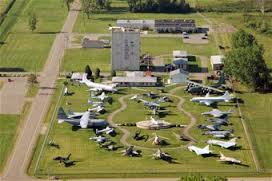
This is a museum displaying military aircraft and associated historical items on the grounds of Selfridge Air National Guard base, an active military facility. All of the items on display are related to the history of this specific base. The museum consists of two parts: an indoor display of historic photos and items, e.g. military uniforms from various periods and an outdoor air museum of vintage aircaft.
This is the centennial of Selfridge Air Base August 2017
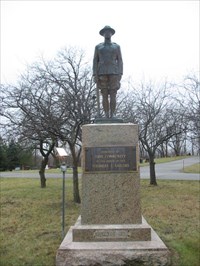
South Haven, John Paulding "Over The Top" / South Haven
Details
American Art Bronze Foundry
Park and Dyckman Sts.
49090
South Haven
MI
USA
This is a life-size metal sculpted by John Paulding, depicting a WWI infantryman advancing through the slumps and barbed wire of No Man's Land, carrying a rifle in his left hand and a grenade in his upraised right hand.
It is sometimes referred to as "Over the Top" and others as "The American Doughboy". The original was cast at the American Art Bronze Foundry and like so many of these statues copies placed around the country.
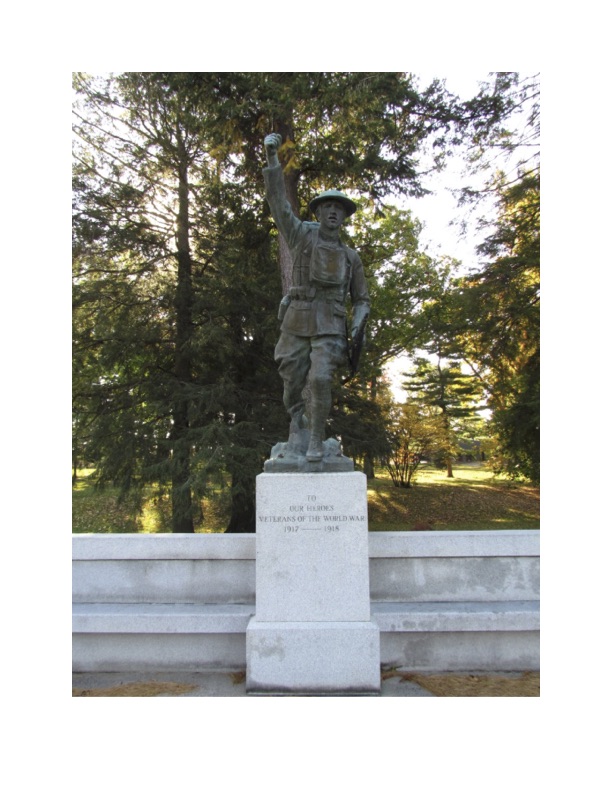
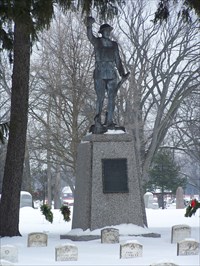
This Viquesney Spirit of the Doughboy statue is located in the Roselawn Cemetery in the Veterans of Foreign Wars Section, in Berkley, Michigan.
Dedidcated to the Memory of our Comrades who served their country on foreign soil or hostile waters in time of war.
Wayne County Veterans of Foreign Wars of the USA May 1941
The Smithsonian Art Inventories Catelog at (visit link)
Tells us this in part:
Spirit of the American Doughboy, (sculpture).
Artist: Viquesney, E. M., 1876-1946, sculptor.
Title: Spirit of the American Doughboy, (sculpture).
Dates: Copyrighted 1934. Dedicated May 1941.
Medium: Sculpture: metal; Base: granite.
Dimensions: Sculpture: approx. 7 x 2 1/2 x 3 ft.; Base: approx. 7 x 5 x 5 ft.
Inscription: (On front of metal base:) SPIRIT OF THE AMERICAN DOUGHBOY (On back of metal base:) COPYRIGHTED 1934 BY/E.M. VIQUESNEY-SCULPTOR/SPENCER - INDIANA (On front of granite base:) DEDICATED/TO THE MEMORY OF/OUR COMRADES/WHO SERVED THEIR COUNTRY/ON FOREIGN SOIL OR/HOSTILE WATERS IN TIME OF WAR/WAYNE COUNTY COUNCIL/VETERANS OF FOREIGN WARS/OF THE U.S.A./MAY 1941 signed
Description: Standing figure of soldier, dressed in World War I uniform of jacket, leggings, helmet, ammunition belt at waist, and front and back packs. Proper right arm is raised overhead with grenade in hand. Proper left hand holds rifle at side. Proper right leg is bent, proper left leg is forward. Two tree stumps wrapped in barbed wire at his feet. Set on flaring stone base. Plaque on base has emblem of Veterans of Foreign Wars above inscription.
Owner: Roseland Park Cemetery Association, Roseland Park Cemetery, Woodward Avenue & Twelve Mile Road, Berkley, Michigan 48072
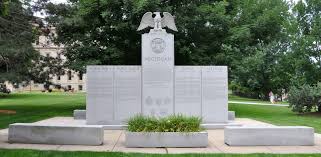
The Michigan Veterans Memorial recognizes the sacrifices of Michigan men and women who served in World War I, World War II, and the Korean and Vietnam conflicts.
The memorial was dedicated at 11:00 a.m. on Thursday, November 11, 1982, by Michigan's Veteran Organizations and Auxiliaries.
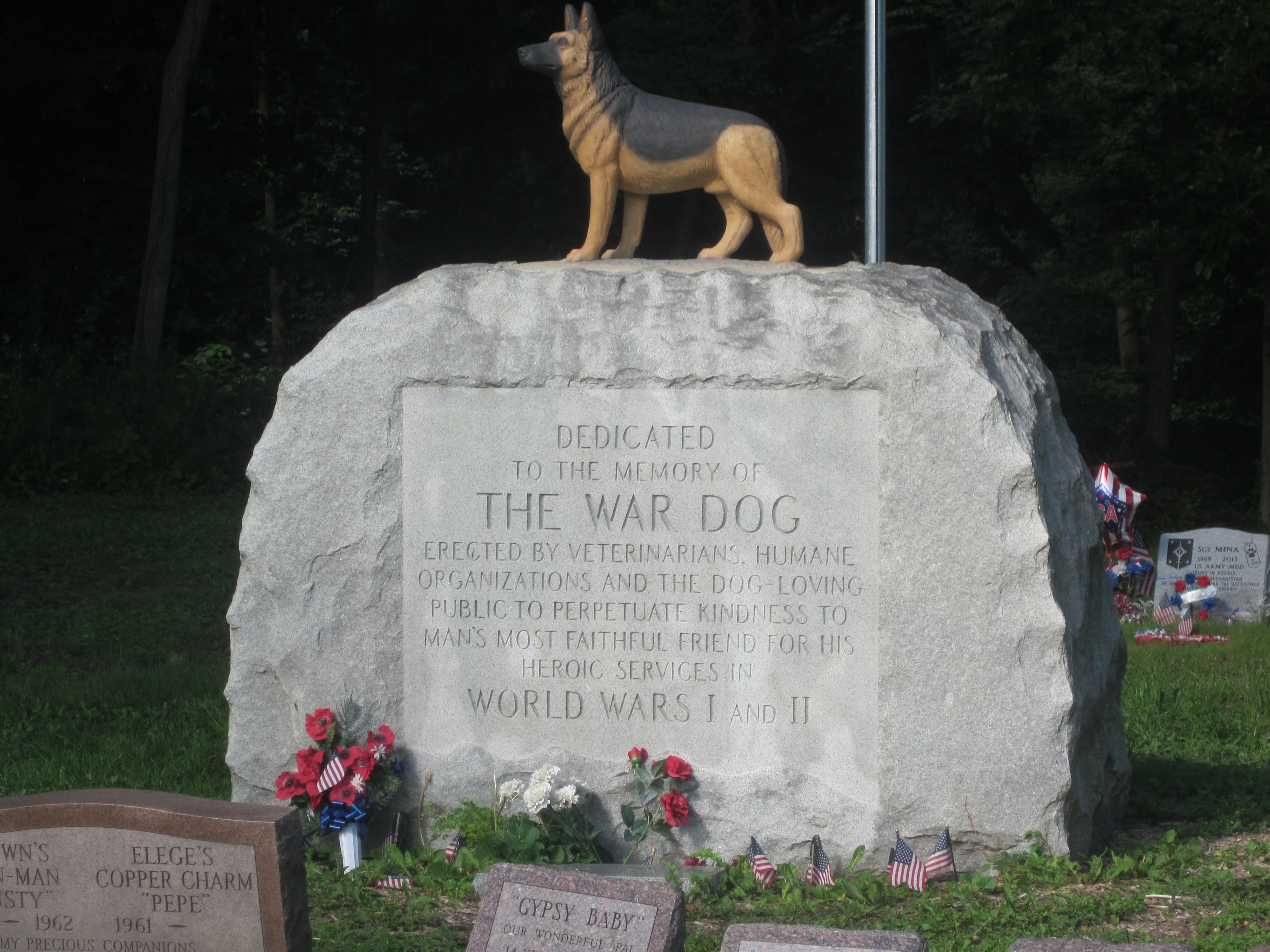
The War Dog - Military War Dogs have been fighting alongside our men and women in uniform in many of our conflicts. In WWI they were called Ambulance Dogs, they were trained to find wounded soldiers in No-Man’s land after a frontal attack. In WWII they were trained in many disciplines; scout, tracker, sentry and messenger. According to Military records War Dogs saved 15,000 lives during this conflict.
In Korea there were only one War Dog platoon deployed consisting of about 28 dogs. Of those 28 dogs on patrol, thousands of ambushes were averted. Thousands of lives were saved. In Vietnam further disciplines were added to their training; explosive detection and booby traps. According to the Military they saved 10,000 lives during this conflict. In Iraq their main function were detecting IED's. Their other duties were sentry and road side check points. They continue on duty today in Afghanistan. There are currently 600 teams deployed saving lives every day.
Today the War Dog is referred to as Military Working Dog (MWD)
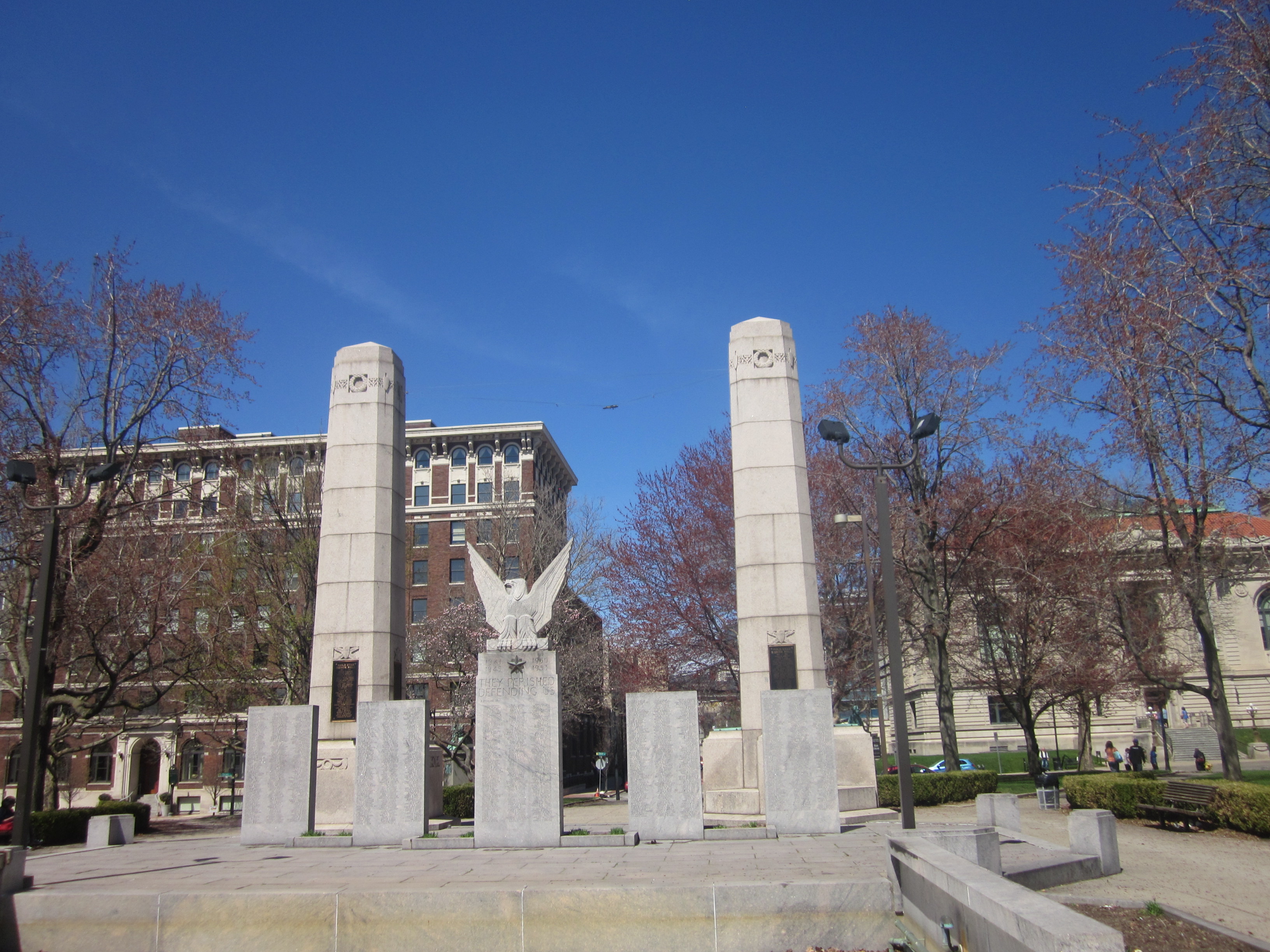
The park was dedicated on November 11, 1926, after the Grand Rapids Council of the American Legion and public contribution funded memorial pillars in honor of WWI vets. In 1945, a citizens group petitioned for a WWII veterans memorial, and coupled with interest for honoring those who served in the Korean War, funds were secured for the addition of five granite pillars to the park. In 1975, two more pillars were added to honor Vietnam veterans.
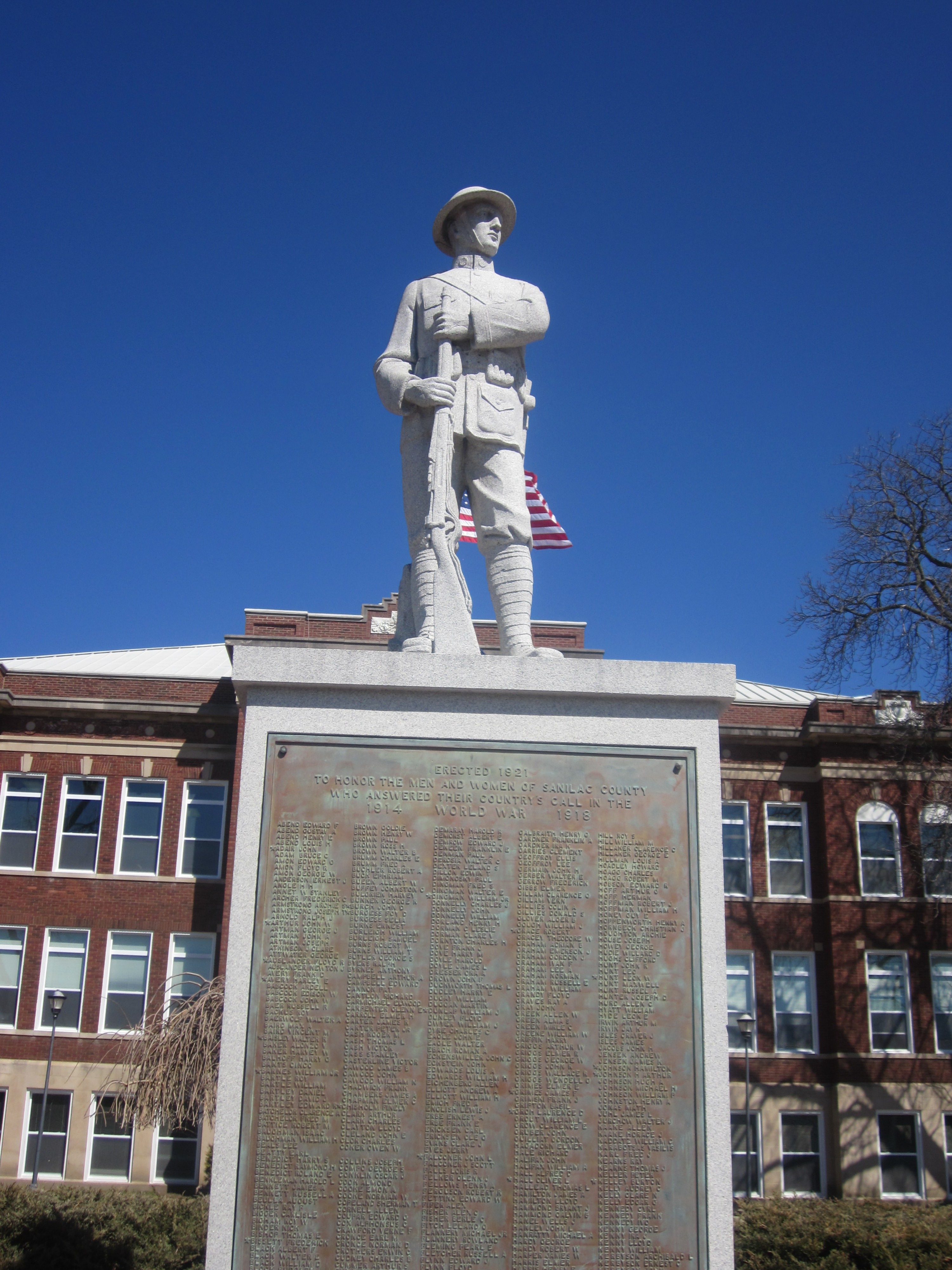
Names of those who died in WWI appear on eight bronze bronze plaques placed on the sides of the granite pillars. Flowers commemorating their sacrifice are place at the base of both monuments. The plaque reads, "ERECTED BY THE CITIZENS OF GRAND RAPIDS WITH FUNDS VOLUNTARILY SUBSCRIBED THEREFORE AND DEDICATED NOVEMBER 11, 1926 TO THE MEMORY OF THE MEN AND WOMEN OF GRAND RAPIDS WHO MADE THE SUPREME SACRIFICE IN THE SERVICE OF THEIR COUNTRY IN THE WORLD WAR. The smaller monument visible between the two pillars is a bust of Thomas Gilbert.
This is an octagonal granite column attached to which is a bronze relief plaque with an image of a soldier and an allegorical Columbia figure. She is dressed in a full-length gown and cape, and holds a sword and a laurel branch, which she offers to the soldier. On the other side of the column is a relief of a shield circled by the foliage. It was sculpted by C.W. Angell (1887-1963) and dedicated on May 30, 1932, to honor the veterans of all wars.
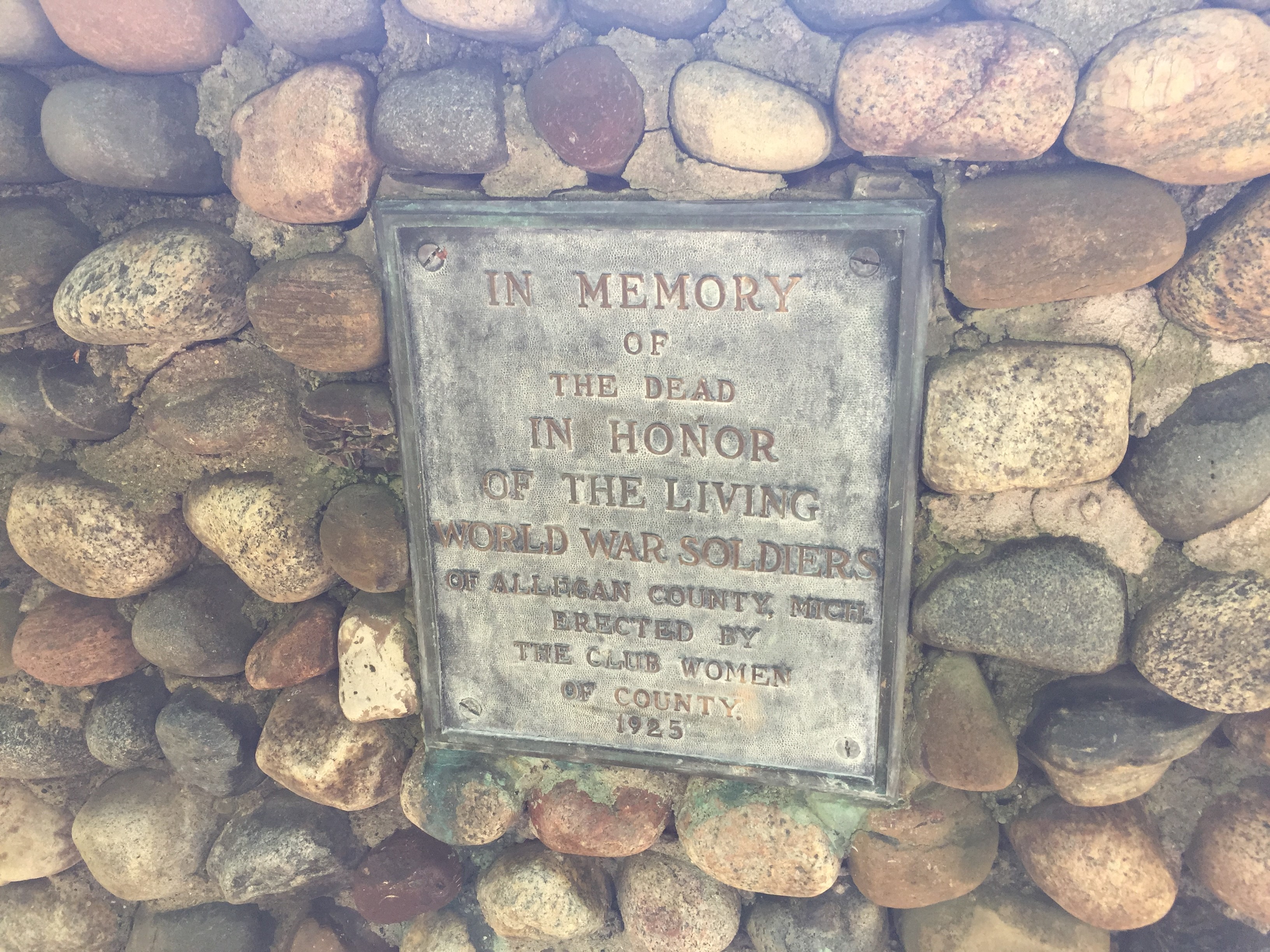
The plaque on the monument is scribed with the following: In Memory Of The Dead In Honor of The Living World War Soldiers Of Allegan County, Mich. Erected By The Club Women Of The County - 1925.
Monument at flag pole: "1917, 1918, Erected by the grateful people of Mason County in memory of these our heroes, who gave their lives for our country and in honor of our soldiers and sailors in the World War. John Benjamin Adam, Frank R. Allen, John Albert Anderson, Frederic Chris Bertelsen, John R. Borski, Russell Clayton Boxell, Louis Brozzo, Eric Carlson, Gordon Chadwick, Carl Christensen, Alvin R. Drabenstott, Dezerie A. Duplessis, Edwin Harold Ewing, Anton Brye, Edwin Glynn, August Gorski, Joseph Hall, John Hanson, Floyd James Herrington, R.D. Keith, Cosmer Leveaux, Walter Loxen, Frank Lukaszewicz, Joseph P. Maluski, Isadore Meyette, Marion Michael, Otto Miney, Francis Joseph Odean, Hans Christian Peterson, Michael Przybysz, Walter Rives, Albert Sheppard, Samuel Shinnock, Samuel Henry Shunk, Wilbur Nelson Sims, Louis Stump, Harold L. Sweet, William R. Vogel, Emil B. Von Sprecken, Lester Vorac, Charles Winner, August T. Ziolkowski, Joseph Zopel , Unveiled May 30, 1926"
These elms were planted by the Auxiliary of Edwin H. Ewing Post No. 76 American Legion in honor of the men of Mason County who served in the World War of 1914-1918
This monument is in the Veterans Memorial Park in Saginaw, Michigan.
The plaque reads: "This monument erected and the road of memory established as loving memorials to the brave men from Saginaw County who gave their last full measure of devotion in the World War that government of the people by the people for the people shall not perish from the earth
By Saginaw chapter Daughters of the American Revolution Patriotic Citizens and Societys of Saginaw County
The monument is located in Veterans Park at the city of Dearborn's municipal complex. The monument was erected in 1991 as a lasting tribute to the city's war dead.
In addition to this World War I monument, the park include walls dedicated to World War II, Korea and Vietnam.
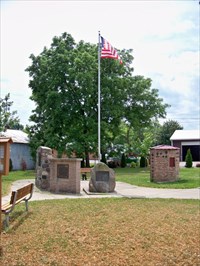
The park contains memorials to several different wars. There are benches to sit on, and plenty of parking in the street.
This memorial is a large boulder with a plaque.
The plaque reads: "In honor of the students of Potterville School who served in the World War 1914-1918" and there is a list of names readable in the gallery photo.
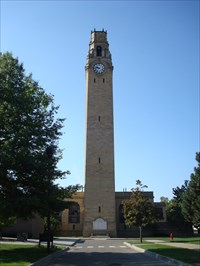
The University of Detroit Memorial Clock Tower was built as a memorial to the 12 U of D students and alumni who died in World War I. As well as serving as a monument, the structure is built around the university's power plant chimney to disguise the industrial structure. It is 175 ft high and was completed in 1926. As you walk up to the base, you will see, etched in stone at the base:
TO THE UNIVERSITY OF DETROIT MEN
WHO DIED IN THE WORLD WAR 1914-18 OUR HONORED DEAD JOHN DesCHAMPS – CHARLES HARRISON – LOUIS MANS – EDWARD J BURNS – THOMAS G KENNEDY ALFRED FULLER – ROGER S MCNAMARA – JAMES WILLIAMS – LIONEL ESLIN – RUSSEL McBREARTY WILLIAM J WILKINSON – THOMAS ABERY
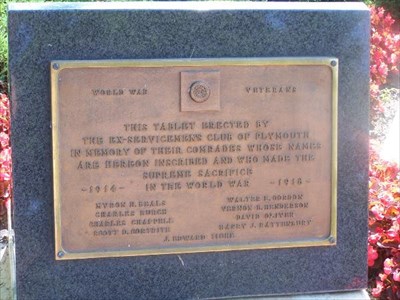
The plaque reads: World War Veterans This Tablet erected by The ex-servicman's club of Plymouth In memory of their comerads whose names are hereon inscribed and who made the supreme sacrifice - 1914 - In the Wrold War - 1918 - Myron H. Beals Walter E. Gordon Charles Burch Verson E. Henderson Charles Chappell David Oliver Scott D. Cortrite Harry J. Ratterbury J. Edward Tighe
The Yankee Air Museum’s exhibitions cover global conflicts from World War One to the present through displays that offer visitors an opportunity to experience those conflicts through the men and woman who lived it. Many items in the collection – including but not limited to uniforms, weaponry, aircraft, medals, letters, artwork, photographs, and other mementos – are currently on exhibit in the Museum. The majority of the collection are kept safely in storage for research and future exhibitions, or are being restored to their original condition. The Museum also has a large collection of oral histories conducted with veterans of all branches and the civilians who helped at the home front
.
The Story of the Yankee Air Museum The Yankee Air Museum has been a great influence in the world of aviation throughout Southeast Michigan for decades. Founded in 1981, the Museum quickly grew when it acquired its flyable aircraft, B-17 Flying Fortress, B-25 Mitchell Bomber, and C-47 Skytrain, offering the public the chance to fly in some of America’s most iconic aircraft. The Museum was originally located on the very North-East side of the Willow Run Airport until it suffered a devastating fire in 2004. While most everything was destroyed, a few aircraft such as the B-17, C-47, B-25, and B-52, among others were moved to safety.
The Museum re-opened to the public in 2010 in a new location just yards away from the original. The Museum has 47,000 sq. ft. that houses its collection of permanent and rotating aviation and historic displays as well as over 5,000 artifacts. In 2010, a school house that was used during World War Two was donated and relocated next to the Museum and has become the Museum’s research library.
In 2011, negotiations began between RACER Trust, Michigan Aerospace Foundation, and Yankee Air Museum for acquiring part of the old Willow Run Bomber Plant that produced B-24 Bombers during World War Two for the Ford Motor Company. After nearly two years of negotiations, the Foundation’s offer was accepted to save a portion of the Bomber Plant. The Save the Bomber Plant campaign raised $8 million to acquire, enclose, and power the 144,000 square feet of the facility. This would create a new, permanent home for the Museum, its exhibits, educational programs as well as its flyable and static aircraft. Along with a new home, the Yankee Air Museum will gain a new name, The National Museum of Aviation and Technology at Historic Willow Run, when it opens to the public.
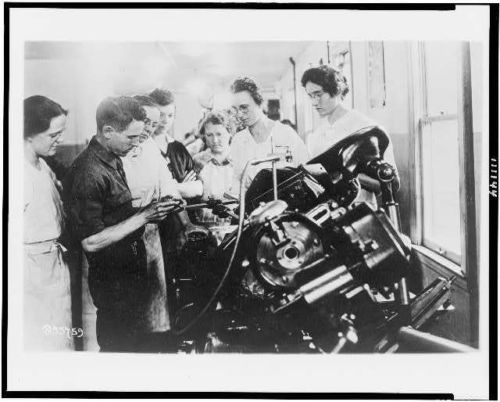
That was only the beginning. A new campaign has been launched to raise the funds to build the Museum and its exhibits within the Bomber Plant. The stories of “How Detroit Saved the World” and “Rosie the Riveter” will be told on the site where they happened some 70 years ago. The Yankee Air Museum’s growing aircraft collection and the research library, the David and Andrea Robertson Education Center, will also be moved inside.
The additional space will allow the Museum to integrate STEM (Science, Technology, Engineering and Mathematics) into its exhibits and programs to inspire young people to pursue education and career opportunities in those fields. The building will also hold the Museum’s growing collection of artifacts and documents in a state-of-the-art facility.
The Yankee Air Museum is rapidly growing and constantly producing new exhibits, educational activities, and exciting experiences for the public. Plan your visit today!

































 The Museum re-opened to the public in 2010 in a new location just yards away from the original. The Museum has 47,000 sq. ft. that houses its collection of permanent and rotating aviation and historic displays as well as over 5,000 artifacts. In 2010, a school house that was used during World War Two was donated and relocated next to the Museum and has become the Museum’s research library.