






























John Michael Nichols
Submitted by: Alan Leventhal, Tribal Ethnohistorian, Muwekma Ohlone Tribe
John Michael Nichols born around 1893. John Nichols served in World War 1 with the United States Army . The enlistment was in 1914 and the service was completed in 1920.
Story of Service
Private John Michael Nichols
U.S. Army, 59th Artillery Regiment, Coast ArtilleryCorps [TD (Tractor Drawn 8" Howitzers), HD (Harbor Defense)], American Expeditionary Force
John was the older brother of Henry Nichols, and he served in the U.S. Army from 1914 to 1920. John enlisted on October 27, 1914 at Fort McDowell on Angel Island. He fought in France serving with the 59th Coast Artillery Regiment which was attached to the 32nd Brigade, C.A.C.
The 59th was engaged in the St. Mihiel offensive and the Meuse-Argonne offensive. John was discharged at Fort Winfield Scott at the SF Presidio on June 4, 1920.
John M. Nichols was listed as an Indian on the 1930 Federal Census along with his son Alfred in Santa Cruz County. On John Nichols's Draft Registration Card dated April 27, 1942 he was identified as residing at the Veteran's Home in Napa (Yountville), California and he had resided there from 1941 to 1953.
John Nichols died in April 1968 while living in Stockton, California. Citations: Victory Medal with France, Defensive Sector, St. Mihiel and Meuse-Argonne bars.
Joseph Aleas
Submitted by: Alan Leventhal, Tribal Ethnohistorian, Muwekma Ohlone Tribe
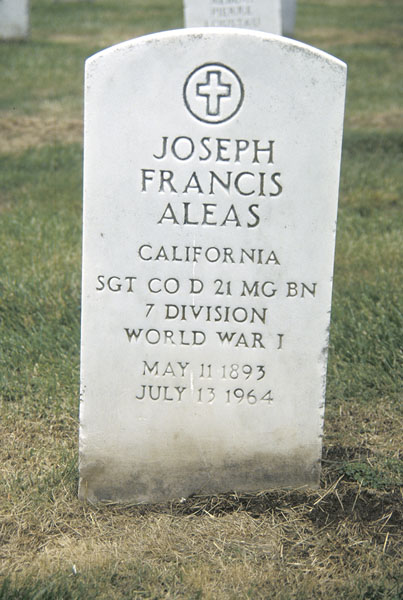
Joseph Aleas born on May 11, 1893. Joseph Aleas served in World War 1 with the United States Army . The enlistment was in 1916 and the service was completed in 1920.
Story of Service
Sergeant Joseph Aleas
U.S. Army, Company D, 21st Machine Gun Battaion, 7th Division, American Expeditionary.
Joseph Aleas was born on the Alisal (Pleasanton) Rancheria on May 11, 1893 and was the son of Margaret Armija. He enlisted in the US Army on June 30, 1916.
According to Armija-Thompson family recollections, he was a good horseman and wanted to fight against Pancho Villa had led approximately 1,500 Mexican raiders in a cross-border attack against Columbus, New Mexico, in response to the U.S. government's official recognition of the Carranza regime. Villa's troops attacked a detachment of the 13th U.S. Cavalry, seized 100 horses and mules, burned the town, killed 10 soldiers and eight of its residents, and made off with ammunition and weapons. President Woodrow Wilson responded by sending 6,000 troops under General John J. Pershing to Mexico to pursue Pancho Villa and his troops. This military mobilization was called the Punitive or Pancho Villa Expedition.
Later, Joseph Aleas served in France in the 21st Machine Gun Battalion, 7th Division (its Hourglass insignia dates back to 1918). Organized originally to serve in the American Expeditionary Forces (AEF) during World War I, the U.S. Army's 7th Infantry Division was created at Camp Wheeler, Georgia on December 6, 1917 and it fought in Alsace-Lorraine, France during the war. The division also served as an occupation force in the post-war period.
Alfred Guzman
Submitted by: Alan Leventhal, Tribal Ethnohistorian, Muwekma Ohlone Tribe
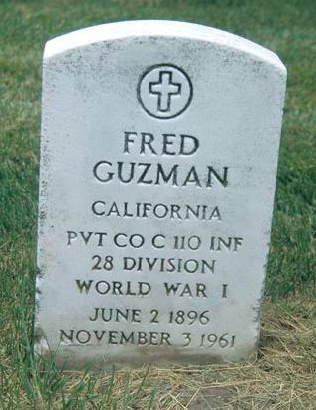
Alfred Guzman born June 2, 1896. Alfred Guzman served in World War 1 with the United States Army . The enlistment was in 1917 and the service was completed in 1919.
Story of Service
Private Alfred (Fred) Guzman
U.S. Army, Company C, 110th Infantry Regiment, 28th Division, American Expeditionary Force under Brigadier General T. W. Darrah.
Alfred Guzman was born on the Pleasanton Rancheria on June 27, 1896 to Francisca and Jose Guzman.
Prior to the declaration of War, Fred Guzman had served in the National Guard at Fort Mason in San Francisco in 1917. Afterwards he enlisted in the U.S. Army, and served in the 28th Division, 55th Brigade Infantry, 110th Infantry, Company "C" and fought in the major battles at Ourcq-Vesle (July 28, 1918), Second Battle of the Marne (July 15-August 5, 1918), Meuse-Argonne Offensive (September 26 to October 8, 1918), and Havrincourt (October 8 - November 11, 1918) in France.
The 28th Division fought in the following campaigns: Champagne-Marne, Aisne-Marne, Oise-Aisne, Meuse-Argonne, Champagne (1918), Lorraine (1918). The cost in lives of these six campaigns was 4,183 casualties including 760 dead. The six fleurs-de-lis on the regimental insignia commemorated their World War I service.
Toney Guzman
Submitted by: Alan Leventhal, Tribal Ethnohistorian, Muwekma Ohlone Tribe
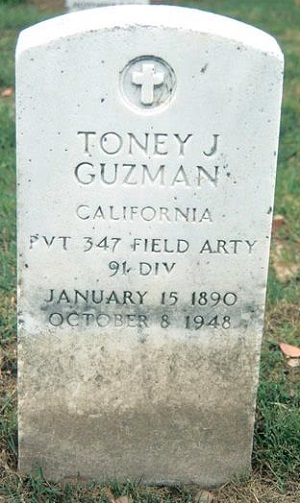
Toney Guzman born January 15, 1890, Toney Guzman served in World War 1 with the United States Army . The enlistment was in 1918 and the service was completed in 1919.
Story of Service
Private Antonio (Toney) Guzman
U.S. Army, Battery F, 347th Field Artillery Regiment, 91st Division, American Expeditionary Force.
Toney Guzman was born on March 27, 1890 either in Centerville or on the Niles Rancheria. He was the son of Muwekma Indians Francisca Nonessa and Jose Guzman. Toney enlisted in the U.S. Army and he fought in the Meuse-Argonne (September 26 to October 8, 1918), Ypres-Lys, and Lorraine campaigns in France.
Toney served in the Army from April 29, 1918 and was honorably discharged at the San Francisco Presidio on April 26, 1919.
The 91st Division was known as the "Wild West Division." The Division's shoulder patch was a green fir tree referring to its origin at Camp Lewis in the Pacific Northwest. The Division was deployed to France in August, 1918 and fought with great distinction.
In the Ypres-Lys campaign, the Division served in the Flanders Army Group, under the command of the King of Belgium. The Division was headquartered adjacent to Flanders Field. Five members of the Division earned the Congressional Medal of Honor.
Stanley Lionel
Submitted by: Tanveer Kalo
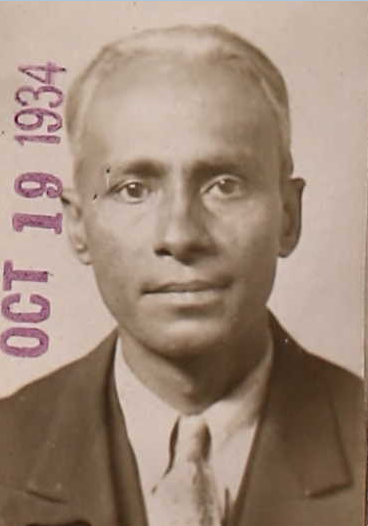 Stanley Lionel served in World War 1 with the United States Army . The enlistment was in 1917 and the service was completed in 1919.
Story of Service
Stanley Lionel was born on January 15, 1893 or 1894 in Ceylon, British India. Lionel's birth year is contested because multiple documents list different years. He immigrated to the United States in either 1904, or 1905 or 1914. The exact year of his arrival is contested by his 1930 census and naturalization application. After his arrival, Lionel settled in Manhattan, New York.
Lionel enlisted in the U.S. Army on June 5, 1917. His World War I draft card recorded his race as "Ceylonian" and birth date as January 15, 1893.
Lionel started his service at Fort Solcum, New York. He was then assigned to the 13th Cavalry Regiment at Fort Ringgold, Texas. His unit was assigned to the Mexican-U.S. border. On December 17, 1917, Lionel was promoted to Private First Class. He did not serve overseas.
James Buha Khan
Submitted by: Tanveer Kalo
James Buha Khan born around 1889 or 1886, James Khan served in World War 1 with the the United States Army . The enlistment was in 1917 and the service was completed in 1919.
Story of Service
Private James Buha Khan was born in Lahore, British India in either 1889 or July 15, 1886. Khan came to the United States in 1904 and settled in Oakland, California until the 1940s. He then moved to Utah and lived there until his death. In 1906, Khan applied for U.S. naturalization in California.
On December 25, 1911, James Buha Khan married Pearl M. Carter in Alameda, California.
Khan enlisted in the U.S. military on December 14, 1917. His World War I draft card recorded his race as "Malayan" or Malaysian.
Khan was assigned to HQ Company, 363 Infantry. Khan and his unit departed from Philadelphia, Pennsylvania on the ship City Of Cairo for France on July 6, 1918. Khan's U.S., Army Transport Service, Passenger List recorded his next of kin as his brother, Mian Khan.
Fred Meyers
Submitted by: Pat Roblewsky {grandson}
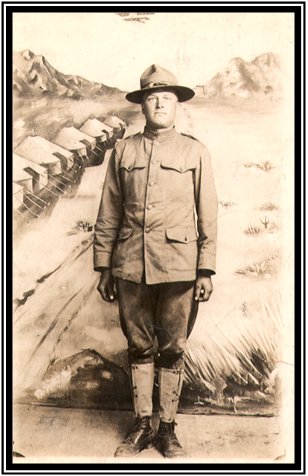
Fred Meyers born around 1896, Fred Meyers served in World War 1 with the United States Army. The enlistment was in 1917 and the service was completed in 1919.
Story of Service
Enlistment
Fred Meyers, a 20 year old farmer from Britton, South Dakota, enlisted in the Army on April 18, 1917. Fred Meyers was assigned to the 59th Depot Brigade 1st S. Dakota Cavalry. In September of 1917 Fred was sent to Boot Camp at Camp Dodge, Iowa. Sometime in October of 1917, he was sent to Camp Cody near Deming in New Mexico for training. Fred Meyers was there until June 1918. In June he traveled to France by way of England to be among the first combat troops to fight in the war with Germany.
Training
Sometime around September 14 or 15, 1917 Fred Meyers left Britton, South Dakota for Boot Camp at Camp Dodge in Iowa. His travel took him to Omaha, Nebraska. Fred probably arrived at Camp Dodge on or about September 17, 1917. It is not known how long he was at Camp Dodge, but it can be assumed that this was his basic military training. He probably learned Military Order and Discipline, i.e. bed making, marching, rules and etc.
Isaac Walter Miller
Submitted by: Kris I. Miller {grandson}
Isaac Walter Miller served in World War 1 with the United States Army. The dates of service are: Known Feb 1917- Aug 1919.
My Grandfather Isaac Walter Miller joined the Army at Reading, PA in 1917. He sailed to France from Hoboken, NJ in June 1917.
He was involved with the following of the First Division: Aisne defense: May - June 1918, Marne offense:July Aug 1918, St. Michael: Sept 1918, Meuse Argonne: Sept- Nov 1918. He was hospitalized for 1 week near Verdun due to gas and shock.
He was promoted to corporal Feb. 1918 and to Sargent July 1919. He arrived back in the US and was discharged Aug. 1919. After his discharge he transferred from regular Army to Pennsylvania National Guard Sept 1919.
While serving as a patrolman assigned to Valley Forge Park he was killed in an accident while riding his motorcycle. At the time of his death he and his wife Mabel had 3 children ages 3, 2, and my father who was 6 months old. My dad never knew his father but spent several years late in his own life researching and compiling his fathers life story. Had it not been for my fathers effort we may never have learned about the decorated war hero that was my grandfather.
William F. Weir
Submitted by: Diane Sleger {granddaughter}
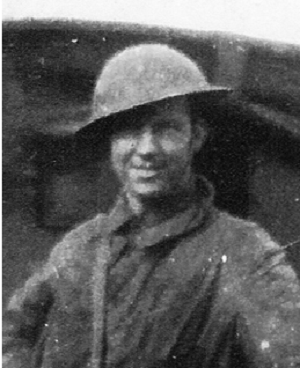 William F. Weir served in World War 1 with the United States Army. The dates of service are: Known 07SEP1917-09JUN1919.
I discovered my grandfather's old wallet filled with WWI 1" x 1.5" old black and white photographs with handwritten captions. As tears filled my eyes, I had to catch my breath as I felt I began to know my grandfather, who I never really knew.
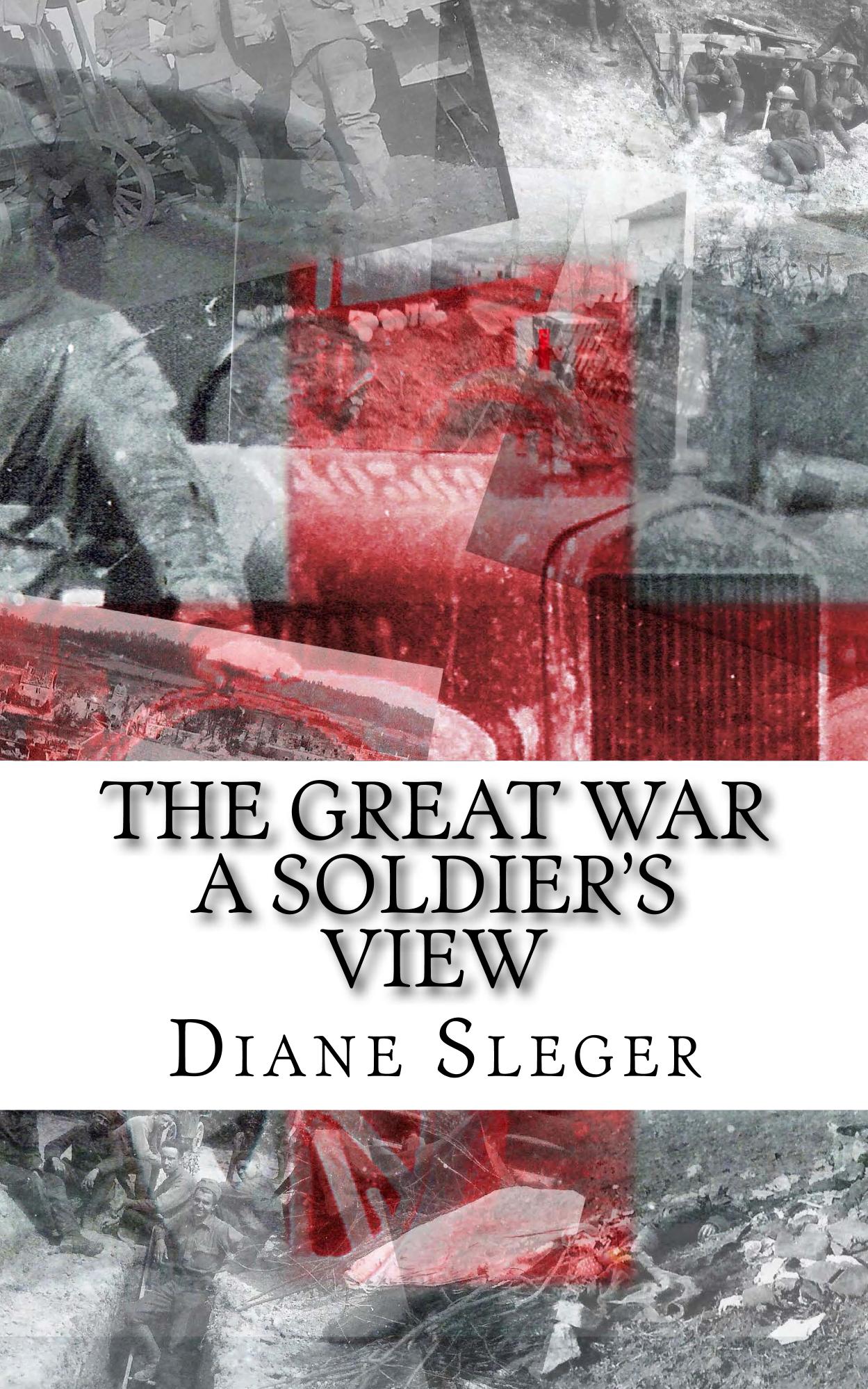 When I was a child, growing up in "Pure Michigan", I only knew my paternal grandparents. I was told he had swallowed mustard gas, and had TB, and lived in the TB Sanitarium in Chicago. I became interested in finding out more about WWI and his contribution. With my degree in Graphic Design, I decided to sort those and compile this book to honor him and share his memories with others.
WWI veteran of William Frederick Weir served with the American Field Service, Special Services Unit 649, with the American Expeditionary Forces in the First Division. It relates specifically to a driver/mechanic’s experiences in the trenches, including Cantigny, Soissons, and Meuse Argonne.