



































Robert James Gowanlock
Submitted by: James Green {grandson}
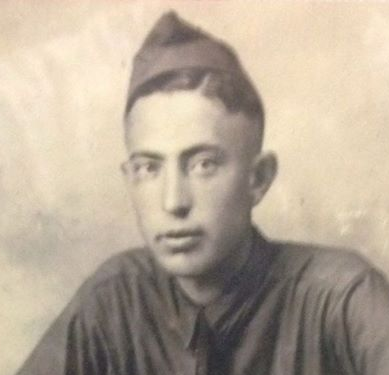 Robert James Gowanlock served in World War 1 with the the United States Army . The dates of service are: Known July 1917- June 1919.
Bob Gowanlock was my grandfather. He was part of the 90th Division, 359th infantry. Comprised of draftees of Texas and Oklahoma, they were known as the "Tough 'Ombres".
He fought in both St. Mihiel in September 1918 and in Meuse Argonne offensive in September and October 1918.
He was gassed at St. Mihiel and dealt with its deleterious effects for the rest of his life.
He had nightmares for decades after his service. He lost many men in his company.
My Granddaddy lived until 1975 so I had the opportunity to know him. He never would speak of the war, except he told his children that the rats in the trenches were the size of cats.
Corporal Dhirendranath Mitra
Submitted by: Tanveer Kalo
Corporal Dhirendranath Mitra served in World War 1 with the United States Army. The dates of service are: Known May 17, 1918 to March 22, 1919.
Dhirendranath Mitra was born on April 17, 1892 in Darjeeling, Bengal, British India to Beni Gopal Mitra. He immigrated to the United States in 1913 sailing from Genoa, Italy. He originally settled in New York City and worked as farm hand. Then he settled in Lynn, Massachusetts and worked as a engineer for the rest of the his life.
His World War I draft card listed his race as white, residence as New York University 39 E 31st St, and occupation as a farm hand for Mrs. D.P. Warren in West Park, New York.
On May 17, 1918, Mitra was inducted into the United States Army. He was assigned to the Company H 56 Engineers until June 4, 1918. He petitioned for and was granted U.S. naturalization in Washington D.C. on June 4, 1918.
His next two assignments were to Company I 56 Engineers until August 1, 1918 and Company D 605 Engineers until September 1, 1918. On August 7, 1918, Mitra was promoted to corporal.
Mary Alice Lamb
Submitted by: Mary Rohrer Dexter
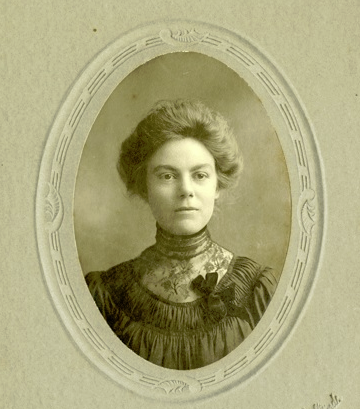
Mary Alice Lamb served in World War 1 with a non-government service organization. The dates of service are: Known 1918-1928.
“Those who go forth ministering to the wants and necessities of their fellow beings experience a rich return, their souls being as a watered garden, and a spring that faileth not…”
– Lucretia Mott
Tucked away in the South West corner of Miami County, Indiana is the small community of Amboy where in 1844, the first Friends Worship service was held in Miami County and six years later, a log church was erected at a location that would later be next to Amboy Friends Cemetery. Until a school was built in 1872, the church doubled as a school. In 1867, the Panhandle Railroad was completed through Miami County and the small town of Amboy was platted as the location of the train station.
When, in 1871, Benjamin B. Lamb laid an addition to the original Amboy platt, his son Ezra must have been living in the area, for on July 28, 1878, Ezra Lamb and his wife Eliza were holding a beautiful baby girl in their arms whom they named Mary Alice.
As she grew, Mary Alice probably attended school in Amboy at a building known as The Academy. The years flew by and soon Mary Alice Lamb was attending school at Earlham College in Richmond, Indiana. She graduated in 1901 with a teaching degree. By this time, she was a young woman, 5’4 1/2” tall, sporting brown hair and brown eyes. Known to her friends as Alice, her first teaching job was at Stit School, four miles from the home in which she grew up. Every morning she would drive to school in a two-wheel cart pulled by a horse. If it rained, she would wear water proof garments or pull into the nearest barn lot until the rain let up. Sometimes, if the weather was very bad she would stay with the Stit family, on whose land the school was located.
Katherine Rose Kreutzer
Submitted by: Mary Rohrer Dexter
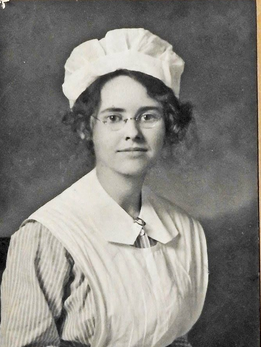
Katherine Rose Kreutzer served in World War 1 with the United States Army. The dates of service are: Known 3/1918 - 4/1919.
April of 1918 was rainy in Southwestern Ohio, with temperatures which ranged in the upper forties to lower fifties, as 30-year-old Katherine Rose Kreutzer arrived at Wilbur Wright Field, Fairborn, Ohio. Pulling her cape around her more closely while shivering in the biting wind, she stepped into a new juncture of her life. She was beginning her period as an Army Corps Nurse.
Wilbur Wright Field was a new base. The land had only been acquired one year prior to her arrival. The hospital building construction had started in July of 1917, but an adequate amount of additions to the original structure were not in place until March of 1918. During the construction phase, civilian workers and their families camped in the area, as were the teams of animals used in the construction work. Conditions were very unsanitary. The stench of many pit privies combined with large amounts of animal manure caused the area to become infested with flies and the drinking water became contaminated.
Luckily, after Katherine had been at the base a month, all these issues were resolved. The hospital did not have telephone service during the time frame she was at Wilbur Wright Field. In spite of the primitive conditions, Katherine immediately rolled up her sleeves alongside ten other nurses to care for the 353 soldiers who were in the hospital that month. Twenty of the young men were inflicted with communicable diseases which put these young women at risk, and twenty-five others had contracted venereal disease. The work was demanding and the shifts were long.
Harriet Louise Carfrae
Submitted by: Mary Rohrer Dexter
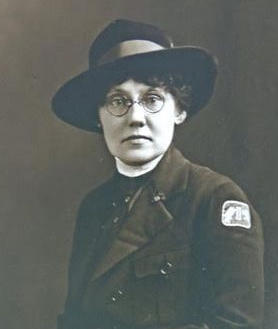
Harriet Louise Carfrae served in World War 1 with the Red Cross. The dates of service are: Known 5/1917-5/1920.
Story of Service
Born Ninety miles south of Lake Erie at Norwalk, Ohio on January 10, 1879 to immigrant parents, Harriett Louise Carfrae moved west with her family to Miami County, Indiana before her first birthday. Her father, James, was Scottish and worked as a boilermaker for the railroad. Her mother, Margaret Dillon Carfrae, was Irish, but arrived in the United States by immigrating first to Canada. Harriett had curly, dark hair, light eyes and wore round wire glasses. It can be guessed that she was not very tall from the average size of others with the same nationality of her parents.
When she was 18, Harriett was part of the leadership of a Christian youth organization named, The Christian Endeavor, which was involved in the temperance movement. She was known as Hattie by her friends. When she turned 21, she moved to St Louis in order to attend the Baptist Sanitarium Hospital School of Nursing. She graduated with 17 other women in 1903. The school of nursing was a two-year program which enrolled its first students in 1895, indicating Harriet was part of the school’s seventh graduating class. At some point, the nursing school expanded to a three-year program.
Private Minoo Phiroze
Submitted by: Tanveer Kalo
Private Minoo Phiroze served in World War 1 with the United States Army. The dates of service are: Known March 22, 1917 to June 4, 1920.
Private Minoo Phiroze was born March 5, 1892 in Bombay, British India. He immigrated to the United States in 1916.
He enlisted into the United States military on March 22, 1917. at Fort Slocum, New York. He was then assigned to Training I 11th Calvary until June 21, 1917. Then he was assigned to Training I 23rd Calvary until August 1, 1917.
The U.S., Army Transport Service, Passenger List from November 2, 1918 recored Private Phiroze leaving from the of New York with the Battery E 81st Field Artillery on the ship Aquitania. However, his name was crossed out with what appears to be the words, "Bld Corp Spies". The list also recored his next of kin, John Mose, who lived at 3rd Ave YMCA, New York.
His next assignment was Battery E 23rd 23rd Calvary(Battery E 81 Field Artillery) until February 8, 1918. Training H 4 Calvary was Phiroze's next assignment until l February 21,1918. His late assignment was HQ Training 4 Calvary till March 22, 1920.
Private Bivuty Vushon Mukerji
Submitted by: Tanveer Kalo
Private Bivuty Vushon Mukerji served in World War 1 with the United States Army. The dates of service are: Known April 3, 1918 to May 1, 1918.
Private Bivuty Vushon Mukerji was born about 1892 or 1893 in Calcutta, British India. Mukerji completed medical studies at the Glasgow University in Scotland on October 18, 1910. He immigrated to the U.S. prior to 1918 and settled in New York City. He lived at 415 W 22 St in Manhattan.
By 1917, Mukerji had his first papers and registered for the draft on June 5. Mukerji's draft card listed his race as Caucasian (White).
On April 3, 1918, Mukerji was inducted into the U.S. military at age of 26 or 27. He was assigned to the 152 Depot Brigade at Camp Upton in Long Island, New York. His New York military service abstract recorded that he served with the brigade until discharge and did not serve overseas.
Joseph Miller Duff, Jr.
Submitted by: Andrew Capets (Author of "Good War, Great Men")
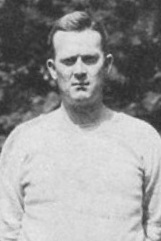
Joseph Miller Duff Jr. born around 1889, Joseph Duff served in World War 1 with the United States Army. The enlistment was in 1918 and the service was completed in 1918
Joseph "Joe" Miller Duff Jr. was destined to lead men. Unfortunately, like so many brilliant young men of their time, his life was cut short in the killing fields of the Meusue-Argonne. Duff was an Ivy League graduate, the Head Football Coach for the University of Pittsburgh, an attorney for the Allegheny County Bar in Pittsburgh, and a World War I machine gunner.
Joe Duff was an American hero. Despite being rejected by the Army on three different occasions for medical reasons, Duff was determined to serve his country and was eventually able to convince the local draft board to overlook his vision problems.
Duff was a 1912 graduate of Princeton University. As a standout player on their varsity football team, he was named a 1911 ‘All-American’ and proclaimed to be one of the ‘greatest guards in football history’ according to a 1913 Pittsburgh Press newspaper article.
After graduation he was asked to stay on at Princeton to serves as an assistant football coach. The following year he received an offer to become head football coach at the University of Pittsburgh. Duff delivered two winning seasons for Pittsburgh in 1913 and 1914. Following the 1914 season, Pitt found an opportunity to hire legendary coach Glenn Scobey "Pop" Warner. Coach Warner helped Pitt win the College Football National Championship in 1915.
That same year, Duff obtained his Law Degree from the University of Pittsburgh and went on to work in his brother James Duff's law firm.
Fazal Khan
Submitted by: Tanveer Kalo
Fazal Khan served in World War 1 with the United States Army. The dates of service are: Known May 27, 1917- July 23, 1919.
Private Fazal Khan was born on November 26, 1884 in Lodarmang,Hazara District North-West Frontier Province British India to Ameir Khan and Samnur. He immigrated to the United States in 1906 or 1907 and settled in Boston, Massachusetts.
By 1920, Khan was married to Mabel (Smith) Khan and was naturalized. Mabel was born in New Jersey. According to her 1920 federal census, she worked as dressmaker at home. Her 1900 , 1910, 1920, and 1930 federal censuses recorded her race as black. She was listed as white in her 1940 federal census. The Massachusetts Marriage Index listed Mabel's and Fazal's marraiage year as 1930. Khan's 1920 federal census recorded his race as Hindu (East Indian) and native tongue as Hindustani.