































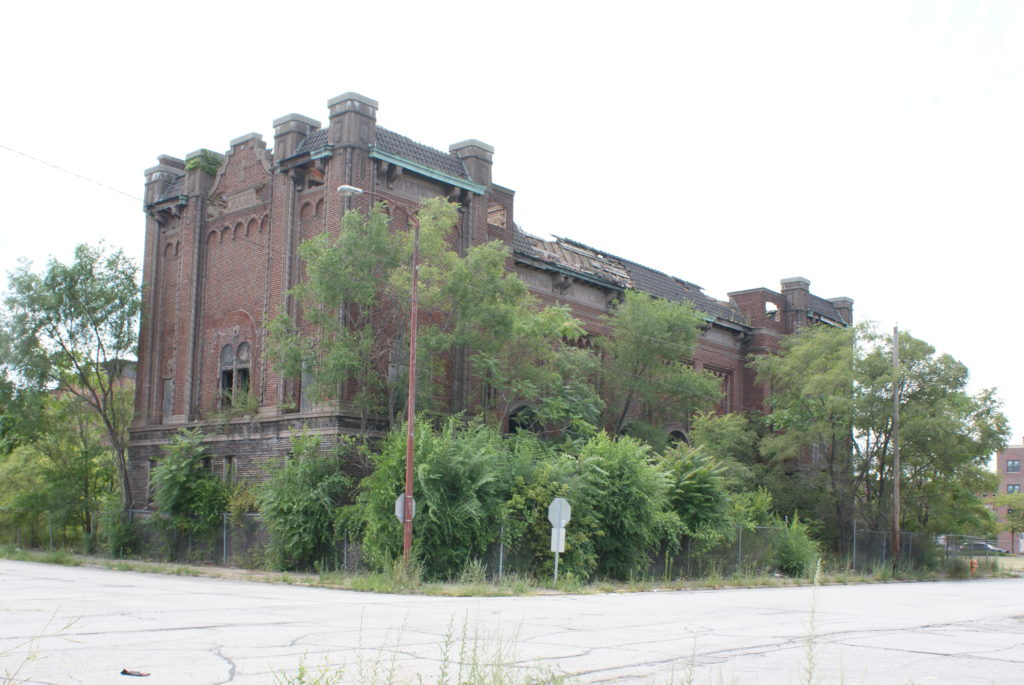
The Memorial Auditorium was erected in 1928 and closed in the 1970s. In 1997, fire destroyed much of the building but the main lobby survived.
Memorial
- Details
- Memorial Hunters Club Submission: The Wanderer
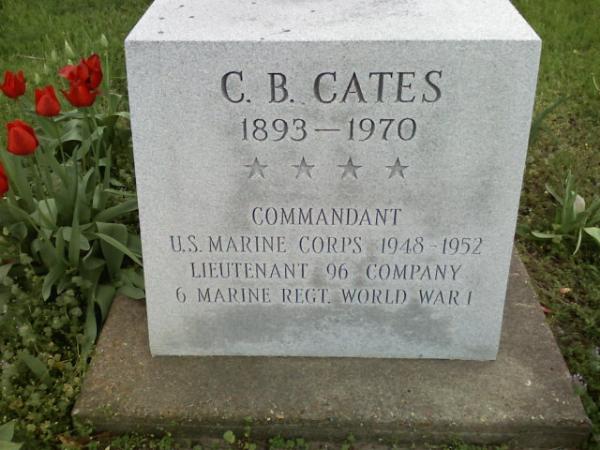
During World War I, Cates served with the 6th Marine Regiment, fighting in France. For his heroism in the Aisne defensive at Boursches and Belleau Wood, he was awarded the Navy Cross, the Distinguished Service Cross and Oak Leaf Cluster, in addition to the Purple Heart. He was awarded a Silver Star for his gallantry at Soissons. In addition to his medals from the U.S. military, he was recognized by the French government with the Legion of Honor and the Croix de Guerre with Gilt Star and two palms.
Cates returned to the United States in September 1919, and he served in Washington, D.C. as a White House aide and Aide-de-Camp to the Commandant of the Marine Corps. In 1920, he served in San Francisco, California, as Aide-de-Camp to the Commanding General, Department of the Pacific. From 1923 to 1925, he served a tour of sea duty as commander of the Marine Detachment aboard the USS California.
In 1929, Cates was deployed to Shanghai, China, where he rejoined the 4th Marines, where he served for three years. He then returned to the U.S. for training at the Army Industrial College and in the Senior Course in the Marine Corps Schools. In 1935, was assigned to the War Plans Section of the Division of Operations and Training at Headquarters Marine Corps (HQMC). In 1936, he returned to Shanghai as a battalion commander with the 6th Marine Regiment. In 1938, he rejoined the 4th Marines in Shanghai.
In 1940, and he was named the Director of the Marine Officers Basic School at the Philadelphia Navy Yard. In 1942, Col Cates took command of the 1st Marines.
Colonel Cates led the 1st Marine Regiment at Guadalcanal, for which he was awarded the Legion of Merit with Combat “V". He then took command of the 4th Marine Division in the Marianas operation, the Tinian campaign and the seizure of Iwo Jima. For his services at Tinian he received the Distinguished Service Medal and a Gold Star in lieu of a second Distinguished Service Medal for his service at Iwo Jima.
After his first tour of duty in the Pacific, returned to the United States to serve as Commandant of the Marine Corps Schools at Quantico until 1944. He then returned to the Pacific theater until the end of the war as commander of the 4th Marine Division.
On January 1, 1948, he was promoted to the rank of General and sworn in as Commandant of the Marine Corps. He served as Commandant for four years and then returned to serve again as Commandant of the Marine Corps Schools. He retired on June 30, 1954. General Cates died on June 4, 1970 in Annapolis, Maryland. A Marine for thirty-seven years, he is buried in Arlington National Cemetery.
- Details
- Dedication Date: 1919
- Memorial Hunters Club Submission: thewanderer
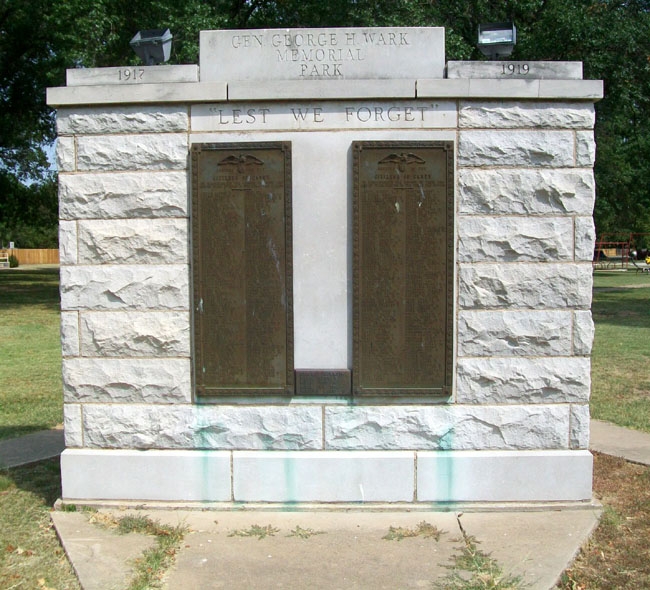
This city park was established in 1919 in memory of Caney's Company D who participated in World War I. Gen. George H. Wark organized Co. D, 3rd Kansas Infantry and mustered the first units of the Kansas Army National Guard into federal service at Caney's Elk's Hall, May 19, 1917, and led the troops to Europe. He retired in 1943 as a brigadier general.
- Details
This is a bronze bust of the WWI general, sculpted by Jo Davidson in 1919.
- Details
- November 13, 1948
- Dedication Date: November 13, 1948
- Other
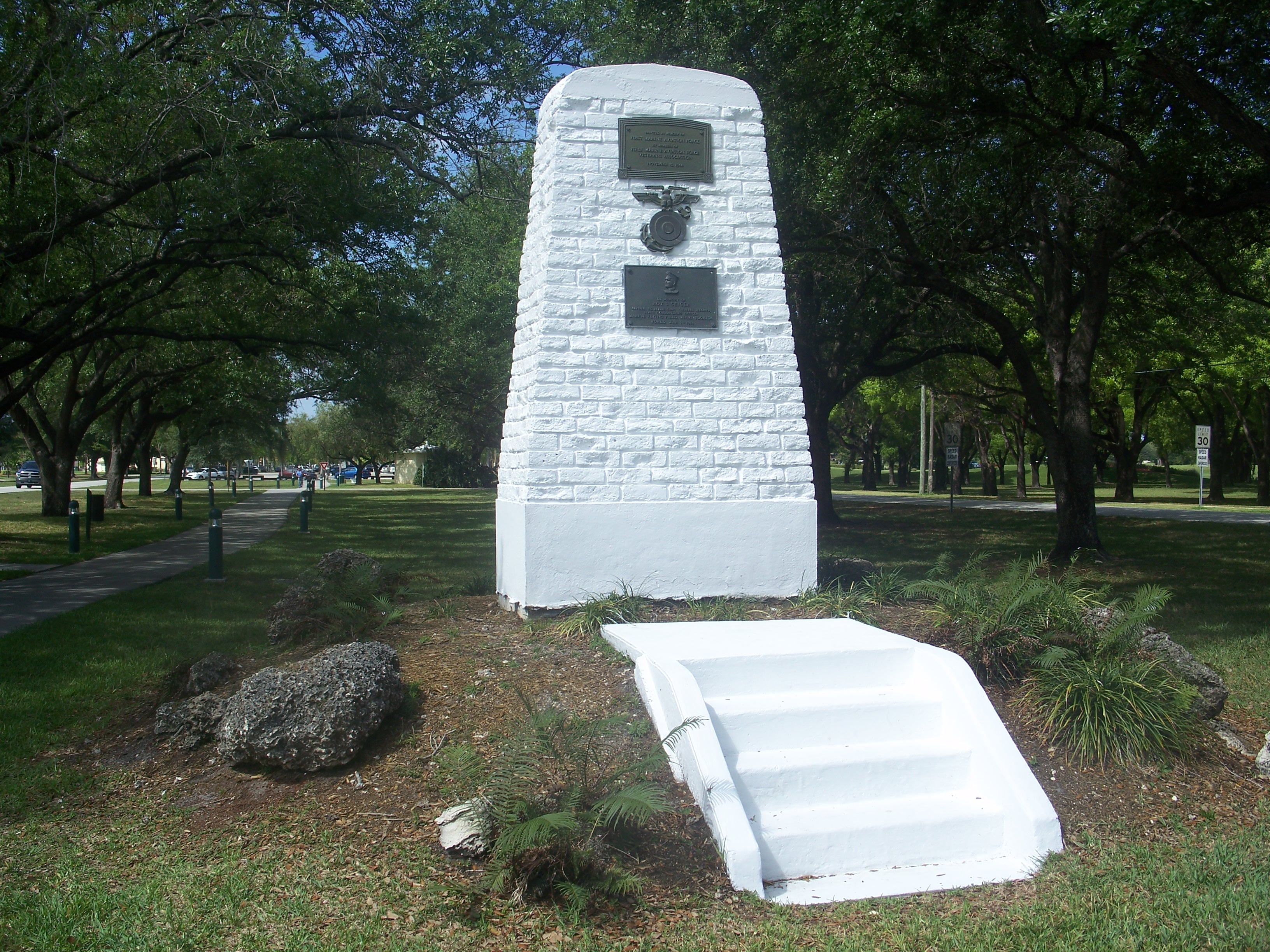
Marine Major General Roy Stanley Geiger (1885 - 1947) was a U.S. Marine Corps four-star general who served in World War I and World War II. During World War I, he served in France with 5 Group, Royal Air Force, at Dunkirk. He commanded a squadron of the First Marine Aviation Force and was attached to the Day Wing, Northern Bombing Group. For distinguished service in leading bombing raids against the enemy, he was awarded the Navy Cross. In World War II, he became the first Marine Corps general to lead an army-sized force. This memorial was restored and rededicated in 2015.
- Details
The inscription on this memorial to George Dilboy* reads:
GEORGE DILBOY
BORN FEB. 5, 1896, ALACHATA, ASIA MINOR
KILLED IN ACTION NEAR BELLEAU WOODS, FRANCE, JULY 18,1918
PVT. 1ST CL. CO. H 103RD INF. 26TH DIV. U.S. ARMY A.E.F.
POSTHUMOUSLY AWARDED THE CONGRESSIONAL MEDAL OF HONOR FOR "GALLANTRY AND INTREPIDITY IN ACTION AND BEYOND THE CALL OF DUTY"
FROM FAR IONIA HE CAME A NEW AMERICAN TRUE TO HIS HELLENIC ANCESTRY TO FIGHT AND DIE FOR COUNTRY AND LIBERTY UNDER THE STARS AND STRIPES
GEORGE DILBOY CHAPTER NO. 13 DAV OF WW
UNDER THE AUSPICES OF THE GEORGE DILBOY MEMORIAL FOUNDATION
COSTAS P. MELLAS, PRESIDENT
*For more information on George Dilboy see the George Dilboy Memorial in Somerville, MA
- Details
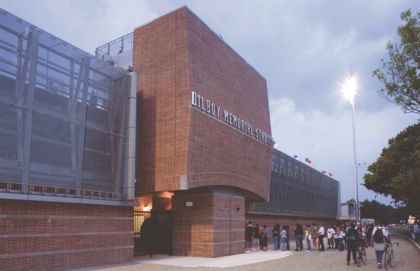
The George Dilboy Memorial Stadium is a multi-purpose public sports stadium, home of the Somerville Rampage semi-pro men's football team, the Boston Renegades semi-pro women's football team, as well as teams from Somerville High School, Saint Clement High School, and Matignon High School. The stadium is named for George Dilboy*, who lived in Somerville and was awarded the Medal of Honor during World War I. The original stadium opened in 1955. It was demolished and rebuilt in 2006.
* See the George Dilboy Monument in Somerville, MA.
- Details
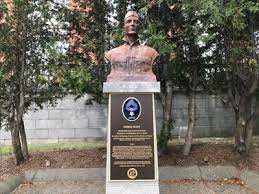
This bronze portrait bust of George Dilboy, produced by the Grenier Studio and dedicated in August of 1931, sits atop a slender granite base attached to a bronze plaque. It honors the recipient of the Congressional Medal of Honor who died in action at Belleau Wood, France, on July 18, 1918 during WWI.
George Dilboy was born in February 1896 in the Greek town of Alatsata (modern day Turkey). Dilboy and his family immigrated to the United States in 1908, settling first in Somerville, MA. In 1912, at the age of 16, he returned and fought for Greece in the Balkan Wars of 1912-13. He then returned to the U.S. where he joined the National Guard and served in the Mexican Border campaign. After the U.S declared war against Germany in 1917, Dilboy's National Guard unit was called up for the U.S. Army and joined the 103rd Infantry Regiment, 26th Division. In 1918, he fought in the Battle of Belleau Wood in France.
The following excerpt is from his U.S. Army Medal of Honor Citation:
After his platoon had gained its objective along a railroad embankment, Private First Class Dilboy, accompanying his platoon leader to reconnoiter the ground beyond, was suddenly fired upon by an enemy machine gun from 100 yards. From a standing position on the railroad track, fully exposed to view, he opened fire at once, but failing to silence the gun, rushed forward with his bayonet fixed, through a wheat field toward the gun emplacement, falling within 25 yards of the gun with his right leg nearly severed above the knee and with several bullet holes in his body. With undaunted courage he continued to fire into the emplacement from a prone position, killing two of the enemy and dispersing the rest of the crew.
George Dilboy died on July 18, 1918 due to his wounds. He was initially buried in the Aisne-Marne American Cemetery in France, but at the request of his father he was later buried at his birthplace of Alatsata, Turkey, where thousands attended his funeral. In January 1919, Dilboy's father, presented with his Medal of Honor, said "Under other circumstances I would have shed tears because of my son's death. But when I learned of the manner in which he died, I was proud that he had given his life with honor the cause of his adopted country, the United States. ... We came to this country from Smyrna, where my boy and other children were born, and we know and have felt the persecutions of Turkey." The distinction made George Dilboy the first Greek-American to earn America's highest decoration for valor. In 1922, when Turkey's Kemalist army occupied Alatsata, Turkish soldiers broke open Dilboy's coffin entombed in the Church of the Theotokos, desecrating Dilboy's remains and the U.S. flag. An outraged President Harding ordered a U.S. warship to recover the remains and return them to the States. Harding also demanded and received a formal apology from the Turkish government. Following their return, Dilboy's remains were interred at Arlington National Cemetery on November 12, 1923.
The George Dilboy Monument inspired Eddie Brady, a Somerville resident, to fictionalize Dilboy's life in the novel Georgie! My Georgie!
- Details
- Bench
The George E. Davenport Code Talker Bridge (Beaver Creek Bridge) is located on SH-3 -- east of Antlers.
- Details
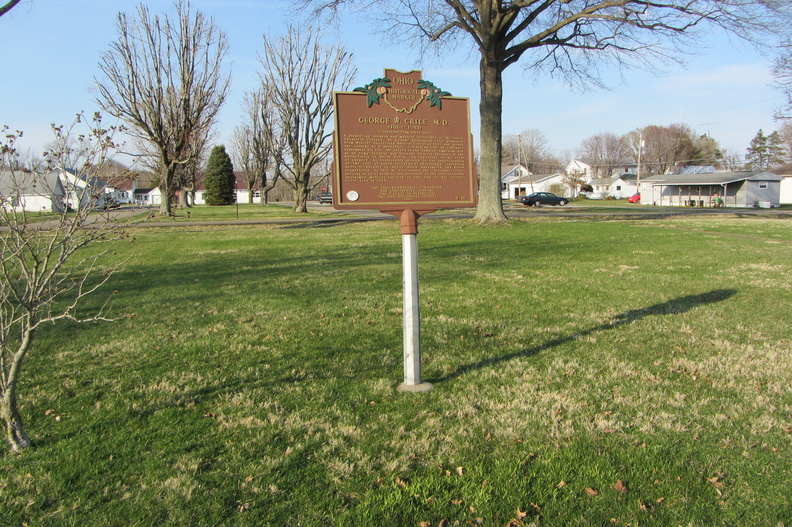
George Washington Crile was born in 1864 at Chili, in Crawford Township, Coshocton County. He served in the Spanish-American War as an Army surgeon and brought clinical advances to the battlefields of World War I.
- Details
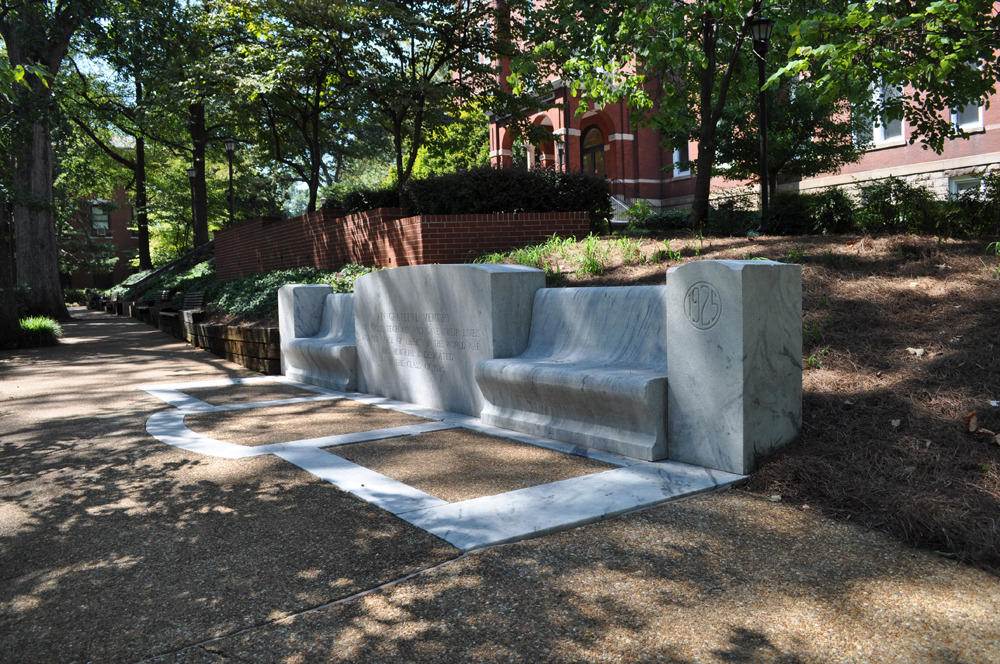
This large bench-style monument located on the Georgia Tech campus was given by the Class of 1925 in memory of those Georgia Tech men who gave their lives in World War I. It was created by Beth Grashof.
- Details
- 1934
- Dedication Date: 1934
- Forest Hills Post, No. 630, American Legion
- Frederic De Henwood
- Single figure -- soldier
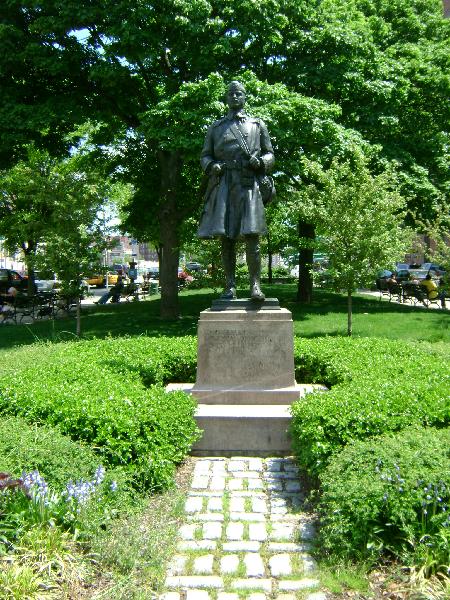
CAPT. GERALD MACDONALD / MEMORIAL DEDICATED BY / FOREST HILLS
POST NO. 630 / THE AMERICAN LEGION / TO THOSE WHO SERVED / IN THE WORLD WAR / 1934/
Architect: Henry Deacy
- Details
A relief tablet made by an unknown artist was installed at this square in 1924 to identify the first German gun captured by American troops during WWI. The cannon was donated by the U.S. Navy to the Joseph S. Beattie Post No. 310 of the Veterans of Foreign War.
This small park is named after a local resident, Joseph S. Beattie, who died on a battlefield in France in October of 1918, only a month before the armistice. The small park was said to have been renamed for Beattie at the insistence of the Beattie VFW post in 1921. In 1924 a 12, 000 pound German Krupp gun was placed there but it, too, was lost to a World War II scrap metal drive.
- Details
- Dedication Date: 1933
- Arno Steinecke
- Memorial Hunters Club Submission: thewanderer
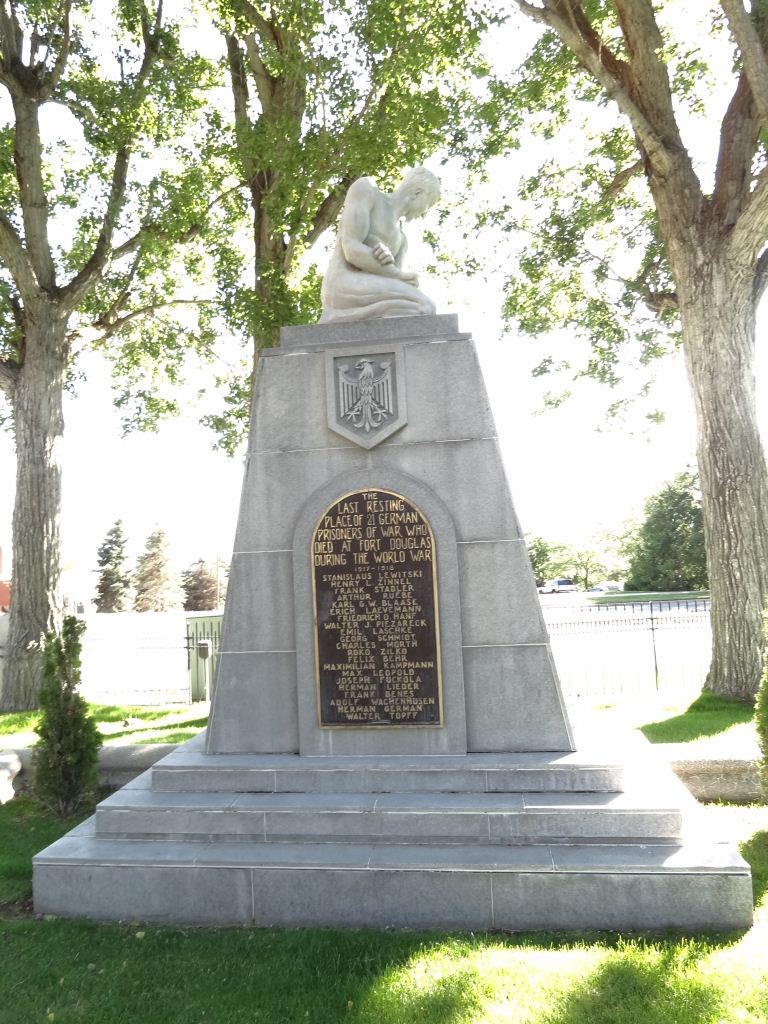
Massive monument dedicated to 21 German Prisoners of war who died at Fort Douglas during the Great World War.
Ring around marker reads:
German War Memorial
The German War Memorial to the Victims of War was erected by the German-Americans of the United States of America in cooperation with the American Legion of the State of Utah in memory of the men who died while interned at Fort Douglas during World War I.
The monument was designed and constructed by Arno Steinecke. It was dedicated on Memorial Day, May 30, 1933.
Fifty-five years later, in 1988, the monument was restored by sculptor Hans Huettlinger and his son John under arrangements made by the German Air Force and German War Graves Commission.
Today the restored monument stands in of the victims of both World Wars who are buried here in Fort Douglas Cemetery and to the victims of war and despotism throughout the world.
- Details
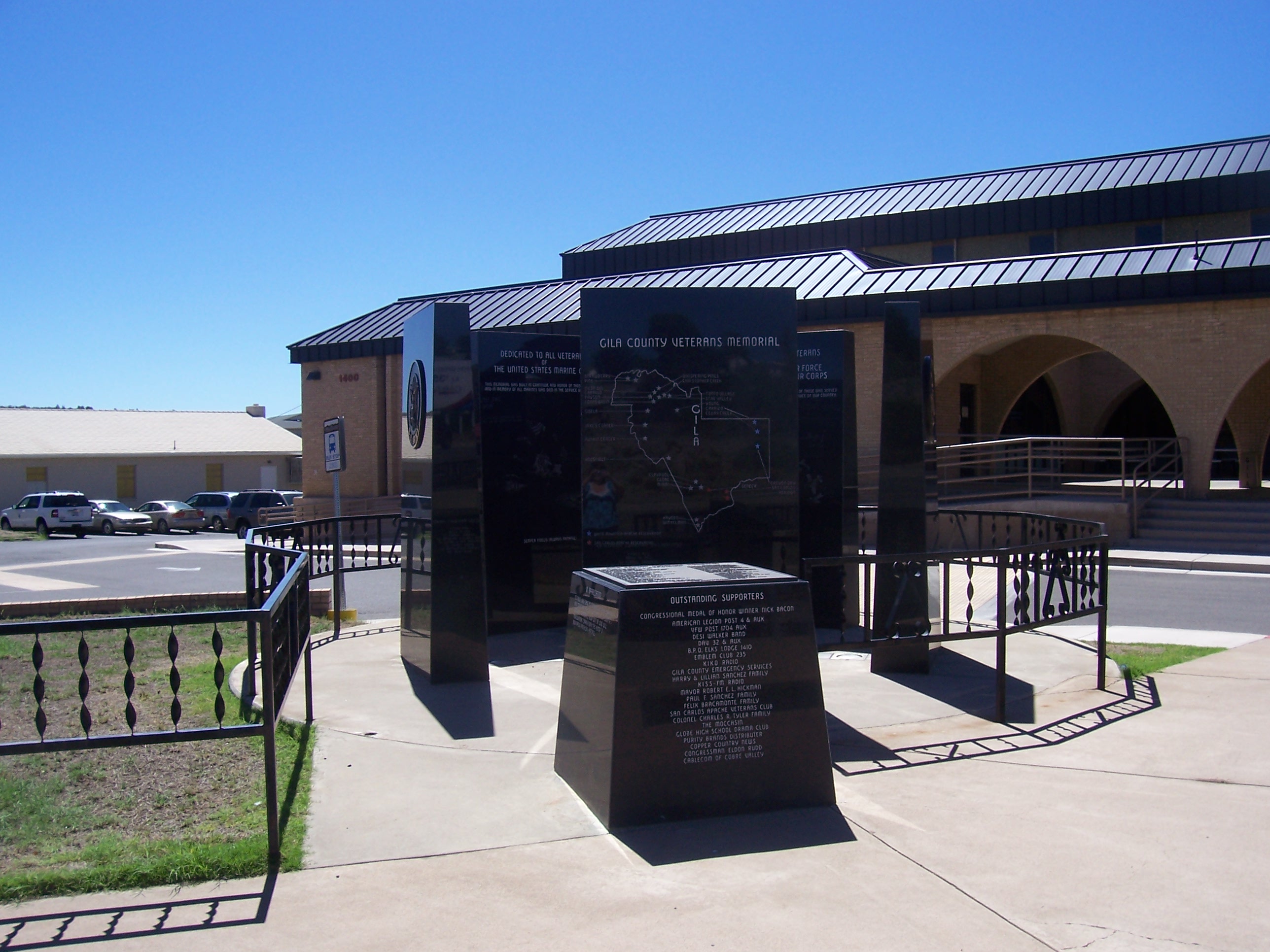
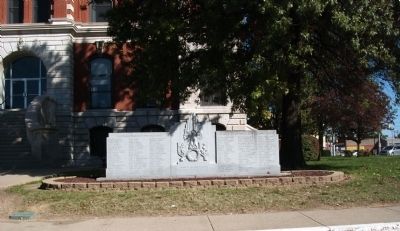
Designed by Fernando C. Navarro, this memorial consists of five black granite/marble slabs representing the military branches of service. A pedestal has a bronze dedication plaque. On the five slabs are etched dedication inscriptions and the insignias of the Navy, Coast Guard, Air Force, Army and Marines. It was completed on November 10, 1989.
- Details
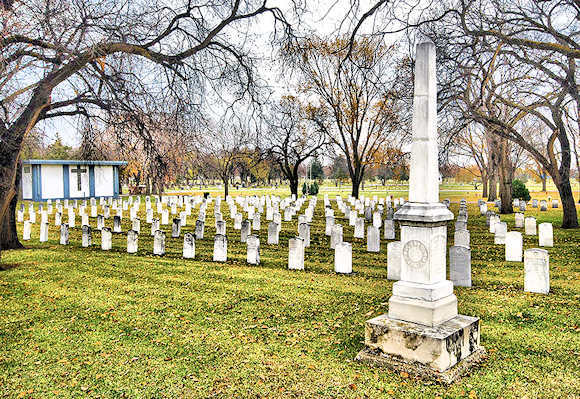
This white marble monument, erected by the Girls' Military Squad of Minot , is believed to be the first permanent memorial in the nation to recognize local soldiers who died during The Great War.
The memorial was dedicated on 30 May 1918, in Riverside Park, now Roosevelt Park. It was moved to Rosehill Cemetery due to flooding. The date of the move is uncertain; cemetery and park officials are researching to locate that date, known to be before 1962, and welcome any information the public might have.
The base of the monument is inscribed on all four sides. On the north side is engraved, “Erected by the Girls Military Squad, Minot, ND, May 30, 1918.” Other inscriptions read, “All For Our Country,” “In Memory of Minot’s Heroes Who Have Sacrificed Their Lives In The World’s Great Struggle for Universal Democracy,” and “That Government of, by, and for the People Might Not Perish From the Earth.”
For an interesting article about this memorial, please see: http://roadstothegreatwar-ww1.blogspot.com/2021/12/americas-first-world-war-i-memorial.html?utm_source=feedburner&utm_medium=email
- Details
- Memorial Hunters Club Submission: Memorial Hunter: Doug C.
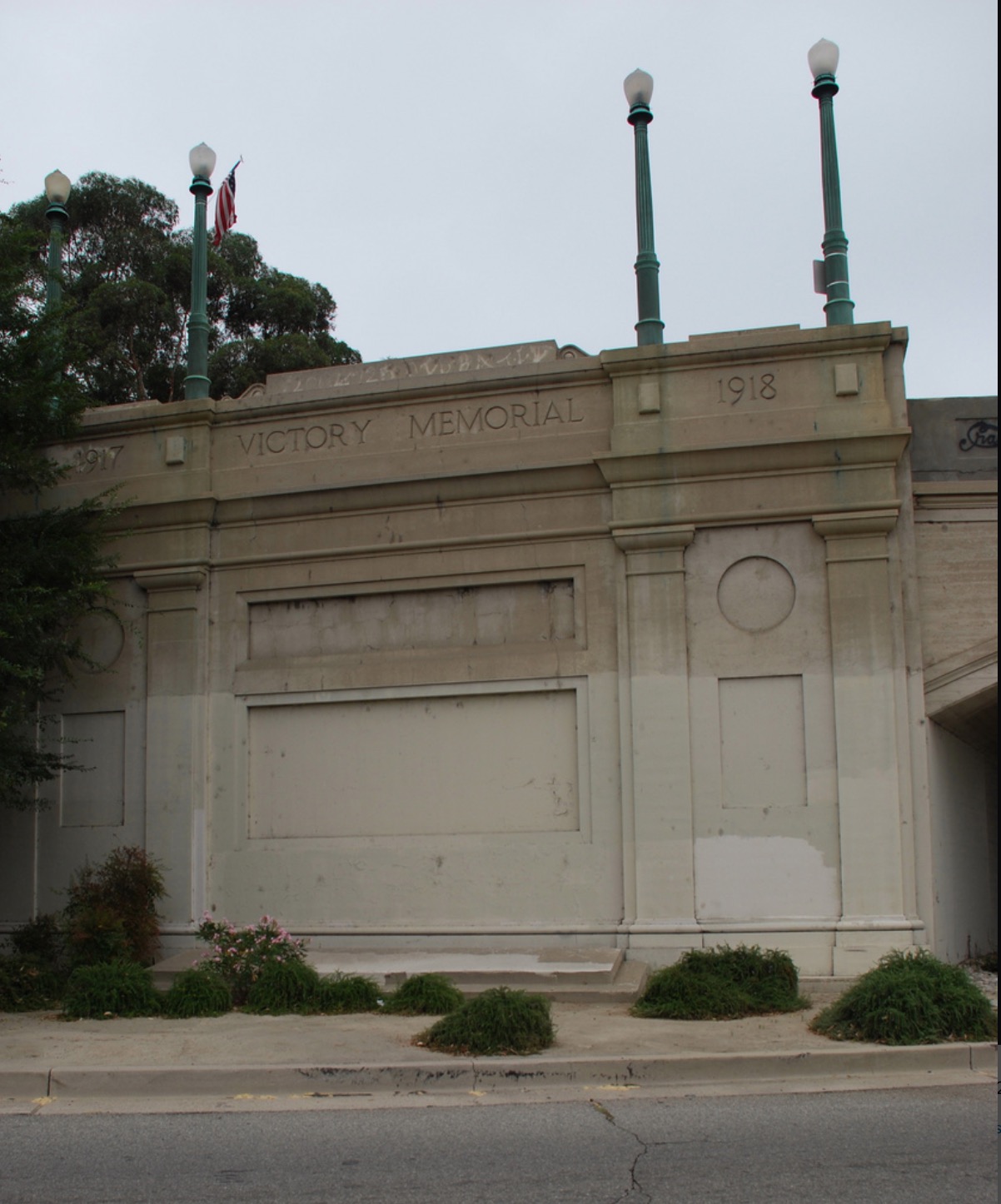
DUPLICATE: This bridge is already in the system (CA state map and 100C/100M national map) as "Victory Bridge."
This bridge is still used between L.A. and Glendale, CA, but the memorial is long gone other than the parts built into the bridge structure.
- Details
- Width: 11'
- Depth: 7'
- 1921
- Dedication Date: 1921
- People of Glendale
- Plaque with bas-relief of female figure holding a torch aloft in her right hand over a list of twenty-one names, on a stele
- Anton Schaaf
- Plaque or tablet
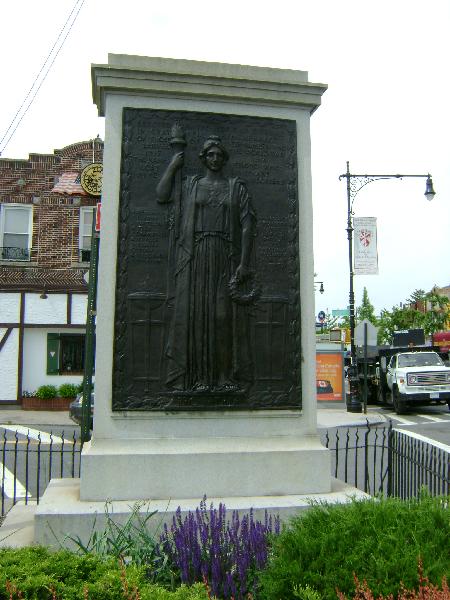
ERECTED BY THE PEOPLE OF GLENDALE / IN GRATEFUL REMEMBRANCE / OF THOSE OF THEIR NUMBER WHO / SERVED IN THE WORLD WAR / 1917-1918 / THE NAMES OF THOSE WHO / LOST THEIR LIVES ARE / HERE INSCRIBED / P.D. BODAMER --- J.J. MCCOURTY / S. BIRNEY --- F.E. PAYNTON / J.V. DETTLING --- G.G. POWELL / C. FREY --- J.E. RAUTH / J.E. GRAUMANN --- C. ROESCH / C. KAYSER --- P.J. SCHEIBEL / A. KNIPPER --- C.J. SCHMIDT / O. KOCH --- W. SCHULTZ / C.T. LEONARD --- E.V. SULLIVAN / J.F. MATHIS --- F. WINTER / A.R. WALKER / PRO PATRIA /
Architect: Helmle and Corbett