































A Distant Field: American's Great War Highlanders
By RJ MacDonald
 Duart Castle on Argyll’s Isle of Mull, seat of the Chief of Clan Maclean. The 236th Kilties of American were based in Fredericton in New Brunswick.Image source: orargyll.info
RJ MacDonald’s WWI historical novel, A Distant Field, will be released on November 11th, 2018. The first in a series, it follows Stuart and Ross McReynolds, Scots-Americans who survive the sinking of the Lusitania. Together with four Irishmen, a Canadian, and a young English officer, they join Scotland’s Seaforth Highlanders and head towards the bloody battlefields of WWI. This week, RJ MacDonald gives WWrite both a preview and behind-the-scenes look at this unprecedented literary perspective of the Great War:
America’s Great War Highlanders
The mornings were cold in November 1917, so it’s easy to imagine the scene- Her Majesty’s Troopship Canada arrives at Liverpool docks, England. Soon lines of soldiers, burdened down with kit and rifles, are disembarking down the gangplanks. They form up into ranks, glad to be on dry land again, and with a nod from their commanding officer to the pipe major, the drone of bagpipes tuning up carries through the still air. Then, to the command of, “By the right, Quick March!” the men of the 236th MacLean Kilties of America march smartly away from the docks to the sound of their own pipes and drums. America’s Great War Highlanders had arrived.
How Do Wars Begin?
By Donald Anderson
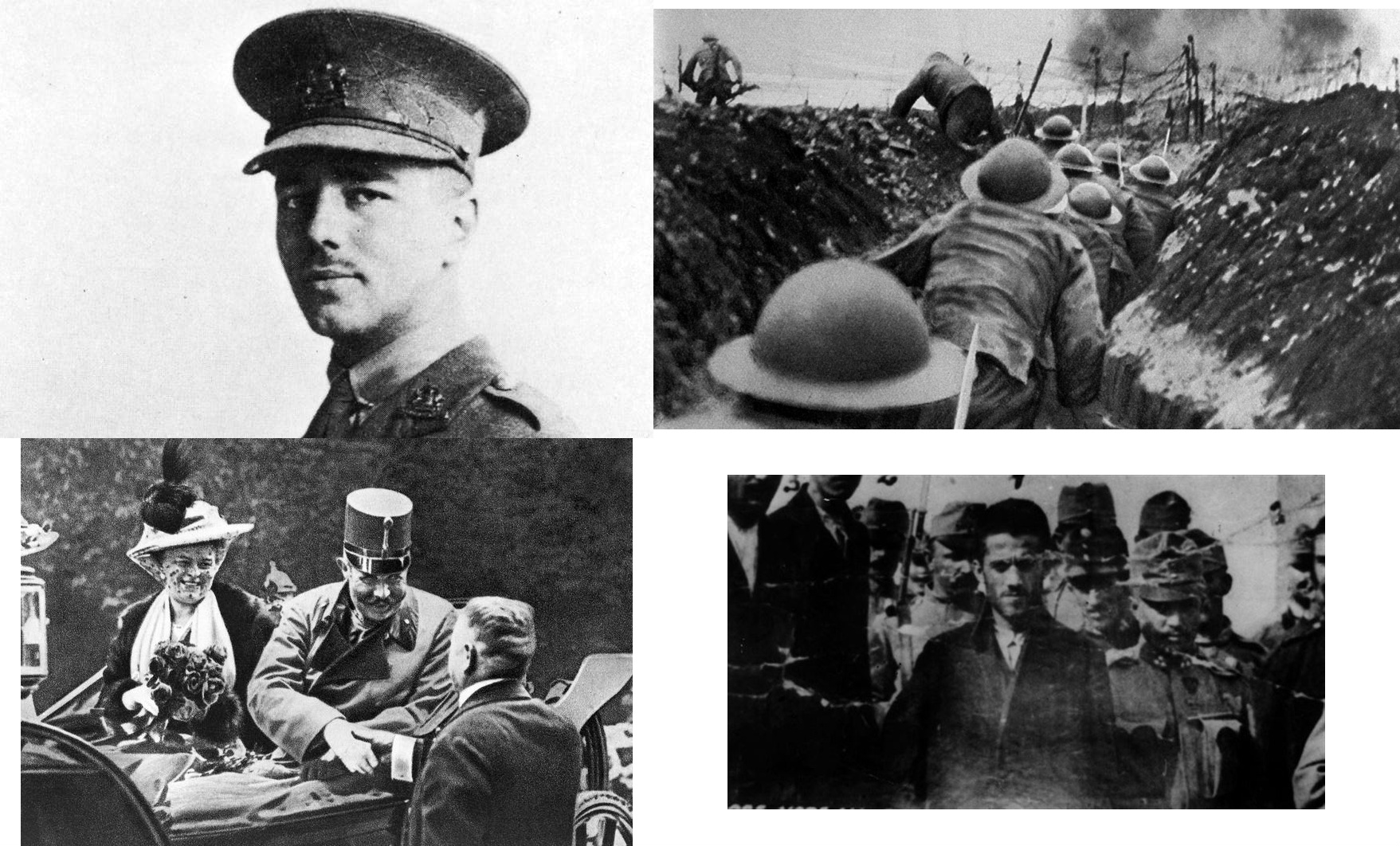 Images from top left: Wilfred Owen, a photo from the Battle of the Somme, Archduke Ferdinand and his wife Sophie, and Gavrilo Princip
Written exclusively for the WWrite Blog! WWrite asked Donald Anderson, Professor of English and Writer-in-Residence at the United States Air Force Academy, to write a post about WWI for the blog. A few days later, he sent the following original piece, entitled "How Do Wars Begin?" A unique mix of poetry, prose, fiction, and history, "How Do Wars Begin?", brings together British poet Wilfred Owen, Archduke Franz Ferdinand of Austria, the Archduke's assassin, Princip, bombs, and an expired cyanide pill to put into question not only the origins of WWI but of all contemporary conflicts:
How Do Wars Begin?
Today’s newspaper: Wilfred Owen died on Armistice Day 1918, the last day of the war.
[ ]
Actually, Owen’s parents were informed of his death on Armistice Day. Owen had died the week before.
[ ]
The newspaper is running the story in commemoration of the 100th anniversary of the assassination of the Archduke Franz Ferdinand of Austria—the act that starts the war.
[ ]
Turns out that the assassin is one of nine children, six of whom had died in infancy. The newspaper reports a celebration in Sarajevo where the assassin, Princip, is treated as hero.
[ ]
In truth, it was Princip’s accomplice who first tosses the bomb—a kind of grenade—at the motorcade. The bomb is deflected by the Archduke—hitting him in the arm. The Archduke is in an open car, so as to wave at his non-Austrian minions. The deflected bomb explodes late, missing the Archduke’s car all together. Hard not to see it as a kind of cartoon: the Duke in a tallish hat with a lavender plume and the bomb a black ball with a visible fuse lit. Right? So here’s the rest: the bomb thrower swallows a cyanide pill, then leaps into the nearby river. The cyanide pill, though, is expired, and the river that time of year is four inches deep.
[ ]
The Duke—ever paternal—drives to the hospital to visit the injured victims of the car that actually caught the bomb. Big mistake, because Princip happens to be on the sidewalk when the Duke’s driver takes a wrong turn. The Serb had been in a sandwich shop. While the driver is backing up, Princip shoots the Duke and then the wife when she tries to shield her royal hubby.
[ ]
What if the Serb hadn’t been hungry?
[ ]
This is what starts the war: a mis-thrown bomb, a wrong turn in a car, bad cyanide, child non-mortality, lunchtime? Austria takes a hard line against Serbia and other powers in Europe choose sides. Within 30 days, a half-assed squabble between Austria and Serbia transforms into the first great modern war.
[ ]
At the 100-year assassination site celebration, someone calculated that to hold a second of silence for every person killed in WWI in Europe that the attendees would have to stand mute for about two years.
[ ]
And this: Princip’s cyanide pill was expired too.
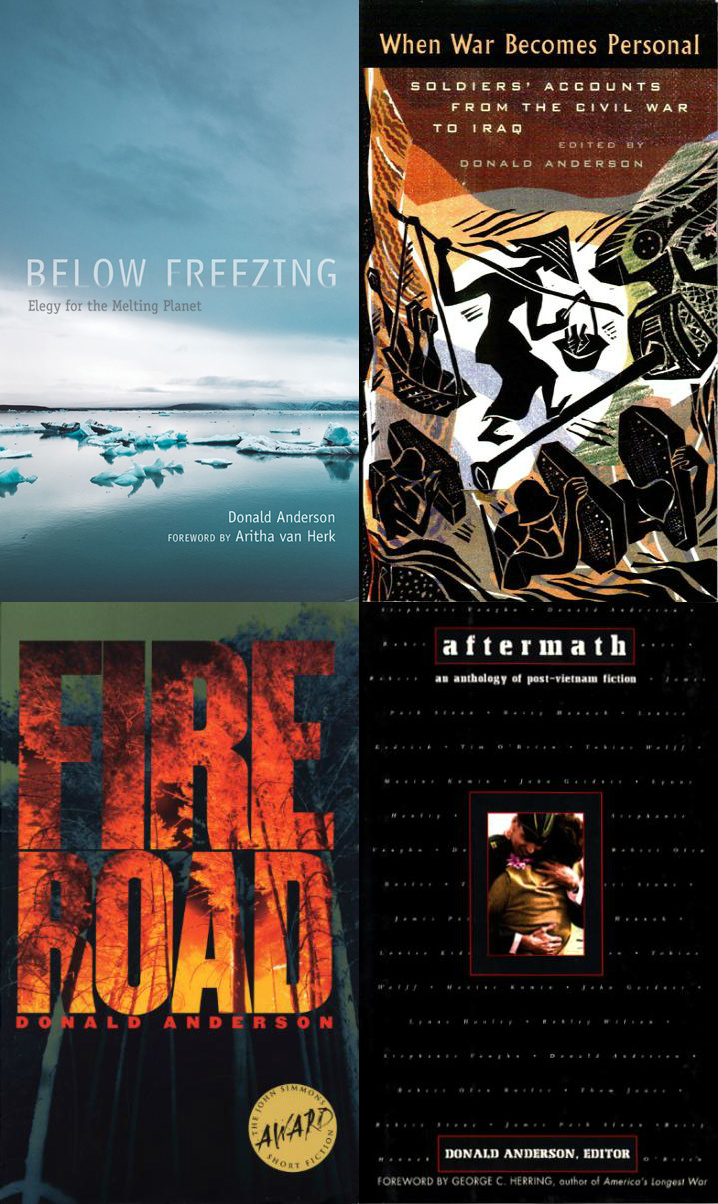 Anderson's books: Below Freezing, When War Becomes Personal, Fire Road, and Aftermath
Author's bio
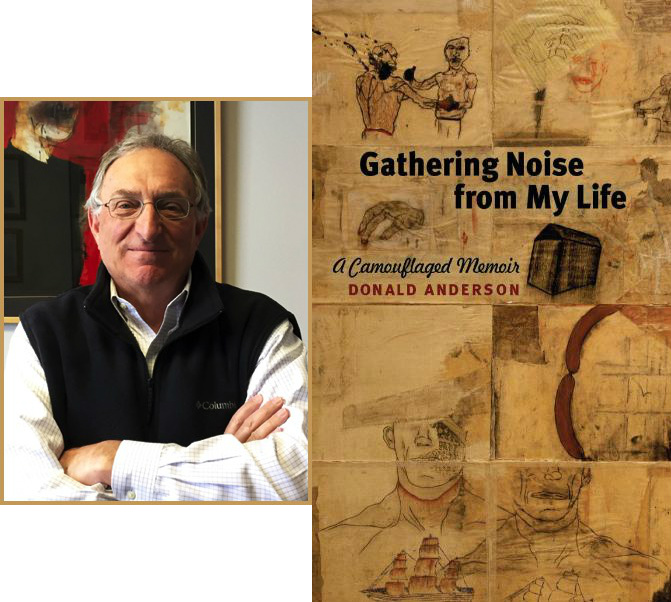
Donald Anderson, who served 22 years in the US Air Force, was born in Butte, Montana in 1946. His fiction and essays have appeared in The North American Review, Fiction International, Epoch, PRISM international, Western Humanities Review, Columbia, Michigan Quarterly Review, Connecticut Review, and elsewhere. Since 1989, he’s been Editor of War, Literature & the Arts: an international journal of the humanities. He’s editor, too, of Aftermath: An Anthology of Post-Vietnam Fiction (Henry Holt, 1995), Andre Dubus: Tributes (Xavier University Press, 2001), and When War Becomes Personal: Soldiers' Accounts from the Civil War to Iraq (University of Iowa Press, 2008). His story "Fire Road" was awarded First Place in the Society for the Study of the Short Story 2000 Contest, and the collection Fire Road won Iowa's 2001 John Simmons Short Fiction award. His essay “Gathering Noise” was named a “Notable Essay of 2012” in the 2013 edition of The Best American Essays. His essay "Rock Salt" was listed in 2008 and his essay "Luck" was listed in 1999. In 1996, he received a Creative Writers’ Fellowship Grant from the National Endowment for the Arts. He holds an MFA from Cornell University. A former Air Force officer, he now lives in Colorado, where he directs creative writing at the United States Air Force Academy. His most recent book, Gathering Noise from My Life: A Camouflaged Memoir, was named by the Christian Science Monitor as one of “12 Electrifying Memoirs” appearing in 2012.
Fictions of Rehabilitation
By Mark Whalan, PhD
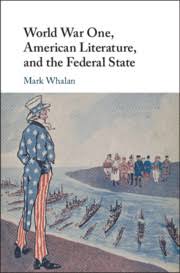 Cover of Dr. Whalan's recent book, World War One, American Literature, and the Federal State
Fictions of Rehabilitation
Bu Mark Whalan, PhD
My recent book examines the Homefront in the US in World War One, and specifically how American literature engaged with the fierce debates that roiled US society over the rights and responsibilities of citizenship in wartime, and over what the state was empowered to do in moments of national emergency. As the US state expanded into new areas of American life—through conscription, the nationalization of the railways, and the control of information flow and the mass manufacture of propaganda, for example—authors considered what this meant for the experience of everyday life, and how they could imagine the new communities and identities expanded state power had seemingly brought into being. One of the most interesting arenas this happened in was government-run healthcare, as WWI saw a complete transformation in the ideas and institutions the government deployed to assist wounded veterans. These changes revolutionized customary ideas about disability, and about male citizenship—changes often taken up and contested by authors of the era, some of whom were wounded veterans themselves.
Josephine H.: A French-Vietnamese Journalist Traces the Life of an American WWI Nurse
By Hélène Lam Trong
JOSEPHINE H. (ENGLISH SUBTITLES) from Hélène LAM TRONG on Vimeo.
In 2017, I was on summer holidays at my parents’ in the South of France, when I received an interesting message via Facebook. It was from a young French woman who suggested making a documentary about something she discovered in the her family’s attic while moving – a bag with the words “Marguerite Horine, American Red Cross, Stanford Unit” written on the side.
As a documentary filmmaker, you can’t imagine how exciting it is to have a great story served to you on a tray. I thought right away that this bag would provide an original way to shed light on the ways World War I, even a century after the Armistice, are still so present in our lives, here in Europe. So I began my research to see if I had enough material to make a film. I quickly found out that Marguerite Horine had been brilliant Stanford student from Palo Alto who volunteered to be a nurse in 1917. I knew it was going to be fascinating to tell her story.
War Without Allegory: WWI, Tolkien, and The Lord of the Rings
By Rachel Kambury
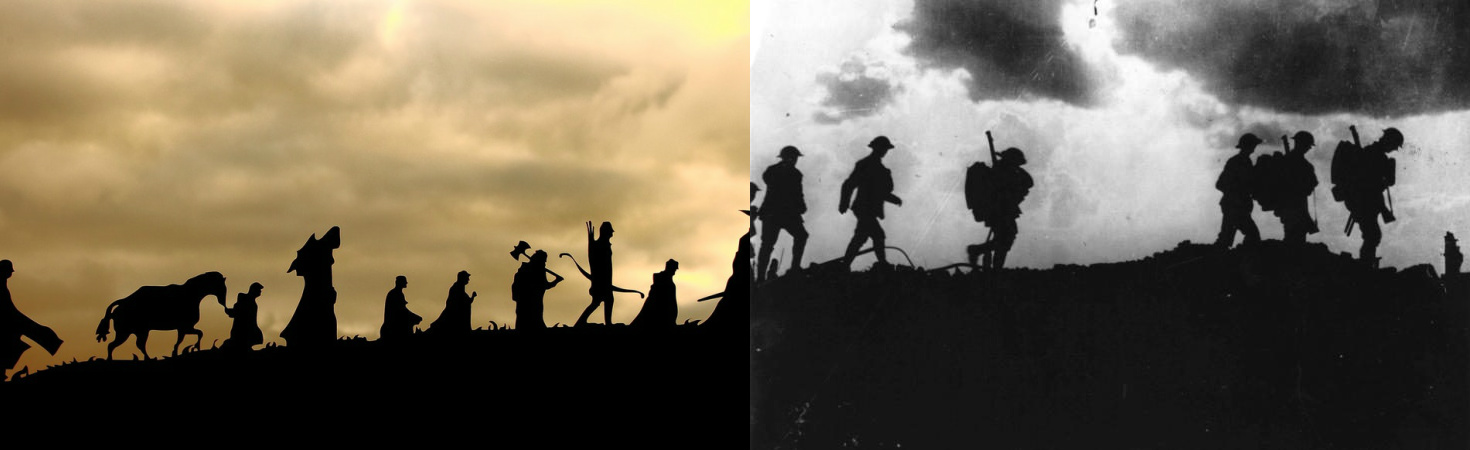 Left, shot from the film, The Lord of the Rings. Right, photo taken at the Battle of Passchendaele, 1917.
The Lord of the Rings is a war story.
It borrows heavily from that grandest of traditions set forth by works like Beowulf and The Wanderer—Old English warrior poetry, by turns heartbreaking and bloody, meant to be spoken—and its author was steeped in the same fetid waters that brewed the most famous novels to come out of the Great War in which he fought: All Quiet on the Western Front, Parade’s End, A Farewell to Arms…
Looking past the Elves, Dwarves, Hobbits, kings, and Istari, past the natural and unnatural magic, past the One Ring and its maker, war rests firmly at the heart of The Lord of the Rings.
So why, in all the years since its publication, has J.R.R. Tolkien’s epic never found its way onto any “Best-Of” lists of war literature? Why, in spite of the overwhelming number of parallels, has it never been counted among the greatest novels to emerge from the events of World War I?
How could it not?
The Faulkner Sequel. "Faulkner Stole My Father's War Wound:" Centennial Reflections on William Faulkner and John Reid, PART 2
By Panthea Reid
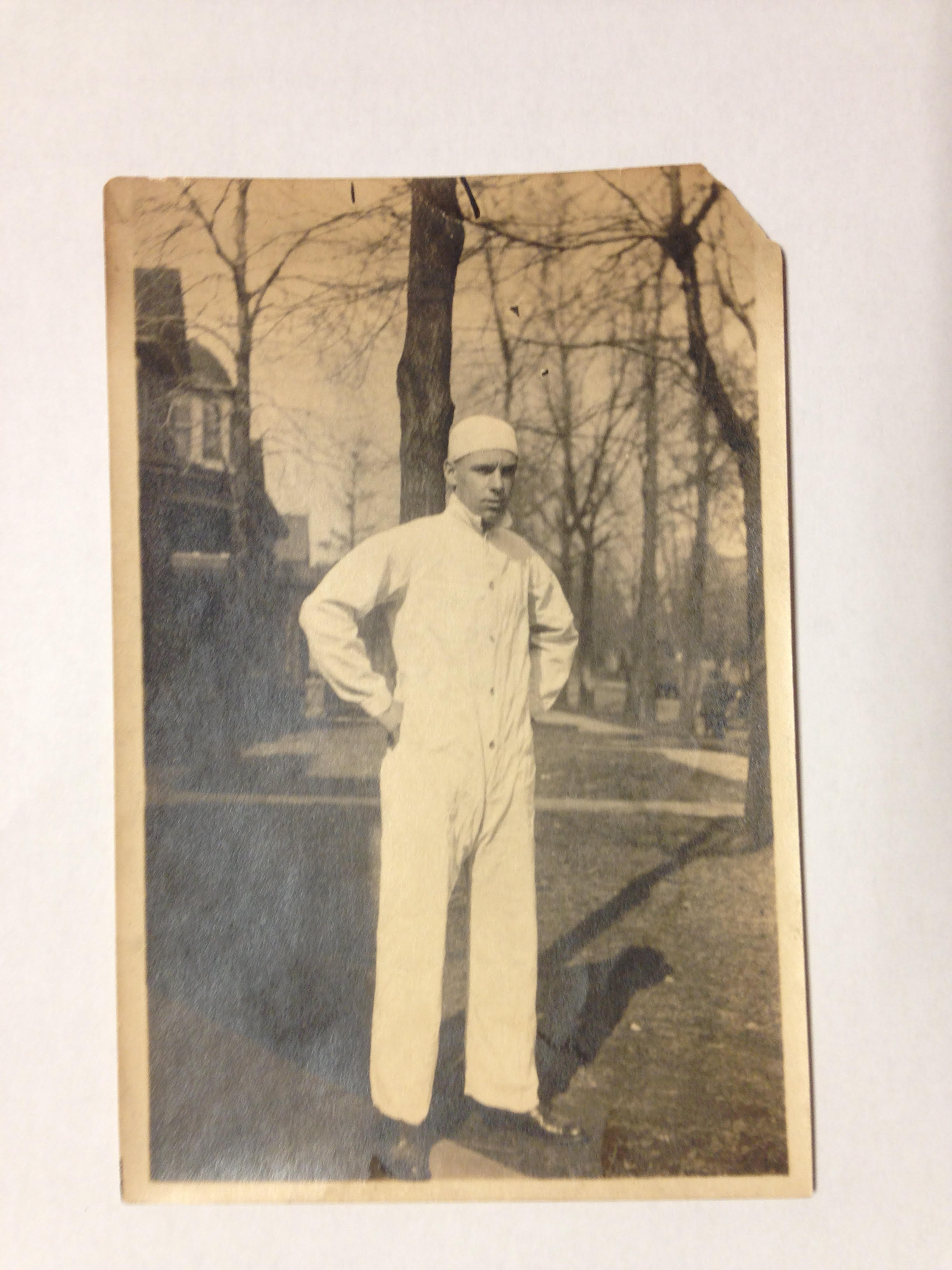 John Reid at Rose Polytechnic Institute where he graduated 1915 with a degree in electrical engineering. This was the outfit worn by engineers at this school. Image courtesy of Panthea Reid and the Small Collection at the University of Virginia.
*Last week, WWrite published the first part of this riveting story by Panthea Reid about her startling discovery while writing her book on William Faulkner. Faulkner, who received the 1949 Nobel Prize in Literature, had claimed that he was wounded while serving in the British Royal Flying Corps during WWI. Not only did Professor Reid debunk these claims with archival research; she also learned that Faulkner had confiscated the record of her own father's WWI wound and claimed the story for himself. Special thanks to Peter Molin, veteran, writer, and blogger for bringing this article to WWrite. Be sure to read Peter's blog, Time Now, about Iraq and Afghanistan here and his two WWrite pieces on Aline Kilmer and James Joyce.
Now, here's where we left off:
...Faulkner continued to parade about Oxford in a uniform, his limp and overseas insignia inspiring salutes from returning soldiers. He was photographed in at least six different combinations of military garb, looking jaunty, dapper, and self-assured.
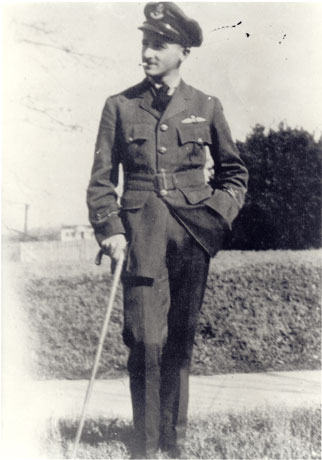 William Faulkner in his RAF Uniform. Source: wikipedia
Before she married Will Parks in 1922, a number of suitors pursued Carolyn Smythe. In probably early 1919, a soldier stationed at a nearby army camp arranged to meet her in the lobby of the old Peabody Hotel. When they met, William Faulkner also appeared “in uniform and bandaged.” His arm was in a sling and he walked with a cane. Faulkner told Carolyn’s beau, who later told Carvel Collins, that, when Faulkner’s plane had been hit, the British Major with him had been killed. Faulkner had also said he had “fallen through trees so that he was only injured, not killed.” Carolyn’s soldier friend found her an “extremely attractive and energetic spicy girl.” She thought Faulkner rather humorous. Her beau thought she led Faulkner on.