





























World War I Centennial News
Watertown, CT students help build the National WWI Memorial
By Chris Isleib
Director of Public Affairs, United States World War One Centennial Commission
We recently received a wonderful letter from the parents of two students of St. John the Evangelist High School, in Watertown, CT. The students, Taylor Gibbs and Lyvia Bartoli, brought our Centennial Commission's Poppy Seed Fundraising Program to their school, to help raise awareness for our World War I veterans, and to help raise money for the new National World War I Memorial at Pershing Park in Washington, DC, and for their own school's charity efforts.
Through their efforts with the Poppy Seed Program, they grew in awareness of the contributions of the men & women who served in World War I, and the two students decided to donate the money they raised directly to our National World War I Memorial.
We have been truly touched by this generous gesture, so we wanted to share their parents' letter with you all, along with our sincerest expression of thanks to these young people.
Read more: Watertown, CT students support Memorial with poppy seed sales
Corporal Freddie Stowers awarded Medal of Honor for service and sacrifice in WWI
By Nicole Renna
Staff Writer
Corporal Freddie Stowers was an African American war hero born in 1896 in Anderson County, South Carolina.
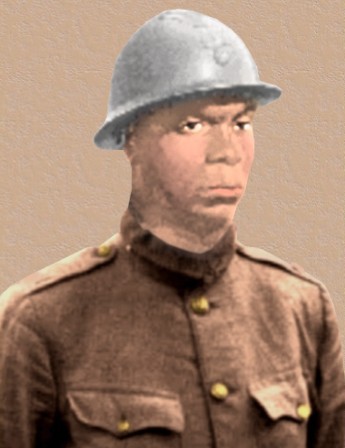 Corporal Freddie Stowers
 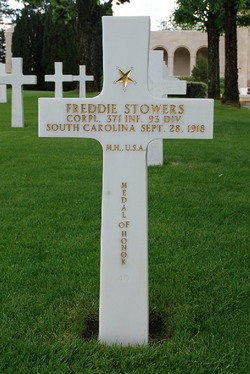 Despite the discrimination he faced there, he made the decision to serve our country on the segregated 371st Infantry Regiment. He was serving as the squad leader in Company C of that regiment, in the 93d Infantry Division, during the attack on Hill 188, in the Champagne Marne Sector of France. He was killed in action that day, but his exceptional bravery and leadership lived on, earning him the Medal of Honor posthumously.
At the attack September 28, 1918 attack on Hill 188, enemy units fired down on Corporal Stowers company only for minutes before holding up their arms in surrender, prompting American forces ceased fire and come out into the open. When Stower’s unshielded men were roughly 100 meters from the trench line, the enemy soldiers jumped back into their trenches and unleashed bands of machine gun fire and mortar fire on them, causing over 50 percent casualties.
Despite these conditions, Stowers heroically crawled forward through the fire, inciting that extraordinary bravery in his quickly-falling men.
They fought fiercely to dismantle the machine gun fire in the first trench, and then Stowers courageously pressed his men forward towards the second trench, getting gravely wounded in the process. He continued onward, urging his men to do the same, until he succumbed to that injury. His courage, strength, and devotion so inspired his squad that they continued to push forward after his death and so, despite their terrible odds, contributed greatly to enemy casualties and the capture of Hill 188.
WWI service of Storer College students: Overlooked no more
By Christine Snyder
via the Spirit of Jefferson and Farmers Advocate newspaper web site
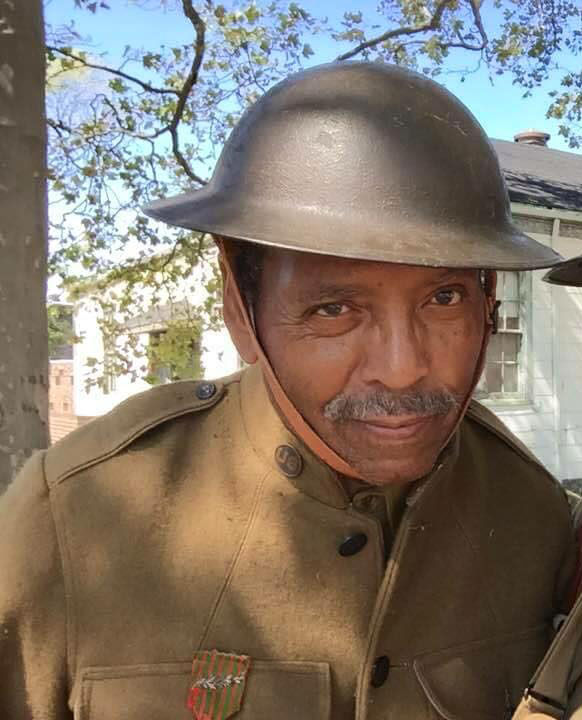 New Jersey native Algernon Ward, a historical re-enactor since 1999, talked about Storer College students’ contributions in The Great War in a presentation at Harpers Ferry. The message is important, he said: “Educate the next generation to the whole breath of the American story, being sure to include the previously overlooked contributions of African Americans to that history, and everyone will gain deeper appreciation for what it has taken to make and preserve this country. The idea that we all have a shared destiny will be embedded in their DNA.”HARPERS FERRY – When Algernon Ward began as a historical re-enactor in 1999, he portrayed a Civil War soldier who fought to preserve the United States. Living in his hometown of Trenton, N.J., where Gen. George Washington famously crossed the Delaware River to lead the surprise attack on the Hessian mercenaries stationed there on Christmas Day 1776, he and his colleagues expanded their work to include African-American soldiers who fought in the Revolutionary War – the First Rhode Island Regimen.
“Over time, we found that one could not confine the 300-year span of African-American military history to any particular period,” the 64-year-old retired research scientist with the New Jersey Department of Health and Senior Services in Trenton explained in an interview. Ward and others soon founded additional re-enacting units to bring to light African-Americans’ contributions in the major conflicts of the 20th century.
On Sunday, February 11, Ward delivered a lecture on the World War I service of students at Storer College, the famed Harpers Ferry school for the formerly enslaved that operated from 1867 through 1955. The African-Americans who fought for the United States in the Great War in 1917 and 1918 are nicknamed the “Ebony Doughboys.”
Ward’s talk, free and open to the public, happened at Mather Training Center at 51 Mather Place on the former Storer campus, now part of the Harpers Ferry National Historical Park. It was originally scheduled for Feb. 4, but postponed until this weekend because of icy weather.
His 2 p.m. presentation kicked off the Black History Month celebration jointly put on by the park and the Jefferson County branch of the NAACP.
With this November marking a century since World War I’s end – and with white supremacy movements rallying in Charlottesville, Va., and elsewhere, Ward said it’s an important time for all Americans – black and white alike – to finally get an accurate picture of the ways African-Americans have been part of the U.S. military since Colonial days.
Ward said that after the summer’s deadly violence in Charlottesville over elected leaders’ plans to take down statues of Confederates Robert E. Lee and Stonewall Jackson, Ward and other Ebony Doughboys along with several local military historians were invited to take part in a day-long Veterans Day program at a museum in Charlottesville.
“I was heartened to observe how the hundreds of black and white students who attended were fascinated by the exhibits and information we shared,” Ward said. “My impression was that this was indeed the way forward – educate the next generation to the whole breath of the American story, being sure to include the previously overlooked contributions of African-Americans to that history, and everyone will gain deeper appreciation for what it has taken to make and preserve this country. The idea that we all have a shared destiny will be embedded in their DNA.”
Besides Ward’s work with the Ebony Doughboys, he also continues to volunteer as a re-enactor with the U.S. Colored Troops from the Civil War, the First Rhode Island Regiment from the Revolutionary War and the Fifth Platoon from World War II.
For the last six years, the groups have collaborated during Black History Month to host an event, “Three Centuries of African-American Soldiers” at The Old Barracks Museum in Trenton. The event also showcases history exhibits, authors, World War II veterans and others, he said. Ward said that in recent years he’s seeing growing interest in American involvement in The Great War. Last year marked the centennial of the start of U.S. involvement in the war, which had begun in 1914.
Read more: WWI service of Storer College students: Overlooked no more
New Mexico state World War I Centennial Commission formed
By Chris Isleib
Director of Public Affairs, United States World War One Centennial Commission
SANTA FE, NM – On February 7, the New Mexico Department of Veterans Services announced New Mexico’s special committee to commemorate the 100th anniversary of the end of World War I.
 The Honorable Susan Martinez, 31st Governor of New MexicoThe New Mexico World War I Centennial Commission will work locally on the National WWI Centennial Commission’s nationwide effort to educate Americans about the war.
New Mexico’s commission will host events around the state highlighting New Mexico’s impact on the war and the sacrifices made by its citizens less than five years after becoming our nation’s 47th state.
Named to the New Mexico WWI Centennial Commission are:
Chairwoman:
- Governor Susana Martinez
Commissioners:
- Jack R. Fox/Cabinet Secretary, New Mexico Department of Veterans Services
- MG Kenneth A. Nava / Adjutant General, State of New Mexico
- Veronica Gonzales / Cabinet Secretary, NM Dept. of Cultural Affairs
- Rebecca Latham / Cabinet Secretary, NM Dept. of Tourism
- Andrew J. Wulf / Director, New Mexico History Museum and the Palace of the Governors
- MG Jerry Grizzle / President, New Mexico Military Institute
- Jeffrey A. Lowdermilk / World War I Historian/Author
- CCM Mitchell Brush / New Mexico National Guard
- CSM Jerry Garcia, New Mexico National Guard
- Meredith Davidson / Curator, NM History Museum and the Palace of the Governors
- Tom Leech / Curator-Director, The Palace Press/NM History Museum/Palace of the Governors
- CPT Gabriel Peterman / Officer in Charge, New Mexico National Guard Museum
- Gary Miller / Curator, New Mexico National Guard Museum
- Ray Seva / Public Information Officer, NM. Dept. of Veterans Services
- Joe Vigil / Public Affairs Officer, New Mexico National Guard
Service on Islay to remember sinking of SS Tuscania
via the BBC News web site
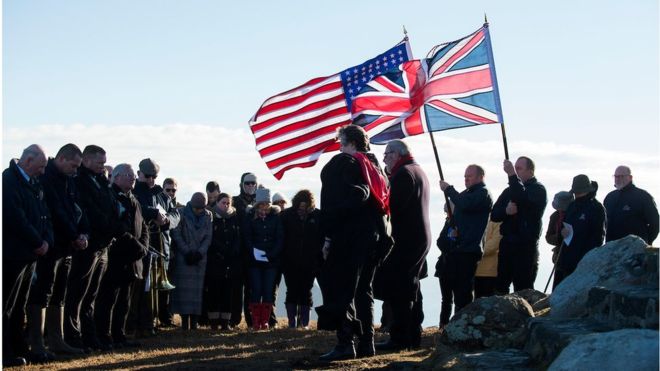 Commemoration service held on the Scottish island of Islay to mark the 100th anniversary of the sinking of the troopship SS Tuscania.A service of commemoration has been held on the Scottish island of Islay to mark the 100th anniversary of the sinking of the troopship SS Tuscania.
The ship was carrying more than 2,000 US soldiers at the end of World War One when it was torpedoed by a German U-boat close to the island.
Many of the soldiers on board were saved and cared for by local people.
But more than 200 drowned, with the bodies washed up on the beaches of the small island.
A wreath-laying ceremony has taken place at the American Monument.
It was followed by a memorial service at Kilnaughton Commonwealth War Graves Commission Cemetery, held at the grave of Pte Roy Muncaster, the only US soldier still buried on the island.
The bodies of other US soldiers - initially buried on Islay - were later exhumed and either repatriated to the United States or buried at the American Cemetery at Brookwood in Surrey.
Former Nato secretary general Lord Robertson, whose grandfather Malcolm MacNeill was a policeman on Islay at the time, told BBC Scotland that many local residents helped to recover the dead and aid the survivors after the sinking.
New mural & exhibit in Tampa honors WWI crew of USCGC Tampa
By Roberto Roldan & Andy Lalino
via the University of South Florida WUSF Public Media News web site
One hundred years after the sinking of the USS Tampa during World War I, a new mural was unveiled on February 3 honoring the more than 130 men - including 24 from Tampa Bay -who were killed when the ship was sunk by a German submarine.
 The new mural, designed by artists Sandra Bryan and Carl Bryant, attempts to capture the history of the original USS Tampa.During a dedication ceremony at the the Tampa Bay History Center, Robin Gonzalez read each of the names of Tampa residents who were aboard the USS Tampa warship when it sunk in 1918. Afterwards, city leaders and descendants of those who died tossed memorial wreaths onto the water across from the history center.
Gonzalez helped lead the push for the city to create a remembrance of the tragedy.
"After World War I, then came the depression and World War Two and people just kind of forgot," she said. "Now with the mural and the education program, it will never be forgotten again."
In addition to Saturday's event, the Tampa Bay History Center will have an exhibit on the USS Tampa running through March.
Gonzalez and Tampa resident Nancy Turner compiled a book about the USS Tampa that has been distributed to all Hillsborough County schools. The book documents the connection between the warship and its namesake city.
The Coast Guard cutter was the first to be a part of the Gasparilla invasion in 1913. In 1914, it was ordered onto iceberg watch in the North Atlantic Ocean following the sinking of the Titanic in 1912.
In 1917, the ship was transferred from the Coast Guard to the U.S. Navy, where it was tasked with escorting ships from Gibraltar to the southern coast of Great Britain. The sinking of the USS Tampa on September 26, 1918 was the largest Navy combat loss during the war.
"There's nothing to tie Tampa to much history, and to tie Tampa directly to World War I is amazing," Gonzalez said.
Read more: New mural & exhibit in Tampa honors the WWI crew of USCGC Tampa
WWI’s Zeppelin Bombings Popularized the Trend of ‘Pyjamas’
By Sarah Zhang
via the Atlantic Magazine web site
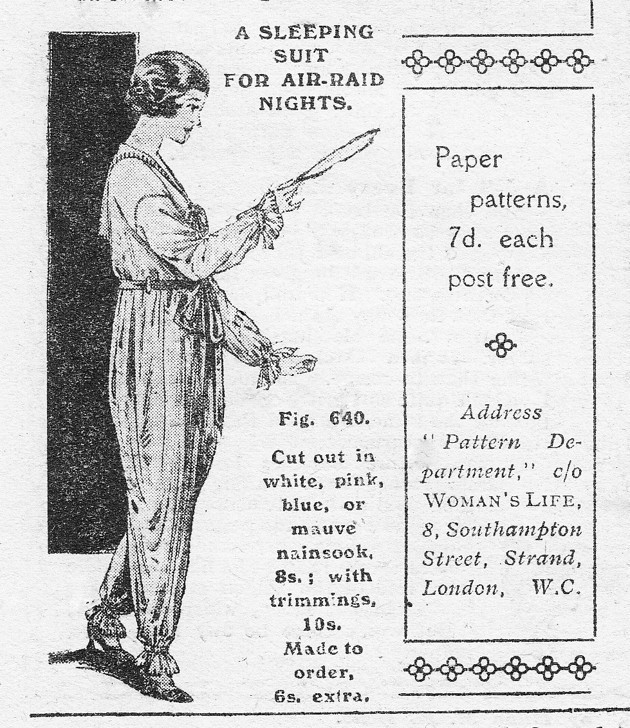 Another novel form of trousered attire for women was the one-piece sleeping suit, suitable for venturing out during air raids.World War I introduced so many terrifying new ways to die, and chief among those was, of course, death by air.
You didn’t even have to be a soldier. For Londoners, the threat began in January 1915, when the Germans sent zeppelins loaded with bombs across the Channel. Eventually, they sent planes, too.
The air raids, often at night, accomplished little tactically, but their true purpose was to terrorize civilians and sink British morale. “There’s never been anything like this. Suddenly a blazing bomb is coming out of the sky and setting light to a house, it’s almost science fiction,” an aviation historian told the BBC.
The air raids brought the war to the home front. They intruded in the bedroom, the most private space of all. And thus, they had quite an effect on fashion.
Think about it this way: Bedclothes are among most intimate of garments. But with the advent of nighttime raids, these private fashions were thrust suddenly into the public sphere when people had to evacuate their homes at a moment’s notice. It was the original “I woke up like this.”
A crumpled nightdress would no longer do. It was a matter of practicality! But also a matter of looking good!
On January 21, 1915, days after the first zeppelin raid over England, the Manchester Guardian reported that women were already strategizing how to prepare to “meet the midnight world at a minute’s notice.”
None of those questioned seemed to be much alarmed at the prospect of a raid, but they all admitted—with some surprise that anyone else should have had the same forethought—that when they go to bed nowadays they are always careful to hang a becoming cloak near at hand. Some of them had thought of silk scarves to throw over their heads. An elderly lady recommended an emergency toupee.
As the bombings continued, distinct trends took hold. Pajamas, or “pyjamas,” as the Brits called them—a loose-fitting set of jacket and pants—became especially popular. “Women in trousered attire of any kind was a new phenomenon in 1915 and many magazines saw pyjamas simply as ‘the season’s novelty,’” wrote the historian Lucie Whitmore in a recent Twitter thread on WWI air-raid fashions. But they ended up being much more than a season’s novelty—“pyjama” sets are hanging on the racks of your local Target even today.
Read more: WWI’s Zeppelin Bombings Popularized the Trend of ‘Pyjamas’
Herbert Hoover’s Meatless Wheatless World War I Diet
By Nicholas Gilmore
via the Saturday Evening Post web site
So you’ve started a vegetarian, gluten-free diet, but did you remember to complete your pledge card to send to the U.S. Food Administration? This is — of course — no longer a reality, but 100 years ago it was, when Herbert Hoover suggested changes to the American diet to support the war effort.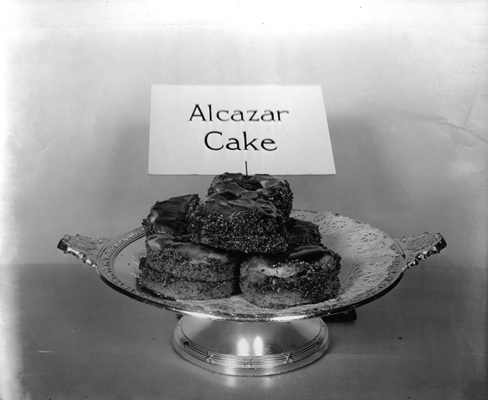 Alcazar Cakes made with potato flour. NARA/4-G-30-31
When Hoover became the “food czar” in April 1917 upon America’s entry into World War I, the U.S. Food Administration had been created to encourage patriotic conservation of certain ingredients for the war effort. Since his recent stint as chairman of the Commission for Relief in Belgium, Hoover understood the logistics behind a large-scale food operation. In order to supply hearty non-perishables — beef, wheat, and sugar — to American soldiers and Allies overseas, Hoover’s USFA asked for cooperative sacrifice from civilians.
Hooverizing Housewives
“Meatless Tuesdays” and “Wheatless Wednesdays” were part of the USFA’s Hooverization of America’s kitchens. By 1918, the administration claimed more than 10 million homes had submitted pledges to use potato flour, molasses, and chicken instead of wheat flour, sugar, or beef in their tried-and-true recipes.
Hoover’s culinary campaign also recommended its own recipes, cataloged by the National Archives. Pamphlets from the USFA urged homemakers that a pledge to their recommendations would not amount to skimpy cooking: “The word ‘save’ has been overemphasized in the public mind and the word ‘substitute’ overlooked.”
A Hoover-compliant dinner in 1918 might include a shark steak, potato bread, and greens from a family victory garden. For dessert, the tempting Lintz Tart called for rye flour, lemon zest, and cinnamon with an almond paste filling.
Read more: Herbert Hoover’s Meatless Wheatless World War I Diet
General George Kenney, Master Aviator and American War Hero Who Fought In Both World Wars
By David Herold
via the War History Online web site
Every soldier who puts his life on the line is a true hero. However, some amazing souls go the extra mile and really reach for the stars in their service to their country.
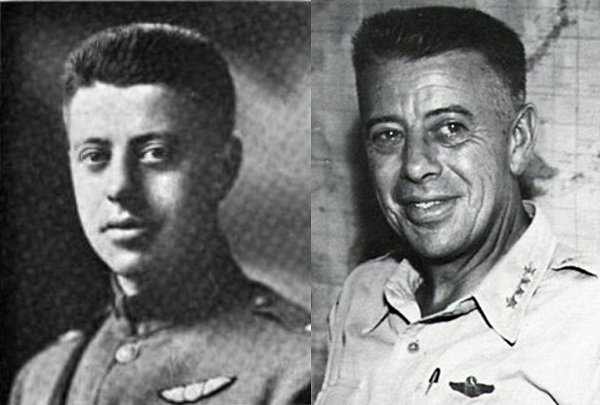 Captain George Kenney in 1919; General George Kenney in 1945One of them is George Kenney, a US Army Air Force General. Kenney who not only mastered this position for 30 years as a true professional, but he took part in multiple battles – not to mention both World Wars – with gusto, earning him a decorated military record for his efforts.
A Young Man Finds His Footing
George Kenney was born in 1889 to American parents, but he was brought into the world in Nova Scotia, Canada after his family decided to take a summer trip up north to avoid the heat of Boston. Growing up in Massachusetts as the oldest of three younger siblings, Kenney succeeded through school flawlessly.
Eventually, he found himself attending college at the Massachusetts’ Institute of Technology (MIT), a very highly-regarded Ivy League school for some of the country’s brightest students. Aiming to pursue a career in civil engineering, he was well on his way to something great, even from a young age.
However, the sudden departure of his father affected him so much that he actually quit college, taking on various jobs in different cities just to pass the time. Then, once his mother passed away in 1913, he finally returned to Boston, intent on figuring out where he needed to be. Working his way back into engineering, he helped build a bridge in New London, Connecticut, readjusting to life as he had originally planned it years before.
Kenney was content in his choice of career, and he later formed a partnership with Gordon Glazier, a former school friend, to build upon his experience in the field.
However, the beginning of World War I would throw his life into a tailspin again, setting him on an entirely different course – this one taking place high up in the sky.
Read more: General George Kenney, Master Aviator and American War Hero Who Fought In Both World Wars
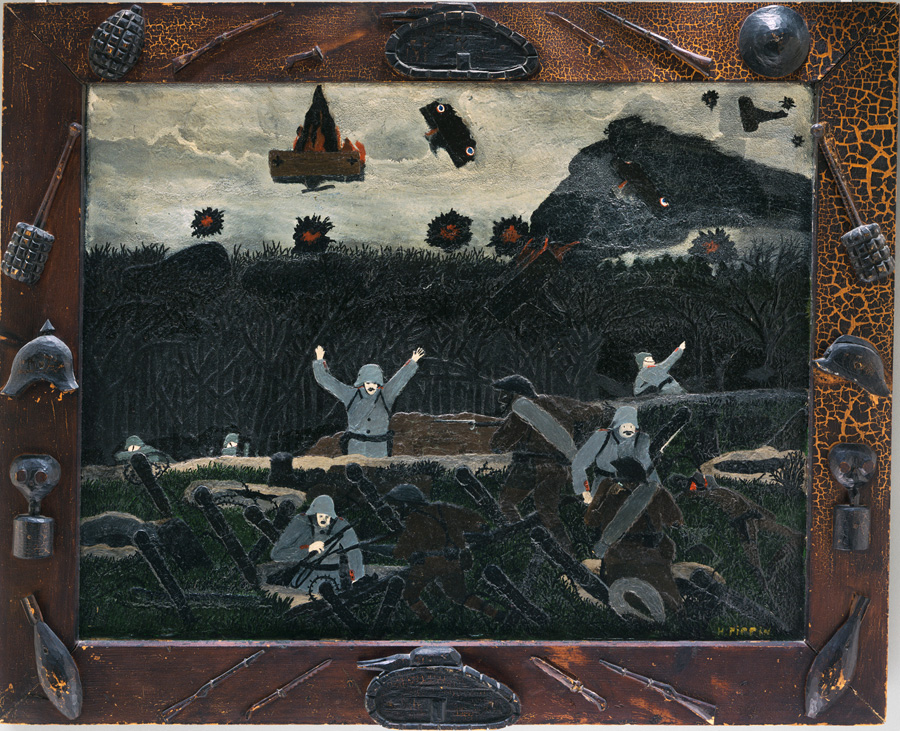 Horace Pippin painting: The End of the War - Starting Home
Trench warfare inspired World War I artist
By Barry Hudock
via VFW Magazine
WWI Army veteran Horace Pippin fought with the famed “Harlem Hellfighters” during the Great War. His oil-on-canvas depictions of his experiences in France made him famous.
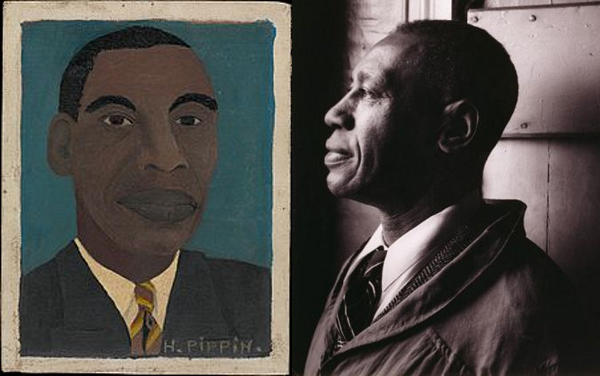 Painter Horace Pippin self portrait and portrait photo.As America marks the centenary of its involvement in World War I, the achievement of one veteran deserves commemoration. Horace Pippin, who fought in France with the renowned 369th Infantry Regiment of the 93rd Infantry Division, went on to achieve importance as an artist after the war, despite war wounds that left him partially disabled.
“His work is endlessly fascinating and quite beautiful,” said Anne Monahan, a current fellow at The Met in New York and an independent scholar who specializes in 20th century art. “American art would be diminished if he were not known.”
Born in West Chester, Pa., in 1888, Pippin moved at age 3 with his mother and two siblings to Goshen, N.Y., where he attended a segregated, one-room schoolhouse. Horace enjoyed art even in childhood, but the realities of growing up in a poor black family meant he had to leave school to find work at 15 years old.
He worked in a variety of manual labor jobs until he enlisted in the Army in March 1917, just as the U.S. was about to enter WWI. He joined the 15th New York National Guard Regiment, soon to be renamed the 369th Infantry Regiment and known more informally, and more famously, as the Harlem Hellfighters, or Harlem’s Rattlers (see sidebar). Cpl. Pippin served with K Co., 3rd Bn.
Commission shares U.S. Mint WWI coin with key partners
By Chris Isleib
Director of Public Affairs, United States World War One Centennial Commission
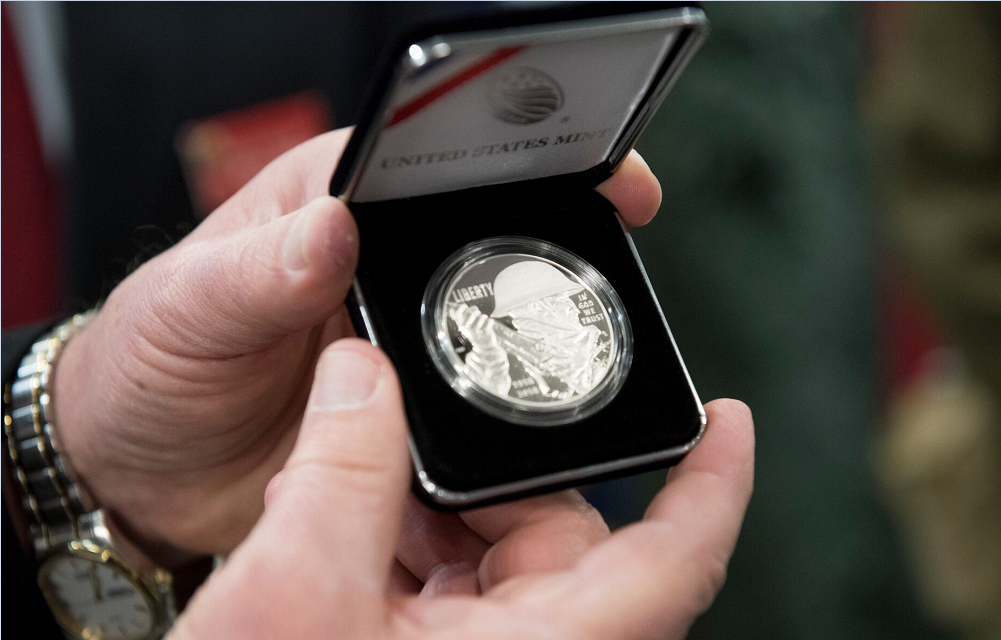
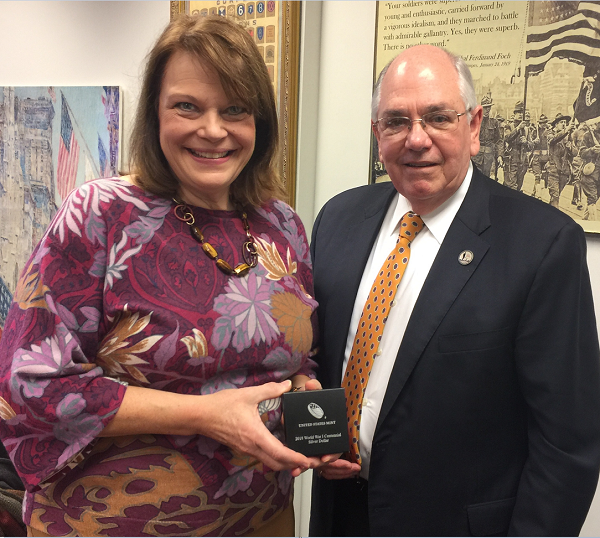 Susan Menenga (left) receives the gift to the Pritzker Military Museum & Library in Chicago of a 2018 World War I Centennial Silver Dollar from Daniel S. Dayton, Executive Director of the United States World War One Centennial Commission.A few days ago, the U.S. Mint opened sales for their new collective 2018 World War I Centennial Silver Dollar. This new coin was authorized by Congress as a tribute to the American men and women who served during the war. Sales from the coin help support our centennial programs -- so the coin is a tangible way for people across the country to directly participate in America's World War I Centennial.
Since that opening sales day, our Centennial Commission has had the honor of sharing this new silver dollar with a few of our commemorative partners, organizations who help veterans and their families every day, and groups who remember and tell the story of America's sacrifice during World War I.
We value the work that these people do, and are proud to stand by their side in our mission.
Our greatest partner is our Founding Sponsor, the Pritzker Military Museum & Library (PMML). When Congress created our Centennial Commission in 2013, they provided us with no appropriation. As a result, we need private donation to survive.
The Pritzker Library leadership saw this, and through a generous initial grant, they took the incredible step of ensuring that our Centennial Commission had the finances and resources to perform our important mission. We would not exist without the Pritzker Military Museum and Library.
Since 2013, we have worked through our tireless PMML liaison, Susan Menenga, to create a network or state organizations, plan activities, and carry our national programs like 100 Cities/100 Memorials.
Read more: Commission shares U.S. Mint coin with key partners
St. Lawrence Student receives national, international attention for WWI research
By Abraham Kenmore
via the Watertown, NY Daily Times web site
CANTON — Several million Americans served in the military during World War I, including a small but significant group of men who had moved to the United States from India before enlisting in the armed forces.
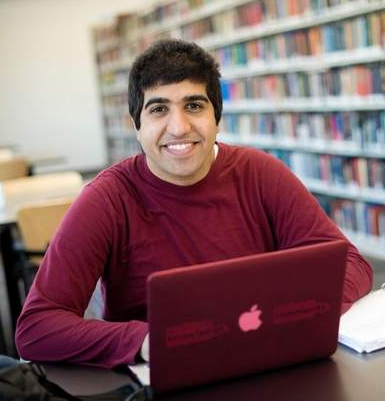 Tanveer KaloNow, 100 years later, St. Lawrence University senior Tanveer Kalo is working to bring the stories of these veterans to light — and receiving national and international attention for his scholarship.
Mr. Kalo, a government major and history minor from Queens, found this group of Indian-American soldiers by accident.
“A couple years ago, I was just wanting to find more about the Indian-American community,” Mr. Kalo said. “I was just goofing around with Wikepedia and found Dr. Bhagat Singh Thind.”
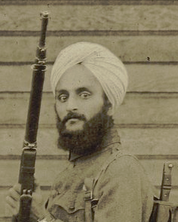 Dr. Bhagat Singh ThindBorn in 1892 in Taragarh, Punjab, Mr. Thind came to the United States in 1913 to study at the University of California, Berkeley.
He joined the Army in 1917, the first turbaned Sikh to serve, and was honorably discharged the next year at the rank of acting sergeant. He later unsuccessfully sought citizenship in the case Bhagat Singh vs. the United States, a Supreme Court decision that declared Indian-Americans were not white, and therefore could not be naturalized under contemporary law.
In spring of 2017, Mr. Kalo did an internship with the United States World War One Centennial Commission researching information for their website, and mentioned Mr. Thind to his supervisor.
His supervisor encouraged him to find more, and Mr. Kalo found digitized copies of “Young India,” a Indian-American publication from 1918, which included a list of “Our Men With Uncle Sam,” 10 Indian-Americans who were currently serving in the military.
After publishing the information about these soldiers on the Centennial website, Mr. Kalo continued to pursue the research, and is using it as the basis of a senior research paper. He traveled to Washington, D.C., to look through 1,000 index files from the Bureau of Naturalization, and combed through draft cards, passenger lists, and census data to piece together complete stories.
“When looking at the documents, you see basically someone’s life,” Mr. Kalo said. “It’s just incredible to see all this stuff.”
Read more: St. Lawrence Student receives national, international attention for WWI research
Four Questions for Amy Rohmiller, Ohio WWI Centennial Committee
"Ohio played a major role in WWI in almost every area you can think of."
By Chris Isleib
Director of Public Affairs, United States World War One Centennial Commission
We are thrilled to report that the state-level WWI Centennial Committee from Ohio has gone live with a new web page. The page is hosted by the U.S. WWI Centennial Commission's own website, and can be found here. We caught up with Amy Rohmiller from the Centennial Committee to talk about the new site, and what Ohio is doing to commemorate the Centennial.
The new Ohio new web site is amazing. Who is the target audience for it? What will people find there?
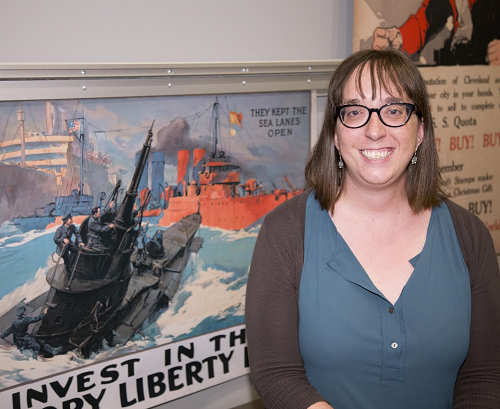 Amy Rohmiller of Ohio History ConnectionOur target audience for our news section is anyone who wants to learn more about World War I and Ohio’s role in World War I. We hope to include a variety of different things in that section. We’re using it to highlight exciting resources coming out of the World War I commemoration, including lesson plans for educators and newly digitized and accessible collections available through Ohio Memory, the website for statewide digital collections. We’re also using it to bring more attention to interesting topics and people in Ohio’s World War I history.
Ohio has a rich World War I history, and we’d like to tell the story of the home front as well as the story of military. So far, we have articles posted giving an overview of Ohio’s home front and telling the story of how the town of New Berlin changed its name to North Canton as a result of anti-German sentiments at the time. We’ll have upcoming articles exploring propaganda and newspaper coverage, the role religion played in World War I, the beginnings of Daylight Savings Time, and the War Library Service among others. We aim to post new articles every other week, so keep checking back for new content.
Ohio played a very important role in World War I on several aspects -- recruitment, training, the Buckeye Division and others in combat and support roles, invention/innovation, production of key war materials such as vehicle tires, farm-raised produce & animals, etc. etc. etc. Tell us about that role. What have you learned?
Ohio played a major role in World War I in almost every area you can think of. I was surprised at how big of a role Ohio played. As a state, Ohio sent the 4th most troops in the country and about 5% of the entire nation’s military manpower. Ohio was the home of Camp Sherman, the third largest training camp for soldiers. Over 120,000 soldiers trained at the camp outside of Chillicothe. (Sadly, Camp Sherman also had the highest rate of flu casualties.) As the birthplace of aviation, Ohio, and especially the Dayton area, played a role in World War I aviation. Factories in Dayton produced thousands of Liberty Engines and the Dayton Wright Airplane Company was the largest manufacturer of airplanes producing the American version of the DH4. Ohio also manufactured some of the first mass-produced tanks to support the military war effort.