





























World War I Centennial News
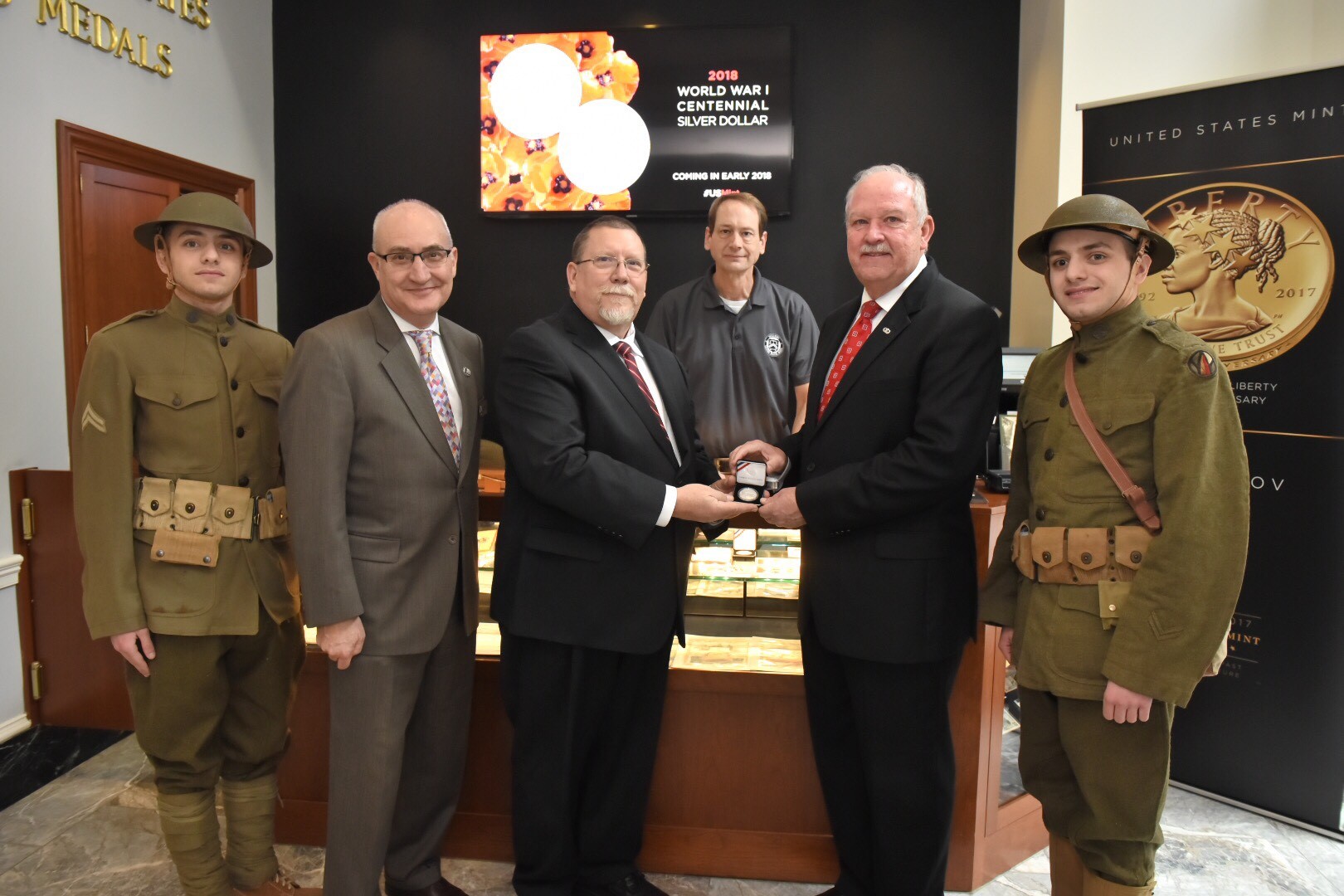 The United States Mint has opened sales for their new 2018 WWI Centennial Silver Dollar. This new coin honors the 100th anniversary of American participation in WWI. The first official purchase was made by Colonel Gerald York (second from right), grandson of WWI hero, Sergeant Alvin York. Joining him is Acting Deputy Director of the U.S. Mint David Motl (third from left), and U.S. World War I Centennial Commission Veteran Liaison, David Hamon (second from left). A surcharge from the coin supports the Centennial Commission's education and commemorative programs.
U.S. Mint opens sales for 2018 World War I Centennial Silver Dollar
Congressionally-authorized coin, medals honor America's Veterans of World War I
By Chris Isleib
Director of Public Affairs, United States World War One Centennial Commission
WASHINGTON, DC: The United States Mint has opened sales for their new 2018 World War I Centennial Silver Dollar. This new coin honors the 100th anniversary of American participation in World War I.
A ceremonial 'first purchase' of the coin was made at U.S. Mint Headquarters by Colonel Gerald York, grandson of famous World War I hero, Sergeant Alvin York. He made the first purchase at the Mint's lobby gift shop, in Washington, DC.
On hand for the event was Acting Deputy Director of the U.S. Mint David Motl, who expressed his support for the coin's mission. "This new coin gives us all a symbol that we can hold in our hands, a way for us to directly participate in the World War I centennial period."
Terry Hamby, Chair of the U.S. World War I Centennial Commission agreed. "These veterans should be remembered. During World War I, nearly five million American men and women placed their lives on hold. Many deployed to places that most had never visited, to fight for the freedom of people they never met. They did not do this for personal gain, they did it solely to bring peace to the world.”
Read more: U.S. Mint opens sales for 2018 World War I Centennial Silver Dollar
Designer of national WWI memorial visits Joplin for Scouting event
By Jordan Larimore
via the Joplin Globe web site
The Boy Scouts of America and the country's efforts in World War I are closely intertwined.
Even 100 years ago, Scouts planted gardens to feed soldiers, collected fruit pits and shells to be used in gas masks, gathered wood for weapons and more.
Perhaps it makes sense then that a 27-year-old Eagle Scout will be in charge of memorializing America's World War I service members a century later.
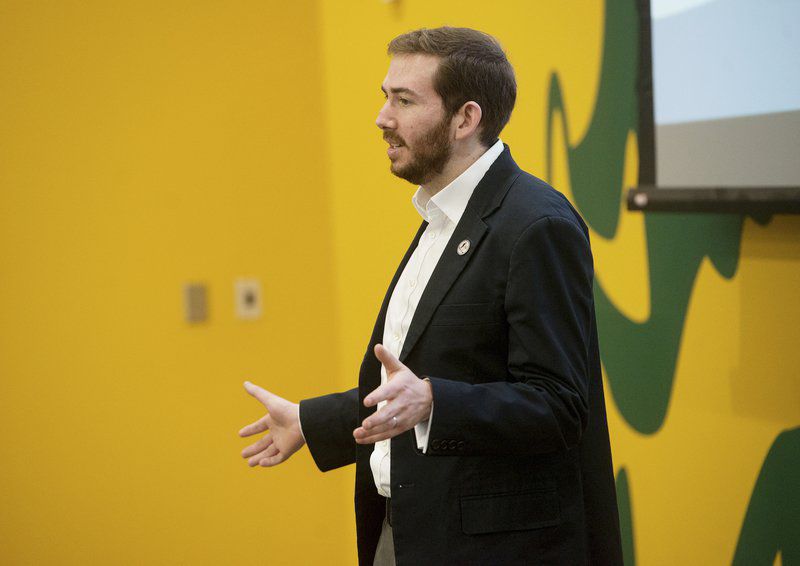 Joe Weishaar talks about work in planning and designing the new national World War I Memorial at Pershing Park in Washington, DC recently while attending a Friends of Scouting Breakfast at Missouri Southern State University in Joplin, MO. Weishaar is a native of Fayetteville, Arkansas, and an Eagle Scout. (Globe photo by Roger Nomer.)Joe Weishaar, a Fayetteville, Arkansas, native and Chicago-based architect, was selected in 2016 to lead the design of the World War One Centennial Commission's memorial in Pershing Park in Washington, D.C.
Weishaar visited Joplin on Thursday to present his plans at the annual Friends of Scouting Breakfast, a fundraiser for area Scouting organizations. The event was put on at Missouri Southern State University.
"For me, especially in Scouting, there's always been that component of service," Weishaar said after his presentation. "And it's really kind of written into Boy Scouts and citizenship in the community and nation and the world. ... And so there's always been some kind of theme occurring in my life of 'If you do something, how's it going to impact your community and your nation?' And with this project, I'm able to connect all those dots again."
The design and planning work has been underway for nearly two years, and an official groundbreaking for the construction of the memorial is scheduled for November, Weishaar said. Once work begins, it is expected to take six years to complete what he said will be the largest free-standing bronze sculpture in the Western Hemisphere.
Artistic representations of the eventual memorial Weishaar presented depict the journey of a World War I soldier, beginning with leaving family and friends, and continuing with training, combat and even suffering a battle injury.
Weishaar said the work has involved combing through thousands of photographs and other research, then attempting to re-create the images with actors or artists. Photographs are taken of those re-creations, Weishaar said, and 3-D printing provides a basis for the eventual sculpting.
"There's some rough days," he said. "You click through 1,000 pictures of guys dead, hung up on barbed wire. And that's not the easiest thing to take from."
Read more: Designer of national WWI memorial visits Joplin for Scouting event
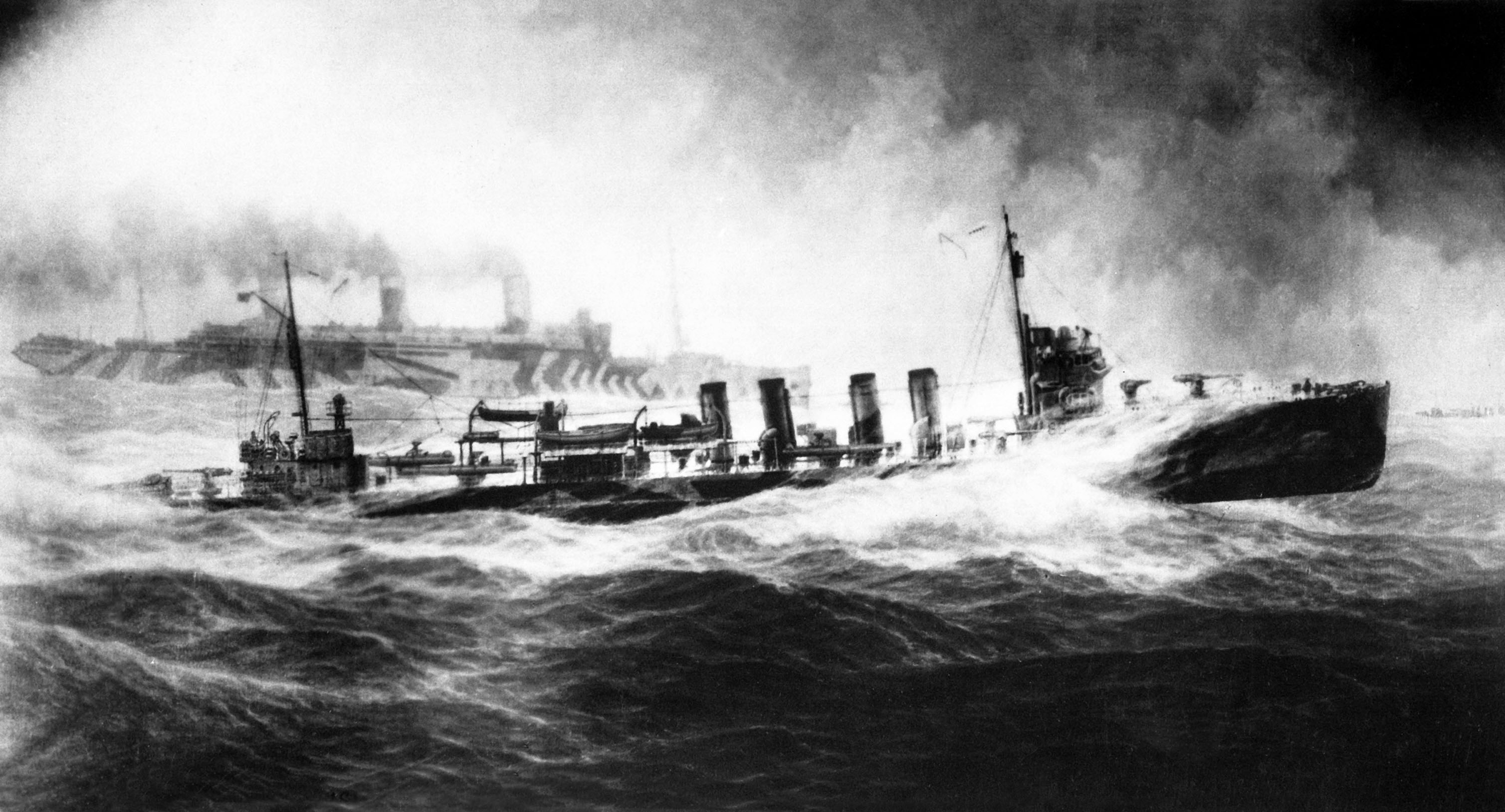 Painting of a U.S. Navy destroyer on convoy-protection duty during World War I. Dr. Dennis Conrad asserts that "the convoy was what in the end defeated the German submarine offensive."
Four Questions for Dr. Dennis Conrad, Naval History and Heritage Command
"The U.S. Navy was a key contributor to the German decision to end the war."
By Caitlin Hamon
Staff Writer
The role of the U.S. Navy in the Great War is one that is, at times, debated, but mostly forgotten, primarily due to the lack of large-scale naval warfare and victories comparable to the Spanish-American War and later World War II. However, the Navy did provide crucial functions, including transportation of over 2.5 million soldiers, supplies, service as aircraft carriers, and more. Dr. Dennis Conrad, Historian at the the Naval History and Heritage Command, visited the Centennial Commission on Friday, December 1, 2017, and gave a presentation on the various operations performed by the U.S.Navy throughout World War I. Dr. Conrad holds a P.h.D from Duke University in history and has done extensive work for the NHHC researching and documenting Navy history from the American Revolutionary War up to the Spanish American War. He is currently working on a biography of Josephus Daniels, Secretary of the Navy during World War I. We asked him a few questions following up on his presentation to the staff
How did you come to grow such rich and deep interest in WW1 Naval history?
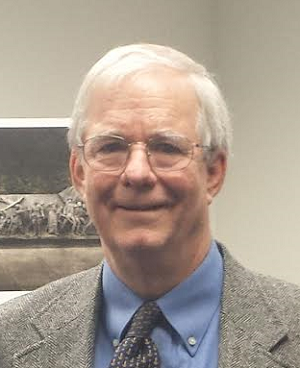 Dr. Dennis ConradI joined the Navy History and Heritage Command (although then it was called the Naval Historical Center) in 2001. I did not have any background in naval history. I had been editor and project director of the Papers of General Nathanael Greene. However I did have expertise doing documentary history and the NHC was in the midst of a documentary project on the American Revolution called Naval Documents of the American Revolution so they hired me to work on that project, which I did.
Early on, however, I realized that the centennial of WWI was fast approaching and that the NHC/NHHC did not have anyone who was an expert in that war so I began work on a monograph on Secretary of the Navy Josephus Daniels, who was SecNav during WWI, with the idea that I would learn about the war so there would be someone on staff that could discuss the Navy's role in that war intelligently. I have also done work on the War of 1812 and the Spanish-American War so now I truly do have a strong background on the early U.S. Navy.
What were the top 5 innovations developed from the war that impacted naval power in the interwar years?
- Airplanes--they went from the Wright Brothers to a plane that could fly across the Atlantic.
- The aircraft carrier, which became the cornerstone of the US Navy in WWII.
- Development of the U-boat/Submarine--the American victory in WWII was primarily the success of the USN submarines in a guerre de course against the Japanese merchant marine.
- ASW developments--destroyers, depth charges, and particularly sonar, which was in its early stages in WWI.
- Development of the Naval Consulting Board that morphed into the Navy Research Lab, which has become the cornerstone of the Navy's R & D.
Read more: "The U.S. Navy was a key contributor to the German decision to end the war."
True Sons of Freedom
By Jennifer D. Keene
Historical Advisory Board, United States World War One Centennial Commission
via the American Legion web site
When Delaware artist Edward Loper Sr. was a young man, “there were certain kinds of black men who I admired and they were the kind of black guys who ... came out of the first world war. They had self-respect ....”
Often forgotten today, these veterans were pivotal figures in the modern civil-rights movement who fought valiantly to break down racial barriers within the military and at home. Returning home with their heads held high, they inspired the next generation of black servicemen to continue the struggle against racial discrimination.
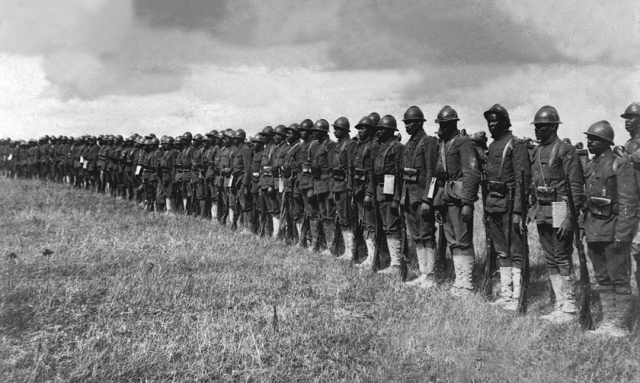 At first glance, the challenges that African-American men faced in the World War I-era Army seemed almost insurmountable.
Upon the U.S. declaration of war in April 1917, all existing eight black National Guard infantry regiments quickly filled to capacity with volunteers. As a result, over 96 percent of the 367,710 African-Americans who served during the war were conscripted by local draft boards staffed by white men. Blacks eventually formed 13 percent of the wartime Army, even though they represented only 10 percent of the civilian population.
How would the Army use these men? Who would lead them? Alarmed white Southerners sent frantic letters to Secretary of War Newton E. Baker, predicting a future race war if large numbers of black men received military training. For his part, Gen. John J. Pershing, commander of the American Expeditionary Forces (AEF), believed that black men could fight well, but only if led by white officers.
Consequently, over 89 percent of African-Americans were assigned to noncombatant units, mostly in quartermaster and engineer units with white officers. But the black community had some clout to influence official policies – after all, black participation in the war effort was essential. Under pressure from civil-rights organizations, especially the National Association for the Advancement of Colored People (NAACP), the War Department agreed to create one complete black combatant division, the 92nd Division, and melded the National Guard units into four infantry regiments to form a “provisional” 93rd Division. Baker also authorized one black officer training camp at Fort Des Moines, Iowa, to provide company-grade officers for the 92nd Division.

U.S. Bureau of Engraving & Printing offers three WWI Centennial prints in 2018 intaglio program
Intaglio products feature design elements for paper money, bond, stamps
Washington, DC – The Bureau of Engraving and Printing (BEP) is pleased to introduce the newest addition to the Intaglio Print Subscription Program, the World War I – 100th Anniversary 2018 Intaglio Print Collection.
The Treasury Department issued Liberty Loans and Victory Bonds produced by the Bureau of Engraving and Printing to assist with financing the Great War. This collection highlights inspiring allegorical and historical figures featured on these bonds, engraved American iconography, and currency issued during the War.
This World War I 100th Anniversary commemorative collection consists of three intaglio prints – Entry, Homefront, and Victory. The first card, Entry, will go on sale January 23, 2018. The second card, Homefront, will go on sale March 8, 2018. The third card, Victory, will go on sale August 14, 2018 in conjunction with BEP’s participation in the American Numismatic Association’s (ANA) World’s Fair of Money Convention in Philadelphia, Pennsylvania.
To participate in BEP’s 2018 Intaglio Print Subscription Program and to ensure receipt of each intaglio print, subscriptions must be received by February 8, 2018. The entire three-card collection is $51.00. Individual cards are $20.00 through the BEP gift shops and $22.50 through mail order/internet. Individual cards are $17.00 when purchased in quantities of 10 or more. (Each Intaglio Print measures 8 1/2" x 11")
When the Great War Reached Wisconsin, Free Speech Was the First Casualty
By Richard L. Pifer
via the What It Means to be American web site
Woodrow Wilson did not want to go to war. On two different occasions during the weeks leading to the 1917 declaration of war that brought the United States into World War I, the president expressed reservations regarding the course he was contemplating.
 Examples of anti-anti-war propaganda in 1918 Wisconsin: (left) Wisconsin senator Robert LaFollette is pictured receiving medals from the Kaiser; (right) labor agitators are accused of being in the pay of Germany.Because war is autocratic, he feared that free speech and other rights would be endangered. The President told Frank Cobb of the New York World: “Once lead this people into war, and they’ll forget there ever was such a thing as tolerance. To fight you must be brutal and ruthless, and the spirit of ruthless brutality will enter the very fiber of our national life, infecting congress, the courts, the policeman on the beat, the man in the street. . . . If there is any alternative, for God’s sake let’s take it!”
Wilson’s predictions became self-fulfilling prophecies. Once the United States joined the fight against the Kaiser, Congress and Wilson’s own administration implemented legislation and surveillance programs designed to keep America safe by ferreting out subversive activity and crushing dissent—especially in states like Wisconsin, which I have studied for many years. These steps curtailed meaningful debate about how best to fight the war at home and abroad. Tolerance did indeed go out the window.
Public discourse very quickly defined a new, clear dichotomy between the righteous people of the United States and the bestial German Hun, between us and “them.” As Congress assembled for Wilson’s war message, Texas Representative Joe Eagle told the Wisconsin State Journal: “The Kaiser is a cave man with murder in his heart . . . . He is bent on the unwavering course of brute force and pillage.” The language of peace, neutrality, and forbearance had almost immediately given way to the language of war: bellicose, dehumanizing, and designed to create a noble enterprise worthy of the sacrifice of thousands of lives. Through posters, pamphlets, and movies, the nation’s propaganda office, the Committee on Public Information, spread the message of the righteous war against the evil Hun.
Read more: When the Great War Reached Wisconsin, Free Speech Was the First Casualty
Department-linked Arizona World War I documentary now screening
via the American Legion web site
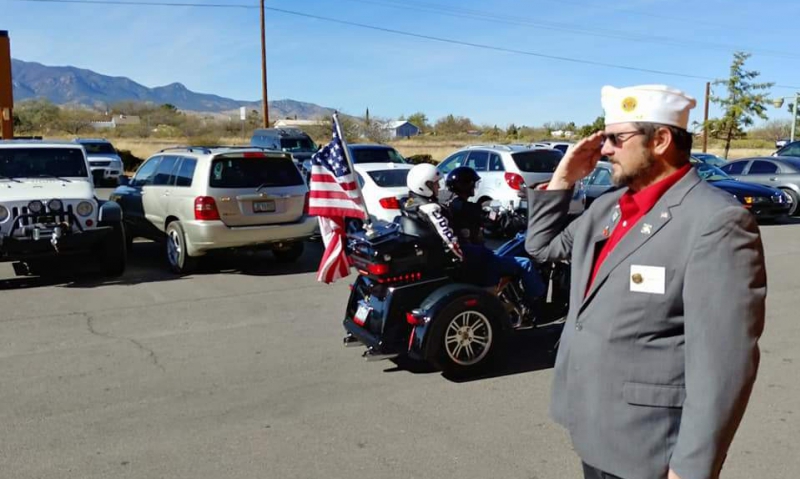 Department of Arizona Area A Vice Commander Ben Headen salutes a group of Legion Riders as they roll in for a documentary screening in Sierra Vista, Ariz. (Photo via Thomas S. Perry)A documentary developed by a Legionnaire and a Sons of The American Legion member that spotlights both Arizona World War I veterans and the formation of the Legion has begun screening in venues across the state.
Will Williams and Thomas S. Perry are the creators of “Arizona Heroes of World War I,” a documentary in 15 chapters that covers the stories of the individuals behind the war. After meeting with the Department of Arizona in 2015, the duo decided to work in content on the Legion, its formation and some of the people behind that.
In November, the first public screening of the documentary was held in Tucson. “With the premiere of the film,” Perry says, “the Department of Arizona is gearing up to advance our Centennial Celebration, remembrance of the end to World War I, and launching and expanding our marketing and branding campaign.” Central to that is a Facebook promotion campaign that includes three-minute film segments and PSAs on the Legion; it has garnered 43,000 views and 70,000 postings.
Several more screenings have taken place across Arizona since the Tucson event. Attendance averages between 60 and 75. Williams and Perry actively solicit comments from viewers; one 16-year-old stated, “I never knew history could be this rad!” Another viewer added, “We are so happy we came. We never knew that Arizona was so involved and had so many real heroes.”
Read more: Department-linked Arizona World War I documentary now screening
100 years later, Great War’s impact on Greenville remains evident
By Andrew Moore
via the Greenville Journal web site
This year marks the 100th anniversary of the end of World War I, a conflict that dragged nations from all across globe into four years of unprecedented bloodshed.
Between the start of the war on July 28, 1914, and end of the war on Nov. 11, 1918, more than 18 million people were killed and 21 million wounded. The American diplomat, George Kennan, described the war as “the seminal catastrophe of this century.”
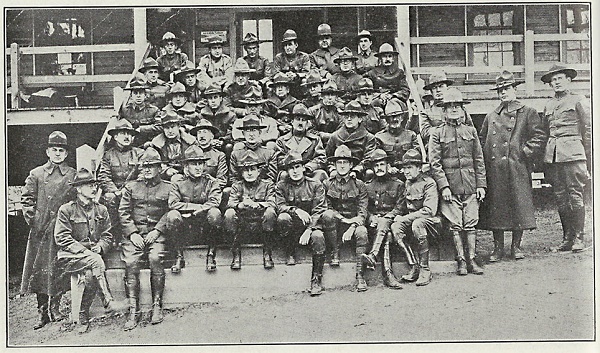 Medical Staff at the Base Hospital, Camp Sevier, SC, 1918.However, the war did much more than cause a global massacre. It allowed millions of women to enter the workforce, featured the initial step of the United States as a world power, and helped to transform Greenville into the city it is today.
Building a camp
When the United States declared war on Germany in April 1917, Secretary of War Newton Baker ordered the construction of 32 training camps, according to local historian and documentary filmmaker Don Koonce. “Most of these cantonments or training camps were to be spread across the Southeast where moderate weather would provide more training days and shorter preparation time before sending the men overseas,” he said.
Local business leaders sensed an economic opportunity and began lobbying for a camp soon after. They were successful. In July 1917, the U.S. Army appointed Greenville’s J.E. Sirrine & Co. and Gallivan Construction to build a 1,900-acre training camp near the base of Paris Mountain for the newly created 30th Infantry Division, which was composed of National Guard soldiers from South Carolina, North Carolina, and Tennessee.
The division was nicknamed the “Old Hickory” division in honor of U.S. president Andrew “Old Hickory” Jackson, who was born near the borders of the three states.
Soldiers from the 1st South Carolina Infantry arrived in Greenville soon after and began to construct the camp, according to Koonce. About 20,000 additional soldiers arrived in the following weeks, and by Aug. 31 the camp was considered complete. It was named Camp Sevier in honor of John Sevier, a Revolutionary War hero and Tennessee’s first governor.
Read more: 100 years later, the Great War’s impact on Greenville remains evident
Celebrations will remember division of soldiers trained in Greenville, SC who helped end WWI
By Carla Field
via the WYFF 4 web site
GREENVILLE, S.C. — An infantry division that trained in Greenville and helped end World War I will be remembered in a yearlong series of celebrations of the 100th anniversary of the war's end.
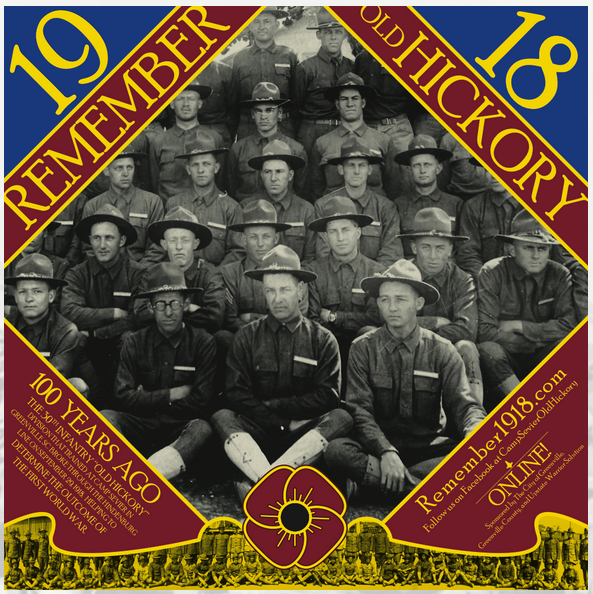 The 30th Infantry Division, known as the Old Hickory Division, broke the Hindenburg Line in 1918, an event acknowledged as leading to the end of World War I.
The Old Hickory Division trained at Camp Sevier in Greenville and included hundreds of local soldiers as well as men from Georgia and Tennessee and the rest of South Carolina.
Police officers, deputies join memorial effort
A group of Upstate leaders is working on a year-long tribute to honor the Camp Sevier, Greenville and the Old Hickory Division's major impact in changing the course of the war.
The Remember the Old Hickory Project is a grassroots effort that will remember Camp Sevier, one of the largest Army bases in America during the war, main events organizer Don Koonce said.
"We want everyone to remember the tremendous contribution Greenville and Camp Sevier made to the war effort," Koonce said. "The 100th anniversary is a great opportunity to raise awareness of that unique moment in history, and what it meant both locally and on the global stage."
The city of Greenville and Greenville County officials are working together with Old Hickory Project to build a yearlong series of celebrations to commemorate the historical significance of the long-gone camp and the sacrifices made by those who went through basic training there.
"I cannot think of a better way to honor the people of the Old Hickory Division who served our country so heroically a hundred years ago," Greenville Mayor Knox White said. "Even as we continue to look forward, the city is always cognizant of our roots and the amazing contributions that people in this area have made to the world."
Quincy, IL physician rose to Major during World War I
By Arlis Dittmer
via the Quincy, IL Herald-Whig web site
After war was declared in April 1917, 14 Adams County physicians volunteered for the reserve medical corps.
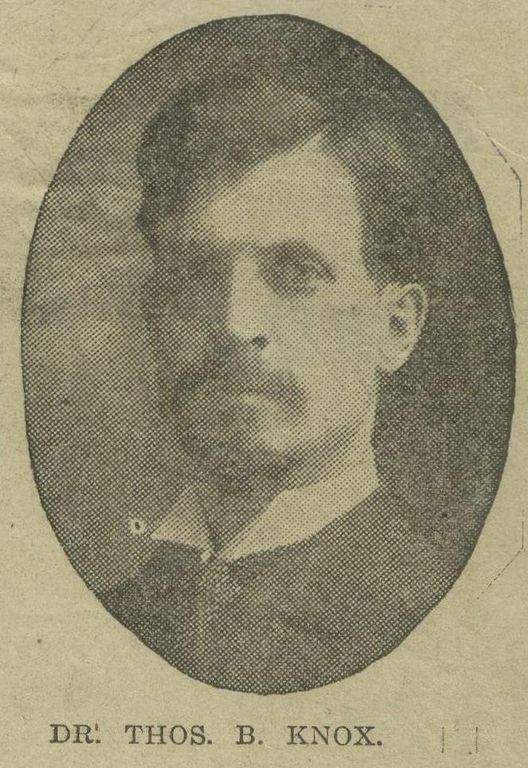 Dr. Thomas Blackburn Knox was the first to receive a commission as a lieutenant and left for Fort Riley in Junction City, Kan., in July 1917. Eventually 21 Adams County physicians served in World War I. That number represented 30 percent of the area physicians who collectively had an average age of 46. Those who were not called to the military served on draft and exception boards.
In September 1917 after a few months at Fort Riley, Dr. Knox was ordered to Camp Dix in Wrightstown, N.J., where he was to be surgeon to the 26th engineers corps. Dr. Knox was then transferred to the 312th ambulance company also at Camp Dix. In early November 1917, The Quincy Daily Herald published a letter from Dr. Knox to his friend Joe Esler. In the letter he describes the camp as very large with a hospital of 3,000 beds. He praised the Knights of Columbus and the YMCA for bringing a variety of entertainment to the recruits. His job consisted of drills and lectures for the men under his command, and he describes the doctors as Easterners and "a fine bunch of fellows, all young men around 35, a good, jolly bunch…." Toward the end of the letter he says, "The east is wonderful and I'm glad I'm here, following the flag of Uncle Sammy, and we are all happy that we are doing our bit." In closing he tells his friend Joe to, "Give my regards and best wishes to all my Quincy friends and tell them the boys need sweaters and mittens and wool socks."
In April 1918, Dr. Knox was promoted to captain and assumed command of the 312th ambulance company. In announcing his promotion, The Daily Whig quoted the Camp Dix Times as saying, "Captain Knox possesses an abundance of enthusiasm and a breezy western manner. Everyone who knows this commanding officer is delighted to know of his merited promotion and he has received scores of congratulations."
Dr. Knox left for France on June 4, 1918, on the RMS Mauretania. He sailed with his company as part of the 303rd Sanitary Train, 78th division. In Europe, he was in command of officers, enlisted men, 13 ambulances and two dressing stations where the injured received first aid before being sent behind the lines. During the summer of 1918 his company was stationed with the Fourth and Fifth British Army in Flanders behind Arras and then transferred back to the American sector in September and in October took part in the battle of the Argonne Forest.
The battle lasted 47 days. Dr. Knox's company spent 28 days of the battle at the front with the 311th and 312th infantries. He told The Daily Whig, "There is where we went into hell. The casualties in the infantry were heavy and we lost some of our men, but the ambulance boys died mostly from disease because of the conditions in which we were forced to live during the heaviest fighting and then some of them were killed when struck by shells." The company also lost ambulances because of shelling and had to use trucks to carry the wounded.
Read more: Quincy, IL physician rose to Major during World War I
Book and TV show set to tell the story of the Bute-born American soldier who was among the 200 men who died when their ship was sunk by a German U-boat during the First World War 100 years ago
By Kevin Quinn
via the Buteman (Scotland) web site
BUTE, UK — On February 5, 1918, German submarine UB-77 sank a British troopship, SS Tuscania, between Rathlin Island and Islay. More than 200 men died – most of them young American ‘Doughboys’ on their way to the trenches of World War One.
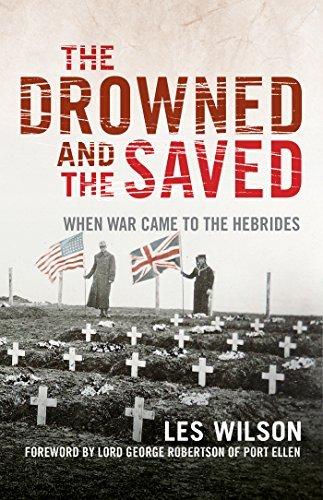 But one of these lost ‘Americans’ was actually a Buteman who had emigrated to the USA and had got caught up in the war in 1917, just after American joined the Allied cause against the Kaiser’s Germany.
The story of how Bute’s Alexander McAlister became a soldier and victim of a U-boat was discovered by writer and documentary film-maker, Les Wilson from Port Charlotte, while researching a book about the sinking, The Drowned and the Saved, and a documentary for BBC ALBA.
“I discovered from the US records that there were two Scots-born Doughboys lost on the Tuscania, and had their names,’” said Les.
“I knew that one of them, John Sloss came from Kilwinning, but I had no idea where Alexander McAlister came from. I had been sharing information with an American researcher and one day, out of the blue, she e-mailed me as my wife was driving us to Wemyss Bay to catch the Rothesay ferry where we were travelling to attend a dinner. She said McAlister came from Bute, where he died in hospital and is buried. I was flabbergasted.”
Les discovered that Alexander McAlister was from a large family that farmed at Meikle Kilmory, and that Alexander had emigrated to America, where he was employed as a horseman in a college which is now part of the American University in Washington DC.
The 27-year- old Scot was one of 2000 soldiers who clambered onto the Tuscania in New York Harbour on January 24, 1918. The Tuscania was part of the 12-vessel convoy bound for Liverpool. Relatively safe in the wide Atlantic, the ‘danger zone’ for convoys was the entrance to the North Channel, between Ireland and the coast of Scotland. This was the U-boats’ hunting ground.
Les said: “Shortly after sunrise on February 5 , Kapitan Wilhelm Meyer of UB-77 spotted the convoy through his periscope. After a lengthy game of cat and mouse Meyer fired two torpedoes. The Tuscania was hit and quickly began to sink. While most of the crew and the soldiers were rescued more than 200 men were lost when their lifeboats were driven onto the cliffs of Islay’s Oa peninsula in the dark.
Read more: Book and TV show set to tell the story of the Bute-born American soldier
Flu killed more World War I troops than any battle
By Harry Thetford
via the Greensboro, NC News & Record web site
The second flu wave of 1918 coincided with the Meuse-Argonne Campaign of World War I, according to the National Institute of Health.
Over 1 million U.S. troops participated, and it was our largest front-line commitment of the war.
Statistics vary, but the National Institute of Health reports 26,277 American soldiers died during this campaign, the deadliest World War I battle for U.S. troops.
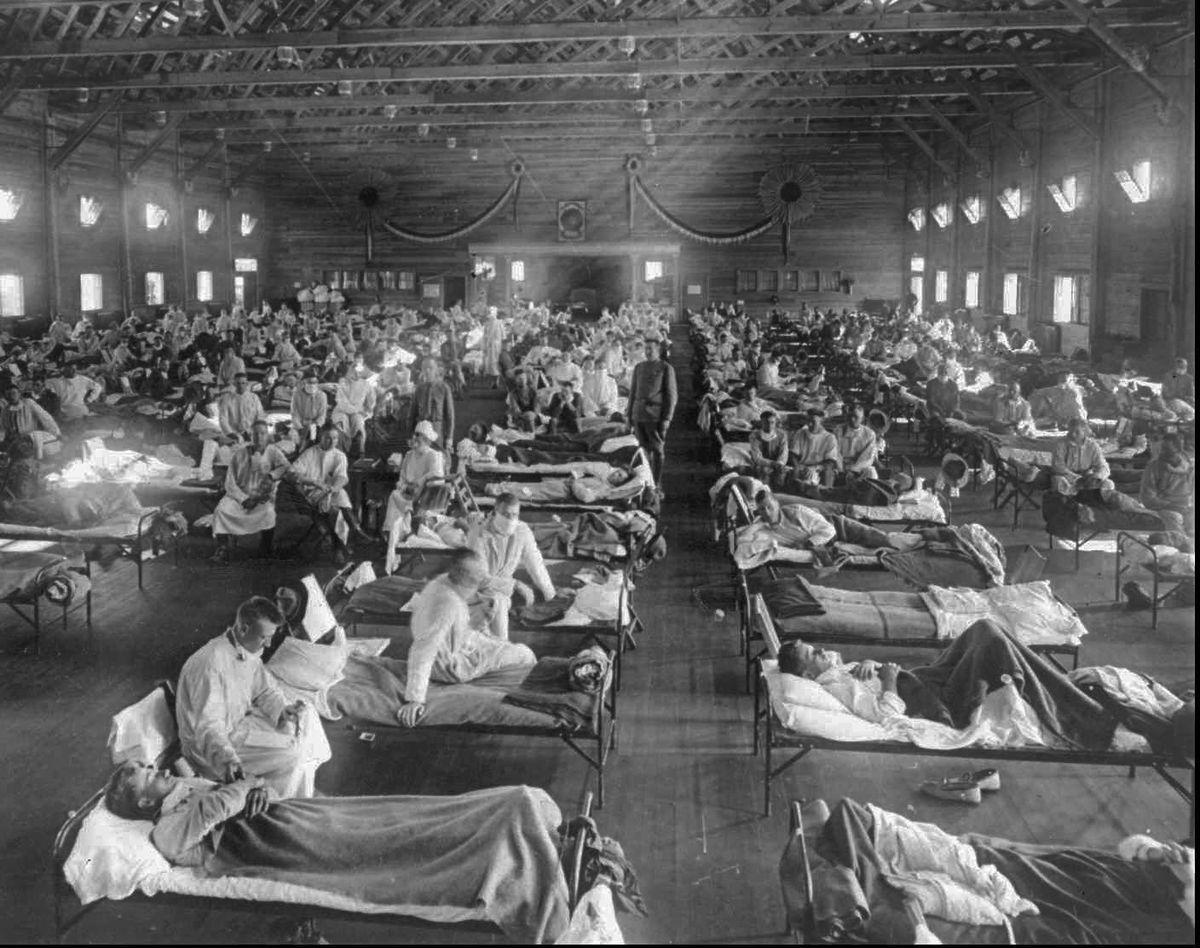 Influenza victims crowd into an emergency hospital near Fort Riley, Kansas in 1918. The 1918 Spanish Flu pandemic killed at least 20 million people worldwide.However, the flu killed more U.S. soldiers than did any Great War battle. The flu was equal opportunity. At least 14,000 German troops died from the flu.
Call it the Spanish Flu if you wish, as coined by the French — perhaps because the Spanish King Alphonso XIII caught the flu. From that logic, Wilsonian Flu would have worked. President Woodrow Wilson was also a flu victim.
The flu killed 15,849 U.S. soldiers in France and another 30,000 in stateside camps. That’s 45,849 killed by the flu versus 26,277 killed at Meuse-Argonne — documenting that the flu was by far our most deadly battle.
More civilians (over 50 million) died from the flu than from both World Wars and the Holocaust combined. Another 500 million civilians were incapacitated by the flu.
From 3 to 6 percent of the global population caught the flu, and 26 percent of U.S. soldiers caught the flu. The mortality rate is more telling. More developed areas lost 2 percent of their population to the flu, Mexico, 4 percent; Russia, 7 percent; Fiji Islands, 14 percent; Labrador, 33 percent; and some Alaska villages lost everyone.
According to the World Health Organization, 759 died in Philadelphia in one day, 12,000 in six weeks. Priests drove carts down city streets to collect bodies to be buried in mass graves.
The Smithsonian Institute reports 670,000 Americans died from the flu pandemic of 1918.
Read more: Flu killed more World War I troops than any battle
United States Mint Begins Sales of 2018 WWI Commemorative Silver Dollar and Companion Medal Sets on January 17
via the United States Mint web site
 WASHINGTON – The United States Mint (Mint) will open sales for the 2018 World War I Centennial Silver Dollar and the World War I Centennial Silver Dollar and Medal Sets on January 17 at noon Eastern Time. Product information is below.
The introductory sales period ends on February 20, 2018, at 3 p.m. ET, when regular pricing takes effect. Product descriptions are below.
World War I Centennial Silver Dollar
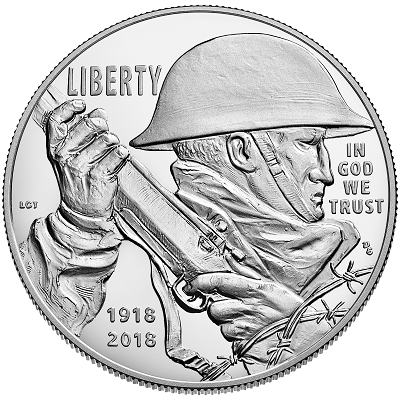
The obverse (heads), titled “Soldier’s Charge,” depicts an almost stone-like soldier gripping a rifle. Barbed wire twines are featured in the lower right-hand side of the design. Inscriptions are “LIBERTY,” “1918,” “2018,” and “IN GOD WE TRUST.”
The wire design element continues onto the reverse (tails), titled “Poppies in the Wire,” which features abstract poppies mixed in with barbed wire. Inscriptions include “ONE DOLLAR,” “E PLURIBUS UNUM,” and “UNITED STATES OF AMERICA.”
Public Law 113-212 authorizes the bureau to mint and issue up to 350,000 silver dollar coins. Customer demand will determine the ratio of proof to uncirculated coins minted within the authorized mintage limits.
The price of each coin includes a $10 surcharge, which the law authorizes to be paid to the United States Foundation for the Commemoration of the World Wars, to assist the World War I Centennial Commission in commemorating the centenary of World War I.
In support of the coin program, the Mint has created special companion medals honoring each of the branches of the U.S. Armed Forces that were active during the War. Each World War I Centennial Silver Dollar and Medal Set includes a proof silver dollar and a proof 90 percent silver World War I Centennial Medal. The medals are available only in these sets. Medal descriptions are as follows: