





























World War I Centennial News
World War I Centennial Ceremonies scheduled at ABMC sites
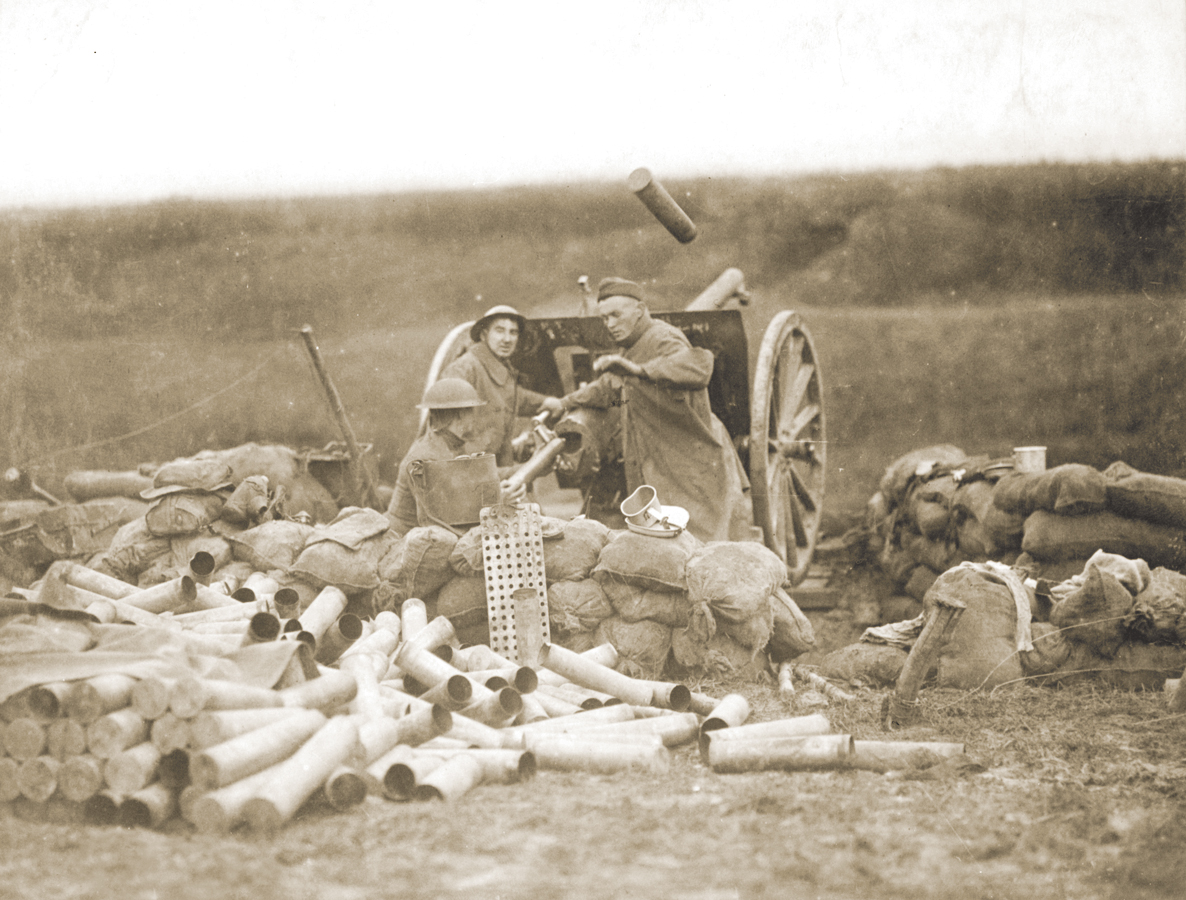 U.S. artillerymen fire 75mm gun toward Montsec from a position near Beaumont on September 12, 1918. Image courtesy of The National Archives.To commemorate and remember America's role in World War I, American Battle Monument Commission sites in Europe will host a variety of centennial ceremonies in 2018.
The commemorations will kick off Memorial Day weekend 2018 with special ceremonies at Somme American Cemetery, Aisne-Marne American Cemetery and Cantigny Monument.
The ceremonies will continue throughout the year, ending with the 100th anniversary of the Armistice.
The ceremonies will mark the 100th anniversary of key events, such as the first World War I U.S. Offensive, the Battle of Belleau Wood, the Meuse-Argonne Offensive, and more.
All the ceremonies are free to attend and open to the public. Ceremony times will be confirmed closer to date of the event. Be aware that ceremony details can change.
Read more: World War I Centennial Ceremonies scheduled at ABMC Sites
The U.S. Economy in World War I
By Heather Michon
via the ThoughtCo.com web site
When war broke out in Europe in the summer of 1914, a sense of dread rippled through the American business community. So great was the fear of contagion from tumbling European markets that the New York Stock Exchange was closed for more than three months, the longest suspension of trade in its history.
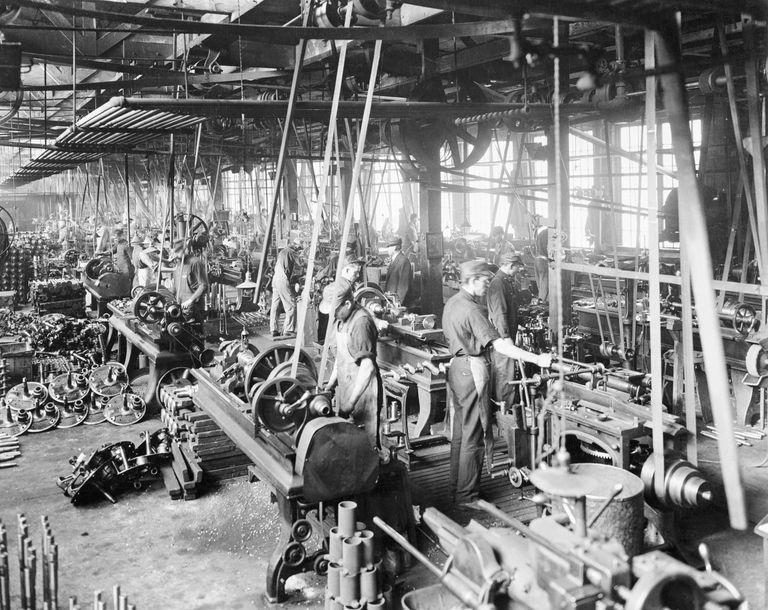 American automobile factory during WWIAt the same time, businesses could see the enormous potential the war might bring to their bottom lines.
The economy was mired in recession in 1914 and war quickly opened up new markets for American manufacturers. In the end, World War I set off a 44-month period of growth for the United States and solidified its power in the world economy.
A War of Production
World War I was the first modern mechanized war, requiring vast amounts of resources to equip and provision massive armies and provide them with the tools of combat. The shooting war was dependent on what historians have termed a parallel “war of production” that kept the military machine running.
During the first 2 ½ years of combat, the U.S. was a neutral party and the economic boom came primarily from exports. The total value of U.S. exports grew from $2.4 billion in 1913 to $6.2 billion in 1917. Most of that went to major Allied powers like Great Britain, France, and Russia, which scrambled to secure American cotton, wheat, brass, rubber, automobiles, machinery, wheat, and thousand of other raw and finished goods.
According to a 1917 study, exports of metals, machines, and automobiles rose from $480 million in 1913 to $1.6 billion in 1916; food exports climbed from $190 million to $510 million in that same period. Gunpowder sold for $0.33 a pound in 1914; by 1916, it was up to $0.83 per pound.
America Joins the Fight
Neutrality came to an end when Congress declared war on Germany on April 4, 1917 and the U.S. began a rapid expansion and mobilization of more than 3 million men.
“The long period of U.S neutrality made the ultimate conversion of the economy to a wartime bases easier than it otherwise would have,” writes economic historian Hugh Rockoff. “Real plant and equipment were added, and because they were added in response to demands from other countries already at war, they were added in precisely those sectors where they would be needed once the U.S. entered the war.”
The Brave Animals That Helped Win World War I
By Jennifer Nalewicki
via the Smithsonian.com web site
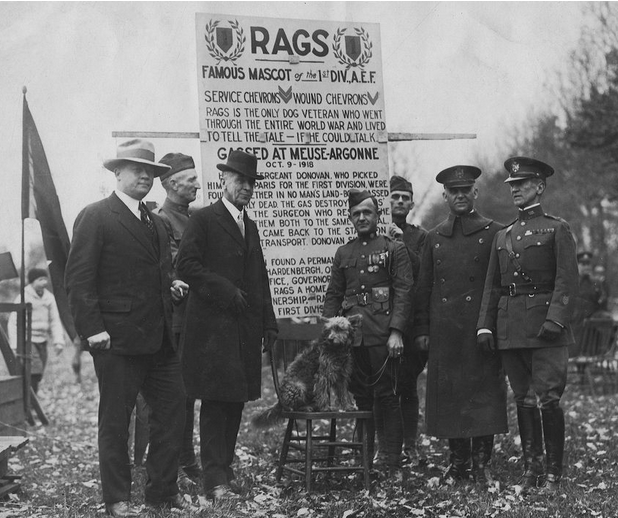 Rags' friends stand in front of a sign commemorating him for his bravery in battle.Rags was as brave and hardworking as the American soldiers he fought alongside during World War I. But one key detail set him apart from the men serving in the First Division American Expeditionary Forces: He was a dog.
The stray dog turned soldier was just one of the estimated millions of dogs, horses, camels and other animals that served during the Great War. Often referred to as “military mascots,” these beasts of burden typically acted as soldiers’ companions, boosting morale when times got rough for soldiers living thousands of miles away from home.
But military mascots didn’t just lend a supportive paw: They did real work on the battlefield. Thanks to their speed, strength or agility (depending on the species), they’d take on important tasks like lugging munitions and other cargo, carrying crucial messages between units and sniffing out buried mines. But many of these animals never received any recognition for their hard work and dedication, and their short lives were largely forgotten—until now.
Recently, the National Archives completed a massive scanning project, digitizing 63,000 World War I photos for its American Unofficial Collection of World War Photographs (165-WW) record series. The extensive collection, which took two years to get online, contains images obtained from the U.S. Army Signal Corps, various federal and state government agencies and the American Red Cross. While a majority of the collection contains images of soldiers participating in various stages of military life, from training for battle to engaging in active warfare, archivists noticed something else in the photos: animals.
“I’m an animal lover,” says Kristin DeAnfrasio, an archivist who worked on the project. “As I was going through the photos, I kept seeing unique animals, like a raccoon, an alligator and a bear, that stood out to me.”
Upon further research, DeAnfrasio learned that many of the animals captured in black and white served as military mascots. (She wrote a post on the subject for the archives’ Unwritten Record blog.)
Not much is known about the animals in the collection beyond the typewritten captions that accompany each photo. But they provide rare insight into an aspect of the war that often gets left out of the history books. Animals have often served on the battlefield—the Assyrians and Babylonians were some of the first groups to recruit dogs for war purposes. Closer to home, animals were a part of the Civil War, sniffing out wounded soldiers and responding to bugle calls. However, their role is often underappreciated or unknown.
"The Poppy Lady" Moina Belle Michael: a legacy of helping veterans
By Sara Freehand
via the University of Georgia web site
It began with a simple idea from a University of Georgia professor — sell poppy flowers to raise money on behalf of soldiers killed and injured in World War I.
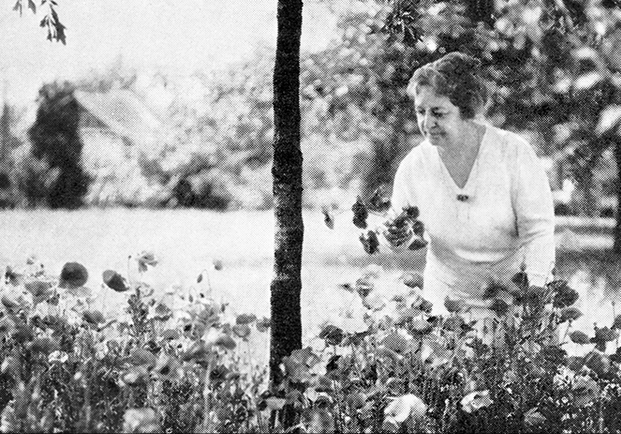 Moina Belle Michael’s simple idea turned into a groundbreaking movement supporting military veterans.Now, nearly 100 years and billions of dollars later, the poppy has become the international symbol of remembrance and support for all military veterans, thanks to the tireless efforts of Moina Belle Michael, affectionately known today as "The Poppy Lady."
"During her lifetime, if you adjust for inflation, poppy sales raised $3 billion worldwide, most of which went directly to veterans," said Tom Michael, a great nephew of Moina Michael, who died in 1944. "She championed the poppy as a permanent symbol and reminder of our collective obligation to support our veterans and their families And through all the poppy sales around the world, her legacy of helping veterans lives on."
Moina Michael, an education professor from the small Georgia town of Good Hope, was in Germany on the final leg of a European vacation when World War I unexpectedly broke out in 1914 — forcing her to flee to Italy to find a ship that would carry her home.
 Poppy seeds are helping build the national World War One Memorial at Pershing Park in Washington, DC. Click here to learn more.After a harrowing 16-day trip through mine-infested waters and an ocean patrolled by enemy submarines, she returned to the relative quiet of her Athens, Georgia, home — but did not find peace. The nation was fixated on the war, and Michael did everything she could to bring comfort to soldiers awaiting deployment. She made sure soldiers were adopted by local families. She also set up a campaign for the families to write the soldiers while they were overseas.
"How busy everyone was kept back in those early days responding to and arousing others to respond to the superhuman struggles to win the war," Michael wrote in her autobiography. "I anguished for some power by which our boys might be saved from gas, bombs [and] shrapnel."
During the war, Michael volunteered with the National YMCA. It was while she was working for the war effort in New York that she was struck by a sudden inspiration.
A young soldier left a copy of Ladies Home Journal on her desk with a marked page containing Lt. Col. John McCrae's famous poem "In Flanders Fields," about the war's devastation.
"The last verse transfixed me," she wrote. "'To you from failing hands we throw the Torch; be yours to hold it high. If ye break faith with us who die, we shall not sleep, though poppies grow in Flanders Fields.'"
On Nov. 9, 1918 — two days before the armistice that ended World War I — she wrote her own reply to McCrae's poem — entitled "We Shall Keep the Faith" — and decided "always to wear a red poppy of Flanders Fields as a sign of remembrance and emblem of 'keeping the faith with all who died.'"
Read more: "The Poppy Lady" Moina Belle Michael: a legacy of helping veterans
Mt. Airy, PA War Tribute Re-dedication
By Barry Johnson
Pennsylvania World War One Centennial Committee
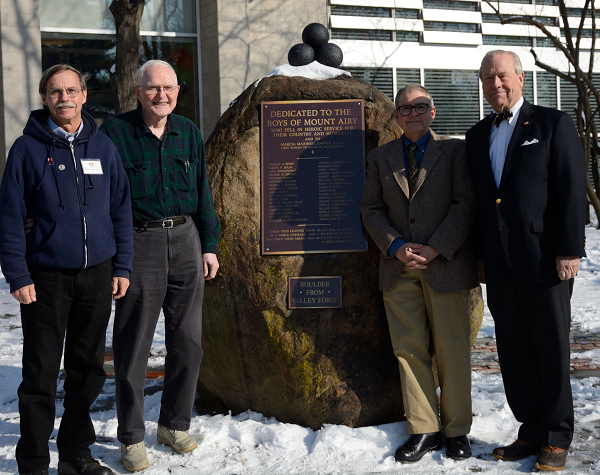 The re-dedication team (L-to-R): Barry Johnson, volunteer, Pennsylvania World War One Centennial Committee; Irv Miller, Treasurer, Friends of Lovett memorial Library; David T. Moore, President, Friends of Lovett memorial Library; Bayard Fiechter, whose great uncle Jaques A. Fiechter is listed on the plaque.In the Philadelphia neighborhood of Mount Airy, a ceremony was held in December, 2017 to rededicate the Mount Airy World War I Tribute memorial, with newly-installed bronze plaques. These plaques replaced the originals, which were lost sometime in the 1970s.
The war tribute is located on the grounds of the Lovett Memorial Library, a neighborhood branch of the Free Library of Philadelphia. The memorial was originally dedicated May 25, 1924.
The names of 34 men and one woman from Mount Airy who lost their lives during the First World War are listed on the larger plaque (20” X 30”), with the smaller plaque stating that the boulder is from Valley Forge.
The replacement bronzes, made by Franklin Bronze Plaques, Franklin, PA, cost $1600. The plastic replicas made by a sign company in Ardmore cost $300. Both sets of plaques were paid for by the Friends of the Lovett Memorial Library. Planned during 2016., the re-dedication of the plaques had to await completion of a $31 million renovation and expansion of the Lovett library branch.
For safekeeping, the new bronzes are mounted inside the library in the Community Room, with excellent plastic replicas mounted on the stone outside the library on Germantown Avenue.
Four Minute Men, and the U.S. Committee on Public Information
By Thomas Richardson
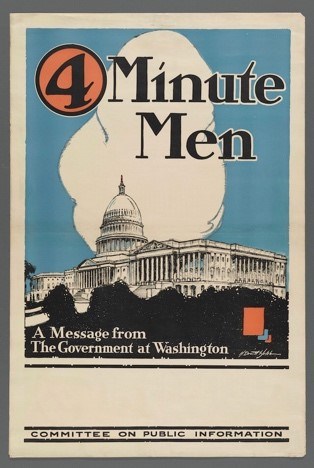 Posters like these advertised Four-Minute Man speeches.President Woodrow Wilson struggled to maintain United States neutrality when war broke out in 1914. Strong social and political forces lobbied specific arguments supporting intervention or isolation.
With the declaration of war in April 1917, Wilson understood that in order to maintain public support for the war, the U.S. government needed to create an agency for that purpose.
Wilson established the Committee on Public Information (CPI) soon after the declaration of war. This independent agency would be solely responsible for interpreting and creating messages about the home front and the war.
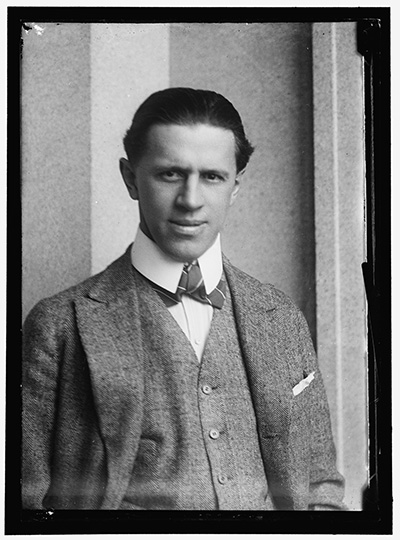 George CreelThe CPI’s purpose was to create and distribute wartime information supporting the United States’ war efforts. Committee chairman George Creel, a Midwest newspaper man, embarked on a national propaganda campaign that incorporated nearly every type of medium – newspapers, magazines, pamphlets, advertising, radio, and early films – to spread a positive message about war.
Creels’ previous career as a journalist influenced the Committee on Public Information’s method of information gathering, and he emphasized that it based its message on factual evidence rather than embellishment. However, the CPI still portrayed its messages in a positive light.
One specific practice Creel developed was the Four Minute Man program whereby public speakers gave a four minute presentation on multiple topics in social settings. This formal, personal tactic combined with a deluge of daily propaganda through news and radio, demonstrated the effectiveness of the CPI propaganda methods.
Read more: Four Minute Men, and the U.S. Committee on Public Information
GU alumnus Laurence Stallings used WWI experience to inspire books, plays, and films
By Matt Ellison and Charlotte Kelly
via the Georgetown University School of Foreign Service web site
Laurence Stallings, who graduated with a Master’s degree from the School of Foreign Service in 1922, turned his experience as a wounded veteran in the First World War into inspiration for a career as a journalist, author, and playwright.
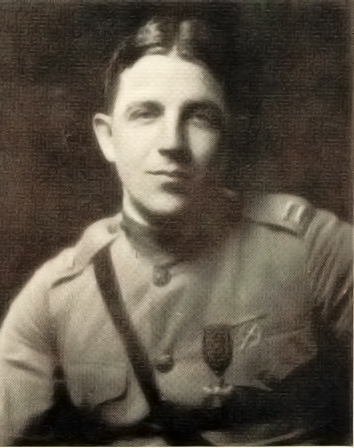 Laurence Stallings in his World War I Marine uniform in 1918.Laurence Tucker Stallings was born on November 25th, 1894, in Macon, Georgia to Larkin Tucker Stallings and Aurora Brooks Stallings. In 1912, he matriculated to Wake Forest University, where he became the editor of the literary magazine on campus, Old Gold and Black. It was there where he met his first wife, Helen Poteat, the daughter of the university president.
In 1916, Stallings graduated from Wake Forest and got a job writing advertising copy for a local military recruiting office. Then, in 1917, he himself joined the United States Marine Reserve. On April 24th, 1918, he left Philadelphia aboard the USS Henderson for overseas duty in France. Stallings served in France as a platoon commander with the 3rd Battalion, 5th Marines during the fighting at Chateau-Thierry. But then, at the Battle of Belleau Wood, Stallings was shot in the right leg leading a successful assault on an enemy machine gun installation. He was promoted to Captain, awarded the Silver Star, and given the Croix de Guerre by the French Government. Although he begged not to have the leg amputated, a wish respected at the time, he would have to have it amputated in 1922 after a bad fall on ice. He began work on his novel Plumes while recovering at Walter Reed Hospital.
Stallings was no longer able to serve due to his injury and returned home to the United States. Stallings married Helen Poteat on March 8th, 1919, and had two daughters, Sylvia, born in 1926, and Diana, born in 1931.
Stallings then attended the School of Foreign Service, where he received his Master’s degree in Foreign Service in 1922. After graduation, he began working as a reporter, critic, and entertainment editor at the New York World.
Perhaps Stallings’s greatest work was his pseudo-autobiographical novel Plumes, which told the story of Richard Plume, a U.S. Marine whose combat injuries cost him a leg and much of his faith in government and society. The novel was published in 1924 and became a huge success, with nine printings in that year alone. The novel was so popular, in fact, that it was adapted into King Vidor’s 1925 film The Big Parade, which was MGM’s largest-grossing film until Gone with the Wind in 1939.
Read more: Laurence Stallings used WWI experience to inspire books, plays, and films
Christmas Eve road march in NY honors deployed service members, WWI history
By Spc. Andrew Valenza, New York National Guard
via the army.mil web site
GLENS FALLS, N.Y. -- New York National Guard Soldiers, Airmen, families and community supporters made up more than 1,200 marchers here Dec. 24 as part of a Christmas Eve Road March to remember the service of past and present troops overseas.
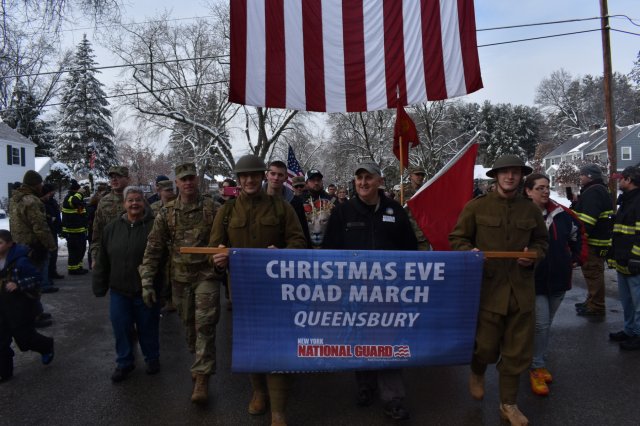 Led by soldiers in WWI Doughboy uniforms, N.Y. Army National Guard Soldiers and civilians march through Glens Fall, N.Y., Dec. 24, 2017. Soldiers and families of service members participated in Sgt. First Class (retired) Arthur Coon's Christmas Eve Road March to honor men and women currently deployed, who cannot celebrate the holidays with their families. (Photo Credit: Pfc. Andrew Valenza)This was the 14th time that people turned out for what's become an annual event, organized by retired Sgt. 1st Class Arthur Coon, a former New York Army National Guard member.
"We began this event in 2004 with just 10 people starting at the Glens Falls Armory," Coon told the crowd before the march began from the Cool Insuring Arena in downtown Glens Falls. "I would never have thought it would grow to the size we have today," he said.
The Christmas Eve Road March was first held for the New York Army National Guard's Company C, 2nd Battalion, and 108th Infantry when the unit was deployed to Iraq over Christmas.
Coon got together with some local Soldiers to conduct a road march in their honor starting and finishing at the Glens Falls armory.
The event has grown every year since, and now includes local veteran organizations, the Association of the U.S. Army, Gold Star Families and community supporters.
"We wanted to make sure they knew we hadn't forgotten them, at this time when we could be sitting at home in our pajamas," Coon said. "To me, [the best part] is the core of the event, sending a message to those deployed, or someone currently serving, it's good for them to know that we remember them."
This year's road march included Soldiers in khaki leading the march instead of the more commonplace camouflage. A special contingent of New York Army National Guard Soldiers from the 42nd Infantry Division Headquarters, based in Troy, led the road march in replica WWI uniforms, commemorating the service of New York's Doughboys of WWI and remembering their arrival in France in 1917 for combat service.
Read more: Christmas Eve road march in NY honors deployed service members, WWI history
In Flew Enza: Remembering the 1918 Plague Year in Berkeley
By Pat Joseph
via the Cal Alumni Association web site
In 1918, America was at war and students arriving at the University of California in the fall of that year found their campus transformed. From the Center Street entrance, the view of the hills was now obscured by large new barracks and the dark smoke issuing from the powerhouse gave the place the look of a factory. Everywhere young men wore the khaki uniforms of the various military outfits represented on campus—the Student Army Training Center, the School of Military Aeronautics, the Naval Unit, and the Ambulance Corps.
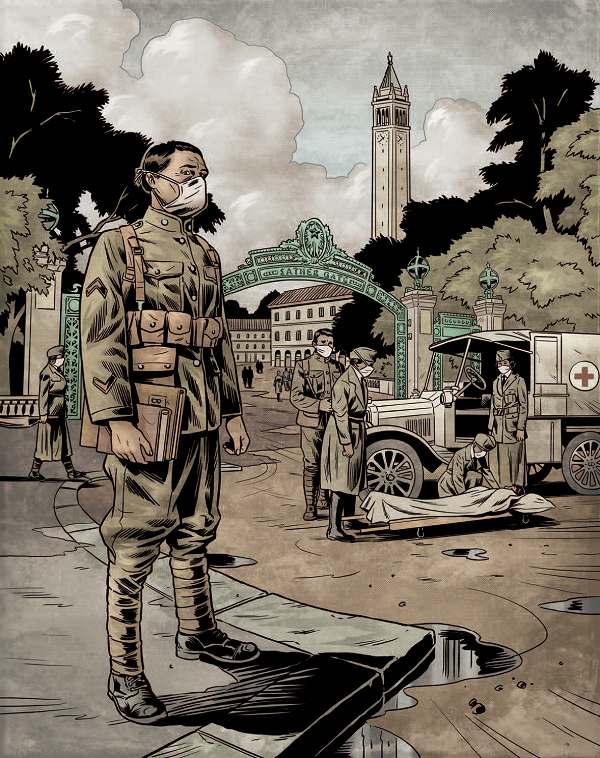 “Instead of the college atmosphere which prevailed here before the war,” one student observed, “there has grown up a disinterested attitude which has placed the war before everything else. … To try to start a discussion on anything besides the war, with a view to starting a little ‘California spirit’ has proved futile. The students simply will not respond. Their hearts are not focused on things here at college. They are far away—mostly ‘over there.’”
Yet while the coal smoke and the war in Europe no doubt cast a pall, a still more ominous cloud loomed near, for 1918 was to be a time of plague in Berkeley and around the world, the year of the so-called Spanish influenza. It was called that only because Spain, being a neutral country, did not censor its press to buoy wartime morale; when Alfonso XIII, the young king of Spain fell ill with the grippe, his subjects knew about it.
Even now, no one is sure where the flu originated, although many experts have pointed to Haskell County, Kansas, as a probable ground zero, a district so rural and primitive that many residents still lived in sod houses. A flu epidemic had emerged there in January 1918 that was like nothing ever seen before. Author John M. Barry wrote, “the strongest, the healthiest, the most robust people in the county—were being struck down as suddenly as if they had been shot. Then one patient progressed to pneumonia. Then another. And they began to die.”
In March, a similar epidemic raged through the Army’s Camp Funston (now Fort Riley) some 300 miles away and spread rapidly from there, carried in the lungs of the young conscripts shipping off to the front. In the end, the disease, no doubt accelerated and exacerbated by the war, would have greater reach than the conflict itself, penetrating as far as Asia and Africa, Europe and South America, the Pacific Islands and the Arctic.
Read more: In Flew Enza: Remembering the 1918 Plague Year in Berkeley
“Old soldiers fade away” – Missouri veteran served in the predecessor to U.S. Air Force in WWI
By Jeremy P. Ämick
via the War History Online web site
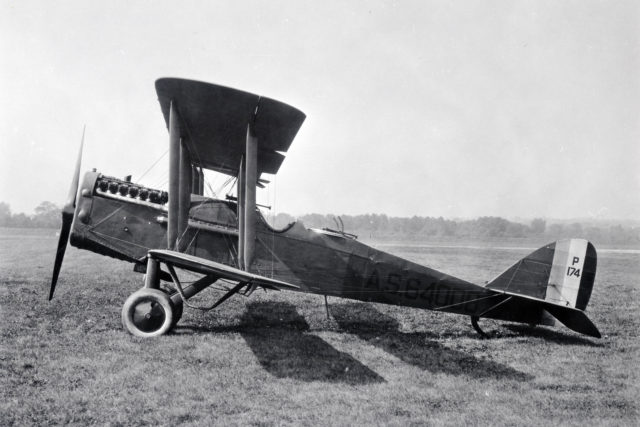 During World War I, enlisted men such as Linkenmeyer flew as observers/gunners in the second seat of the De Havilland DH-4, which was modeled after an aircraft used by the British forces. The fence surrounding Woodland Cemetery-Old City Cemetery in Jefferson City, Mo., hems in hundreds of graves, many of those occupied by veterans of the nation’s wars, said Nancy Thompson, chairman of the Cemetery Resources Board of the City of Jefferson. But within the confines of this hallowed space lie the resting spots of only two known WWI veterans—one of whom served in the budding American Air Service, which years later morphed into the the U.S. Air Force.
Harold Linkenmeyer was born in Jefferson City on July 18, 1893, the son William Linkenmeyer, a German immigrant who later became chief engineer for the former G.H. Dulle Milling Company in Jefferson City.
In later years, when the younger Linkenmeyer came of age, he embarked upon his career by becoming a machinist for the former A. Priesmeyer Shoe Company in Jefferson City. This is where he was employed, his military service card indicates, when his draft lottery number was selected.
Inducted into the U.S. Army on September 20, 1917, the 24-year-old Linkenmeyer was assigned to Company M, 356th Infantry Regiment, which was “composed chiefly of men from Cole, Boone, Henry, Andrews, St. Louis and Jackson Counties” in Missouri, as was written in the official company history from World War I.
As the book goes on to explain, Linkenmeyer and his fellow recruits faced many challenges while stationed at Camp Funston, Kan., surviving “epidemics of Meningitis and other less serious diseases” in addition to overcoming a “shortage of clothing, equipment and facilities for training” during the early weeks of their initial training cycle.
Naval War College Museum unveils exhibit to teach about WWI
By Jennifer McDermott
via the Washington Times.com web site
NEWPORT, R.I. (AP) - The U.S. Naval War College Museum has unveiled a new exhibit to teach people more about World War I.
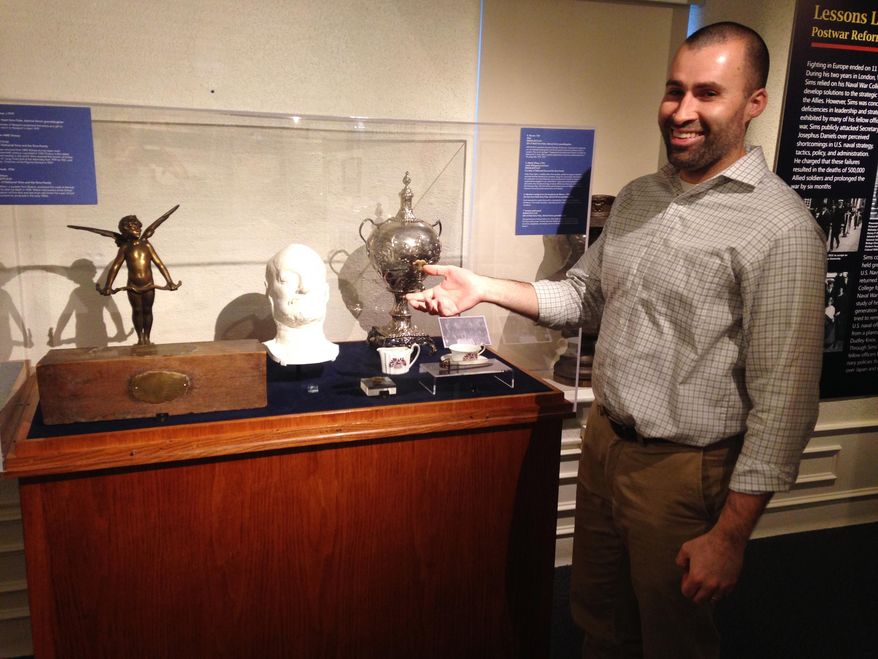 U.S. Naval War College Museum Curator Rob Doane points to artifacts donated by the family of Navy Adm. William S. Sims for the museum's new exhibit about World War I in Newport, R.I. Sims commanded U.S. naval forces in Europe during the war. The artifacts include Sims' death mask from 1936. (AP Photo/Jennifer McDermott) It focuses on the Navy’s role in the war, using the career of Navy Adm. William S. Sims to tell the story. Sims commanded U.S. naval forces in Europe during the war, and his family donated artifacts.
The Rhode Island museum is displaying the exhibit for about three years.
Curator Rob Doane said people will be interested in the Navy’s role because many successful strategists in World War II learned how to coordinate complex operations and forge relationships with allies during World War I.
Sims went on to lead the war college. He changed the curriculum based on his experiences during the war and influenced a generation of naval leaders, Doane said.
“World War II gets a lot more attention,” he said. “Even within World War I, the Navy’s role is not that understood.”
Visits must be scheduled about a week beforehand so a background check can be done for entry to the Newport facility.
The exhibit opened this month. The family heirlooms include Sims‘ death mask from 1936, swords, a ship model, family photos and gifts given to Sims in Europe to thank him for his service.
“This isn’t just another World War I exhibit,” said David Kohnen, director of the college’s John B. Hattendorf Center for Maritime Historical Research. “What you will see are things Adm. Sims himself kept for his family, and 100 years later, they’re now on display for the very first time outside of the Sims family. It offers a uniquely human perspective on a figure who really helped build the United States Navy of the 21st century.”
Read more: Naval War College Museum unveils exhibit to teach about WWI
Travel Documents for post-WWI Gold Star pilgrimages
By David Langbart
via the National Archives Text Message blog
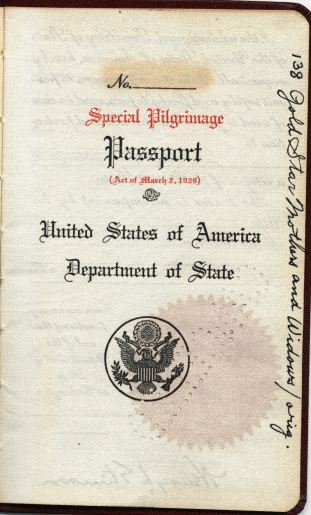 On March 2, 1929, President Calvin Coolidge signed PL 70-952. That law authorized the War Department to arrange for trips, designated as pilgrimages, by the mothers and widows to the overseas graves of soldiers, sailors, and Marines who died between April 5, 1917 and July 21, 1921. Congress later expanded eligibility to include the mothers and widows of men who were buried at seas or whose place of burial was unknown.
After World War I, more than 30,000 American dead from that conflict remained overseas, buried in U.S. cemeteries. The passage of the law resulted from the work of the mothers and widows of those servicemen and their supporters who pushed for the pilgrimage to the gravesites at government expense. International travel was not as common as it is now and the cost of such travel was beyond the means of the families of many of the dead.
The War Department prepared and submitted to Congress a list of the mothers and widows it identified as falling under the provisions of the law. The report was arranged by state and thereunder by county. In addition to the name of the mother or widow, the list indicates the relationship to the deceased service member, the name of the decedent along with rank and service organization, the cemetery, and an indication of whether the mother or widow desired to make a pilgrimage in 1930 or later. The House of Representatives published the report as an official House Document.
The resulting trips took place between 1930 and 1933. Travel outside the United States required a passport. To facilitate travel by the mothers and widows, the Department of State established the “Special Pilgrimage Passport.” Those documents were valid only during the trip in which the mother or widow participated. The Department charged no fee for those passports.
Since the Department of State issued passports only to American citizens and numerous mothers and widows did not hold that status, the Department established the special “Pilgrimage Travel Document” for use by those women who owed allegiance to the U.S. The Department charged no fee for the travel documents.
Read more: Travel Documents for post-WWI Gold Star pilgrimages
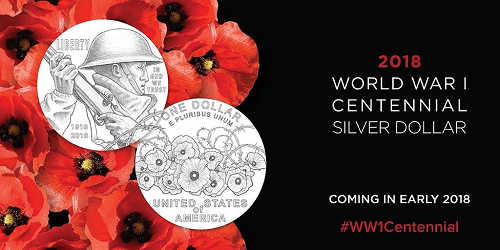
2018 WWI Centennial Silver Dollar pricing announced
 via the coinnews,net web site
The United States Mint announced pricing for the 2018 World War I Centennial Silver Dollars and related products.
Commemorating the 100th anniversary of America’s involvement in the First World War, the .900 fine silver dollars will launch Jan. 17, 2018 in collector finishes of proof and uncirculated. Earlier this month, the U.S. Mint unveiled examples of the dollars made during a ceremonial striking event.
The U.S. Mint on Jan. 17 will also begin selling companion .900 fine silver medals that pay homage to branches of the U.S. Armed Forces that were active in World War I,
Read more: 2018 WWI Centennial Silver Dollar pricing announced
- U.S. Government takes over control of nation’s railroads, December 26th, 1917
- The Christmas Truce miracle: Soldiers put down their guns to sing carols and drink wine
- Why the Christmas Truce Endures in Historical Memory
- WW1's real life Christmas Day Truce is being honoured by the Battlefield 1 community