































World War I Centennial News
A Soldier’s Journey – The Classic Monomyth
By Sabin Howard
via sabinhowardsculpture.blogspot.com/
Two years ago, I was faced with the task of: How can I tell a story that everyone will understand clearly? How can I tell a story that has universal meaning?
And in so doing create a WWI Monument honoring the men and women that went through this horrific moment in global history?
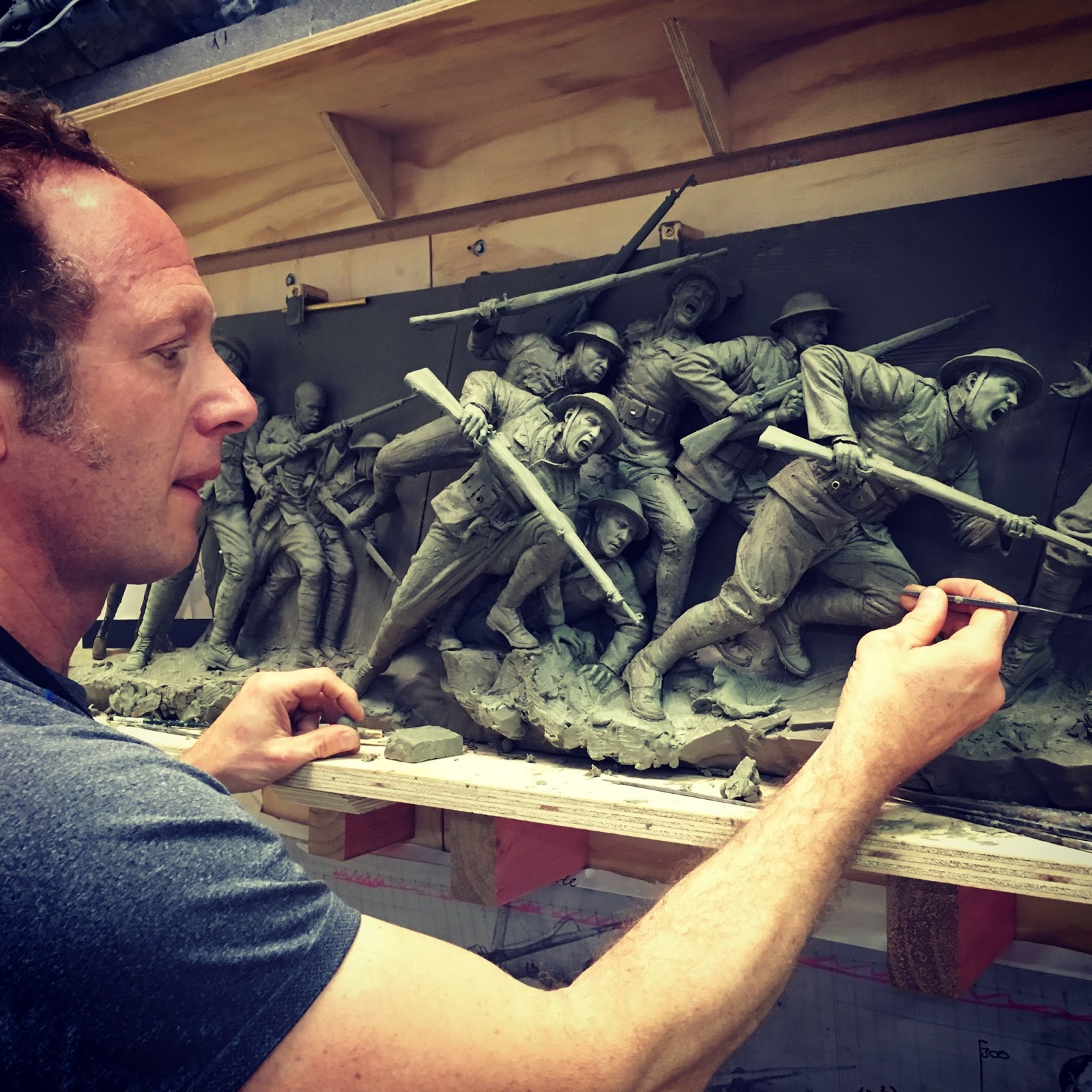 Sculptor Sabin Howard working the small-scale maquette for the new National World War I Memorial at Pershing Park in Washington, DC.Well, now I'm on the other side of that in terms of the storytelling for the nine-inch sculpture maquette. What WWI looked like is told through a visual narrative called A Soldier’s Journey. It is a story of a soldier and father, who departs from home and family, traveling to the distant shores of Europe, experiencing the horrors of war, only to return home again, forever changed.
35 years ago, when I began learning the craft of making art, I was always taught to work from general to specific. And that lesson became my mantra as I proceeded in this incredibly complex design.
It took nine iterations over twelve months, with 12,000 pictures taken of re-enactors in my Bronx studio to create a story of transformation and change that would explain this war to the Memorial visitor. The strangest part of this process is that I was unaware as I assembled the scenes and drew out the final drawing that I was working in the template of what Joseph Campbell calls a ‘monomyth’. It has also been referred to as the hero's journey.
It is only recently that my wife, Traci Slatton, an internationally published author and a gifted storyteller, looked over at me at 6am one morning over breakfast and said, “You know that Soldier’s Journey that you are doing is right out of the template that has existed for ages in many different cultures of myth.”
Joe Weishaar, my designer partner, had said to me back in the fall of 2015, “Create a beginning, a middle, and an end." But I was completely unaware that what I was doing visually fit an age-old way of telling stories.
Traci continued and filled me in. “You ought to read up on this. Joseph Campbell refers to it as ‘mankind's one great story.’ This structure of narrative involves a hero who goes on an adventure, and in a decisive crisis wins a victory (just to name a few, it is found in Native American culture, Greco-Roman culture, and Judeo-Christian culture.) The protagonist then comes home changed or transformed and wiser by his passage through this perilous task.” My wife has always been very instrumental in helping me find the right track for the story in my art. When you live with somebody that's gone to Yale and Columbia, there is bound to be an intellectual conversation at the breakfast table! Picking up one of Joseph Campbell's books on the dining room table, she filled me in on the road that I had taken. It was a little shocking to realize that somehow I had downloaded a storytelling template that had existed for ages in many different cultures to explain the story of WWI.
Four Questions for Jo Ellen Hayden
Horse Heroes "served with heart, with obedience, with loyalty" in WWI
By Ashleigh Shaw
Staff Writer
For three years prior to the nation's entry into World War I, the United States shipped approximately one million American horses and mules to Europe, to assist the war effort as they worked for the British and French armies. These animals carried men into battle, and wounded men to safety. They carried food, water, medical supplies, ammunition, gun carriages and other supplies to the front lines across difficult terrain, in brutal weather, often surrounded by dead and dying men and animals. For peace-loving animals, the sights, sounds, and smells were as dreadful as they were for the men.The story of these animals is one of courage, and also of tragedy. Brooke USA is charity dedicated to improving the welfare of horses, donkeys and mules in the developing world. They have a special project to honor and remember the story of these animals. Brooke USA is a Commemorative Partner to the WW1CC, and we are honored to host their new section on our website, which goes live this week. We discussed Horse Heroes, and the efforts by Brooke USA, with Jo Ellen Hayden, Brooke USA's Horse Heroes Special Project Volunteer
Tell us a little bit about the new Horse Heroes section on the Commission’s website.
The Horse Heroes site honors and documents the use of American horses and mules in World War 1. Approximately 1.2 million American horses and mules served Allied forces in Europe during the war. Many were used by the British, French, Italian, and even German armies well before the United States entered the war.
 Jo Ellen HaydenThe first wave of American horses and mules arrived in France in late 1914 – only a few months after the war began in Europe. Though hard to understand today, horsepower was an essential part of every army during World War I. Most were used as draft animals, pulling everything from ambulances to guns to water carts. Some were pack animals, carrying food, medical supplies, and ammunition. And some horses were used by officers as saddle horses. Just as an officer might be issued a Jeep in later wars, he was issued a horse in World War 1. Horses served on or just behind the front lines, across difficult terrain, in brutal weather, and often surrounded by dead and dying men and animals. They did their part, in spite of being terrified and often while sick and wounded themselves, and they worked until they were annihilated by guns or poison gas, or simply died in their harnesses from exposure, disease, and sheer exhaustion. In total, eight million horses and mules died in WW1 on all sides, including hundreds of thousands of American animals.
Only 200 horses came back to the U.S. after the war. When the war ended there was neither funding or political will to bring the working animals home. Horses were a commodity, and just as armies today routinely abandon motor vehicles, so these armies sold off their horseflesh. Some went to slaughter, if too old, worn out, or injured to be sold as working animals.
The Horse Heroes website delves into where all these animals came from and how they got to Europe. We also set the scene so that our readers will know where the fighting took place and what the conditions were like – including why there was so much mud! We explore, and in our future releases will show hundred-year old film clips, of their training, veterinary care, and life in the field. The site contains hundreds of photographs, many gathered together in one site for the first time.
Army Nurse's WWI bracelet returned after long search
By Padraig Murphy
RTE News, Ireland
A bracelet that had belonged to an Irishwoman serving with the US Army Nurse Corps in France in World War I has been returned to her relatives in Bray, Co Wicklow after a long search.
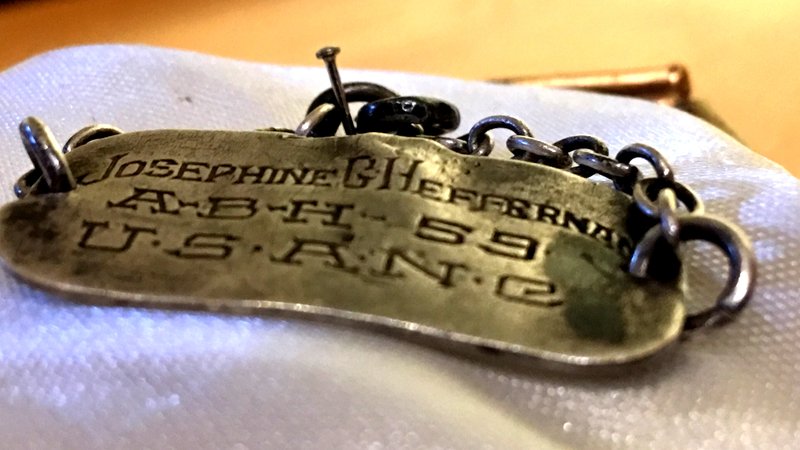 The Bracelet which belonged to Josephine HeffernanThe bracelet, inscribed with the name Josephine Heffernan, was discovered fifteen years ago by an eight-year-old boy in a schoolyard in Rimaucourt in northeastern France.
He brought it to his teacher, Estelle Lefeuvre, who promised to help him find the owner. It was not until after she retired that Ms Lefeuvre began researching Ms Heffernan.
Lefeuvre linked the bracelet with World War I, and discovered the Americans had created and maintained a base, during the war, in Rimaucourt. In fact, the school had been used as an army hospital. Lefeuvre concluded that Ms Heffernan had been an Army nurse stationed there. However, she could not find any further records.
Ms Lefeuvre was joined in her search by international nurse historian Marjorie DesRosier and documentary filmmaker Hélène Lam Trong.
"I was fascinated by the idea of finding out who this woman was. It was a gamble to see if we could find her, but the gamble paid off," said Ms Lam Trong.
Initially, their search was concentrated in the US, as they believed Ms Heffernan was American. They eventually discovered a death record showing the nurse to be Irish and buried in the Irish town of Bray.
Read more: Army Nurse's WWI bracelet returned after long search
Four Questions for Richard Lanni
"All it took was friendship and love to turn a little homeless dog into an unlikely hero."
By Ashleigh Shaw
Staff Writer
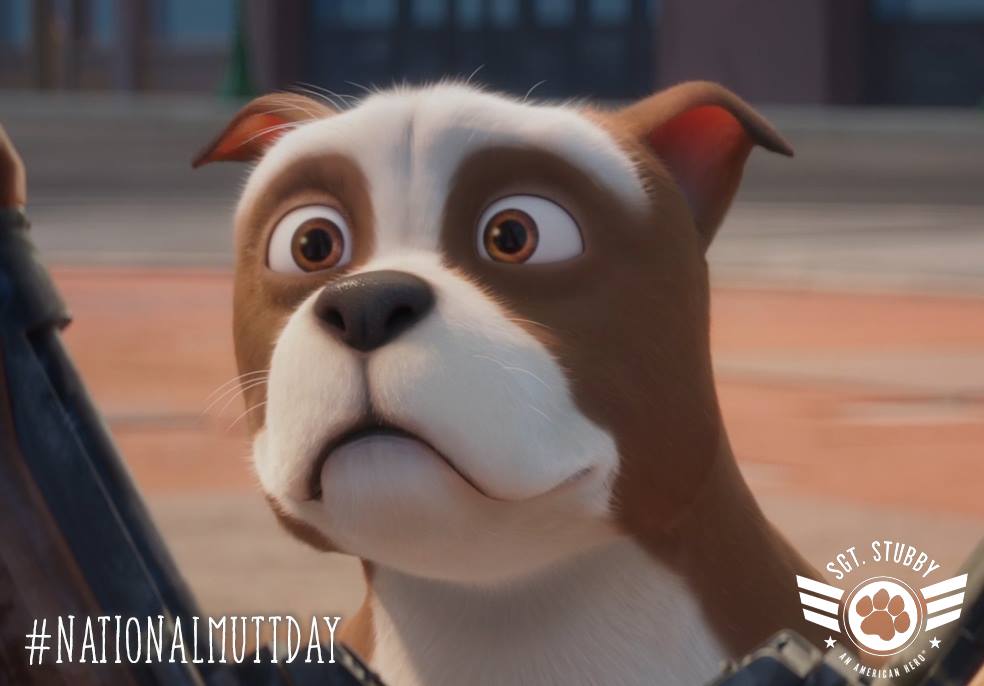 The animated movie, SGT Stubby: An American Hero, is a WW1CC Commemorative Partner, and will come to theaters nationwide on 13 April 2018. The film is based on the remarkable true story of the 26th "Yankee" Division's legendary mascot, SGT Stubby, a stray dog who became a hero of World War I. The film features the voices of actors Helena Bonham Carter, Gerald Depardieu, and Logan Lerman, among others. Sgt. Stubby's new teaser trailer arrived this week in select theaters across North America. You can view it at https://www.youtube.com/watch?v=PgYMvDzxj0M. We had a few moments with the film's writer/producer, Richard Lanni, to talk about the movie.
 Richard Lanni
Tell us a little bit about your upcoming film, Sgt. Stubby: An American Hero.
Sgt. Stubby is a full length feature animation that tells the story of America's most famous canine. It plots his rise from homeless to hero. He stowed away on the boat to France and came home leading the parade. It is one of the first, if not the first true stories to be told in animation; it's certainly the first animated family war movie.
How did you first come across Sergeant Stubby's story? What made it such a compelling story to you?
I was working on a WWI documentary series for PBS when I found Stubby and I just kept coming back to his story. It was the American Dream all encapsulated in a dog.
What made you decide to tell this story through animation rather than live-action?
We decided to make the movie in animation because, WWI is a hard pill to swallow and in animation we have total control of Stubby and his emotions. By carefully crafting the violence off camera and by the dramatic use of music and sound effects, we can shield a young audience without losing the essence of the piece.
Sergeant Stubby has such a unique story. Why is it so important for people to remember Sergeant Stubby and the other incredible stories of World War I?
History is being lost to the young, so Stubby is the perfect conduit to explain this long forgotten war to an audience that might never know anything about that important time.
Ashleigh Shaw is a Fall 2017 Intern at the United States World War One Centennial Commission.
Hilton Village: An enduring sense of place for 100 years
By Mark St. John Erickson
via the Newport News, Virginia Daily Press web site
In the months after America entered World War I in April 1917, few places saw such dramatic change as Hampton Roads, Virginia.
Though already home to the Army’s biggest coastal fort and the Navy’s most vital shipyard, the region was reshaped by the birth of pioneering Langley Field in Hampton and a mammoth new naval base in Norfolk.
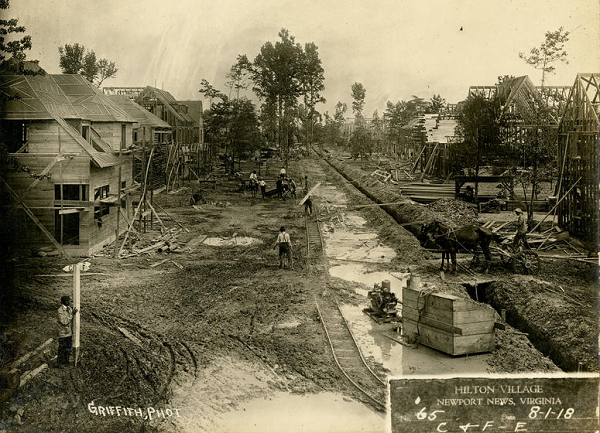 Hilton Village under construction in 1918.Then there was the new Hampton Roads Port of Embarkation in Newport News, which drew hundreds of thousands of soldiers from across the country for the war in Europe, plus thousands of additional officers, men and women to run the giant staging camps and keep the pipeline flowing.
More change swept through the Norfolk Navy Yard — which added not just one but three new dry docks — and the nation’s largest private yard in Newport News — which ramped up to meet contracts worth $2 billion in today’s dollars.
So feverish was the pace at Newport News that its ranks of shipbuilders rocketed from 7,600 to 12,512 during the war, while the city’s population city leapt from 26,246 to 47,013.
Yet even after erecting a small city of tents and barracks and opening his home to boarders, shipyard chief Homer L. Ferguson couldn’t hire the thousands of extra hands he needed.
Not until he dressed down a Senate subcommittee in early 1918 did Washington grasp the depth of the housing crisis, leading in hours to the funds for historic Hilton Village.
Designed and built for workers, the pioneering neighborhood was the first federal housing project — and 100 years later it has been cited by planners and architectural historians as a landmark achievement.
“Newport News was just so fortunate that all these visionaries showed up and made something like this happen,” says John V. Quarstein, author of two new books on the groundbreaking streetcar suburb. “These were forward-thinking people — all trying to create what they saw as a perfect place to live.”
Read more: Hilton Village: An enduring sense of place for 100 years
The International Modernisms of World War I
By Natalie Haddad
via the Hyperallergic web site
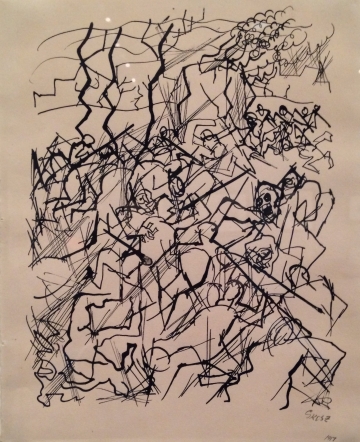 George Grosz, “War Drawing” (1917)World War I and the Visual Arts at the Metropolitan Museum of Art can easily go unnoticed, in the shadow of the museum’s Michelangelo drawing show and other major exhibitions. That would be unfortunate; while relatively small — it occupies four mid-sized rooms in the print wing — its tour through the first modern war provides insight into the conflict’s early reception and the physical and psychological toll it took on each nation involved.
Drawn primarily from the Met’s collection, the exhibition encompasses art, documentary photography, and ephemera and artifacts, the latter ranging from propaganda posters to textiles to gas masks, and brings together artists and perspectives from various nations. It is organized chronologically by room — The Outbreak; No-Man’s-Land; The Aftermath; and a smaller section, The Intersection of Arms and Art — a schema that risks an oversimplified narrative, but the modernity, austerity, and raw power of much of the art predominates.
International modernisms are represented in works by artists including Gino Severini, Wyndham Lewis, Fernand Leger, Otto Dix, and Marsden Hartley. While pieces such as Lewis’s geometric machine gunners for the cover of the periodical Blast (July 1915) and Severini’s charcoal drawing “Flying Over Rheims” (1915) toe the Futurist/Vorticist line of technological dynamism, Severini’s “Still Life: Bottle + Vase + Journal + Table” (ca. 1914-15), which collages a charcoal and gouache abstraction with newspaper clippings on French military actions, brings a level of social commentary to the image.
In many cases, the most effective works are the simplest. Belgian artist Léon Spilliaert’s poignant 1917 watercolor, gouache, and graphite painting “Rockets” transforms flares into a constellation of stars illuminating an indigo sky. Japanese-American artist Kerr Eby portrays an explosion with an expanse of negative space consuming almost the entire upper half of his drypoint print “A Kiss for the Kaiser” (1919). Eby’s mezzotint and drypoint print “No Man’s Land — St. Mihiel Drive” (1919) is more evocative, as its soft, deep gray washes over the sky, veiling troops below.
Three 1914 charcoal drawings by Marsden Hartley confirm the artist as one of America’s great modernists. The drawings — memorials to his close friend and rumored lover, Karl von Freyburg, a German officer killed early in the war — belong to a suite of works produced between 1913 and 1915 in Berlin, which also includes lush, colorful paintings. The abstraction of military insignia and symbols echoes the paintings, but the black and white palette pares down the visuals, rendering the drawings almost elegiac.
Leeke chronicles Major Leaguers during WWI in ‘From Dugouts to the Trenches’
By Dennis Anderson
via the New Bedford, MA South Coast Today web site
Johnny Evers of “Tinker-to-Evers-to-Chance” fame, was visiting an army chaplain at the front during World War I. The chaplain told Evers about finding a tattered baseball inside the pocket of a dead American soldier’s overcoat while searching him for personal effects.
 “I’d like to have that ball,” the future Hall of Fame second baseman said.
“Not for a million dollars,” the chaplain replied. “I’m too big a fan, and this is too precious to me. It will be too precious to others. If I can find (his family) when we get back that boy’s baseball belongs to them. If not, then I’ll keep it as one of the biggest prizes of my life.”
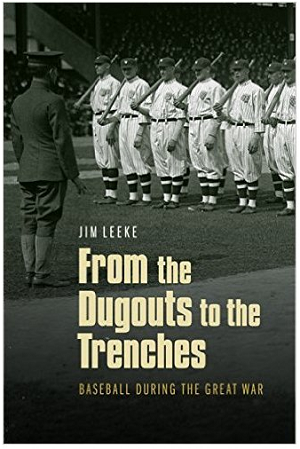
This poignant vignette is one of many in Jim Leeke’s well-researched book “From the Dugouts to the Trenches: Baseball During the Great War” (University of Nebraska Press; 238 pages; $32.95). Leeke tells the story of two seasons 100 years ago when professional ballplayers, executives and sportswriters enlisted, waited for the draft to catch up to them or went to work in steel mills or shipyards.
World War I was already raging in Europe for four years by the time the United States joined the Allies in the battle against Germany and the Central Powers in April 1917. That spring, American League and some National League teams hired army sergeants to drill players, some reluctantly, before games and to encourage fans to donate to the war effort or to send baseball equipment overseas.
One player, Billy O’Hara, an outfielder from Canada who played for John McGraw’s New York Giants, had already experienced considerable combat by 1917 and was wounded. “How small the great games of baseball I have played seem beside my days in the trenches,” O’Hara told a sportswriter. “Life and the world seem mighty small and no-account when you have seen your best friends die about you every day. I remember the time when we sympathized with a pal that got spiked in a baseball game. Day after day I have seen good pals shot through the head drop dead at my feet.”
World War I, like World War II and Vietnam generations later, engaged a great percentage of the country’s young men compared to today. The government’s Work or Fight policy of 1918 required men of draft age to work in a war-essential industry, such as steelmaking and shipbuilding, or enlist. Baseball was not considered an essential industry.
By spring 1918, 76 Major Leaguers were in the military, 48 from the American League and 28 from the National League (there were only 16 Major League teams then). There were 120 players in the military by July 1918.
Read more: Leeke chronicles Major Leaguers during WWI in ‘From Dugouts to the Trenches’
First Mainer lost in WWI a painful memory of a century ago
By Donald Zillman
via the Portland Press Herald web site
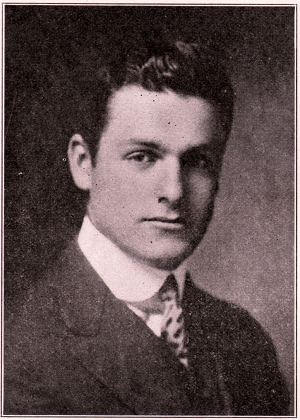 Harold T. Andrews of Portland, MaineOn Nov. 30, 1917, Cpl. Harold T. Andrews of Portland became the first Mainer in the American Expeditionary Forces to die in combat in World War I. This son of a prominent Portland educator died when his engineering unit was called into combat to fight a German offensive on the Cambrai front in France.
America had entered the war in April 1917. A month later, young Andrews volunteered and joined a New York-based engineering unit. American engineers were badly needed to improve a French railroad system that was woefully inadequate and badly needed for moving incoming American troops from French coastal ports to the inland battlefields.
Harold Andrews reflected service by “the best” of young Americans in the war. That included both volunteers like Andrews and thousands of draftees who followed him. By the Armistice on Nov. 11, 1918, America included among its military deaths the immediate past mayor of New York City, one of the leading members of the House of Representatives, one of the outstanding collegiate athletes of his year and the son of former President Theodore Roosevelt. A present analogy might be to imagine the death in the Iraq and Afghanistan wars of Rep. Paul Ryan, one of several young big-city mayors who were being considered future presidential prospects, one of the Bush or Obama daughters, or a Trump son and a recent Heisman Trophy winner.
At the time of Andrews’ death, the world war was not going well for America and its allies. Earlier news in November 1917 reported that Germany had effectively won the war on the Eastern front and that former ally Russia was drifting into anarchy and civil war. Ally Italy was faced with German and Austrian invading forces. France had changed its civilian leadership after 18 months of horrific losses and a mutiny of some of its troops. German submarines still threatened to cut food supplies to Great Britain. America was becoming aware of what it meant to declare war on Germany, often described in congressional debate as the “most powerful military nation in history.” While few American leaders spoke of it publicly, few of them did not wonder: “Have we joined too late?”
The next 12 months would answer that question. It would see America rising to numerous challenges that it had never, or rarely, faced before. Among those were how to raise an army, how to fight as part of a major alliance, what financial assistance to give to those allies, how to pay for those costs and what other sacrifices civilians would have to make. It also had to deal with serious issues that did not arise from the war but were influenced by it such as votes for women, race conflicts, prohibition of alcohol, labor-management relations and treatment of immigrants.
Read more: First Mainer lost in WWI a painful memory of a century ago
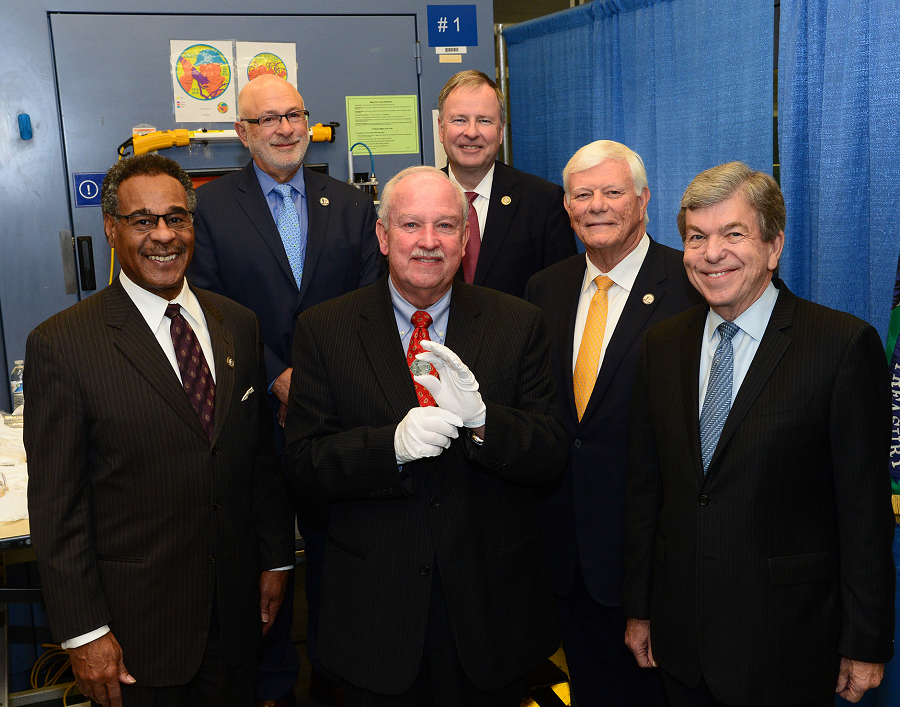 Gerald York, grandson of WWI hero SGT Alvin York (front center), holds the U.S. Mint's newly-minted 2018 WWI Centennial Silver Dollar. He is joined by (l to r) Congressman Emanuel Cleaver, II (D-Missouri), Daniel Basta, U.S. Foundation for the Commemoration of the World Wars, Congressman Doug Lamborn (R-Colorado), U.S. WWI Centennial Commission Chair Terry Hamby and Senator Roy Blunt (R-Missouri). The new commemorative coin was authorized by Congress, through bipartisan legislation. The coin, available to the public in January 2018 via www.usmint.gov, honors America's WWI veterans during the centennial period of the war, and a surcharge will support work of the Foundation.
United States Mint hosts Ceremonial Strike of new 2018 World War I Centennial Silver Dollar
By Chris Isleib
Director of Public Affairs, United States World War One Centennial Commission
PHILADELPHIA, PA — On November 28, the United States Mint hosted a ceremonial strike of the 2018 World War I Centennial Silver Dollar honoring the 100th anniversary of American participation in World War I.
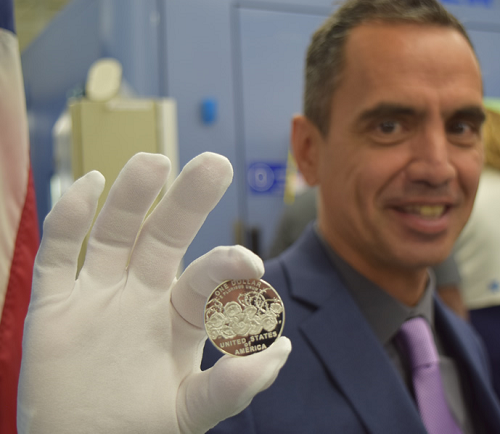 Designer of the 2018 WWI Centennial Silver Dollar, Leroy Transfield, holds up coin he just struck at the Philadelphia Mint last week.The World War I Centennial Silver Dollar was authorized by statute in 2014 with bipartisan Congressional support. Three of the sponsors of the legislation, U.S. Senator Roy Blunt (R-Missouri), U.S. Representative Emanuel Cleaver, II (D-Missouri), and U.S. Representative Doug Lamborn (R-Colorado) personally attended the strike event. A fourth sponsor of the coin legislation, U.S. Senator Claire McCaskill (D-Missouri), was unable to attend.
An exceptional group of distinguished guests joined the elected officials for the event. They included:
- - Colonel Gerald York, (U.S. Army-Retired) the grandson of famous World War I hero, Sergeant Alvin York
- -Mr. Rod Gillis, Education Director at the American Numismatic Association Money Museum in Colorado Spring, CO
- -Chief Dennis O’Connor, United States Mint Police
- -Mr. Michael Flynn, Vice President of Interpretation and Visitor Experience, Independence Seaport/Cruiser Olympia Museum. The USS Olympia is a World War I-era warship, and famously brought the remains of World War I's Unknown Soldier back from France, to Washington DC, in 1921.
- -Leroy Transfield, designer of the new Commemorative Coin.
- - Terry Hamby, Chair of the U.S. World War I Centennial Commission, a Congressional Commission created to mark American service and sacrifice in the war.
- - Donald Everhart, recently retired United States Mint Lead Sculptor.
2018 WWI Centennial Silver Dollars Minted in Ceremonial Event
via the CoinNews.net web site
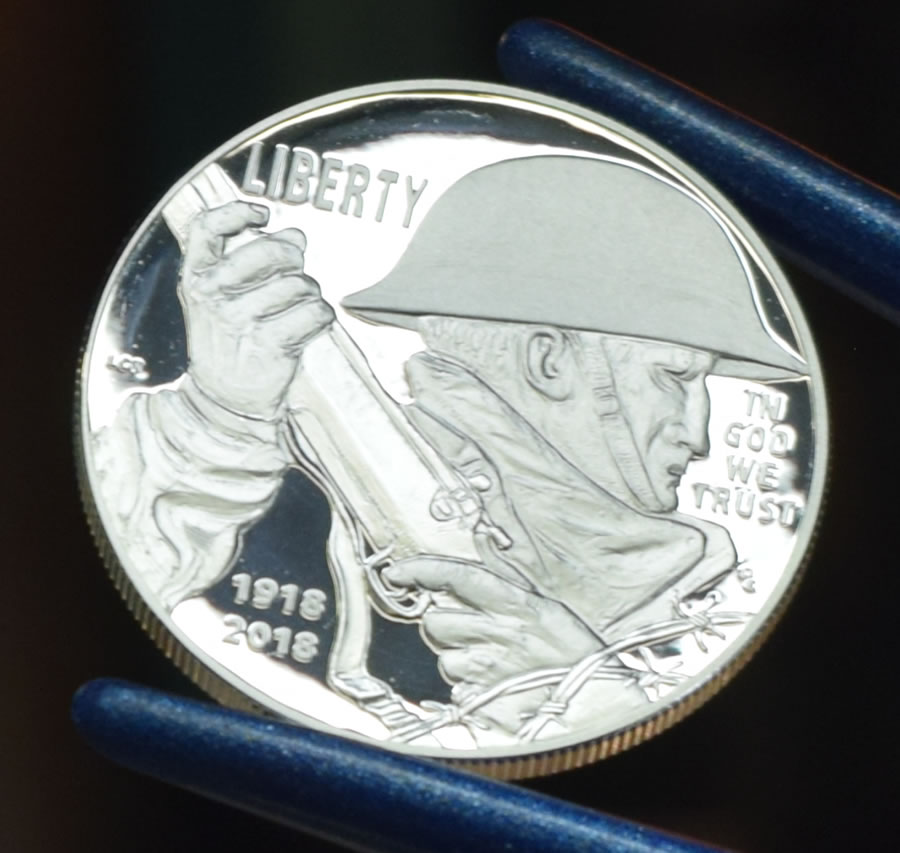 A newly-minted World War I Centennial Silver Dollar. The coin will be released on Jan 17, 2018. U.S. Mint photo by Sharon McPike.On Thursday, Nov. 28, officials from the United States Mint hosted a ceremonial strike event for the 2018 World War I Centennial Silver Dollar commemorating the 100th anniversary of America’s involvement in the First World War.
Guests at the ceremony included three sponsors of the legislation authorizing the commemorative coin, the dollar’s designer and sculptor, the chair of the WWI Centennial Commission, and the grandson of a famous World War I hero.
LeRoy Transfield created the silver dollar’s designs and recently retired United States Mint Sculptor-Engraver Don Everhart sculpted them for coins. They were selected by the Treasury Secretary based on winning designs from a juried competition.
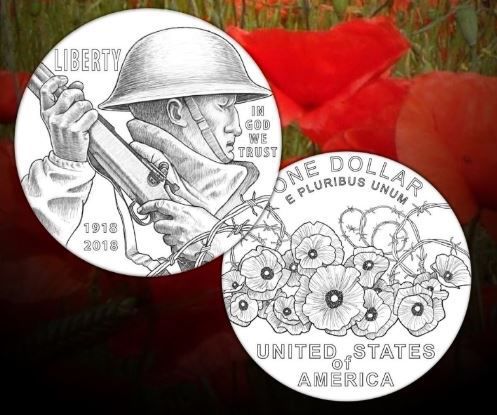
Transfield’s obverse or heads side design, titled “Soldier’s Charge,” depicts an almost stone-like soldier gripping a rifle. Barbed wire twines appear in the lower right-hand side.
Inscriptions are LIBERTY, 1918, 2018, and IN GOD WE TRUST. Poppies have been used since 1921 to commemorate soldiers who have died in war.
The barbed wire design continues onto the coin’s reverse, which is titled "Poppies in the Wire." It shows abstract poppies mixed in with the wire. Inscriptions include ONE DOLLAR, E PLURIBUS UNUM, and UNITED STATES OF AMERICA.
Read more: 2018 WWI Centennial Silver Dollars Minted in Ceremonial Event
Missourians take part in planning WWI centennial
By Ken Newton
via theNews-Press Now web site
Nearly 11 months from the centennial of the World War I armistice, Missouri and its federal lawmakers remain in the thick of planning for the celebration.
Not only does Kansas City host the congressionally designated museum concerning the war, and not only did the commander of allied forces, Gen. John “Black Jack” Pershing, come from northern Missouri, state members of the House and Senate have worked on behalf of the 100-year anniversary.
 Three of them — Rep. Emanuel Cleaver and Sens. Roy Blunt and Claire McCaskill — had a role Tuesday as the U.S. Mint in Philadelphia held the ceremonial strike of the 2018 World War I Centennial silver dollar.
The lawmakers, along with Rep. Doug Lamborn of Colorado, sponsored the legislation that authorized the collectible coin. McCaskill could not attend the Philadelphia event.
Cleaver, a Kansas City Democrat, said the coin and the centennial events aim to properly honor the 4.7 million Americans who served in World War I and the 117,000 who died.
“It is critically important for us to understand that without memory, there are no heroes. And if there are no heroes, we forget how we got to where we are now,” he said in Philadelphia.
Blunt, a Republican and a former high school history teacher, told those in attendance at the mint that World War I provides significant lessons about the world situation today.
“The map of Africa, the map of the Middle East, the chaos in both of those regions are largely traced to the end of World War I and the mistakes that were made there,” he said.
“We really come here to the centennial of the war at a time when the war is uniquely important, uniquely instructive. ... Fifty years ago, a study of World War I would not have taught us the lessons, in my view, that it teaches us today.”
Has the US forgotten about World War One?
By Jane O'Brien
via the BBC News web site
There are no World War I veterans left alive in the US, but a century after the conflict that reshaped the world, ground has broken on a new monument in Washington, DC, to the 4.5 million Americans who served.
The US entered the war in 1917 - almost three years after European powers had been bludgeoning themselves to near destruction. Some 53,000 US soldiers were killed in combat, according to the defence department, while 64,000 died off the battlefield, including deaths from the influenza epidemic. Another 200,000 were wounded.
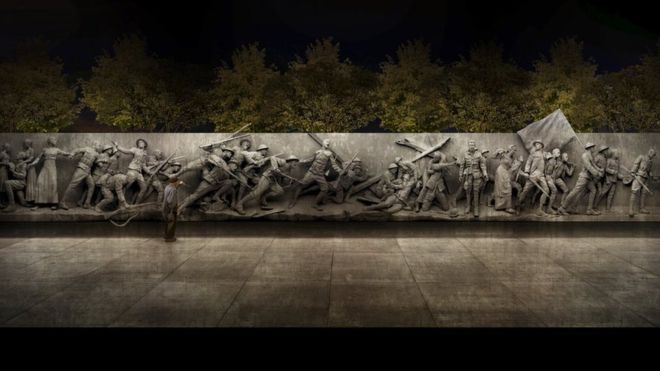 An illustration of the WW1 memorial concept, scheduled to be completed by late 2018 At the time, few Americans wanted to join a conflict largely thought to be pointless and irrelevant. Despite its profound impact on what became the "American Century", World War I remains a marginal war for many in the US.
"The Great War" was overtaken in the national consciousness by the Great Depression and World War II, says Edwin Fountain, vice-chairman of the WWI Centennial Commission. The commission has been authorised by Congress to build the new memorial in Washington, DC, as well as increase awareness of the war.
"The Centennial is the last best opportunity to teach Americans that World War I was in fact the most consequential event of the 20th Century," he says. "It had effects that we live and struggle with today, overseas and at home."
"The debate about the role of America in the world, the balance between national security and civil liberties, the place of women, African Americans and immigrants in our society - all those issues were vigorously discussed during WWI.
"You cannot contribute to those discussions today without understanding our historical roots."
How Cubism protected warships in World War I
By Marty Graham
via the wired.com web site
If you’re stuck in traffic along the I-5 near San Diego International Airport, and your attention wanders from the brake lights in front of you, your eyes might land on a low-slung leviathan of a building, a third of a mile long, resembling the upper deck of a buried cruise ship peeking above ground. Keep your gaze there long enough, and you will notice that the geometric black-and-white pattern on the northeast side of the structure keeps changing.
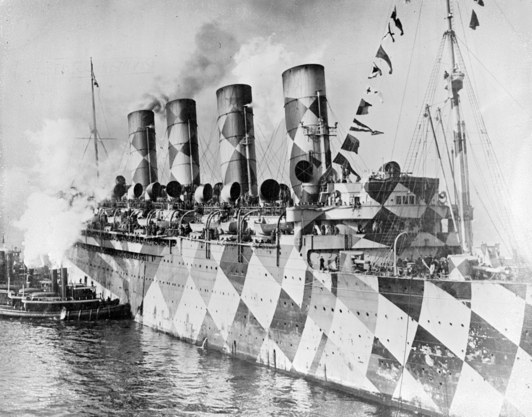 Dazzle painting on a World War One troop shipWhat you’re seeing is simply a gargantuan rental car center. But as of September, it’s also a massive e-ink display—and even a sort of time-travel portal. The project by artist Nik Hafermaas deploys thousands of e-paper panels to turn the side of the garage into a sort of outsize mutant Kindle screen, cycling through 15 different designs. Its mesmerizing show offers a flashback to a World War I-era camouflage technique known as Dazzle. That’s where your trip back in time begins.
During World War I, artists protected massive warships by hand-painting them with eye-popping monochrome shapes that fooled enemies aboard German U-boat submarines. The distracting patterns made it hard for periscope-peering targeters to be sure which part of the ship they were looking at, or where it was heading.
Hafermaas is not the first artist to be dazzled by Dazzle. Pablo Picasso is said to have claimed that Dazzle artists drew inspirations from his Cubist paintings. More recently, William Gibson’s science fiction novel Zero History drew inspiration from the disruptive patterns. But Hafermaas, who chairs the graphic design department at the ArtCenter College of Design in Pasadena, has actually brought Dazzle back to hypnotic life, in the largest display of the camouflage style in many decades. For the San Diego airport project, Hafermaas and his team at the Ueberall International studio commissioned 2,100 e-ink panels—each of which, solar-powered and wirelessly connected, becomes a pixel in a shifting array.
Hafermaas says he found his inspiration when, leafing through a magazine, he chanced upon pictures of a ship, painted in a distorted checkerboard of black and white. “I saw these patterns that are really part of minimalist art, op art,” Hafermaas says. “But here it’s not meant as art but as the functionality to disguise a warship. It looks like art, but it’s actually engineering.”