































World War I Centennial News
America’s forgotten memorial — the time to honor our WWI warriors has finally come
By Sandy Pershing
via The Hill web site
Historians and those who teach history have been engaged in a fierce but ultimately academic debate over the nation’s understanding of the root causes and lasting legacies of World War I. Unfortunately, few are listening.
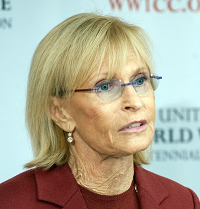 Sandra Sinclair PershingEducators rhetorically ask whether we understand that many of our 21st century political borders and contemporary ethnic blood feuds were created by four years of carnage that scarred the world some 100 years ago. Its legacy also includes the birth of modern civil rights, women’s suffrage, contemporary military technology, and a dominant America that became the world’s feared and respected superpower. That long-ago war has lessons for today’s diplomats and generals as well as students in our classrooms, but our national character traditionally declines to be reflective.
Finding consensus on how to teach, much less what to teach, consumes us on topics far less complex than World War I. Common Core, for example, requires educators to teach to the test if they expect their own careers to advance. World War I is left to be taught with catchphrases, abbreviated narratives and summaries designed to “check the box.” What irony, then, when we consider that paying solemn tribute to those who have fallen in the defense of freedom is part of America’s proud legacy, even if it takes more than a generation to recognize that sacrifice.
Since World War I, the conclusion of each conflict that sent our young people off to war has generated a prolonged and inexplicable national debate on where and how and when to honor those who have died in the line of duty. It would take until 1982 for the Vietnam War Memorial in Washington, D.C., to be dedicated. The Korean War Memorial in the nation’s capital was finally completed in 1995. And it wasn’t until 2004 that the World War II Memorial was opened to the public on the National Mall.
The World War I Memorial to the millions of Americans who served? One hundred years later, it hasn’t been started.
It would be inconceivable to Gen. Jack Pershing that a century ago he would be told the men under his command would not have a memorial to their sacrifice in the nation's capital when the centennial of that conflict would finally arrive. Yet that reality overshadows the programs and retrospectives now underway as we study the cause and effect of America’s entry into “The Great War.”
Read more: America’s forgotten memorial — the time to honor WWI warriors has finally come
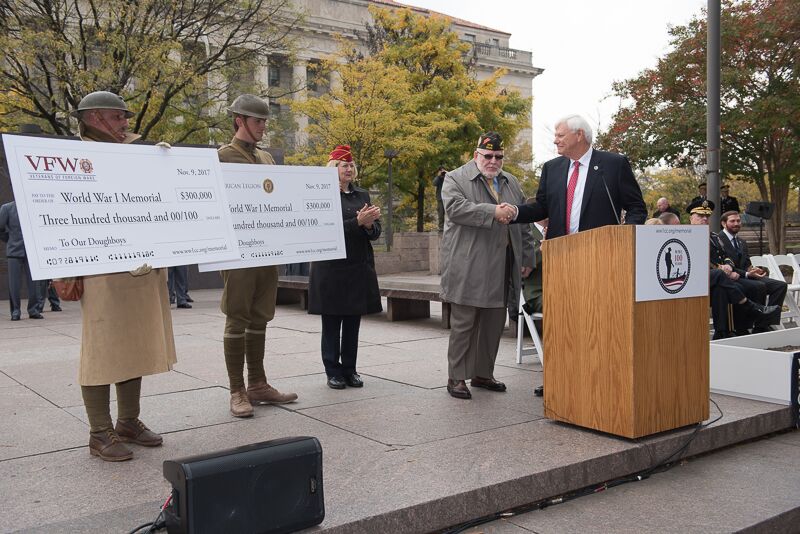 Ceremonial presentation of donation checks from the American Legion and Veterans of Foreign wars:(r to l) Terry Hamby, World War One Centennial Commission Chair; Keith Harman, commander-in-chief of the Veterans of Foreign Wars; and Denise Rohan, National Commander of the American Legion.
The American Legion and Veterans of Foreign Wars make significant donations to help create America's National World War I Memorial at Pershing Park in Washington, DC
By Chris Isleib
Director of Public Affairs, United States World War One Centennial Commission
WASHINGTON, DC — The U.S. World War I Centennial Commission announced Thursday that the commission has received leadership gifts from the American Legion, and the Veterans of Foreign Wars. Each of the gifts is in the amount of $300,000, and will be used for the creation of America's World War I Memorial at Pershing Park in Washington, DC.
The Centennial Commission was established by Congress in 2013 to provide education programs, public outreach, and commemorative events regarding the American involvement in the war. The Centennial Commission was also authorized by Congress to create a new national-level memorial in the nation's capital, to honor the men and women who served.
The American Legion was founded by World War I veterans in 1919, as a veteran support organization made up of former and current U.S. military members. It has since become the nation’s largest veterans organization. Throughout its history, The Legion has been committed to mentoring youth and sponsorship of wholesome programs in America’s communities, advocating patriotism and honor, promoting strong national security, and support for servicemembers and veterans.
The Veterans of Foreign Wars was founded in 1899 to support all honorably-discharged servicemembers, from any military branch, who served the U.S. in wars, campaigns, expeditions, on foreign soil, or hostile waters. The VFW grew rapidly after World War I, with hundreds of thousands eligible veterans returning from the war. The VFW today is the nation’s oldest and largest major combat veterans organization
While it is a Congressional Commission, the U.S. World War I Centennial Commission operates solely through private donation. The founding sponsor for the Centennial Commission is the Pritzker Military Museum and Library, in Chicago. Their continued support, since 2013, has allowed the Centennial Commission to undertake numerous successful education partnerships, memorial restoration grants, and historical/cultural exhibits & symposia.
Read more: American Legion and Veterans of Foreign Wars make significant donations to Memorial
Veterans, dignitaries break ground for D.C. World War I Memorial
By Anthony C. Hayes
via the Baltimore Post-Examiner web site
In an act which many Americans feel is long overdue, almost 300 people joined members of the U.S. World War I Centennial Commission yesterday, as it hosted a ceremonial groundbreaking for a World War I Memorial in Washington, D.C. The new memorial will be erected on the southeast side of the White House, on the parcel of land known as Pershing Park.
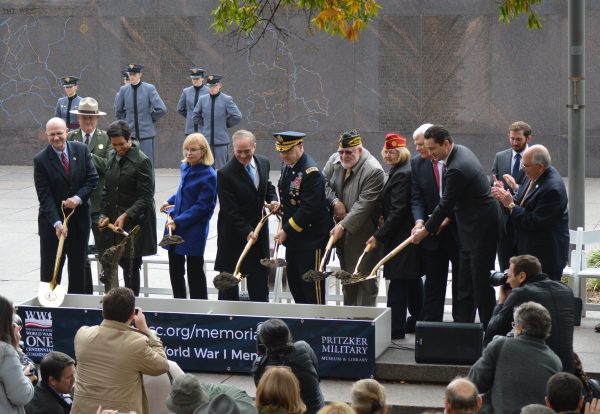 Dignitaries participating in the ceremonial groundbreaking for the National World War I Memorial at Pershing Park in Washington, DC shovel soil brought from French battlefields, signifying the allied service and sacrifice of those who fought for the the United States in the Great War.The event was a flourish of sights and sounds. Participants included a host of U.S. Military Academy Cadets, the Pershing Rifles Group, and the U.S. Army Band’s “Pershing’s Own” Brass Quintet, and over a dozen World War I living-history reenactors.
Attendees included a host of notable military and veteran leaders, as well as Centennial Commission members, notable members of the historical/cultural community, U.S. and city officials, and major donors. Also on hand were military representatives from many of America’s allies during World War I.
“Our duty as citizens of a free country is to remember our Veterans – to honor them every day,” said David Shulkin, U.S. Secretary for Veteran’s Affairs. “Americans benefit from Veterans’ service, so we all have a role in building this monument to memorialize those who served in World War I. We honor them, so Americans serving today know that they, too, will be remembered and cared for in the years after.”
As a backdrop in Pershing Park, the National World War I Museum and Memorial in Kansas City, provided “Fields of Battle, Lands of Peace “, a special traveling exhibit of art photographs taken at the battlefields of France and Belgium, telling the story of America’s doughboys in the war. The “Fields of Battle, Lands of Peace” exhibit will remain for viewing in Pershing Park until December 8th.
For the ceremonial groundbreaking, the keynote speakers used presentation-shovels to turn soil transported from the Meuse-Argonne battlefield in France. Meuse-Argonne was the site of the largest military battle in the history of the United States military and involved over one million service-members. Twenty-six thousand Americans were lost in the battle.
The Centennial Commission also used the event to announce that they had received leadership gifts from two of America’s leading veteran service organizations, the American Legion, and the Veterans of Foreign Wars. Each of the organizations made donations in the amount of $300,000, to be used for the creation of the new national-level memorial.
Read more: Veterans, dignitaries break ground for D.C. World War I Memorial
Ground broken for long-awaited WWI memorial in DC
By Michael S. Darnell
via the Stars and Stripes web site
WASHINGTON — After years of false starts, unused plans and fundraising drives, the National World War I Memorial is finally on track.
Dignitaries including Army Chief of Staff Gen. Mark Milley, D.C. Mayor Muriel Bowser and Secretary of Veterans Affairs David Shulkin helped to break ground on the long-awaited memorial to the “War to End all Wars" Thursday at Pershing Park.
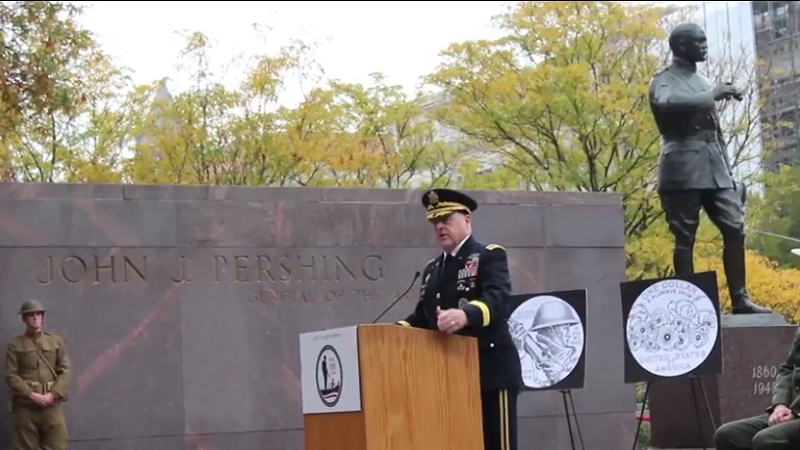 US Army Chief of Staff Gen. Mark Milley speaks at the groundbreaking ceremony for the National World War I Memorial. “Here in Washington D.C. we are very fortunate to have access to many of the nation’s memorials, museums and monuments that tell our nation’s history,” Bowser said. “And we know that the World War I memorial will be a vital and long-awaited addition to this story.”
Plans for the recent memorial date back years. In 2013, the World War One Centennial Commission was formed, in part to oversee the design and construction of the memorial.
The site of the eventual monument was hotly debated, with some wanting it to reside on the National Mall, nearer the memorials to the Korean War, World War II and the Vietnam Wall. Those plans were changed and finalized in 2014, where the commission decided on Pershing Park, a small, often-overlooked area dedicated to the famous World War I general, John “Black Jack” Pershing.
In 2015, the commission held an international competition for the design of the eventual monument. A young student architect named Joe Weishaar, then only 25 years old, and sculptor Sabin Howard eventually won that competition.
Weishaar was on hand for the ceremony and spoke to the crowd. He said being a part of the monument that will rest in Pershing Park was the greatest honor of his life.
“It may be long overdue, but today marks another point in the journey of making sure they’re not forgotten,” Weishaar said of the long-dead veterans of World War I.
But memorials like this one aren’t for the dead. They’re for the living, reminders of conflicts that should never be forgotten, said one veteran with familial ties to World War I.
Read more: Ground broken for long-awaited WWI memorial in DC
Army, VA Chiefs Attend WWI Memorial Ceremonial Groundbreaking
By Richard Sisk
via the Military.com web site
WASHINGTON, DC — In a shabby, partly abandoned little park about a block from the White House, dignitaries gathered Thursday to make amends for the "national tragedy" that left World War I off the roster of America's conflicts that have memorials in Washington, D.C.
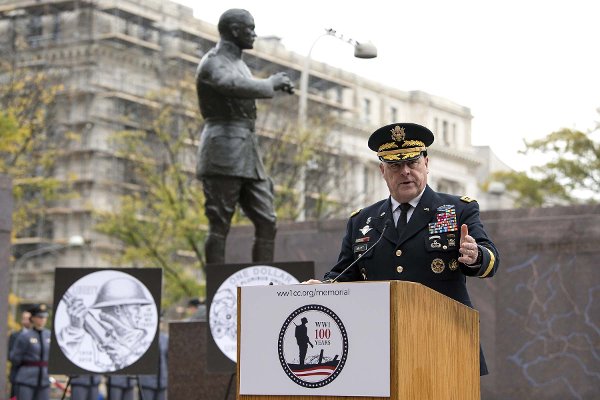 General Mark A. Milley, U.S. Army Chief of Staff, speaks at the ceremonial groundbreaking for the National World War I Memorial at Pershing Park in Washington, D.C. Nov. 9, 2017. (DoD photo by EJ Hersom)Once the homeless were cleared from the area, Army Chief of Staff Gen. Mark Milley; Veterans Affairs Secretary Dr. David Shulkin; and Sandra Sinclair Pershing, the granddaughter-in-law of World War I commander Gen. John J. "Black Jack" Pershing, joined others in taking gold-colored shovels to turn over soil brought from a century-old battlefield in France.
"It's a national tragedy that the millions of vets of the 'Great War' who were the parents of the greatest generation have not been memorialized in our capital," said Terry Hamby, a Vietnam veteran and commissioner of the U.S. World War I Centennial Commission.
"Today, this groundbreaking service starts a process of erecting a memorial," Hamby said, just days before the nation again marks Veterans Day, which began as "Armistice Day" after World War I.
Hamby spoke in front of posters and placards put up by the commission to tell some of the story of the 4.4 million Americans who answered the call to arms for the "war to end all wars."
There was a quote from an Australian trooper to his new American trench pal: "You'll do me, Yank, but you chaps are a bit rough."
That translates as admiration in Australian for the "Doughboys" of the 131st and 132nd regiments of the 33rd Division of the Illinois National Guard, who had just gone over the top in a frontal assault that drove back the Germans in the French summer of 1917.
Read more: Army, VA Chiefs Attend WWI Memorial Ceremonial Groundbreaking
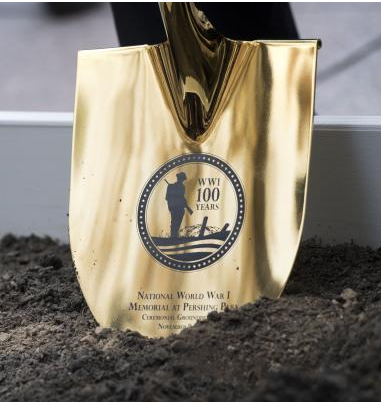 A ceremonial shovel is seen at the groundbreaking for the national World War I Memorial in Washington, D.C., on Thursday. The memorial, designed by 25-year-old architect Joseph Weishaar, is expected to be completed next year. Photo by Kevin Dietsch/UPI
National World War I Memorial breaks ground in Washington, D.C.
By Ed Adamczyk
via the United Press International web site
Nov. 9 (UPI) -- Groundbreaking was held in Washington, D.C.'s Pershing Park, on Thursday for the long-awaited World War I Memorial.
The ceremony marked the start of the $50 million project to honor those who served in what was first called The Great War, which involved U.S. servicemen between 1917 and 1918.
The design features soldiers on a 65-foot-long horizontal panel, and $12 million in private contributions has so far been raised. The World War I Centennial Commission said its goal is to complete the memorial by the end of next year.
Pershing Park, which is being remodeled to accommodate the new memorial, fell into neglect after it was built in 1981 as part of a design renaissance along Washington's Pennsylvania Avenue. A centerpiece of the park is a statue of Gen. John J. Pershing, commander of U.S. forces in WWI -- which is also referred to as The War to End All Wars.
Read more: National World War I Memorial breaks ground in Washington, D.C.
Military, government leaders break ground on WWI Memorial in D.C.
By Mike Carter-Conneen
via the WJLA (Washington, DC) web site
WASHINGTON (WJLA) — Veterans, military leaders and members of Congress broke ground Thursday on a new war memorial in Washington considered long overdue. It will honor Americans who served in World War I and it will be built at 14th Street and Pennsylvania Avenue Northwest in Pershing Park.
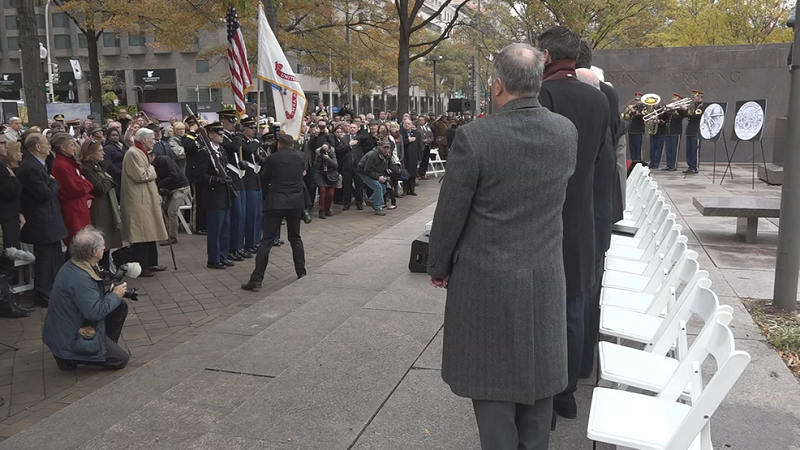 Military, government leaders break ground on WWI Memorial in D.C. (ABC7)Just in time for Veterans Day 2017 — once known as Armistice Day marking the end of the war in 1918 — government and military leaders marked the start of the National World War I Memorial. At the groundbreaking ceremony, they shoveled soil from Meuse-Argonne Battlefield in France.
NPS regional director Bob Vogel said, “Archival footage of the frenzied celebration in the nation's capital of the Armistice on November 11th, 1918, shows Washingtonians packed shoulder to shoulder across Pennsylvania Avenue right here in front of the Willard hotel.”
The granddaughter of famed Army General John Pershing and others at the event expressed regret this day took 100 years.
“I think it was due to the Depression and the fact that the war was so horrific that no one wanted to talk about it,” said Sandra Sinclair Pershing. “Then, World War II happened. And everyone got swept up in that.”
Former Senator, World War II and Korean War veteran John Warner attended the groundbreaking, along with veterans from every major conflict since.
VA Secretary David Shulkin acknowledged both of his grandfathers served in World War I.
Army Chief of Staff General Mark Milley emphasized the more than 200,000 Americans wounded in the so-called "Great War" and more than 100,000 more killed.
“It's our duty to remember what they fought for, why they fought. It's our duty to carry on that legacy,” Milley said.
Read more: Military, government leaders break ground on WWI Memorial in D.C.
Free outdoor exhibition featuring striking modern images of WWI battlefields from acclaimed photographer Michael St Maur Sheil at Pershing Park until 8 December
By Chris Isleib
Director of Public Affairs, United States World War One Centennial Commission
Washington DC — World War I was the first “modern” war as industry enabled weapons and explosives to be manufactured in vast quantities that brought death and destruction on a scale never previously experienced by mankind.
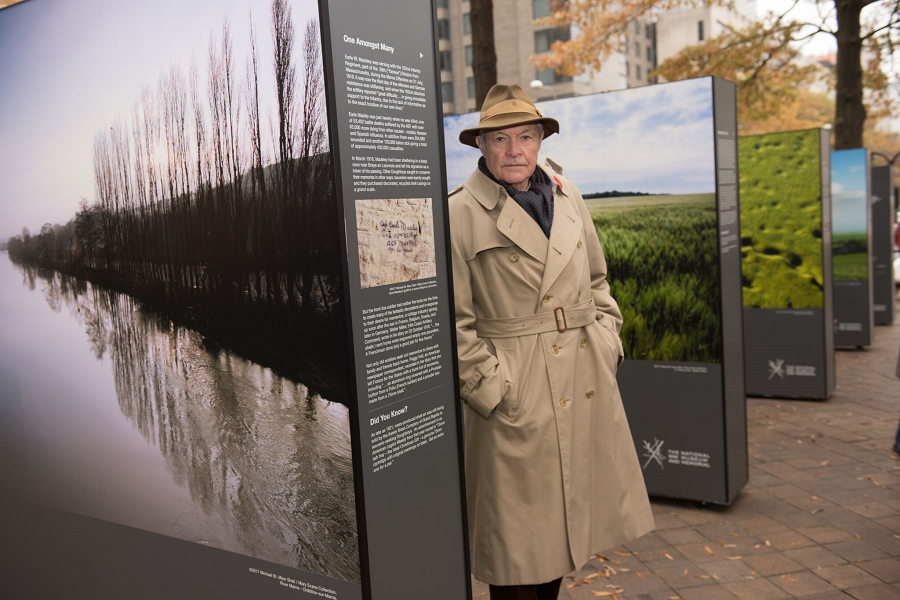 Michael Sheil, the photographer of the exhibitAmerican Sergeant Charles S. Stevenson wrote, “Machine guns, rifles, shells, aeroplanes, and tanks — everything you read about — I saw ‘em all. We followed the first line (the attacking party) for twelve hours and ours was a sort of 'after the battle' review. I saw all kinds of German trenches, barbed wire entanglements, busted houses, burning trees, deep shell holes, torn-up railroad tracks, peaceful gardens, dynamited bridges.”
The experience of American soldiers in the Great War is documented in a free outdoor special centennial exhibition, Fields of Battle, Lands of Peace: The Doughboys, 1917-1918, which debuted Wednesday in Washington DC's Pershing Park.
The exhibition features the incredible contemporary photographs of Michael St Maur Sheil, depicting the battlefields of the Western Front where the Doughboys fought. The exhibition, co-curated by the National World War I Museum and Memorial in Kansas City, opened in conjunction with the ceremonial groundbreaking for America's World War I Memorial.
Exhibit also coincides with the centennial of American entry into the Great War. It is the first large-scale exhibition of Sheil’s work in the U.S. His prior exhibitions have been seen by more than five million people across the world.
Read more: Outdoor exhibition of images of WWI Battlefields at Pershing Park
Rep. Tulsi Gabbard introduces legislation to honor nation’s World War I Memorials
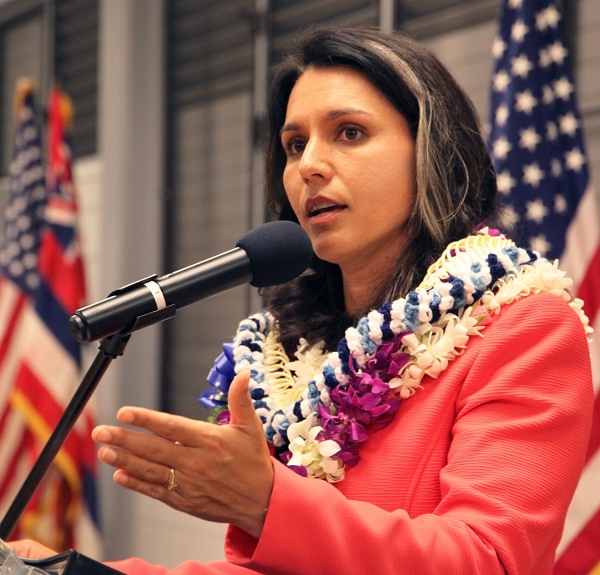 Congresswoman Tulsi GabbardWashington, DC — Ahead of the 100th Anniversary of World War I next year, Rep. Tulsi Gabbard (HI-02) has introduced bipartisan legislation to rehabilitate World War I memorials in Hawai‘i and across the country. H.R. 4328, the Honoring World War I Memorial Act of 2017 would authorize $50 million awarded through VA grants to eligible entities for the rehabilitation of World War I memorials throughout the United States. Eligible entities include non-profit organizations or state or local governments with direct jurisdiction over the rehabilitation of a World War I memorial. Hawai‘i is home to one eligible World War I memorial at Waikiki Natatorium, along with 47 other states.
In recognition of Veterans Day, Congresswoman Tulsi Gabbard will deliver the keynote address during the Veterans' Day Ceremony in commemoration of the 99th Anniversary of the end of World War I at the Waikiki Natatorium this Saturday, November 11.
“More than four million brave men and women, including 10,000 soldiers from the territory of Hawai‘i, bravely served our country during World War I,” said Congresswoman Tulsi Gabbard. “Nearly a century later, many of the memorials, like the WWI Waikiki Natatorium in Hawai‘i, are deteriorating, decaying, and crumbling due to decades of neglect, and many have been closed to the public for decades. The heroes of World War I fought bravely and sacrificed greatly for our country and deserve places of rest and reflection that honor their service. Passing the Honoring World War I Memorials Act of 2017 to restore our country’s World War I memorials would provide a small measure of our nation’s gratitude to those who served and sacrificed.”
“Part of honoring our veterans includes maintaining the war memorials that recognize their heroic sacrifices in defense of our country,” said Congresswoman Colleen Hanabusa. “I thank Congresswoman Gabbard for introducing this legislation to restore World War I memorials for future generations.”
“We applaud Congresswoman Gabbard’s legislation to give our World War I memorials the protection they deserve,” said Stephanie K. Meeks, President and CEO of the National Trust for Historic Preservation. “Often neglected, World War I memorials across the country are some of the most unique and functional community resources. As we join the world in reflecting on the centennial of the war, the Honoring World War I Memorials Act helps bring much needed focus on these memorials and ensures the sacrifices of the millions of Americans who served are not forgotten.”
“We are thrilled to have this support for our efforts of commemoration, education, and public outreach,” said Daniel Dayton, Executive Director of the WWI Centennial Commission. “The American men and women who served in World War I helped to change the entire world. 4.7 million Americans stepped forward to serve in uniform during World War I. Two million of them deployed overseas. 116,516 of them never made it home. No war should be forgotten, and no military member's service should be forgotten. The lessons of their service needs to be honored, and to be learned from.”
Read more: Rep. Tulsi Gabbard Introduces Legislation to Honor Nation’s World War I Memorials
Four question Gaëlle Powis de Tenbossche, and Carl Vander Maelen
"We will never forget the sacrifices made by American soldiers"
By Chris Isleib
Director of Public Affairs, United States World War One Centennial Commission
The Embassy of Belgium has a remarkable new World War I exhibit that has been traveling across the United States. It tells a unique story, of a unique military unit, that had adventures unlike any other, during the World War I period. The Expeditionary Corps of Armored Cars (often called ACM) was a military division formed by Belgian volunteers during WWI. It was sent to Russia at the request of the Tsar to fight the German Army on the Eastern front and distinguished itself in battle in Galicia in 1915. After the Bolshevik revolution, the ACM corps found itself in hostile territory and reached the US through Siberia and China. In the United States, the unit became a tool of propaganda in support of the war effort and was celebrated in May and June 1918 with major military parades (San Francisco, Sacramento, Salt Lake City, Cheyenne, Omaha, Des Moines, Chicago, Detroit, Niagara, New York). The exhibition consists in 19 banners (4 dedicated exclusively to their journey in the USA) and we would like them to be exposed on the trajectory of the ACM corps 100 years ago. We caught up with two members of the Belgian Embassy staff, who worked with the exhibit -- Gaëlle Powis de Tenbossche, and Carl Vander Maelen. They took a few moments to tell us all about it.
The Embassy of Belgium has an incredible traveling exhibit on the Expeditionary Corps of Armored Cars (ACM). Tell us about the exhibit.
T Gaëlle Powis de Tenbossche (left) and Carl Vander Maelenhe exhibit details the epic and one-of-a-kind story of the Belgian Expeditionary Corps of Armored Cars during World War I. Through 19 richly-detailed and beautiful panels, we tell the remarkable journey of this elite corps through Russia, China and the United States.
Just as the ACM traveled through the US, our exhibit will too. We are currently identifying partners in order to display it in the same major cities where the ACM stopped and was celebrated by the American public. The choice to make this a traveling exhibit thus not only helps us find a wider audience, but also honors the journey that the ACM made.
The ACM travelled all around the world from 1915 to 1918. What are some of the highlights of this journey? Who were some of the soldiers who joined this elite group?
The ACM fought alongside Russian troops on the Eastern Front, and earned a distinction during the Battle of Galicia in 1915. However, after the Bolshevik revolution in 1917, the ACM corps suddenly found itself in hostile territory. They undertook an incredible journey that led them through Siberia and China, eventually arriving in the safety of the United States of America in mid- 1918.
In the US, they were celebrated as war heroes. They traveled all across the country to tell their story, and major military parades were held in San Francisco, Sacramento, Salt Lake City, Cheyenne, Omaha, Des Moines, Chicago, Detroit, Niagara and New York.
Read more: Four question for Gaëlle Powis de Tenbossche, and Carl Vander Maelen
Five Questions for Olivier Jaubert
Trains and Traction restoration of WWI American Rail Car
By Chris Isleib
Director of Public Affairs, United States World War One Centennial Commission
An amazing group of people in France have been working on an amazing project to remember the American troops who helped France 100 years ago. Calling themselves Trains and Traction, they are railway enthusiasts who have spent countless hours restoring an original American Army World War I-era railway boxcar, for eventual display & exhibit. The rail car was left behind in France, and was a ruin when discovered by the group a few years ago. Olivier Jaubert is the Director of Heritage for the Trains and Traction Foundation, and he told us about his team, and what they have done.
Olivier, Tell us about your railcar project. This is an amazing and unique way of remembering the people who served in the war. Who had the idea?
The idea came from inside, as these 37000 wagons, sent completely kick-down from US, were locally assembled in La Rochelle by US soldiers from the 35th Engineers in what is now today ALSTOM, the biggest local factory with over 2.000 workers, building TGVs and tramcars.
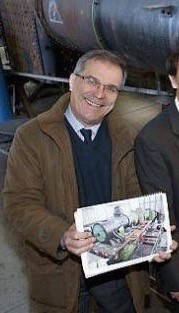 Olivier Jaubert
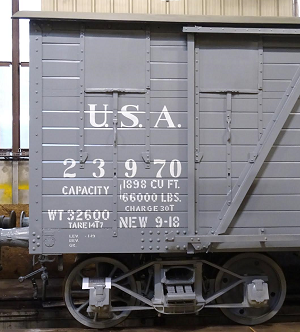 Restored American railcar from World War I.The 35th Engineers guys worked from the end of 1917 to the 31st of March 1919, assembling 17.000 units. Then an American company, the Middletown Car Co., assembled the 20,000 remaining ones.
How did the restoration project get started?
These US wagons have a specific look: any boy who had an electric train to play with had one in his rake.
So when we had the opportunity to buy one for one € plus transport, we bought it. It was six or seven years ago, and this railcar was already derelict, but also already listed as a French Historical Monument since 1990. This listing means that National and local authorities can pay up to 60% of refurbishment costs, which gives ideas to the ones who can find the remaining 40%.
As they were 8 different types of these wagons, from boxcars (two types), flat, tank, to high and low gondolas, etc…, all built with same sub-components, and as they had all been locally assembled, we started collecting one of each of the only six remaining types and filled the files to get money. It seems simple. It is not.
Now two railcars are almost finished, the third “started”, and files filled to get money for the remaining ones: we plan to be ready to show the full rake of six units for your 2018’s Independence Day. The steam locomotive, we have: let’s just find reenacting groups, Ford American Legion ambulances, Liberty trucks, Nash-Quad and Macks of the time, and that’s it!
Remind us of the symbolism of these particular 8/40 rail cars. What role did they serve during the war? What information will people see on the education panels?
8/40 means 8 horses/40 soldiers, the French standard small boxcar’s capacity.
In fact your cars were bigger, and as you may have seen, you US, didn’t painted on these cars ‘sides how many horses and men there were able to transport: 12/60?
Today in France, as it seems also to have been organized in USA in the thirties by your late president Roosevelt, local authorities have training schools to put back in work long time unemployed persons. To train their people, these “schools” need to build things, but are not allowed to compete against private companies. They can only work for cities and non-profit associations. We succeeded to benefit of their work: so is public money not only used to help people, but also to save “Historic Monuments”. We volunteers only take care of the railway sides of the job, like refurbishing brakes, axles, wheels, couplings and car’s markings.
Biblio File, For Teachers
Americans in World War One: History & Stories
By Anne Rouyer, Supervising Librarian, Mulberry Street Library
via the New York Public Library web site
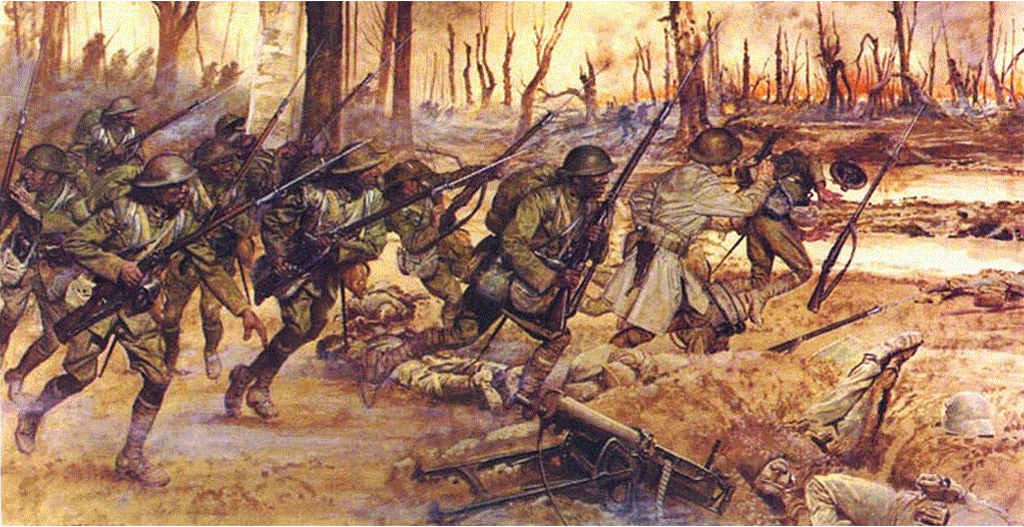 Harlem Hellfighters during the Meuse-Argonne Offensive. Painting by H. Charles McBarron JrWe started celebrating Veteran’s Day on November 11, 1919 as a way to commemorate the first anniversary of Armistice Day, the day that hostilities in World War I ended. In 1926, Congress made Veteran’s Day a national holiday and it has since become a day that we remember all veterans that have served in the United States Armed Forces.
World War I is called "The Great War" but in America it could also be called "The Forgotten War". Compared to four years in WWII, we just weren't in it for very long but it's repercussions are still being felt today.
It began in 1914 but the U.S. stayed out of it until April 1917 when President Wilson convinced Congress we should enter the war and fight. By March 1918, the U.S. had 85,000 troops in France and by September 1918 there were 1.2 million. The total troop mobilization for the U.S. was approx. 4.4 million. All told, America was in the war for about a year and a half and lost 116,516 soldiers and just over 204,000 were wounded.
During the Meuse-Argonne Offensive, the last major campaign of the war, over a million Americans participated and over 26,000 were killed. The Battle of the Argonne is still considered the deadliest battle in American military history. However, that's just a drop in the bucket when you consider that the total casualties for the entire war was a little over 37.4 million people (Allies, Central Powers and civilians). On the opening day of the Battle of the Somme alone, Britain lost nearly 20,000 men. Just reading these statistics can leave you dumbfounded by the sheer loss off life and the complete loss of innocence.
"The First State” Honors its First World War Servicemen with new Memorial at State Capitol
By Steven Jones
Ebony Doughboy Living History Unit
DOVER, DELAWARE — One hundred years after America’s entry in that great, war to end all wars just to the south of where Delaware’s General Assembly meets, Legislative Hall, stands the nation’s latest monument commemorating The First State’s servicemen.
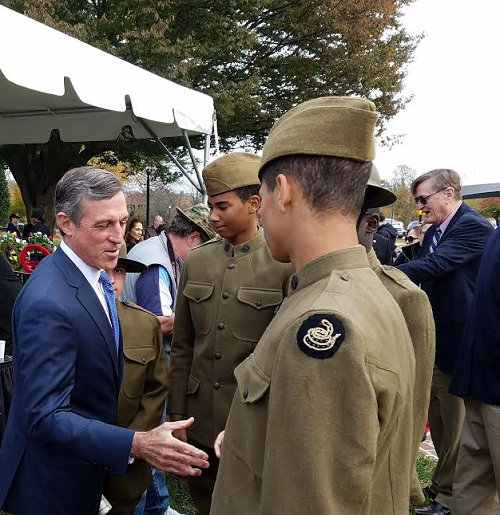 Governor John Carney greets students at the Delaware WWI memorial unveilingIt was the vision of Delaware’s Historical Commission Chair Richard B. Carter two years ago along with the commitment of a dedicated community led by Lori Christiansen Director of Legislative Council-Division of Research that produced the stately granite monument which was unveiled on a cool November 4th before elected officials, residents and visitors.
Personal reflections and recollections of great uncles and grandfathers who mentioned those days to much younger speakers or their parents, marked the moment. The connections were real.
Speakers included: Governor John Carney; State Senator David McBride; Major General Francis Ianni (DE NG ret.) State Senator Colin Bonini and author of “Delaware in World War I” (2015) Brigadier General Kennard Wiggins, Jr. (DE ANG ret.). Unveiling the memorial: State Representative Earl Jaques of Chair of Veterans Affairs; State Senator Bruce Ennis and Major General Carol Timmons and Veteran’s Commission Chair William Farley.
Delaware had approximately 10,000 WWI servicemen and it was noted that 14 percent were African-American. On hand to provide a powerful visual of the First State’s servicemen were five Dover High School JROTC program students, outfitted courtesy of the Ebony Doughboys, in period uniforms.
Each student represented five Delaware servicemen:
- John Henry Temple who served with the 312th Infantry Regiment
- Lewis A. Taylor & Jenkins Fennell, who were killed in action, and served with the 369th Infantry Regiment
- William Ambrose Ross who served with the 808th Pioneer Infantry
- Littleton Van Mitchell who served with the 152nd Depot Brigade. and father of a Tuskegee Airman.
“The goal was not only for them to look the part, but know why it is important” said Steven W. Jones, director of development and education for The Ebony Doughboys. “They look like authentic ‘doughboys’, and connected with the past; what these servicemen accomplished, especially those African Americans given their status in America at the time, was remarkable.”