



























World War I Centennial News
Now is the Time to apply for a Round #2 100 Cities / 100 Memorials Matching Grant
 By Chris Isleib
Director of Public Affairs, United States World War One Centennial Commission
WASHINGTON DC, October 23, 2017—In observance of the Centennial of World War I, a total of 100 matching grants, of up to $2,000 apiece, are being awarded for the restoration, conservation, or even creation, of 100 World War I Memorials across the United States.
The first 50 “WWI Centennial Memorials” were announced on September 27, 2107 and grant applications for the second 50 awards are being taken now.
Applications can be submitted until January 15, 2018. The program management expects to announce the second group of 50 awardees on April 6, 2018.
Any organization, group, municipal government, or individual may apply. The Memorial or monument must be WWI-related, must be in the 50 States or US territories, and the project must be, or have been completed between January 1, 2014 and November 18, 2018.
To date, both American Legion and Veterans of Foreign wars posts from around the country have participated, as well as many other Veterans Service Organization, community groups, city, state and municipal organizations, local historic preservation societies and even individuals.
Read more: Now is the Time to apply for a Round #2 100 Cities / 100 Memorials Matching Grant
Aberdeen Proving Ground born in WWI
The day that changed everything
By Erika Quesenbery Sturgill
via the cecildaily.com (Maryland) web site
ABERDEEN, MD — It was exactly a century ago that everything changed in Harford County and, to an extent, Cecil County.
It was on Oct. 20, 1917, that the Federal Government took official possession of the land that would forevermore become Aberdeen Proving Ground. Allowing no moss to grow, work began the very same day, before the ink on the deed was dry.
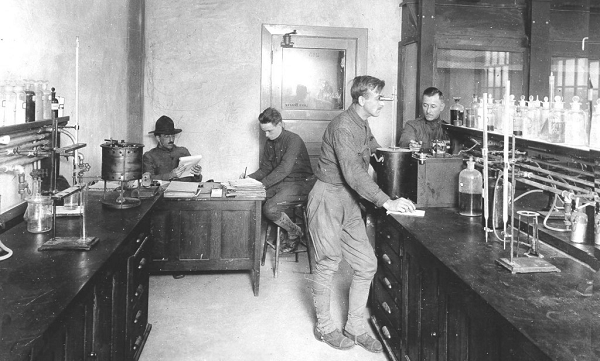 Scientists work in a chemistry lab at Aberdeen Proving Ground's Edgewood Arsenal near the end of World War 1. Edgewood became home to the nation’s Chemical Warfare Service where it conducted the U.S.’s defensive and retaliatory chemical weapons program. The U.S. Army’s oldest active proving ground, APG was established just six months after America entered World War I. It was to be a facility to design and test ordnance materiel, with excellent industrial and shipping center access, and a successor to the smaller Sandy Hook Proving Ground in New Jersey. As technology changed, Sandy Hook proved too small for some of the larger weapons that needed testing.
Work progressed so rapidly at APG that by Dec. 31, 1917, a railroad track was in place with several temporary buildings standing in response to the war effort.
Although a great deal of the munitions for WWI, then called The Great War, were to be created by civilian contractors, the U.S. government built federally-owned plants on APG to manufacture toxic gas being used during that war. These poison gas facilities eventually came to be known as the Edgewood Arsenal, where there were also facilities to fill artillery shells with the chemicals produced there. Production began in 1918 and reached 2,756 tons per month, totaling 10,817 tons manufactured there before the Nov. 18 armistice.
APG earned its nickname as the “Home of Ordnance” as a test, evaluation, research, development, engineering and training installation that is one of the Army’s finest in the world. From the days of proof-testing field artillery, ammunition, trench mortars, air defense guns and railway artillery, APG expanded into an ordnance training school and developmental testing of small arms. Now, mechanical maintenance training is conducted on the site.
War Horses 103 years on: Horse Heroes fund nears $1 million
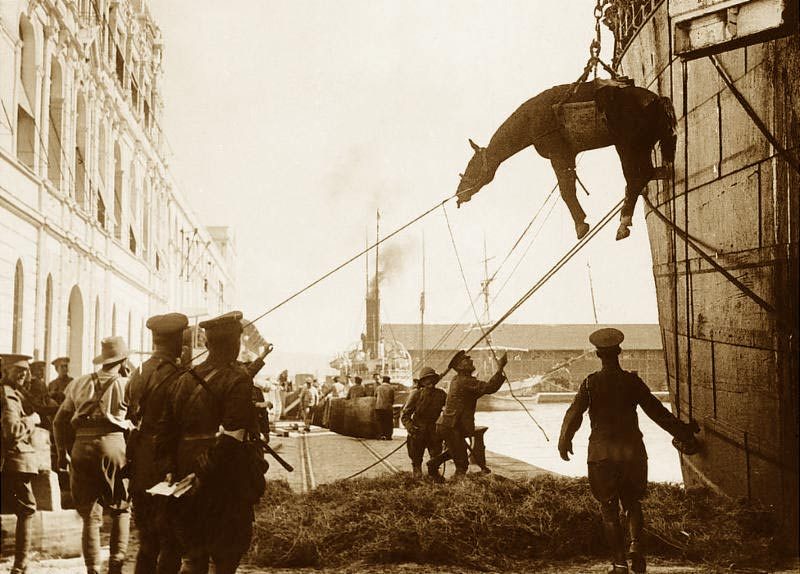 103 years ago this month, America’s horses and mules began their one-way journey to the battlefields of World War One.via the Horsetalk.co.nz web site
Some 103 years ago this month the first of America’s horses and mules exported to join the World War One war effort in Europe left their homes.
This year marks the 100th anniversary of the US entering WW1, and Brooke USA’s Horse Heroes campaign has raised nearly $900,000 of its million-dollar goal to honor the memory of those horses by raising funds to improve the welfare of working equines around the world.
Brooke USA, an official Commemorative Partner of the United States World War I Centennial Commission, is raising one dollar in memory of each of America’s horses and mules who served in World War I.
Once bought for the war effort, the US horses and mules endured a strenuous journey that included traveling to a seaport and shipping in cargo holds across the Atlantic. After several weeks at sea, the animals were admitted to quarantine upon arriving in England. They were shod and kept at remount stations to recover from their trips overseas before they began their formal training as war horses.
Read more: War Horses 103 years on: Horse Heroes fund nears $1 million
Wilmingtonian decodes German World War I Correspondence
By Jessica A. Bandel
via the North Carolina Department of Natural and Cultural Resources web site
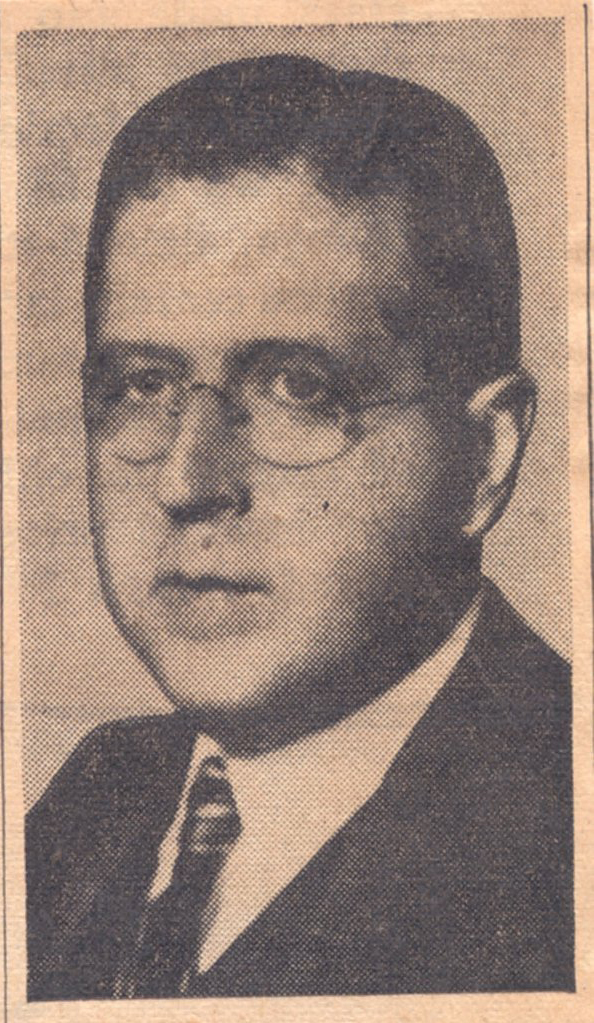 Charles Jastrow MendelsohnNot every North Carolinian who served in the armed forces during the First World War carried a gun on the battlefields of France. Some, like Camelia Rutherford London, were administrators. Others served as nurses, artists, naval officers, and chaplains. In the course of my research, I’ve uncovered at least one person who served as a cryptographer—someone who specializes in encrypting and decrypting sensitive information—during the war period, Wilmington native Charles Jastrow Mendelsohn.
The only child of Rabbi Samuel Mendelsohn and his wife Esther Jastrow, Charles excelled in mathematics and foreign languages, obtaining a Ph.D. in classics from the University of Pennsylvania in 1904. He was employed as a professor of ancient languages at the City College of New York when the United States formally declared war on Germany in April 1917. As a civilian, Mendelsohn supported the war effort as a translator and interpreter of foreign languages for various government offices and as a censor of correspondence and newspapers with the postal service.
His expertise soon caught the attention of Herbert O. Yardley, an influential cryptologist of the time who recruited Charles to join the United States’ first cryptologic agency: Military Intelligence, Section 8, known more commonly by its abbreviated form, MI-8. In July 1918, Mendelsohn entered the army straight from civilian life with the rank of captain. The swearing-in ceremony was deeply moving for him: “[M]y heart is full to the brim of gratitude for the trust that America is placing in me, and the firm determination to serve her to the utmost limit of my slight powers—all to the end that peace may again spread her blessing among men, and that the world of the future may be a world without war and hatred….”
The entirety of his year-long military term was spent stateside at posts in Washington D.C. and New York City where Mendelsohn led at team tasked with decrypting intercepted German diplomatic correspondence. Using ciphers that had already been broken by the British, including one from the Zimmermann Telegram known as 13040, his team broke at least six of Germany’s diplomatic codes. Two of the deciphered messages shed light on Germany’s continued attempts to recruit support from Mexico. Though Mexico declined such offers, Mendelsohn’s work provided a deeper understanding of Germany’s interference with one of our nation’s neighbors.
Read more: Wilmingtonian decodes German World War I Correspondence
National WWI Museum event looks at Great War's resistance and impact
By Tim Huber
via the Mennonite World Review
KANSAS CITY, MO — While many events have honored heroism and sacrifice during World War I, a different kind of conference gathered in an unlikely place to pay tribute to those who opposed the Great War a century ago.
 “Remembering Muted Voices: Conscience, Dissent, Resistance and Civil Liberties in World War I Through Today” took place Oct. 19-22 at the National World War I Museum and Memorial.
Museum president and CEO Matthew Naylor said the work of interpreting the First World War and its impact isn’t just to glorify heroism and sacrifice but to reveal the catastrophe of spilled blood.
“To tell the story of war’s horror warns us, tells us what humans are capable of and steers us to peace,” Naylor said. “. . . At a time when there is much loose talk of war and the sabers are rattled loudly by men in lofty houses . . . this work of remembering, of learning, of peacemaking is even more important than ever.”
Historic peace churches were well-represented at the conference, which included 70 academic paper presentations and was attended by about 250 participants.
On a panel moderated by conference co-planner and Goshen (Ind.) College history professor John D. Roth, Mennonite historian James Juhnke described how American Anabaptists, many of whom spoke German, were gripped in crisis by the conflict and found a sense of identity in the founding of Mennonite Central Committee shortly after the war.
Quakers in Britain advocacy worker Jane Dawson spoke of varying responses among British Quakers to the war, ultimately emerging into the 1920s with strengthened convictions — no longer a quietist church, but a peace church.
Read more: National WWI Museum event looks at Great War's resistance and impact
Four Questions for Steven Clay, President of the 16th Infantry Regiment Association
"To honor our Regiment’s fallen and remember the sacrifices of all 16th Infantry soldiers"
By Chris Isleib
Director of Public Affairs, United States World War One Centennial Commission
On November 3rd, the first Friday of next month, there will be a modest memorial ceremony in the little village of Evansville, Illinois. This ceremony will hold enormous resonance to the World War I community, and represents a significant milestone in America's involvement in the war. The hosts for the event will be the 16th Infantry Regiment Association. We spoke to the Association's President, Steven E. Clay, about what is planned.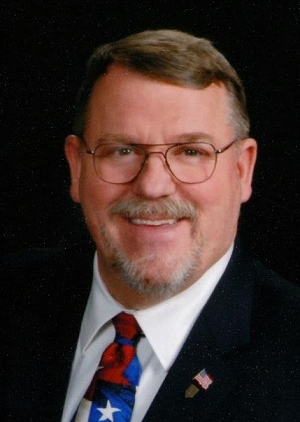 Steven Clay
Your organization is hosting a unique and remarkable ceremony on November 3rd. Tell us about it. Who is being honored, and why?
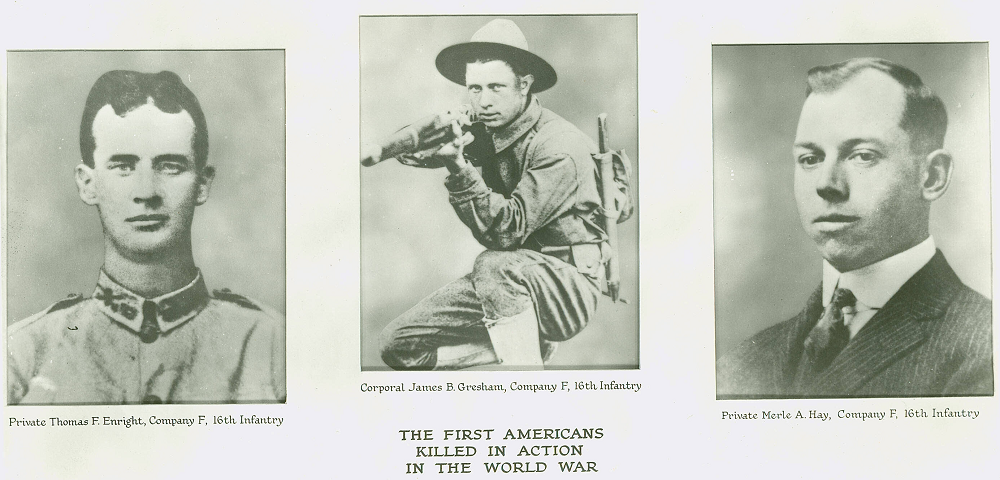
On 3 November 1917, Corporal James Gresham, and Privates Thomas Enright and Merle Hay, were killed in action during a German trench raid near the little village of Bathelémont, France.
These soldiers -- all members of F Company, 16th Infantry -- were the first three American soldiers killed in combat in World War I. The 16th Infantry Regiment Association will honor Gresham with the dedication of a plaque at his mother’s home in Evansville, Indiana, at 10:00 am, on 3 November 2017.
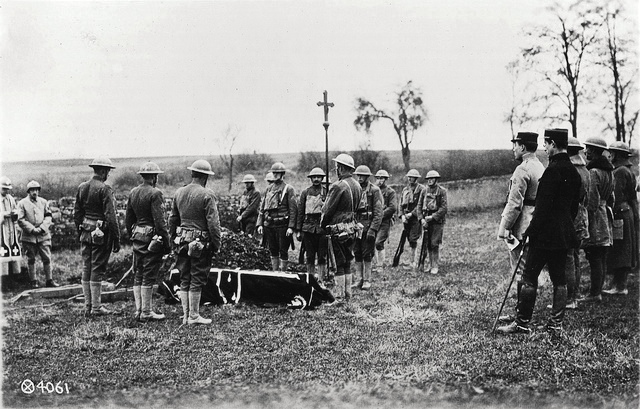 The burial of Gresham, Enright, and Hay, in France in 1917. Gresham was subsequently reburied in Evansville, after the war, in 1921.This event is part of our organization’s mission to honor our Regiment’s fallen and remember the sacrifices of all 16th Infantry soldiers who made the ultimate sacrifice. It is also part of the Regimental Association’s World War I 100th anniversary remembrances as a Commemorative Partner of the United States World War I Centennial Commission.
Tell us about these three soldiers. Who were they? What was their unit, the 16th, doing at the time? How was the news of their fate received, at the time, in the US and in France?
James Gresham was from Evansville, Indiana. He was a pre-war Regular Army soldier who had served with the 16th Infantry in the Punitive Expedition into Mexico.
Like Gresham, Enright was a Regular Army soldier. Originally, from Bloomfield (Pittsburgh), Pennsylvania, he enlisted in the Army in 1909 and saw service in China, the Philippines, and, in Mexico during both the Vera Cruz (1914) and Punitive Expeditions (1916).
Read more: Four Questions for Steven Clay, President of the 16th Infantry Regiment Association
The tragic plight of Germans in America during WWI
By Harvey Day
via the Daily Mail Online web site
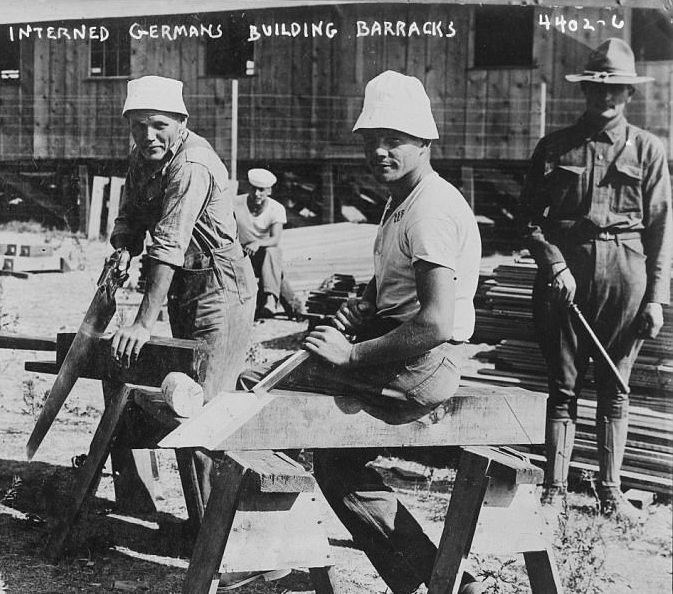 The United States declared war on Germany in April 1917 and helped lead the Allies to victory. But before that, many Americans were terrified of the German threat growing on the other side of the world. Pictured, interned Germans forced to build the barracks for their own internment camp.As Europe was ravaged by fighting, German immigrants in the US suffered harassment, internment, lynchings - and even the humiliation of being tarred and feathered.
Although a little-remembered part of history today, America was completely wracked by the fear and paranoia that swept from coast to coast during the Great War.
The United States declared war on Germany in April 1917 and helped lead the Allies to victory. But before that, many Americans were terrified of the German threat growing on the other side of the world.
A fascinating collection of photos have resurfaced showing the hardships faced by German-Americans at the brutal height of the First World War.
As Europe was ravaged by fighting, German immigrants in the US suffered harassment, internment, lynchings - and even the humiliation of being tarred and feathered.
Although a little-remembered part of history today, America was wracked by the fear and paranoia that swept from coast to coast during the Great War.
The United States declared war on Germany in April 1917 and helped lead the Allies to victory. But before that, many Americans were terrified of the German threat growing on the other side of the world.
This collection of pictures reveals the full extent of war hysteria and open hostility towards all things German that erupted across the nation.
Four questions for Commissioner Monique Seefried
"Involve the young generations to perpetuate the French-American legacy"
By Chris Isleib
Director of Public Affairs, United States World War One Centennial Commission
 Doughboy reenactors in front of the General Pershing statue at Versailles during the dedication ceremonies..Earlier this month, the city of Versailles France rededicated a pair of major memorial statues in their city -- one to WWI American General John Pershing, and the other to American Revolutionary War hero, the Marquis de La Fayette. These statues were conceived and started after the close of World War I, as a thank-you and remembrance of the fraternity between the U.S. and France. However, the peace after World War I was imperfect, and the permanent statues were not completed -- until this month. Our Commissioner Monique Seefried attended the re-dedication ceremony at Versailles, and she talked to us from France about the event, the statues, and what they mean.
Thank you for representing us at the ceremony! Tell us about these statues. They have a very interesting history.
In February 1937, a committee is created in France to erect a memorial symbolizing the participation of the Americans in France during the Great War and the participation of the French in the American Revolution.
 Commissioner Monique SeefriedAmong the members of the council of administration of the committee are the president of the Republic Albert Lebrun, Premier (president du conseil des ministres) Leon Blum and Marechal Petain.
The architect Carlu (did the Trocadero) is chosen for the base and the sculptor Joachim Costa for the equestrian statue of Pershing and the one of Lafayette is the work of Paul Wayland Bartlett (did Michel Angelo in the Library of Congress and on façade of NY Public Library). He did the Lafayette now on the Cours la Reine in Paris.
The project has to be realized with great urgency in order to have General Pershing present in France in October attend the inauguration. This takes place on October 6, 1937.
Situated to the Butte de Picardie, at the entrance of the Avenue de Versailles, flanking both sides of the road, the pedestals are 15 m high and list respectively all the major battles fought by the Americans in France in 1918 and those fought by the French during the American Revolution. The pedestals are erected in 36 days and plasters of the two statues are placed atop the columns.
By 1941, the plaster statues are removed, as they are getting damaged, exposed to the elements. The bronze are not made due to the war.
U.S. Marshals during WWI: Protection of the Home Front
via the usmarshals.gov web site
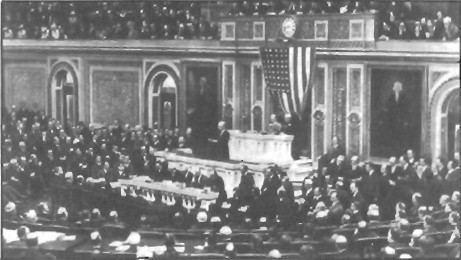 On April 2, 1917, President Woodrow Wilson asked Congress for a declaration of war against Germany. Congress declared war on April 6, 1917.When President Woodrow Wilson issued the declaration of war against Germany April 6, 1917, he told the American people that "the supreme test of the nation has come. We must all speak, act, and serve together." While American troops fought in the trenches of Europe, United States Marshals protected the home front against enemy aliens, spies, saboteurs, and slackers.
From the declaration of war on April 6, 1917 to the Armistice on November 11, 1918, U.S. Marshals:
- INVESTIGATED 222,768 violations of the selective service laws;
- REGISTERED 480,000 German enemy aliens;
- ISSUED 200,000 permits to enemy aliens;
- ARRESTED 6,300 enemy aliens under Presidential Arrest Warrants;
- INTERVIEWED 2,300 enemy aliens in military camps; and
- GUARDED restricted areas around docks, ammunition factories, military camps, and other sensitive areas.
Read more: The U.S. Marshals during World War I: Protection of the Home Front
Army helps unveil WWI commemorative coin
By Gary Sheftick
Army News Service
WASHINGTON -- Army leaders helped the U.S. Mint unveil a World War I commemorative coin on Oct. 9 that will partially fund a national memorial honoring the 4.7 million U.S. veterans who served in that conflict.
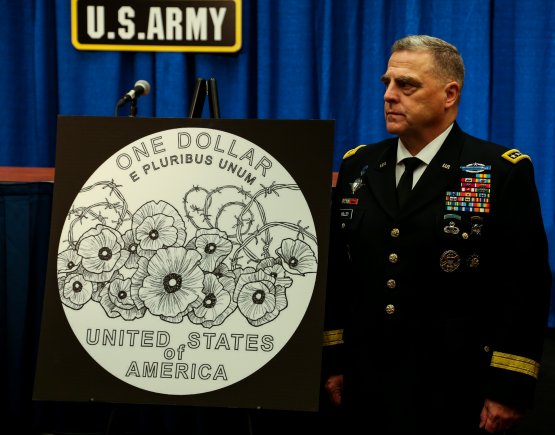 Chief of Staff of the Army Gen. Mark Milley stands beside the design for the back of the World War I commemorative coin, dubbed "poppies in the wire," after he unveiled it Oct. 9, 2017 at the Association of the U.S. Army Annual Meeting and Exposition. (Photo Credit: U.S. ARmy photo by Spc. Connor Ryan Kelly)The coin will actually be issued early next year, but its design was revealed at the Association of the U.S. Army Annual Meeting and Exposition by Acting Secretary of the Army Ryan McCarthy and Army Chief of Staff Gen. Mark Milley.
"No war should be forgotten," McCarthy said, referring to the fact that World War I is the only major American conflict this past century which has no national memorial in the nation's capital. "No military member's service should be forgotten."
Proceeds from the commemorative coin will help fund a WWI national memorial in Pershing Park, in Washington, D.C., along Pennsylvania Avenue and 14th Street, just over a block from the White House. Ground is scheduled to be broken for the memorial Nov. 9.
The design of the coin features a charging WWI "doughboy" on the front with weapon in hand and barbed wire across the bottom. The back of the coin depicts barbed wire behind a field of poppies.
"Poppies in the wire" was designed to remember the sacrifices of WWI veterans, said J.B. Johnson, director of corporate communications for the U.S. Mint. He was at AUSA to help unveil the coin design, along with Terry Hamby, chairman of the U.S. World War I Centennial Commission.
Sale of the commemorative coin "will be the first step" in memorializing the millions who fought, Hamby said. Proceeds from the coin and accompanying five-piece set of medals will not only fund the memorial, but also outreach and education about WWI conducted by the centennial commission.
The coin will be a commemorative silver dollar, but the metals used to mint it will be worth much more, officials said.
Fake News and Fervent Nationalism Got a Senator Tarred as a Traitor During WWI
By Erick Trickey
via the smithsonian.com web site
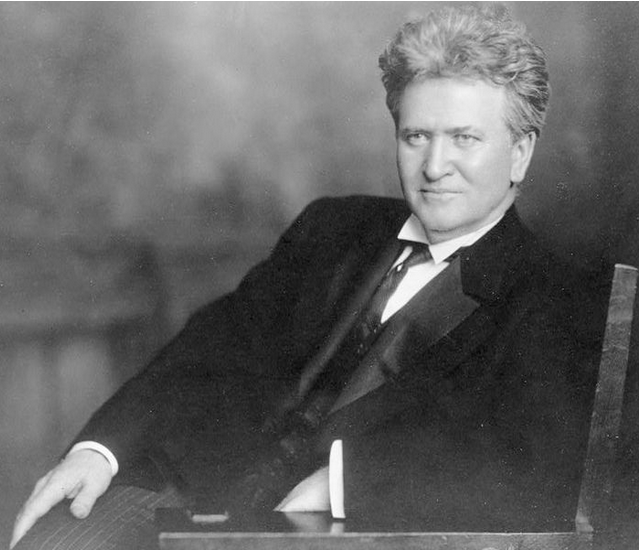 Robert La Follette (Library of Congress)Robert "Fightin' Bob" La Follette was one of the most hated men in America when he took the U.S. Senate floor on October 6, 1917. Vicious caricatures depicted the Wisconsin senator receiving the German Iron Cross medal and holding a German spiked helmet. Theodore Roosevelt, La Follette’s old rival in the Progressive movement, called La Follette “the most sinister foe of democracy in this country” and told an audience that he wished “we could make him a gift to the Kaiser for use in his Reichstag.”
His transgression? Opposing the United States’ entry into World War I.
For years, the stout, stubborn 62-year-old Republican, with a huge shock of brushed-back white hair, had railed against American involvement in the Great War happening overseas. But it was the events of the fall of 1917 that sealed his fate, for better and for worse.
Two weeks earlier, speaking without notes in St. Paul, Minnesota, before 10,000 members of the National Non-Partisan League, a congress of left-of-center farmers and workers, La Follette declared that the nation’s biggest issue had become how to pay for the war he had opposed. Applauded by the crowd, La Follette then ad-libbed a sarcastic attack on the main U.S. justification for war, the German submarine attacks on ships that had killed Americans.
“I don’t mean to say we hadn’t suffered grievances,” La Follette said. “We had, at the hands of Germany. Serious grievances.” He continued, “They had interfered with the right of American citizens to travel on the high seas – on ships loaded with munitions for Great Britain.” This was a partial exaggeration: not all ships the Germans sank had carried military cargoes. But La Follette pointed out – correctly – that the British ocean liner Lusitania had been carrying munitions to England in 1915 when a U-boat sank it, killing 1,193 people, including 123 Americans.
The crowd cheered La Follette, but the next day he found himself facing a nationwide backlash and a classic bit of “fake news.”
Read more: Fake News and Fervent Nationalism Got a Senator Tarred as a Traitor During WWI
5 Key Naval Innovations from WWI for U.S. Navy
By Elizabeth M. Collins
Defense Media Activity
One hundred years ago, convoys of troop ships, protected by U.S. Navy escorts, began to regularly arrive "over there" in France, transporting waves of American ground troops to join the Allies and fight the Kaiser in the churning bloodbath that was trench warfare.
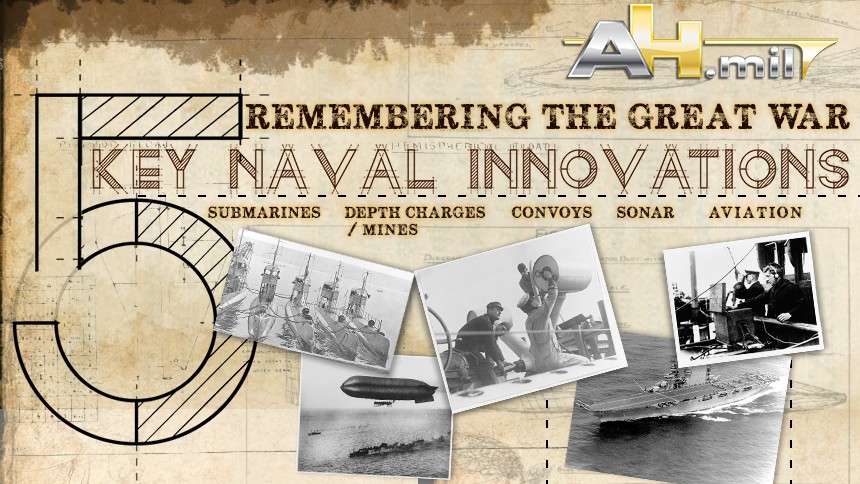 And while the Great War may not be remembered as a great naval war, it did lead to a number of advancements and innovations that would change warfare and the Navy forever.
Submarines
The signature naval weapon of World War I was the submarine. Various inventors had experimented with diving boats and underwater boats since at least the 17th century, and they made appearances in both the Revolution and the Civil War. The U.S. Navy then commissioned its first true submarine, USS Holland (SS 1), in 1900. German officials also saw potential in the new technology. They needed a way to counter the naval might of the United Kingdom, said Dennis M. Conrad, a historian with the Navy History and Heritage Command, and seized on the submarine.
In fact, Germany went from one undersea boat in August 1905 to 28 in the first two months of the Great War to 61 by June 1917, according to Fraser M. McKee in "An Explosive Story: The Rise and Fall of the Common Depth Charge." The U-boats proved remarkably successful, sinking nine British warships in only two months early in the war. The Germans also used their submarines to terrorize the Allies and blockade the United Kingdom, attempting to starve the British out of the war. They haunted Allied shipping lanes across the Atlantic, sinking millions of tons of freight and killing thousands. When the U-20 torpedoed the Lusitania in May 1915, for example, some 1,200 people died, including 128 Americans. Germany's avowal of unrestricted submarine warfare, Jan. 31, 1917, finally brought the U.S. into the war.
Read more: 5 Key Naval Innovations from World War I for U.S. Navy
Kiwi sculptor wins US Mint competition to design American World War I centennial coin
By Vaimoana Tapaleao
via the NZ Herald web site
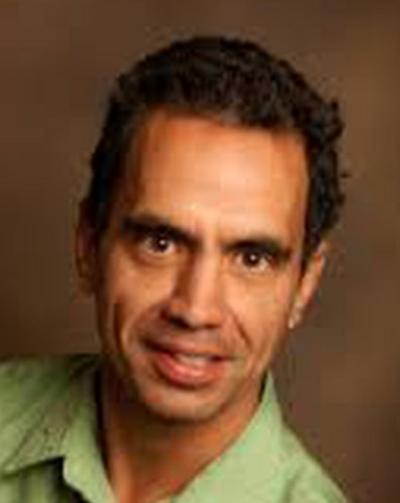 LeRoy TransfieldA New Zealand man living in the US has come up with the winning design to appear on a special coin commemorating the 100th anniversary of the end of World War I.
LeRoy Transfield's designs for both the obverse and reverse were picked out of 20 finalists from all over the US.
The profile of a stoic-looking soldier gripping a rifle, with the words "Liberty'', "In God We Trust'' and the dates 1918-2018 can be seen on one side.
On the reverse, several poppies are caught in barbed wire, with the words "United States of America'', "One Dollar'' and "E Pluribus Unum'' (Out of Many, One) complete it.
Transfield, a full-time sculptor and artist based in Utah but born and bred in Lower Hutt, said it was exciting to win the US Mint-run competition and for his designs to be chosen for a WWI centennial silver dollar.
The 52-year-old decided to put an entry in after coming across the competition while surfing the internet one day.
"I wanted to do poppies but it was really hard because it's kind of a boring flower and I didn't know if it'd work in a coin.
"So when I added the barbed wire, it really made it a lot more interesting. But even though the poppies originally are not really recognised in the United States ... but now it's becoming universal as a symbol for remembrance. And a lot of people wear it over here on Memorial Day.
"There's a lot symbolism in it. Having multiple poppies kind of represent that there was a lot of people who died in the war."
Transfield himself has personal links to the Great War also.
Read more: Kiwi sculptor wins US Mint competition to design American World War I centennial coin