
































World War I Centennial News
100th anniversary of first soldier from Minnesota's Blue Earth County killed in WWI
By Tim Krohn
via the Mankato Free Press (MN) web site
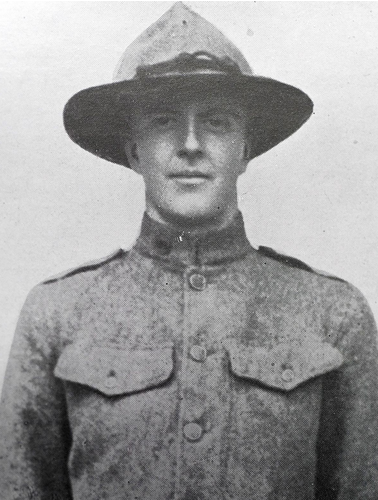 Glenn H. Campbell of St. Clair was one of the first in the area to enlist when World War I started and was the first soldier from Blue Earth County to be killed in the war. Tuesday, Feb. 27, marked the 100th anniversary of his death.President Woodrow Wilson called on Congress to declare war against Germany on April 2, 1917, and less than a month later, a young man named Glenn H. Campbell of St. Clair became one of the first in Blue Earth County to volunteer to serve.
Ten months later, he would be the first serviceman from the county to be killed in World War I. Tuesday, February 27 marked the 100th anniversary of his death.
County Veteran Service Officer Michael McLaughlin happened upon the anniversary recently.
"We have old books and records here, and I was going through this book and just ran across it," McLaughlin said.
The book, "The Story of Blue Earth County’s Part in the Great Struggle for Democracy,” published by The Free Press in 1920, tells Campbell's story.
On the day after enlisting, Campbell was sent to Jefferson Barracks. He served with the Fourth company of the Artillery corps until July 26, when he was transferred to his final post with the Ammunition Train.
He boarded the transport Antilles on Aug. 7 from New York to France and was one of the earliest American troops to land on European shores.
After spending time in winter quarters from November to January, Campbell was stationed at Sanzey for the first few months of 1918. To get to the front, which was just a short distance away, the ammunition train passed through a bend in the road known as “Dead Man’s Curve” because of the fact that several men had been killed there.
On Feb. 27, Campbell, an assistant truck driver on a machine driven by a young man named Sullivan, was proceeding to the front when, just as the truck was rounding the curve, a shrapnel shell struck the roadside and exploded. Part of the shell tore away the radiator of the truck, striking Campbell in the side and passing through his body.
Read more: 100th anniversary of first soldier from Minnesota's Blue Earth county killed in WWI
District of Columbia National Guard commemorates World War I throughout 2018
By D.C. National Guard Public Affairs
via the Andrews Gazette web site
 During the centennial of the end of World War I, the District of Columbia National Guard will host a series of special activities, programs, and events to commemorate the end to the first war. Approximately 400,000 National Guard Soldiers served in the Great War, among them were 2,000 Guardsmen from the District of Columbia.
“As we mark 100 years of the end of World War I, we reflect back on the many contribution and sacrifices made by the Soldiers of the District of Columbia National Guard; citizen-Soldiers who answered the call to protect the Capital and defend the nation in time of great need,” said Brig. Gen. William J. Walker, acting commanding general, District of Columbia National Guard.
Highlights of the District of Columbia National Guard’s activities are below. See the official District of Columbia National Guard Facebook for upcoming event details.
ThisDayInHistory
Throughout 2018, the District of Columbia National Guard will specifically honor all those D.C. Soldiers who served, died and were affected by the war both at home and overseas, as part of their social media #ThisDayInHistory #DCHistory as a lead up to the centennial of the Armistice that brought the conflict to an end on Nov. 11, 1918. Individuals are asked to share their stories, photos and comments about WWI on the District of Columbia National Guard’s Facebook page.
Read more: District of Columbia National Guard commemorates World War I throughout 2018
 This photo shows an American ambulance on the road to Verdun. Inset: American artist and American Field Service ambulance driver Waldo Peirce.
Four Question for Corine Reis
Waldo Peirce Goes to War is a remarkable new WWI Tumblr Blog
By Cheryl Farrell
Staff Writer, United States World War One Centennial Commission
Frenchwoman Corine Reis has an incredible passion for the American volunteers who came and served in France before America joined the war. She maintains several pages, including this very detailed Tumblr blog. The introduction to Corine’s Tumblr page dedicated to American artist Waldo Peirce goes like this:
"November 1915, World War 1 is savagely ripping Europe apart. Waldo Peirce, fresh Harvard graduate, impossibly handsome and talented artist, decides to leave his privileged life to join the American Field Service in France. He finds himself catapulted to the front of the bloodiest war zone ever, rescuing and transporting the wounded to safety, through treacherous battle grounds, in primitive ambulances. His heroism and bravery won him the French Croix de Guerre awarded by the French government to war heroes. The carnage and devastation he saw did not destroy his beautiful mind, because through it all, he kept on painting. "I must paint paint" as he wrote from the front to his mom in 1916 "I'm a painter from the top of my head to the soles of my feet --I know it-- I get a nervous thrill just to take my palette in my hands..." And it's how Waldo never lost his way. 100 years later, almost to the day, here are photographs with short captions of the war he saw."
Corine took some time to answer a few question about her blog for us.
Question: Can you explain for our readers your relationship to Waldo Peirce and why you decided to tell his World War One story through photos? Did you meet Waldo?
 Corine ReisWaldo Peirce was my American husband’s uncle. I heard about him from my Mom-in-law, Rachael. Rachael and Waldo were very good friends and she shared with me wonderful stories about him. Their beautiful friendship is actually documented in various photo albums at the Smithsonian Institution and Colby College. Unfortunately, I could not have met Waldo because of the age difference, but it certainly would have been great fun.
Question: What are your primary sources for information about Waldo Peirce and how did you develop the significant collection of images for your Tumblr site? Do you have a background or education in history?
Waldo and his colleagues of the American Field Service took lots of photos in France. Throughout the years, these photos were duplicated in private collections and various American and French websites and archives departments. As I am French, I am able to find in the French archives incredible photos that are not yet widely published in America. The French photographic archives are particularly complex to navigate for even a native French speaker, so I can only imagine how difficult it might be for an English speaker. The fascinating aspect of this research is to see how the French photos corroborate the American stories (in diaries, letters, books, etc.)
About the texts: as Waldo did not write much about his war experience, I had to dig in his colleagues’ diaries, letters, and books. It was important to do so as I really wanted to present these young American volunteers, and then the American soldiers, in the human context of this war, mostly leaving aside its military and technical aspect. So, between the photos and texts, I developed quite a collection of go-to WW1 diaries, letters, and books.
Finally, I follow a chronological order in my blog. Another rich aspect of this research is that for each day of this war, there is almost always a diary, a letter, or a photo. How cool is that? I am pretty well covered until the armistice!
My academic background is language studies and economics. But I grew up in a house full of history books, as both my parents are history buffs. I also learned about American history from both my very well-educated Mom-in-law and husband.
Read more: Waldo Peirce Goes to War is a remarkable new WWI Tumblr Blog
Smithsonian Postal Museum exhibit: In Her Words: Women's Duty and Service in World War I
By Betsy Sheppard
Staff Writer, United States World War One Centennial Commission
The exhibition In Her Words: Women’s Duty and Service in World War I at the National Postal Museum was developed jointly by the Smithsonian’s National Postal Museum and the Women In Military Service For America Memorial Foundation with co-curators Britta K. Granrud, curator of collections, Lynn Heidelbaugh, curator, and Jessie Henn, collections assistant.
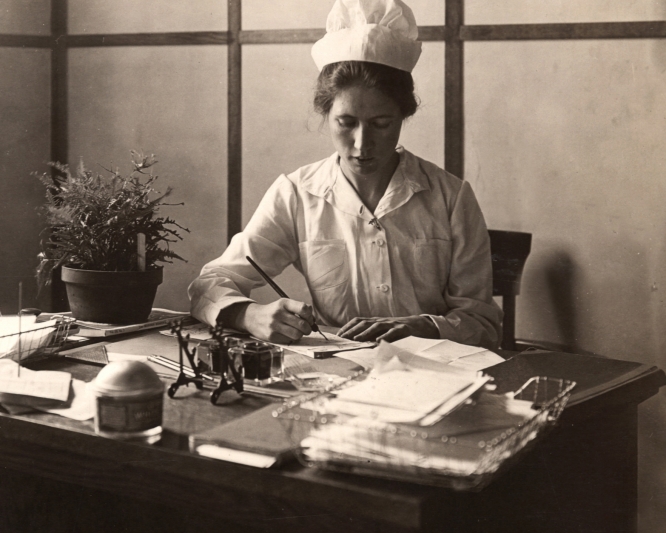 Army nurse, Camp Sherman, OH, 1918. The majority of the 21,400 women in the Army Nurse Corps were graduates of nursing schools, but to alleviate staffing shortages the Army waived state registration requirements and increased age limits. Both the Army and Navy assigned nurses to overseas duty in record numbers during the war. Photo courtesy Grace (Mechlin) Sparling Collection, Gift of Lillian S. Gillhouse, Women’s Memorial Foundation CollectionThe exhibition follows the experience of four women in the war effort through their own letters, journals and records. The exhibition project intended to delve into individuals’ records to gain understanding of women’s experiences from the war. By searching the extensive collection of the Women’s Memorial Foundation, the curators discovered many fascinating letters and stories.
Through the history of the four individuals selected for the exhibition, a range of topics is explored, including why these women choose to serve their country, what it was like to serve in different branches of the armed forces or alongside the military in a civilian organization, what it was like to work stateside or overseas and what opportunities were available to women after the war. The exhibition features the work and lives of two US Army nurses, a US Navy yeoman (F), and a worker with the YMCA. Visitors will find similarities and differences in how these individuals contributed to the war effort.
One of these women, Chief Yeoman Ruth Creveling was on active duty in the Navy during World War I, the first time women could enlist in the Navy and Marine Corps. Increasing personnel numbers was part of the Navy’s preparedness efforts before entering the war and on March 19, 1917, the Navy Department announced women would be recruited for the Navy Reserves. Eighteen-year-old Ruth (Woodworth) Creveling from Washington, DC, was one of the early recruits. She enlisted on March 30, 1917, and her active duty in the Navy commenced straightaway. Eventually, over 11,000 women enlisted as navy yeoman (F)—the “F” denoted “female”—and about 300 women served as Marine reservists.
Read more: Smithsonian Postal Museum exhibit: In Her Words: Women's Duty and Service in World War I
UK'S 14-18 NOW Organization Announces their Schedule for 2018
By Chris Isleib
Director of Public Affairs, United States World War One Centennial Commission
 Our partner arts organization in the UK, the famed 14-18NOW, has announced the details of their final season of extraordinary arts experiences. These public art pieces are aimed at connecting people with the First World War.
The slate of events includes new films by Peter Jackson and Danny Boyle, a Dazzle Ship in New York City Harbor, and much much more.
14-18 NOW is a five-year program of extraordinary arts experiences connecting people with the First World War. Working with arts and heritage partners all across the UK, they commission new artworks from leading contemporary artists, musicians, designers and performers, inspired by the period 1914-18.
 14-18 NOW produced the phenomenal Tower Hill Poppies in 2014 in the moat of the Tower of London, one poppy for each of the 888,246 British and Commonwealth troops who died in WWI.Since the start of the First World War centenary in 2014, 14-18 NOW has commissioned 213 UK and international artists and over 300 arts and cultural organizations to present 73 projects across the United Kingdom. More than 30 million people have engaged with the First World War through these brand new artworks and events.
The group has created such worldwide public art pieces as the poppies in the Tower of London, and the Reenactors of "We Are Here on the centennial of the first day of the Battle of the Somme.
The 2018 season marks the centenary of the Armistice and features brand new commissions by leading contemporary artists from the UK and around the world.
14-18 NOW will be commemorating 100 years since Armistice with a number of exciting commissions – culminating in a work by the brilliant Danny Boyle, who will invite communities across the UK to come together and mark this date.
Read more: UK'S 14-18NOW Organization Announces their Schedule for 2018
Four Questions for Mark Wilkins
"They were all heroes as soon as they put themselves in harms way "
By Chris Isleib
Director of Public Affairs, United States World War One Centennial Commission
Our friend Mark Wilkins is a historian, writer, museum professional, and master model-maker. He is serving as historical consultant and producer of aerial effects for an upcoming feature documentary on the Lafayette Escadrille. Mark recently created a story for AIR & SPACE Magazine, entitled "The Dark Side of Glory: An early glimpse of PTSD". The article found remarkable evidence of PTSD in the letters of World War I aces. He talked to us about the piece, and about what he discovered.
Tell us about your article in AIR & SPACE.
 Mark WilkinsThe article chronicles the psychological impact of aerial combat during WWI. The rise of the “ace” is discussed and contrasted with the reality of combat flying. Five pilots are profiled, and each suffered in a slightly different way—some were forthright about their fears—such as Udet; others like Lambert repressed them causing devastating black outs. The notion that men had a limited amount of emotional capital and courage is explored, and the notion that when these men confronted their humanity—they suffered grievously, leading to the paradoxical sentiment that one must not be concerned about the men that one killed—if only it were that simple. Each man’s humanity caught up with him eventually, and these men were forever transformed from their experiences—how could you not be?
How did you become interested in this topic? Do you have a personal connection to WWI?
I’ve always been interested in aviation, maritime, and general history. During graduate school I really became interested in WWI—I had a great professor, Charles Maier, who really brought the subject to life—socially, politically, militarily, and spiritually (he explored the art and literature of the period as well). Something about this dynamic period resonated with me. After that I was hooked on WWI history.
I began writing an historical fiction novel on WWI flying, and a host of article and book ideas followed. Perhaps what interests me the most about historical events are the psychological motivations for why people behaved the way they did in various circumstances. For example, for a nuanced and very incisive article on the origins of WWI Samuel R. Williamson Jr.’s article “The Origins of World War I” explores the notion that one man may have been responsible for the outbreak—Conrad Von Hotzendorf, chief of the General Staff of the Austro-Hungarian Army and Navy.(Journal of Interdisciplinary History, Vol. 18, No. 4, Spring, 1988).
WWI: African-American soldiers battle more than enemy forces
By Ryan Reft
Historian in the Manuscript Division, Library of Congress
“Interpreters were brought from everywhere to instruct our men in the French methods of warfare because be it known that everything American was taken from us except our uniform.”
—Noble Sissle, 369th “Harlem Hell Fighters” Regiment
The Library of Congress exhibition Echoes of the Great War: American Experiences of World War I explores the role of African-American soldiers in the war and ways in which the international conflict contributed to a growing racial consciousness among black veterans.
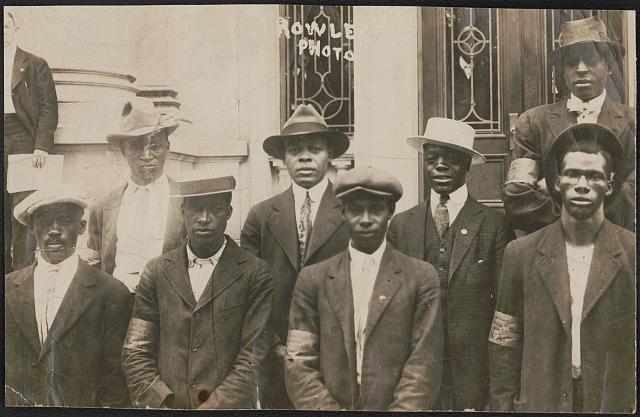 Recruits for what would become the 369th Regiment, also known as the “Harlem Hell Fighters.”Over 350,000 African-Americans served overseas for the American Expeditionary Force (AEF) during the war. Most toiled away in important but menial positions—as stevedores, camp laborers, clerks. But between about 40,000 and 50,000 black American troops served under French commanders in the war, largely in the 93rd Division of the AEF, consisting of the 369th through the 372nd regiments. No black troops experienced as much combat as those assigned to the French military.
As historians like Jennifer Keane, Chad Williams and Adriane Lentz-Smith have demonstrated, racism was deeply embedded in the segregated World War I military. Among officers and the rank and file, white soldiers felt no compunction in demeaning their black counterparts. In France, “U.S. troops were busy spreading rumors among the civilian population that blacks were rapists, thieves, and had tails,” Keane points out.
Although the government organized its first officer’s training camp for black troops during World War I, the camp was segregated. Located in Des Moines, Ia., it trained only enlistees for the infantry. White officers eschewed imparting artillery and engineering skills to camp enlistees even though such skills proved crucial at the front, where many soldiers found themselves assigned to artillery and engineering units. And even in its limited focus on infantry, the camp’s military leaders failed to adequately train their charges for the challenges ahead. The division that emerged from the camp experienced combat, but under white officers who took every opportunity to denigrate the division’s efforts while obscuring their own failures of leadership.
Read more: World War I: African-American Soldiers Battle More Than Enemy Forces
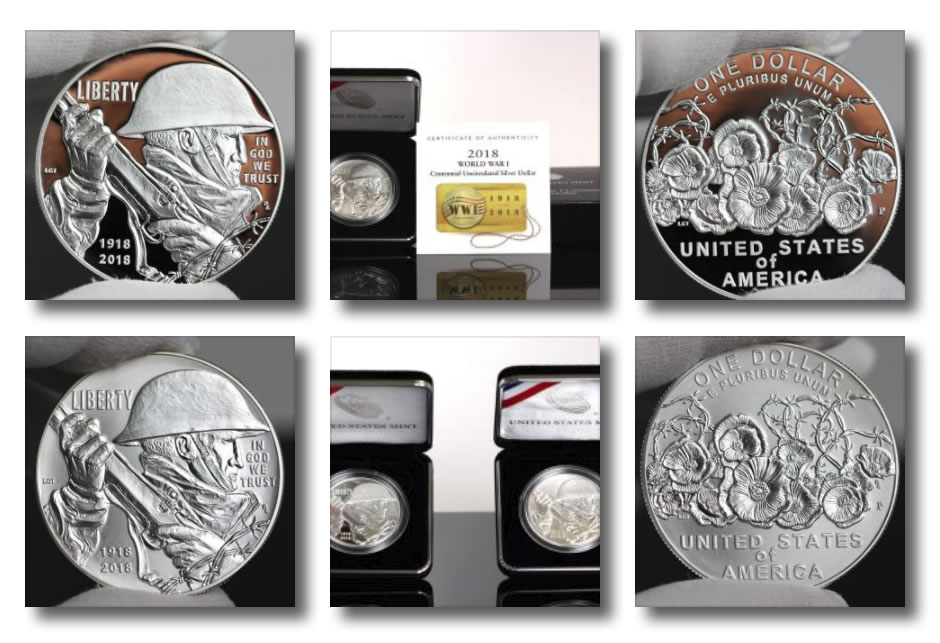 CoinNews dot net Photos of World War I Centennial 2018 Silver Dollars
World War I Centennial 2018 Silver Dollar Photos
By Mike Unser
via the coinnews.net web site
This article presents photos of World War I Centennial Silver Dollars, the U.S. Mint collector coins commemorating the 100th anniversary of America’s involvement in the First World War.
Released on Jan. 17, the collectibles are produced at the Philadelphia Mint in finishes of proof and uncirculated.
Proof coins have frosted designs that contrast attractively against mirror-like backgrounds. They are almost aways more sought than uncirculated coins which have a brilliant but more standard appearance. The following sets of photos show both coin types. In the first photo, a proof WWI Silver Dollar is to the left. You can see its mirrored qualities reflects the red, white and blue colors from its presentation case.
Both dollars ship in similar commemorative packaging. They arrive boxed, are held in a black-velvet presentation case, and are accompanied by a U.S. Mint Certificate of Authenticity.
Post-Dispatch mailroom clerk becomes the first St. Louisan to die in World War I
By Tim O'Neil
via the the St. Louis Post-Dispatch web site
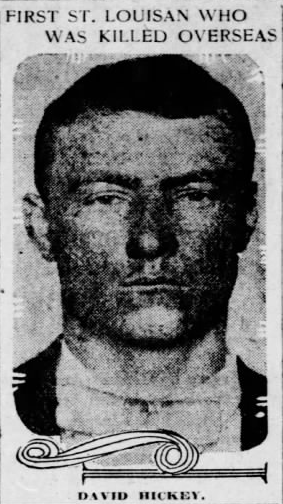 ST. LOUIS • David Hickey was 38 when he answered the patriotic drumbeat in April 1917 to fight in the Great War. He was assigned to a U.S. Army artillery battery in France at the village of Seicheprey, near the slaughterhouse known as Verdun.
Hickey had grown up just north of downtown and was a newsboy. He later worked in shoe factories and the Post-Dispatch mail room, where newspapers were bundled. He played on local amateur baseball teams and never married.
His distinction was posthumous: “First St. Louis Man Killed in France,” was the headline in the Feb. 27, 1918, Post-Dispatch, reporting that Hickey had died three days before of shrapnel wounds suffered on Feb. 12.
It was a big local story. The United States had entered World War I on April, 6, 1917, but still was forming its forces along the Western front when Hickey was fatally wounded. America’s first significant offensive didn’t take place until May 1918. Not until September did the Army begin its major push at Saint-Mihiel, near the village of Seicheprey.
Hickey probably was hit by some of daily shellfire that routinely tossed dirt along the shattered front for four numbing years. Only minor engagements were reported in France on Feb. 12, 1918. The headlines were about the Russian revolutionary government’s withdrawal from the war.
When word of Hickey’s death reached St. Louis, reporters interviewed state Sen. Michael Kinney, who knew him from the old Bates School north of today’s Laclede’s Landing. Kinney said Hickey had sent a letter in November asking the senator to notify his sister at 5872 Garfield Avenue about his service in France.
“Dave was a happy-go-lucky chap always ready to do a pal a good turn,” said Kinney.
But the senator couldn’t locate Hickey’s sister, Celia Ebeler, who had moved. Newspapers described Hickey and Ebeler as “estranged.”
Hickey was the first of 1,072 men from the St. Louis area who died in uniform during World War I. America’s total military deaths were 116,500, a small number compared to other combatants. France and Germany together lost at least 300,000 soldiers killed in the grinding battle for Verdun in 1916.
Read more: Post-Dispatch mailroom clerk becomes the first St. Louisan to die in World War I
A St. Louis Hospital opened in France during World War I
By Blythe Bernhard
St. Louis Post-Dispatch via the military.com web site
For nearly two years during World War I, a St. Louis hospital set up an outpost near the battlefields in France.
Dr. Fred Murphy, head of surgery at Washington University School of Medicine, realized the allies needed help when he volunteered at an American hospital in Paris in 1916 before the U.S. entered the war.
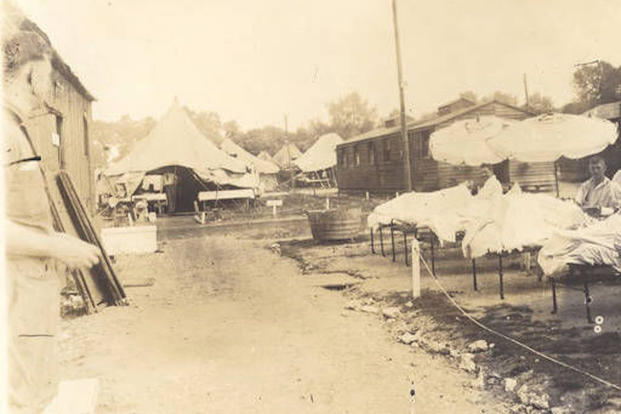 Base Hospital 21 patients were sometimes allowed to sit outside and get some sun. The hospital sponsored by Washington University School of Medicine was located outside of Rouen, France during World War I. Photo courtesy of Becker Medical Library.When he came back to St. Louis, Murphy recruited dozens of doctors, nurses, medical students and other personnel from the university and then-Barnes Hospital to form their own hospital to relieve British and French medical officers.
Soon after the U.S. declared war with Germany, the St. Louis medical team shipped out in May 1917, becoming some of the first Americans to reach the European war zone.
U.S. Army Base Hospital 21 was assigned to Rouen in the Normandy region of France as one of several hospitals formed by American medical schools to serve sick and injured soldiers and civilians.
The medical unit was segregated, with African-American doctors and nurses serving in separate clinics set up by the Army.
Some of the volunteers at the hospital were members of St. Louis' high society, including nurses Rachel Stix Michael, Mary Kennard Wallace and Julia Holmes Francis, daughter-in-law of David R. Francis, former St. Louis mayor, Missouri governor and U.S. ambassador to Russia.
Julia Stimson, then-chief nurse at Washington University, was promoted to head of nursing for the Red Cross after her service at Base Hospital 21.
Read more: A St. Louis Hospital Opened in France During World War I
Artist soldiers: Their self-expression and humanity in WWI is revealed in exhibit
By Nicole Bauke
via the MilitaryTimes.com web site
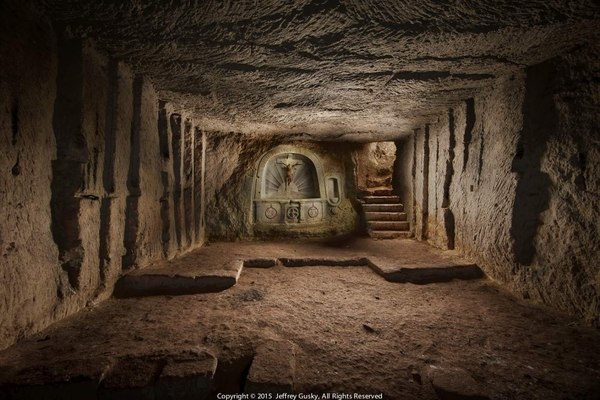 A chapel in one of the underground cities. "When you're standing in this space, it's very easy to imagine a soldier standing in that very spot, contemplating what they were about to face, making their peace, and then going on up to battle," said Peter Jakab, chief curator of the Air and Space Museum. (Jeff Gusky)In underground quarries, spanning for miles underneath the surface of the quiet French countryside, abandoned, make-shift cities hold touching remnants of World War I.
Sleeping quarters, places of worship, even tables still littered with mess kits, are hidden 50 feet underground, unknown to many people and even historians.
Accompanying these artifacts are drawings, carved into the walls of these cavernous quarries, signatures of the individuals, on both sides of the fight, who came together to serve in the war.
“They created a human world with artwork, with a lot of messages to the future, and jokes and notes to loved ones,” said Jeff Gusky, an artist and physician who explored these cities in 2012. “They recreated, the best they could, a human world underground when the surface of the earth became inhuman.”
When Gusky first saw the carvings, he was awed by the humanity and the humanness that can be found within them, even though their creators were in the midst of fighting a war to change all wars.
His photographs make up half of a current art exhibit at the Smithsonian National Air and Space Museum, titled “Artist Soldiers: Artistic Expression in the First World War.” Artist Soldiers is the centerpiece of the museum’s four-year observation of WWI.
“WWI gives us a language to see ourselves, and how, if we lose humanness we are finished,” said Gusky.
Read more: Artist soldiers: Their self-expression and humanity in WWI is revealed in exhibit
World War I helped shape U.S., Nebraska future
By Kerri Rempp
Editor, The Chadron Record, via the Rapid City Journal web site
World War I led to “ultra-patriotism,” the build-up of American forces and military facilities and had long-term impacts on society.
That was the take-away from a presentation Thursday, February 22 by Sandra Reddish, a historic sites coordinator for the Nebraska State Historical Society, at the Mari Sandoz High Plains Heritage Center. Her presentation, which drew about 30 people, was meant to highlight the center’s current exhibit, “Over Here: Americans at Home in World War I. The exhibit runs through March 12. Reddish explored the context of WWI and displayed several items from her personal collection of WWI era items, including uniforms, a suitcase Victrola and a 1918 record, and postcards.
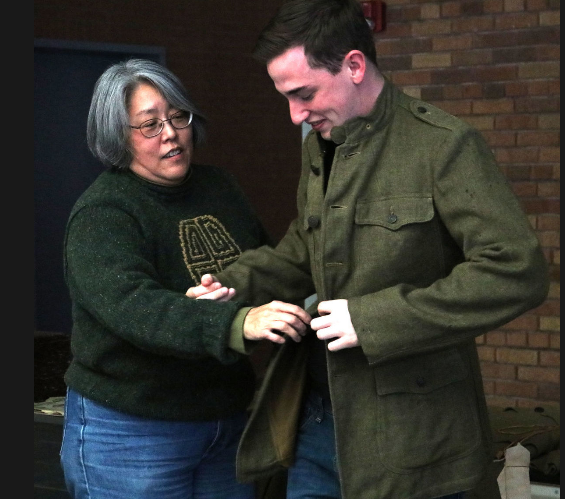 Sandra Reddish (left) assists volunteer Cristian Hulsey of Alliance into a WWI uniform from her collection. Reddish spoke about the era and showcased some of her artifacts at the Mari Sandoz High Plains Heritage Center recently. (Rapid City Journal)The war started in August 1914, and early players believed it would be over by Christmas.
“For some reason people think war’s going to be short,” Reddish said.
Most American citizens didn’t want the country entering the war, and the 1915 song “I Didn’t Raise My Boy to Be a Soldier” became a popular tune.
“That’s the sentiment of the nation,” Reddish explained.
By April 1917, when America entered WWI, that sentiment had changed, in large part due to three things: the sinking of the Lusitania, an explosion at Black Tom Island that was the work of saboteurs, and the Zimmerman Telegraph.
But the U.S. was a nation unprepared for war, with only 121,797 men enlisted, a lack of equipment and weapons and no planes or tanks. The country created a draft to build up its military, and on June 5, 1917, the first day of the draft, 9 million men enlisted. America learned its lessons from the Civil War draft, keeping the procedure at a local level and drumming up support with lots of fanfare.
“They made it a huge community deal,” Reddish said.
Deferments were granted for sole providers with dependents, agricultural and industrial workers.
Dawes County enlisted 838 men June 5, 1917, and by September of the next year had enlisted 2,061. The county granted deferments for 265 men with dependents, 97 agricultural and 26 industrial workers.
America was also unprepared in terms of facilities and had to build training camps throughout the U.S. Most Nebraskan soldiers ended up shipping out to Kansas or Iowa, a point in history Reddish finds peculiar.
W. E. B. Du Bois, World War I, and the Question of Failure
By Chad Williams
via the Black Perspectives web site of the African American Intellectual History Society
2018 marks both the sesquicentennial of W. E. B. Du Bois’s birth and the continued centennial of World War I. That convergence of commemorations offers a unique opportunity to reflect on Du Bois’s legacy as it relates to the war, a pivotal moment in his long life and career.
From the opening guns of August 1914 until his final days, Du Bois wrote extensively about the war and reflected on its significance. For Du Bois, the war marked not only an epochal historical event, it was deeply personal.
I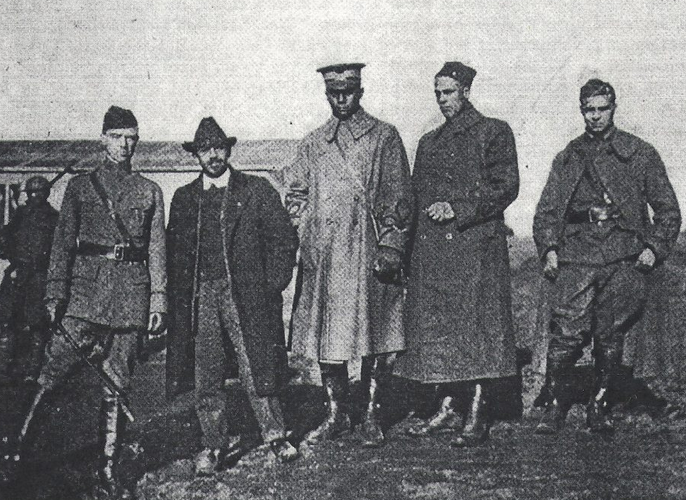 W. E. B. Du Bois with black officers in Le Mans France 1919 (The Crisis June, 1919)n his book Darkwater, completed in the wake of the armistice and in the midst of the “Red Summer” of 1919, Du Bois asked a poignant question: “How great a failure and a failure in what does the World War betoken?”
This question remains haunting. But what would it mean, in the context of the history and memory of the war, to view Du Bois himself as a failure? Approaching Du Bois this way is generative for not only understanding his complicated relationship to the war, but also for problematizing his commanding, yet often romanticized, presence in African American intellectual history.
In reckoning with the idea of Du Bois as a failure in the context of the First World War, I am less interested in what he published than I am in what he did not publish.
For most of the interwar period, Du Bois labored to write what he believed would be the definitive history of the Black experience in the war: The Black Man and the Wounded World. He produced an 800-page manuscript comprised of twenty-one chapters that examined the causes of the war, its impact on the African diaspora, and, most centrally, the role of Black soldiers in the conflict. It would have been a monumental book, rivaling Black Reconstruction as Du Bois’s most ambitious work of history. But The Black Man and the Wounded World went unpublished.
The story of Du Bois’s failed attempt to write and publish The Black Man and the Wounded World is long and complex. In lieu of telling the full story, I highlight three specific dilemmas related to this project that speak to the troubling place of World War I in Du Bois’s life and mind.
Read more: W. E. B. Du Bois, World War I, and the Question of Failure
- Letters by America’s first enlisted women reveal motivation, conflict of WWI service
- African-American WWI 'Harlem Hell Fighters' proved their mettle, patriotism in combat
- 'Fox & Friends' show tapes segment on National World War I Memorial in Washington, DC
- New National WWI Memorial design continues to gain ground