




























100 Cities - 100 Memorials

Memorial Inventory Project: There is one other existing partial database to consult - The WWI Memorial Inventory Project [CLICK HERE]. It contains some memorials our map doesn't. The listings on this database are fair game for the Memorial Hunters Club. So if you want to search for treasure from your desk - find missing listings here and submit them. Remember though, you will need to come up with pictures and the history of the memorial. You might be able to hunt that down through www.Proquest.com and Google.
- Details
- Width: 4'
- Other Measurements: Eagle H:2'
- 1920
- Dedication Date: 1920
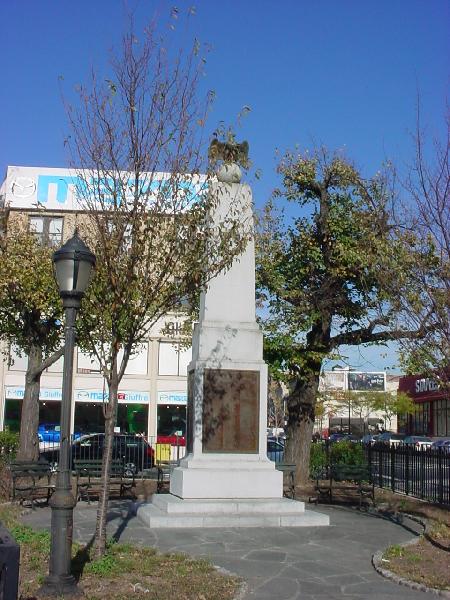
- Citizens of Fort Hamilton
- Obelisk topped by eagle, four plaques
- John Polachek Bronze & Iron Co.
- J.Sarsfield Kennedy
- Column or pillar
- Plaque 1:
1917 --- ERECTED BY THE --- 1919 / CITIZENS OF FORT HAMILTON / IN MEMORY OF OUR MEN / WHO DIED IN THE WORLD WAR / AND IN HONOR OF THOSE / WHO ANSWERED THEIR COUNTRY'S CALL / DIED / [24 names] / ROLL OF HONOR / EDWARD A. WALLACE, CHAPLAIN / [120 names] /
Plaque 2:
ROLL OF HONOR / [67 names]
Plaque 3:
ROLL OF HONOR / [198 names]
Plaque 4:
ROLL OF HONOR / [68 names] /
- Details
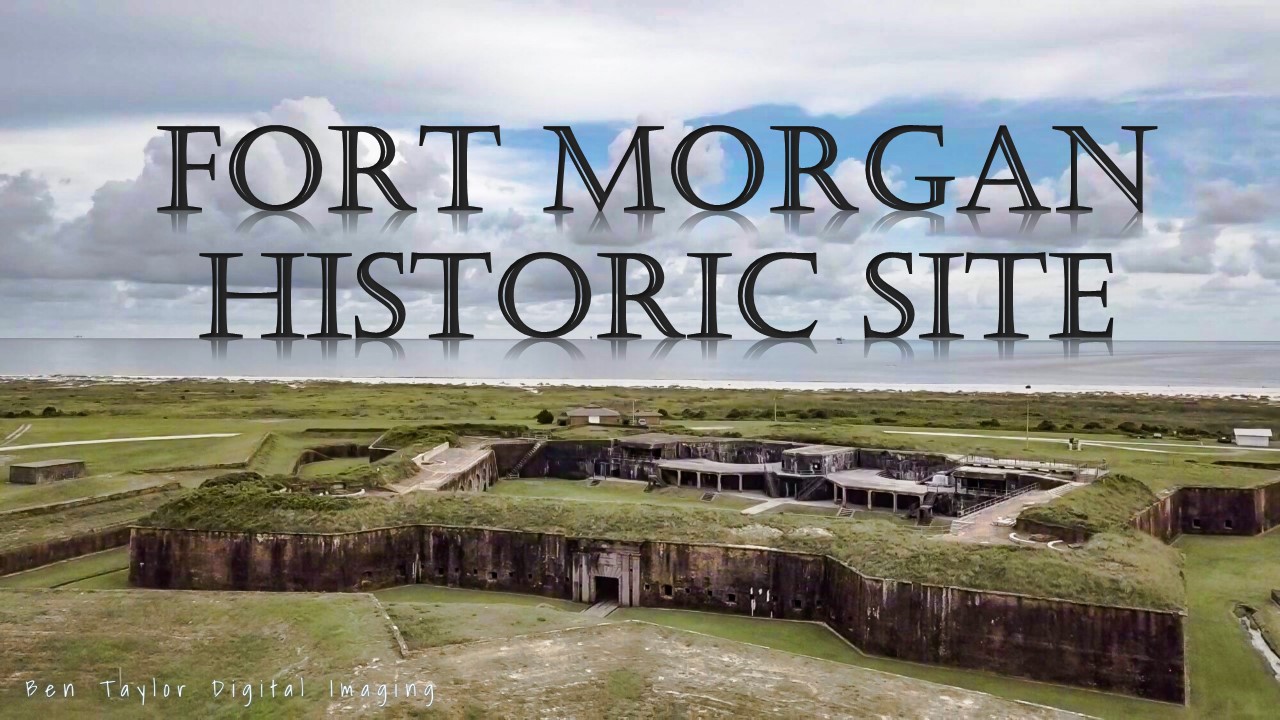
At this fort, built between 1819 and 1834 and named for Revolutionary War hero Gen. Daniel Morgan, is located a museum which contains military artifacts from the War of 1812 through World War II. Included are a U.S. Model 1918M1 155mm Gun and Model 1918A1 Carriage. The fort had been converted to a park in 1927, but in 1941 it was reactivated for use by the Army, Navy and Coast Guard. The harbor was protected by artillery placed here, and patrols headquartered here used jeeps and horses to watch the beaches. After World War II it was again used as a park.
- Details
- City hall/town hall
- Memorial Hunters Club Submission: Memorial Hunter: Barrett Young
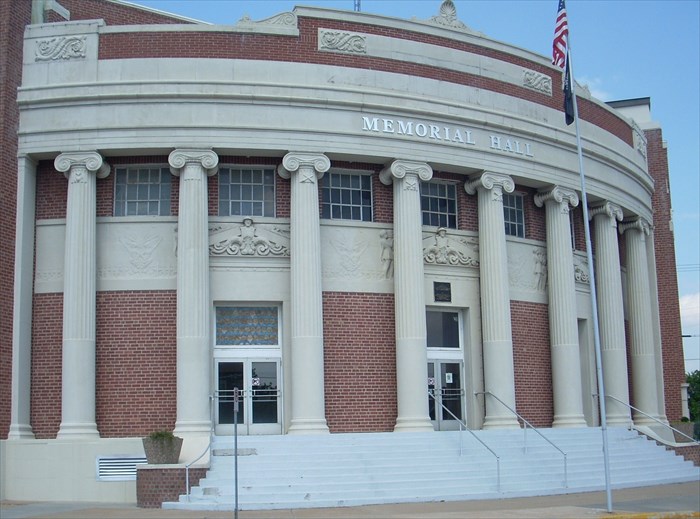
Description and photo from http://www.waymarking.com/waymarks/WM6NQ1_1932_Memorial_Hall_Fort_Scott_Ks
Memorial Hall is still used as a multi-purpose building. Concerts and other functions are held in the main auditorium. The offices below, which once housed the American Legion Post for Fort Scott, now house Fort Scott City Hall.
The Cornerstone Reads:
Memorial Hall Headquarters
Clair C Harkey Post No. 25 and Auxiliary
Dedicated May 30, 1932
There is a dedication plaque above the main entryway that reads:
1925
Memorial Hall was
constructed and dedicated to
"Those men and women who gave their lives
serving our country in World War I"
2001
Memorial Hall is rededicated to
"All of the men and women who have served,
are now serving or will serve
in the Armed Forces
of the United States of America"
- Details
- Memorial Hunters Club Submission: Deborah Williams
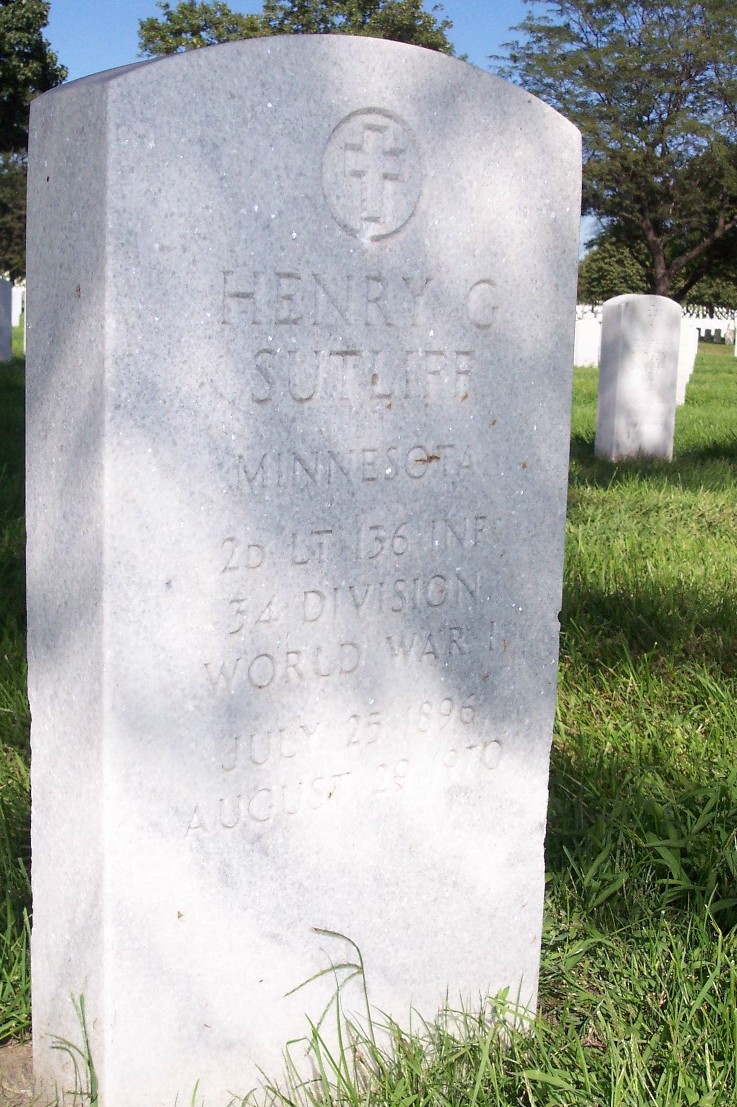
Fort Snelling National Cemetery is located in Minneapolis, Minn. The original Fort Snelling was established in 1805 near the confluence of the Minnesota and Mississippi rivers. However, it was not until 1820 that a permanent post named Fort St. Anthony was constructed under the supervision of Col. Josiah Snelling. Gen. Winfield Scott was so impressed with the conditions at Fort St. Anthony during his first inspection in 1824 that he recommended the installation be renamed Fort Snelling.
Its original purpose was to keep peace on the western frontier, but in 1855 as the frontier moved further west, troops were withdrawn from Fort Snelling. With the outbreak of the Civil War, the fort was reopened and functioned as both an assembly ground and training camp for Minnesota volunteers. It remained open at the end of the Civil War and continued to be used as a training center. In 1947, the Fort Snelling Military Reservation was deactivated as a post, although it continues to function today as the headquarters for the 88th Army Reserve Command.
The Fort Snelling cemetery was established in 1870 to serve as a burial ground for the soldiers who died while stationed at the post. Following World War I, as new legislation expanded the eligibility requirements for burial in a national cemetery, the citizens of St. Paul organized a petition to designate a national cemetery in their area. In 1937, Congress responded with legislation that authorized a portion of land at Fort Snelling Military Reservation for this purpose. Fort Snelling National Cemetery was established in 1939 with the first burial on July 5, of Capt. George H. Mallon, whose acts of heroism at Meuse-Argonne in France were recognized with the Congressional Medal of Honor. Following the dedication of the new cemetery, arrangements were made for the exhumation of the remains of those buried at the older post cemetery and the reinterment of the 680 soldiers who served from 1820-1939 buried in Fort Snelling National Cemetery. The 1930s were also a major boom era for national cemetery growth. Fort Snelling National Cemetery is one of seven NCA properties developed during the period between World War I and World War II to serve large veteran populations in cities across the country.
In May 1960, Fort Snelling Air Force Station transferred 146 acres of land to the national cemetery. One more land transfer of 177 acres followed in 1961, bringing the cemetery to its present size. Because of the frigid winters, about 1,000 graves are dug each fall to be used for winter interments.
Fort Snelling National Cemetery was listed on the National Register of Historic Places in 2016.
- Details
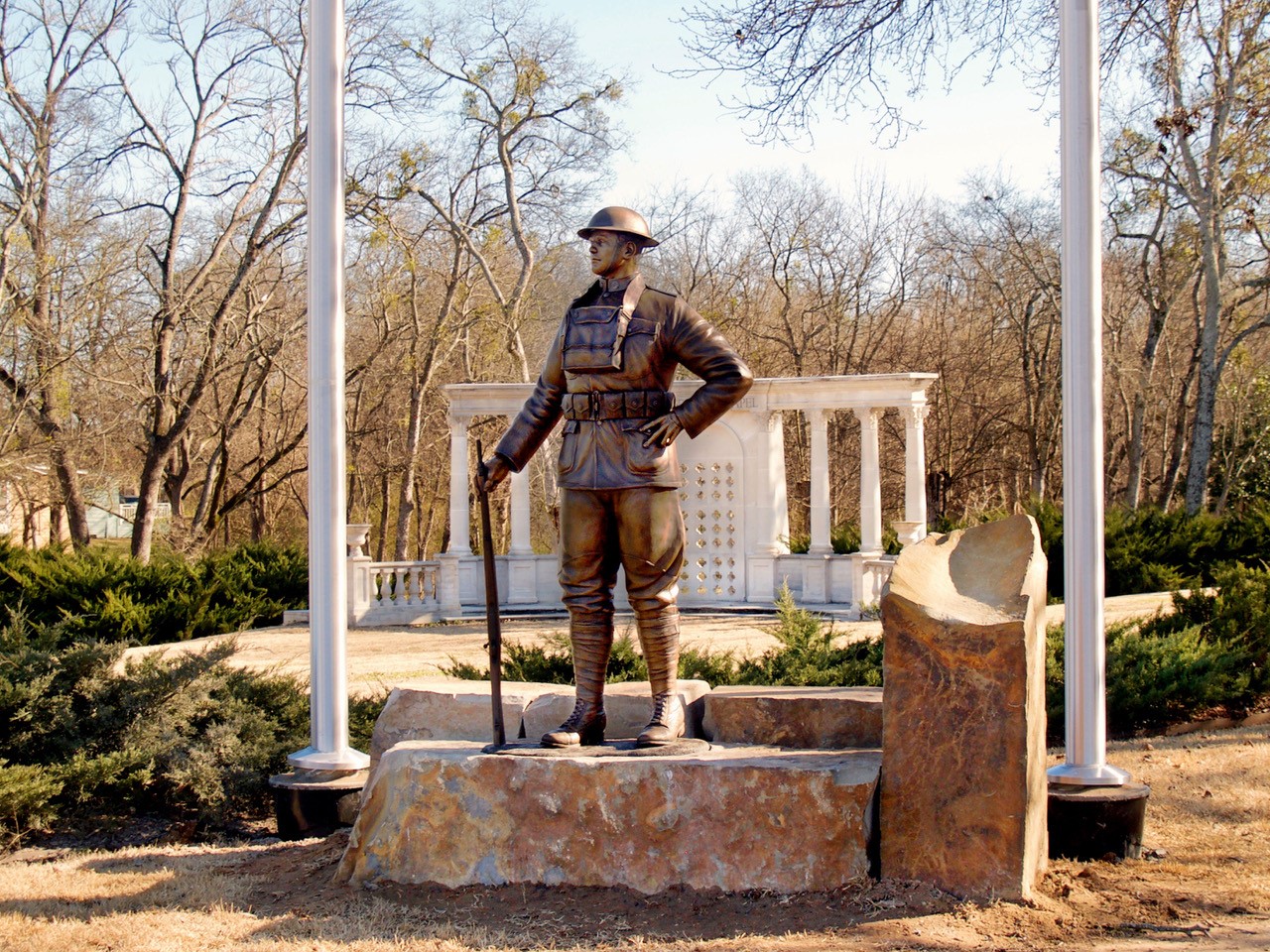
Fort Towson World War I Memorial
100 Cities / 100 Memorials
 The Fort Towson World War I Memorial honors the memory and sacrifices of all the brave men from Fort Towson, Choctaw County and the State of Oklahoma who served and/or gave their lives in World War I. The memorial was completed in 2018 on the centennial of the Great War. To understand the history of the Fort Towson World War I Memorial, one must go back to the mid-1990’s when Margie Hopson Motley made the decision to give back to the little town in Oklahoma where she grew up during the Great Depression. Margie Hopson was born on September 26, 1922 in Ardmore, OK and moved to Fort Towson, OK in 1924 where she lived until 1935 with her parents, Cecil & Jimmie Hopson. Cecil Hopson served in World War I, initially in the Cavalry Corps and later in the Tank Corps, and died at the relatively young age of 47 due to complications from exposure to mustard gas in World War I. For this project Hopson Motley commissioned a new Doughboy statue in the likeness of Cecil, refurbished a local Towson park, installed a memorial arch and flagpole and even purchased the old library building across the street to install a WWI museum. She did all this as a part of the centennial of WWI, to honor her father Cecil and the town in which she grew up. Sadly, Margie Hopson Motley passed away in January 2018; she was 96 years old.
- Details
- Dedication Date: June 17, 1949
- Bench
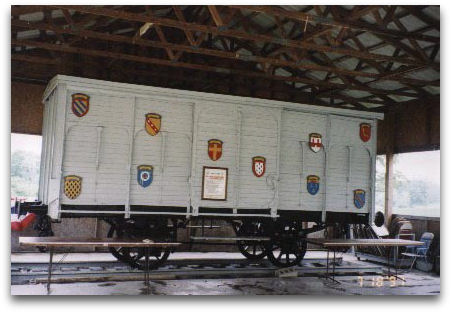
"The Merci Train was a train of 49 French railroad box cars filled with tens of thousands of gifts of gratitude from at least that many individual French citizens. They were showing their appreciation for the more than 700 American box cars of relief goods sent to them by (primarily) individual Americans in 1948. The Merci Train arrived in New York harbor on February 3rd, 1949 and each of the 48 American states at that time received one of the gift laden box cars. The 49th box car was shared by Washington D.C. and the Territory of Hawaii. Parades and ceremonies of welcome were conducted in the state capitols and major cities of almost all the states. The largest and most attended was in New York City where more than 200,000 people turned out to welcome that state's assigned box car."
-Excerpt from http://mercitrain.org/
- Details
- Memorial Hunters Club Submission: Robert Shay, PH3, USNR-R, 1964-70
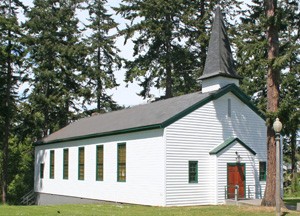
Dedicated to : Colonel Edmond P. Easterbrook, WW1 era Chaplain
Puget Sound Harbor Defense, 1905 - 1918
Puget Sound Harbor Defense Command in World War 1 consisted of Fort Worden, Fort Casey and Fort Flagler, designated the “Triangle of Fire”. These forts alongwith fortifications at Fort Ward and Fort Whitman were built in1898 to protect the America’s critical military asset, The Puget Sound Naval Ship Yards at Bremerton, WA from the Spanish Fleet, in the Spanish American War. Due to the advent of the airplane in warfare, the importance of the fortifications were downgraded, and theforts were used in both WWI & WWII for training purposes.
Also, he was appointed as the 2nd Chief of United States Army Chaplains, 1928 - 1929
- Details
- Memorial Hunters Club Submission: Hollace Weiner
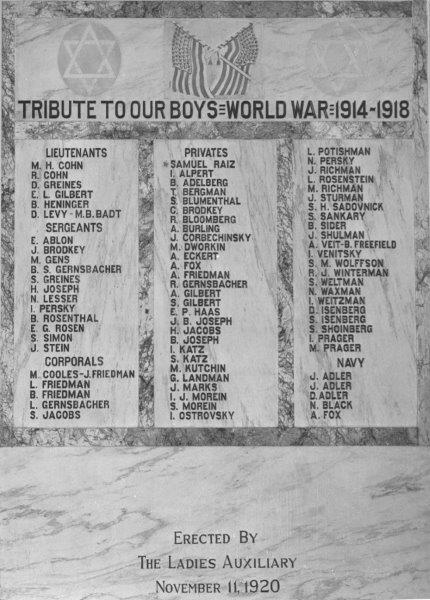
Marble honor roll of 81 Jewish doughboys was unveiled Nov. 11, 1920, and embedded in a wall at Fort Worth's Hebrew Institute. The marble montage was 10 ft. tall and 8 ft. wide. It was made from 5 tablets. The frieze across the top was inscribed with 2 Jewish stars and 2 American flags. The title reads: TRIBUTE TO OUR BOYS=WORLD WAR=1914-1918. In 1951, the marble montage was broken into 5 slabs and stacked in a storage closet. Rediscovered in 1980, four panels were framed and hung in a garden by the entrance to a Congregation Ahavath Sholom's new synagogue at 4050 S. Hulen. The 5th tablet, inscribed with the dedication date and the sponsors, the Ladies Auxiliary to Hebrew Institute, was discarded. Exposed to wind, sun, and rain, the colors on the monument faded until it was white-on-white and only legible up close. However, the memorial has since been restored, as can be seen in the picture gallery. Many soldiers' descendants still live in Fort Worth.
Location:
4050 South Hulen, Congregation Ahavath Sholom, west entrance facing 4800 Briarhaven Lane
Fort Worth, TX, 76116
- Details
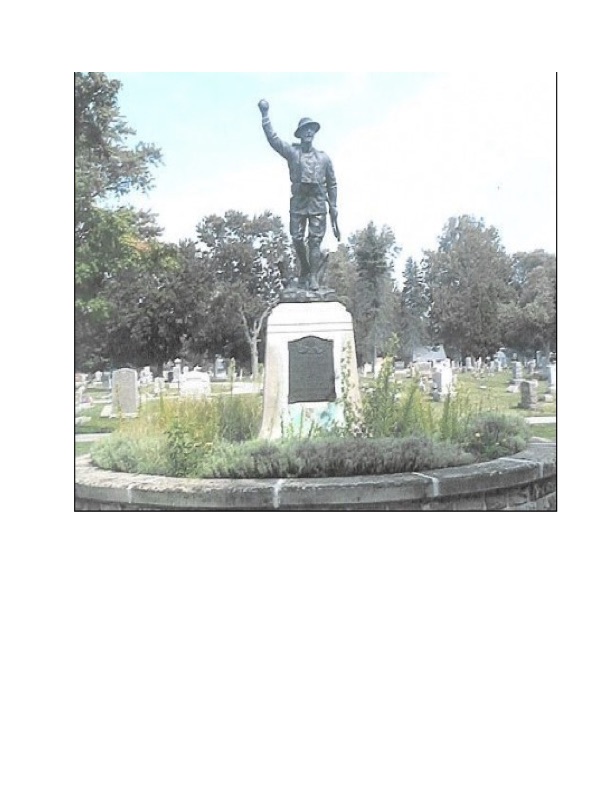
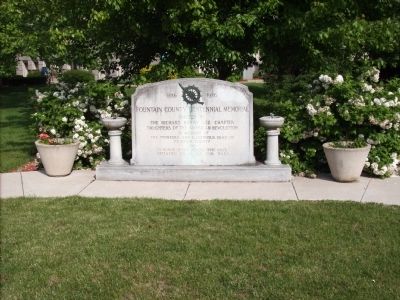
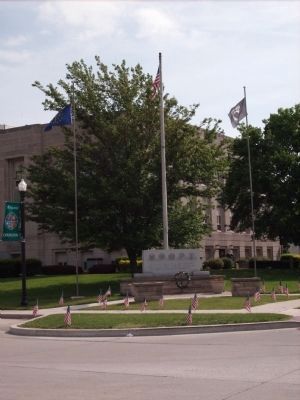
This life-size metal statue, sponsored by the Service Star Legion War Mothers, depicts a WWI infantryman advancing through the barbed wire and stumps of No Man's land. He carries a rifle and a grenade. Beneath is a stone pedestal with a plaque bearing a flag insignia. It was dedicated in 1927 to honor the veterans of WWI.
Dedicated November 11, 1927 on the grounds of old Fostoria High School with the high school band providing music for the ceremony. Mrs. W. S. Finkbein, state president of the Service Star Legion War Mothers, presented the memorial. Acceptance remarks were given by Fostoria Mayor L. W. Gibson and school board President Fred Freese and Bowling Green Mayor F. J. Reider. Mrs. E. H. Retan, a Gold Star Mother, was escorted to the base of the statue by the color guard of the Service Star Legion and was assisted in the unveiling by a Boy Scout as Taps was played.
In 1969, the Doughboy, including its pedestal, was moved by moving contractor Ludwig Berwick to Fountain Cemetery and placed inside a circular stone area containing flowers. Damages were repaired, the bayonet was replaced, and the Doughboy was rededicated May 30, 1969.
The Doughboy received reasonable maintenance at the cemetery, but the years of exposure to the elements took their toll and a major restoration fundraising campaign was undertaken in 1995 to obtain donations of citizens and of Veteran, Fraternal Civic and other organizations. The restoration was performed under the supervision of Tom Podner, McKay Lodge Fine Arts Conservation Laboratory, Oberlin, Ohio.
Fostorian Frank Kirian provided expert advice during the restoration project. Frank and Royetta Kirian visited over 80 Doughboy sites through the years. They were physically looking for them before T. P. Wesley of Spencer, Indiana sent the 1991 letter to Home and Away magazine to solicit information about their locations. While they didn’t previously know Mr. Wesley and Mr. Wesley didn’t know them, when the Kirians learned of the letter, they took all the photos they had to Mr. Wesley in Spencer. Mr. Wesley told me (Earl Goldsmith) of them the first time we talked – and later told me of the Forstoria restoration mentioned above. They were undoubtedly his favorite Doughboy searchers. and have probably seen more standing Doughboys than anyone.
- Details
J.W. Kennedy sculpted this fountain of white Vermont marble, as a round basin on a square base. Arising from the basin is a shaft, atop which is a bronze eagle, whose wings are spread protectively around a globe. A long plaque on the sides of the shaft list the Kearney County residents who served in WWI.
This was initiated by the Ladies Auxiliary of the American Legion, and was the first monument in Nebraska which was erected after state law gave cities the right to tax its citizens to build monuments. Originally, there were ten bubbling cups in the fountain, one for each Kearney County resilient who died in WWI. They are now missing.
- Details
- Dedication Date: 1920
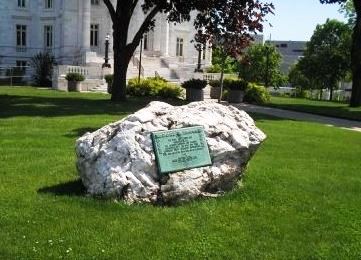
This WWI plaque is mounted on a mortared stone "boulder" on the grounds of the Somerset County Courthouse. The bronze plaque contains the American Legion logo flanked by L-shaped garlands with flower corner blocks.
The plaque reads, "To the citizens of Somerville in appreciation of their hospitality in 1917 to the Fourth New Jersey Infantry. We also speak for those who sleep in France."
It was presented by the Fourth Infantry Post of the American Legion on Decoration Day 1920.
Photos courtesy of:
"Boulder" - Bill Coughlin & Historical Marker Database
Plaque - RC & Historical Marker Database
- Details
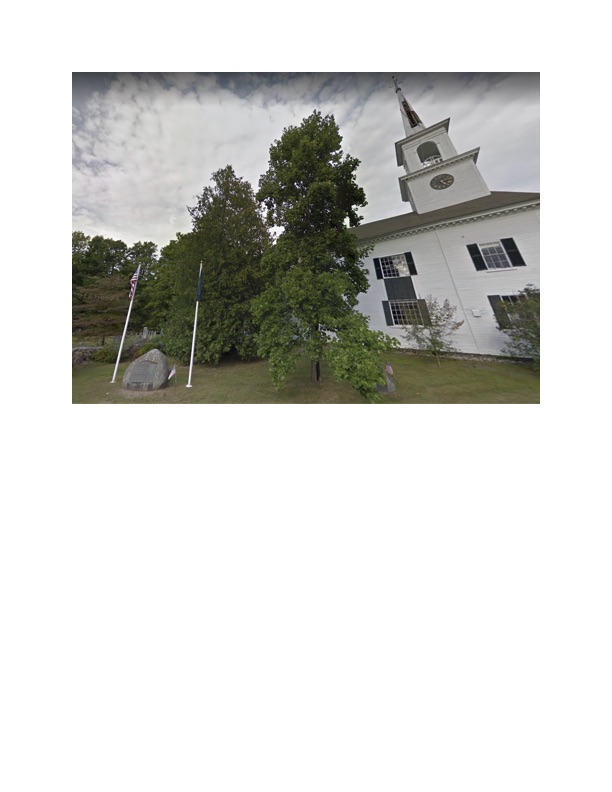
On the side of a large granite boulder is a bronze relief plaque with a laurel branch and a scene of WWI soldiers marching in formation, each carrying a rifle over his right shoulder. A single figure leads them, and there are two flags in the background. It was sculpted by Theo A.K. Kitson for $400 and dedicated in 1920 in memory of the men of Francestown who served in WWI.
- Details
This is a life-size Italian marble WWI soldier wearing a thigh-length coat, helmet, and britches. He stands at parade rest holding the barrel of his rifle, whose butt is near his left foot. Beneath is a marble base which has a central pedestal flanked by wing-like pieces. It was dedicated on September 4,1929, as a tribute to the eight citizens of Frankfort who died in service in WWI.
- Details
- Dedication Date: November 11, 1995
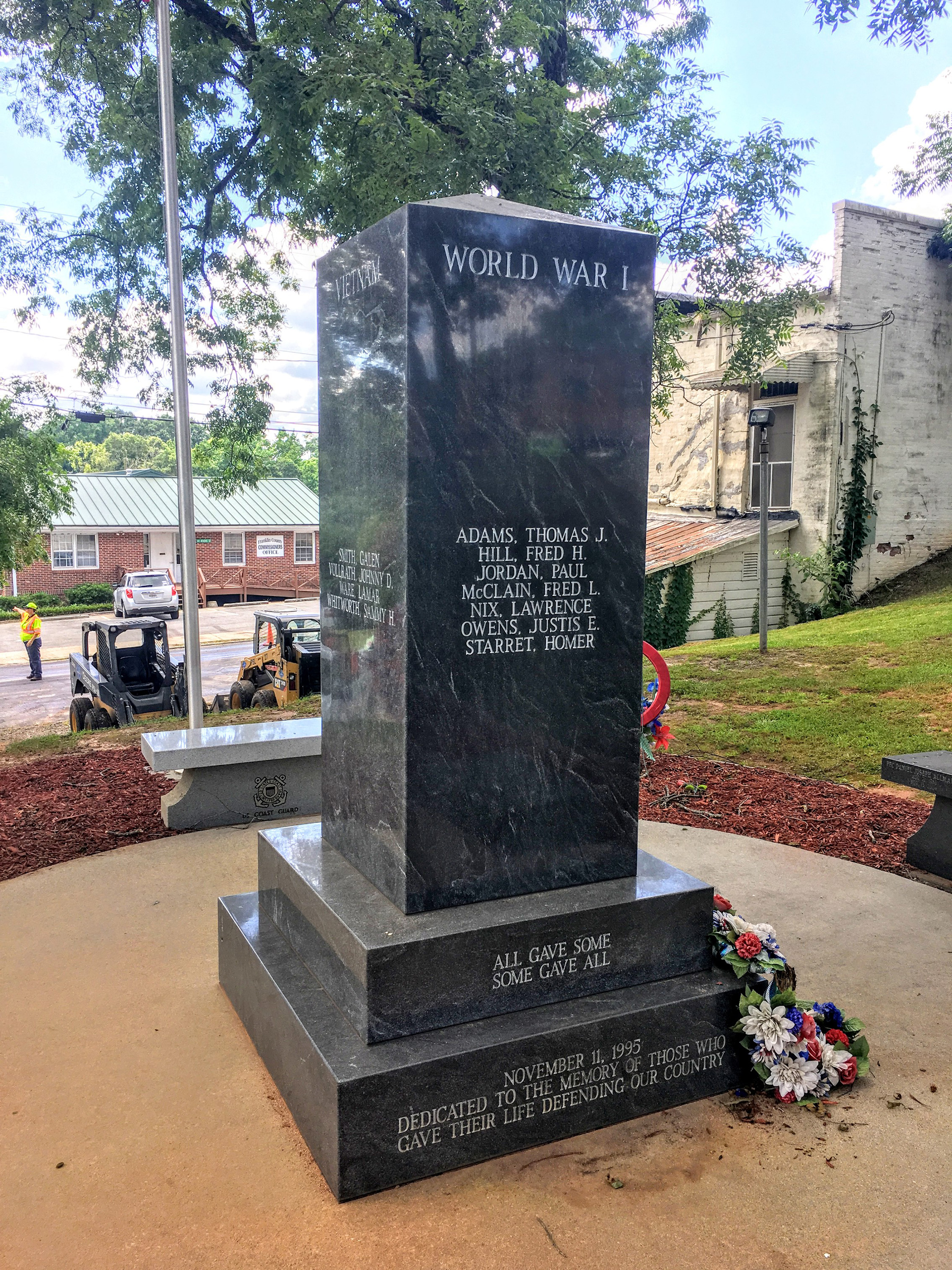
Inscription – “Dedicated to the memory of those who gave their lives defending our country”. VFW Post 4828, VFW Post 5897, American Legion Post 92, All Who Contributed”.