































World War I Centennial News
ASALH calls for papers on "Black Migrations" topic for 2019 program
By Chris Isleib
Director of Public Affairs, United States World War One Centennial Commission
The Association for the Study of African American Life and History (ASALH) has announced a new opportunity for scholars, especially those with interest in World War I, as it relates to the African-American community.
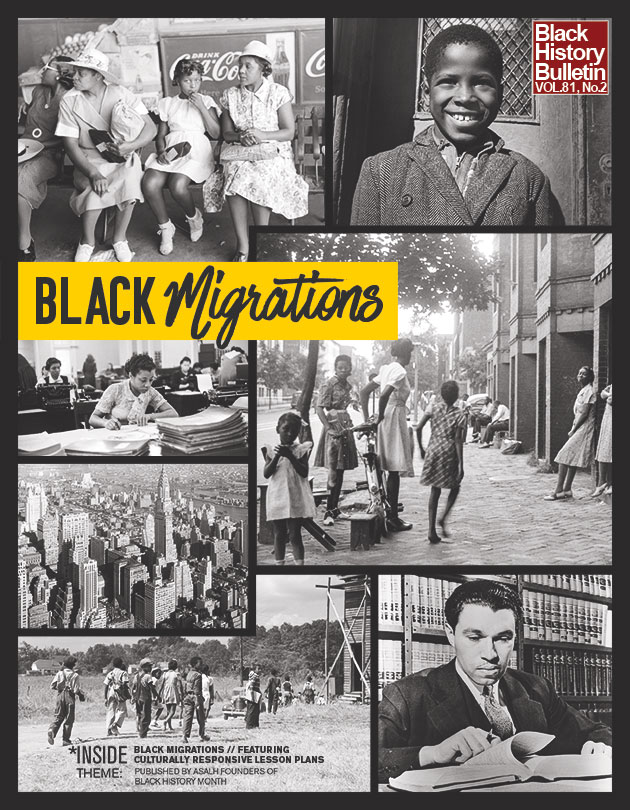 The 2019 ASALH Academic Program Committee invites comprehensive proposals for individual papers, panels, performances, films, round-tables, workshops, conversations, or alternative formats focused on the 2019 theme, “Black Migrations.”
“Black Migrations” spotlights movement to new destinations and subsequently changed social realities for people of African descent. While inclusive of earlier periods and global spaces, this theme centers on the American twentieth and twenty-first centuries. African American migration patterns included relocation from southern farms to southern cities; transition from the South to the Northeast, Midwest, and West and from the Caribbean to US cities; along with African American emigration to Africa and to European cities, such as Paris and London, in the post-world war periods.
These multifaceted migrations resulted in a more diverse and stratified interracial and intra-racial urban population amid a changing social milieu. Migrations cultivated Garvey movements in New York, Detroit, and New Orleans; the emergence of both black industrial workers and black entrepreneurs; the growing number and variety of urban churches and new religions; new music forms like ragtime, blues, and jazz; white backlash demonstrated in the 1919 Red Summer; the blossoming of visual and literary arts, as in New York, Washington, D.C., Chicago, and Paris in the 1910s and 1920s; and much more.
The theme Black Migrations equally lends itself to the exploration of other spatial and social perspectives, with attention to “new” African Americans because of the burgeoning African and Caribbean population in the US; African Americans’ return to the South; racial suburbanization; inner-city hyperghettoization; health and environment; civil rights and protest activism; electoral politics; mass incarceration; and dynamic cultural production.
2019 also marks the commemoration of 400 years of perseverance against enslavement. As such, we are looking for panels and papers that more fully interrogate this legacy of kidnapping and forced migration while honoring the resistance and resilience of black people throughout the diaspora.
The Program Committee seeks a diverse slate of presenters and panels representing a variety of professional and institutional backgrounds, perspectives, and voices. We are interested in detailed, comprehensive, and descriptive proposals that outline the theme, scope, and aim of participants.
Read more: ASALH calls for papers on "Black Migrations" topic for 2019 program
From the World War I Centennial News Podcast
Remembering Veterans: Erin Fehr
 On January 11th's edition of the WWI Centennial News Podcast, Episode 105, archivist Erin Fehr spoke with host Theo Mayer about a new online venture to commemorate the service of American Indians in the Great War. The following is a transcript of the interview, edited for clarity:
Theo Mayer: Today we're really pleased and excited to welcome another wonderful information resource to the fold: ww1cc.org/americanindian, all one word, all lower case. You'll find an exciting new resource focused on commemorating and sharing the service and experience of American Indians in World War I. With us is Erin Fehr, Archivist at the Sequoyah National Resource Center at the University of Arkansas in Little Rock to tell us about it. Erin, welcome to the podcast.
Erin Fehr: Thank you for having me.
Theo Mayer: Erin, tell us about the project and how you got involved in it.
Erin Fehr: Well, it began in the fall of 2017 when we put together an exhibit on the code talkers of World War I. We wanted to do something as a commemoration to the centennial of the war and we decided what better topics than to talk about the code talkers who had a very unique role.
Theo Mayer: The code talkers were typically thought of as World War II but these are the code talkers from World War I.
Erin Fehr: Right, the Navajos in World War II steal the spotlight but the code talkers program began in the First World War. Due to their success in the First World War, it was used on a much larger scale in the Second World War.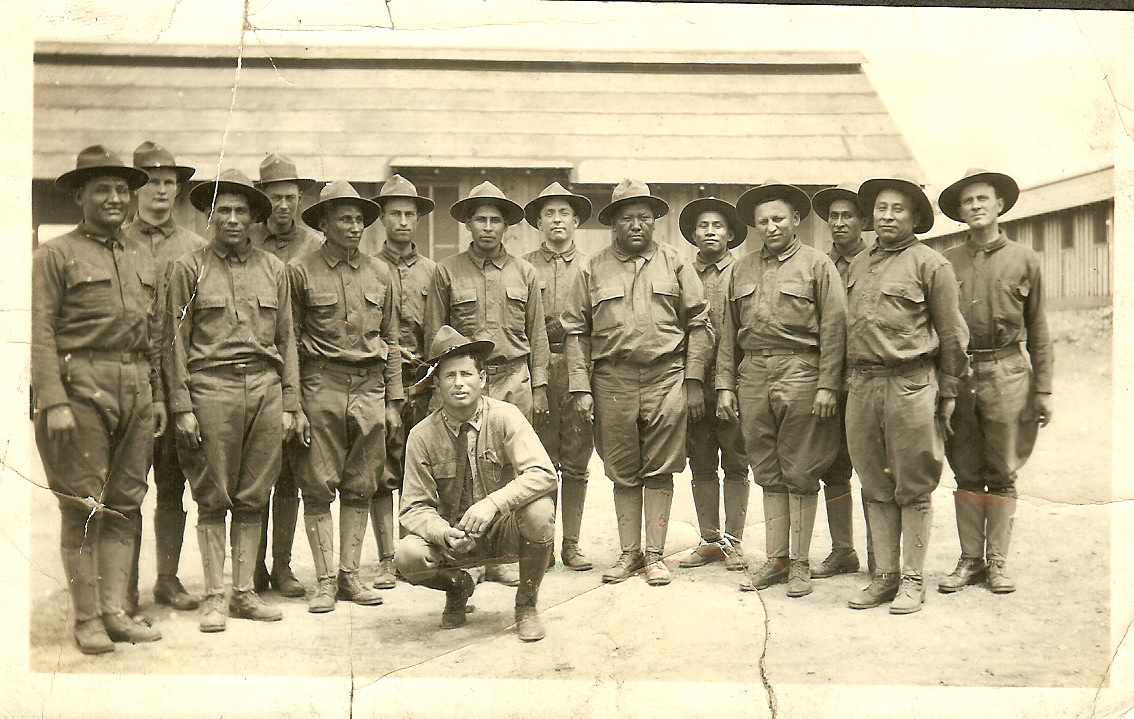 Captain Ben Davis Locke (Choctaw), in front, with American Indian soldiers at Camp Stanley, 1918. Courtesy of Francine Locke Bray. (from https://www.worldwar1centennial.org/american-indians-in-ww1-centennial-home.html)
Theo Mayer: That's how it started and then it expanded from there.
Erin Fehr: Correct. Because of the publicity that we've received from that exhibit, Véronique Lozano, who is the administrator for the Facebook page World War I Native American Warriors, contacted us on behalf of the Commission asking us if we would be willing to create a website on American Indian involvement in the war.
Theo Mayer: Tell us a little bit about your organization.
Erin Fehr: We began in 1983 and we are now the world's largest collection of Native American newspapers and periodicals. In addition to that, we also collect manuscript collections, DVDs, music, anything that could be considered a form of expression of Native Americans.
Theo Mayer: What was the Native American experience like during World War I?
Erin Fehr: Well, there were approximately 12,000 American Indians who served during the war. Many of those were recruited from the federal boarding school system, and these boarding schools were created as a way to assimilate American Indians into mainstream white society. The US needed to build a military because we did not have a large military at that time, and so one of the places that they went to were the boarding schools to recruit these students.
From the World War I Centennial News Podcast
A Century in the Making: An Interview with National Memorial creative team Joe Weishaar and Sabin Howard
In Episode 105 of the WW1 Centennial News Podcast, which aired on January 11th, 2019, we heard from two people who are integral to the creation of the National Memorial: lead designer Joe Weishaar and sculptor Sabin Howard. The following is a transcript from a recent event in Washington, D.C., edited for clarity.
Theo Mayer: Now, our newer listeners may be surprised or even shocked to learn that there's no National World War I Memorial in Washington, D.C. We honor the veterans of every other major conflict of the 20th century in our nation's capital except World War I. To fix that, the U.S. World War I Centennial Commissions Capstone Project is the creation of the memorial. During the centennial of the armistice, we held events in D.C. At the site of the future memorial. At one of these events, the project's lead designer, Joe Weishaar, and sculptor Sabin Howard spoke about the evolution of the project and how they got together. Here are Joe and Sabin.
 Joe Weishaar, designer of the new National World War I Memorial in Washington, DC.Joe Weishaar: Back in June of 2015, I was working in an architecture firm in Chicago and I came across a competition online and it said World War I Memorial and I said, "Okay, that's interesting." And followed the link and it said National World War I Memorial in Washington, D.C. I didn't know that there wasn't a World War I Memorial in Washington, D.C., I didn't know hardly anything about World War I at all. Maybe a week and a half, two weeks worth of high school education devoted to the subject tucked somewhere between the start of the century, Great Depression, World War II, they just jammed it in there. I clicked on the link and it took me to the World War I Commission website that had all these great links to the National Archives, and I started clicking on pictures. I don't know how many hours later I looked up probably after 10,000 pictures, the one that got me into this process more than any other image that I ever looked at and it's of two young guys down in a trench covered in mud. But they're doing relatively normal things, and I had this very instant powerful connection to them because the caption just said, "Two rural farm boys in a trench in World War I." I'm from Arkansas, originally, and I thought to myself, "If I was alive 100 years ago, I could have been one of those guys. They look like they're 25 or so, I was 25 [at the time] and that would have been my life." So I felt a very deep personal connection with them and so then I followed the other links and being an architect I submitted the design and didn't think anything of it until they called me back two and a half months later and said, "Are you sitting down?"
I think at the start we had something crazy like 324 linear feet of sculpture, it was insane. I sat down with the commission at the very first meeting and they said, "How are you going to do this?" And I said, "Oh, I'm 25, I have no idea. Maybe I'll sculpt it myself. I don't know how to do this." I did what any 25-year-old would do, I googled "sculptor," and got this huge range and so I said, "Okay, well we'll have to use Americans on this." So I googled American sculptor and it had these amazing sculptures, Daniel Chester French and August Scott Dens. I said like, "Okay, I'm going to call up Gardens and this is going to be great." He died in 1901 or something, so then I had to google "American sculptor living" and it came up with the National Sculpture Society and went through all of their web pages. And then I came to Sabin's web page and instantly I knew if I could do this myself, this is what I want it to be. This is who needs to do this memorial and Sabin can take it from here.
ASU Polytechnic campus junior thriving in the trenches of history
By Maureen Roen
College of Integrative Sciences and Art, Arizona State University
If you’ve been looking for Arizona State University history major Scott Hilbrands at his usual haunts on the ASU Polytechnic campus this week, you’ll find him instead a few miles north — surrounded by sandbags at Mesa’s Falcon Field.
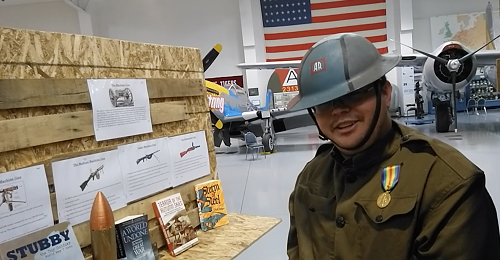 ASU Polytechnic campus history major Scott Hilbrands manned the WWI trench exhibit that the Poly History Club students produced. The exhibit was displayed for a week at the Arizona Commemorative Air Force Museum at Falcon Field.Hilbrands, a junior and president of the new Poly History Club, has been manning the club’s impressive WWI trench exhibit that is on display at the Arizona Commemorative Air Force Museum at Falcon Field.
The installation gives visitors a chance to imagine what prolonged time in a WWI trench might be like, while perusing artifacts and reading about the era.
For Hilbrands, the experience of working to research and produce the exhibit and bring history alive for others lines up precisely with the dreams he has for his future.
“I want to use my degree to not only preserve history but to help promote it to the public, whether that is through being a tour guide, archivist, college professor or historian,” said Hilbrands, dressed in the full regulation American WWI uniform that the club purchased.
“Getting people to realize that history is as vital to the world as math and science — and as exciting — is a dream of mine.”
The club members built the exhibition in October and November for the History Pop-Up Museum that students enrolled in history courses at ASU’s Polytechnic campus curate each semester.
Read more: ASU Polytechnic campus junior thriving in the trenches of history
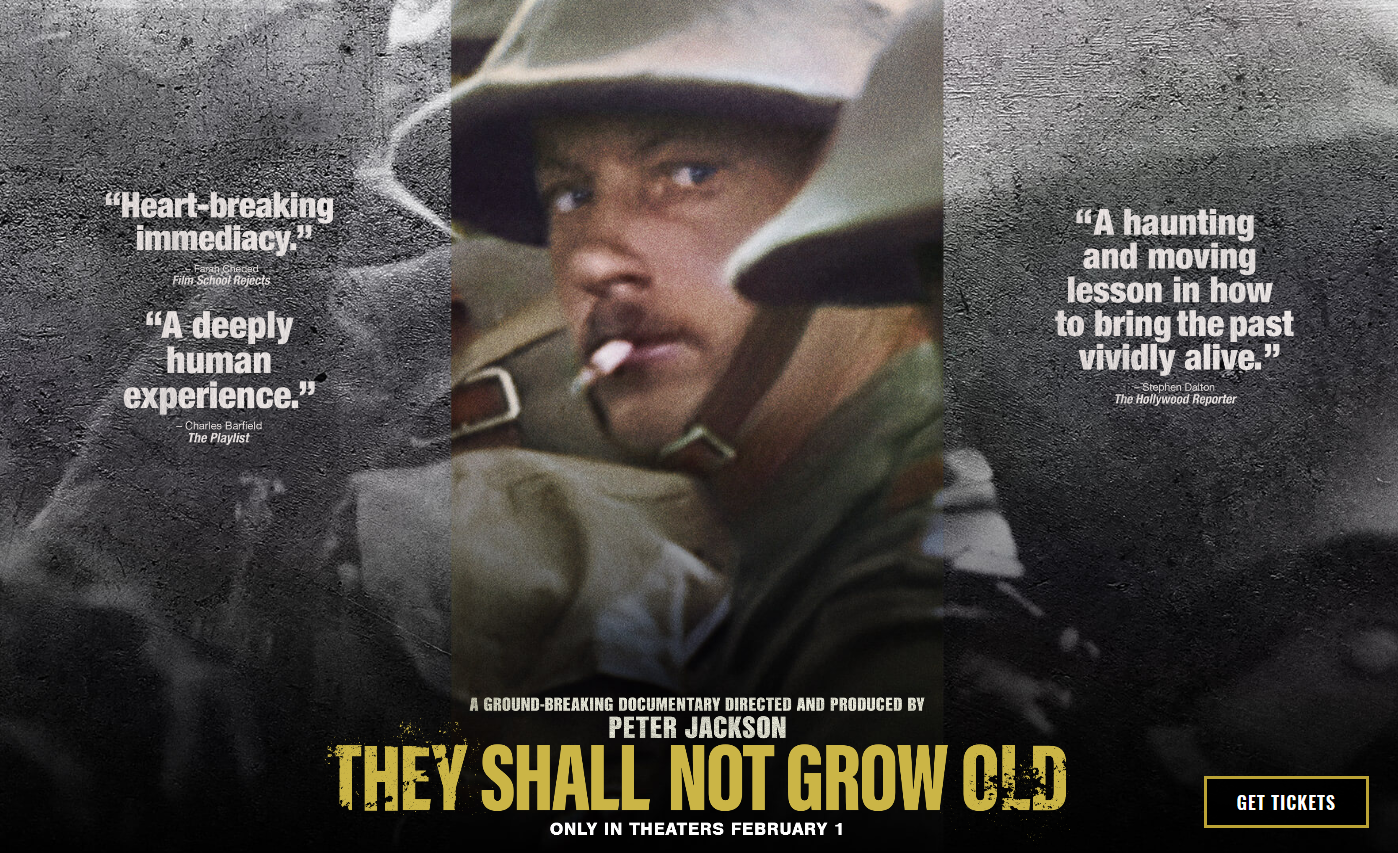
Peter Jackson’s “They Shall Not Grow Old” Marches on, to 150 Markets across North America
via the Associated Press (AP)
BURBANK, CA — Warner Bros. Pictures is widening the front for Peter Jackson’s widely acclaimed World War I documentary, “They Shall Not Grow Old.” The studio will expand the release of the film to 500 theatres across 150 markets throughout the U.S. and Canada, beginning on Friday, February 1, 2019, with special pre-shows the evening before. The announcement was made today by Jeff Goldstein, President, Domestic Distribution, Warner Bros. Pictures.
The Warner Bros. release comes following the film’s hugely successful Fathom Events dates, which yielded record-setting results. “They Shall Not Grow Old” took in $8.34 million, making it the highest-grossing U.S. Cinema Event release ever.
Jackson’s stunning restoration of footage from more than a century ago has received rapturous praise from both critics and audiences, and just earned a BAFTA Award nomination for Best Documentary. It is Certified Fresh on Rotten Tomatoes with an impressive 97% positive reviews and received an A CinemaScore.
In his announcement, Goldstein said, “We are proud to share Peter Jackson’s outstanding documentary with audiences across North America. Bringing us into the trenches and onto the battlefield of the Great War, the film stands as a powerful reminder of the sacrifices made by all those who serve, both then and now.”
From Academy Award-winning filmmaker Peter Jackson (“The Lord of the Rings” Trilogy, “The Hobbit” Trilogy) comes the groundbreaking documentary “They Shall Not Grow Old,” presented on the centenary of the end of the First World War.
Applying state-of-the-art restoration, colorization and 3D technologies to century-old footage—carefully chosen from hundreds of hours of original Great War film held in the archives of the Imperial War Museum (IWM)—Jackson has created an intensely gripping, immersive and authentic cinematic experience. The only narration comes from Great War veterans themselves, selected from over 600 hours of BBC and IWM archive interviews, resulting in a gripping account of “The War to End All Wars,” told by the soldiers who experienced it.
Read more: Peter Jackson’s “They Shall Not Grow Old” Marches on, to 150 Markets across North America
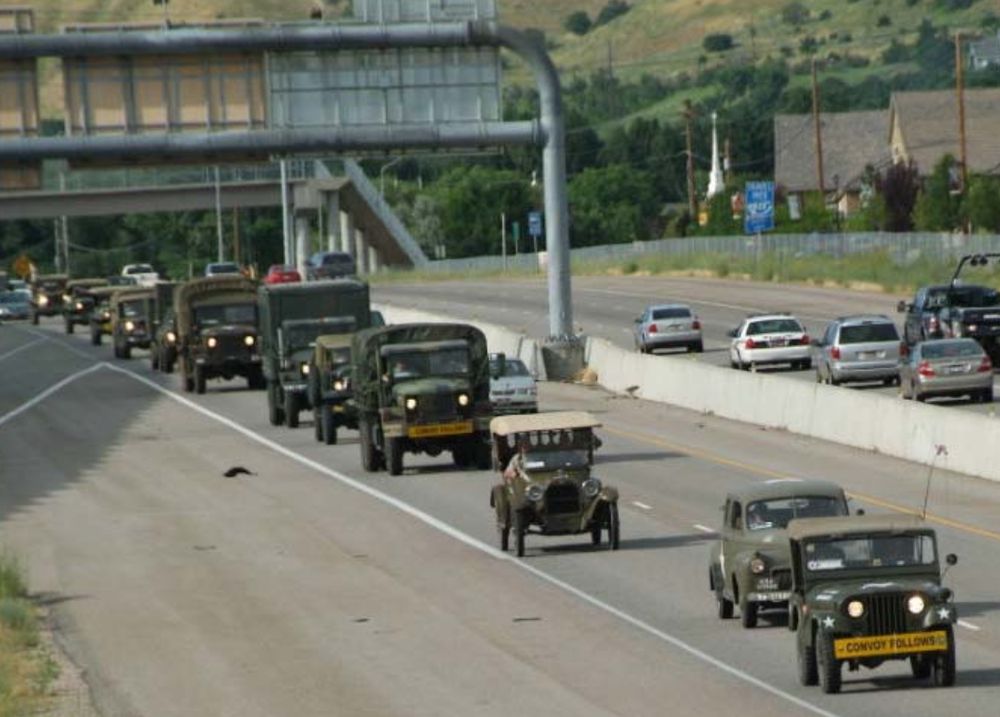 Vintage vehicle convoy underway. (Image courtesy Military Vehicle Preservation Association.)
Pair of convoys to celebrate centennial of WWI trip that led to the Eisenhower Interstate System
By Daniel Strohl
via the Hemmings Motor News
The first Transcontinental Army Motor Transport Expedition in the summer of 1919 did make it from Washington, D.C., to San Francisco, though it arrived several days late, abandoned nine vehicles and all but one of its kitchen trailers, destroyed 88 bridges, and had more than 200 unintentional off-road incidents, all due largely to the undeveloped (or lack of) roads along the way. Still, as a then-Lt. Col. Dwight Eisenhower wrote in his report, among the people he met while participating in the expedition, “It seemed that there was a great deal of sentiment for the improving of highways, and from the standpoint of promoting this sentiment, the trip was an undoubted success.”
Within 40 years, that sentiment became a reality with the country’s interstate highway system, ribbons of road stretching from coast to coast and border to border that have — for better or worse — transformed the country and the lives of the people who live in it. Now, a century after that 62-day cross-country slog, at least two caravans will retrace the steps of Ike and the nearly 300 other men who took part in the expedition.
As Capt. William Greany of the Army’s Motor Transport Corps wrote in his report of the expedition, the point of the trip was, essentially, to field-test a number of vehicles developed for use in World War I “and to determine by actual experience the possibility and the problems involved in moving an army across the continent.” A good mix of vehicles constituted the convoy: 34 heavy cargo trucks, four light delivery trucks, eight touring cars, a reconnaissance car, nine motorcycles with and without sidecars, a wrecker, and a handful of support trucks and trailers built by a variety of truckmakers including Mack, GMC, F.W.D., Militor, White, Packard, and Riker.
The Army decided to use the privately funded Lincoln Highway — Carl Fisher’s second grand idea after the Indianapolis Motor Speedway, officially dedicated just six years prior — for the transcontinental route, but as Greany pointed out “at the time (the highway) existed largely in the imagination and on paper.” The expedition set out in early July from Washington and relied on a network of pre-existing highways and roads that, though paved, were often too narrow for the oversized trucks. Somewhere around Illinois the pavement gave way to dirt roads. Then in Nebraska the roads gave way to sandy, muddy, rutted trails. The convoy even had to negotiate the Donner Pass before descending into California.
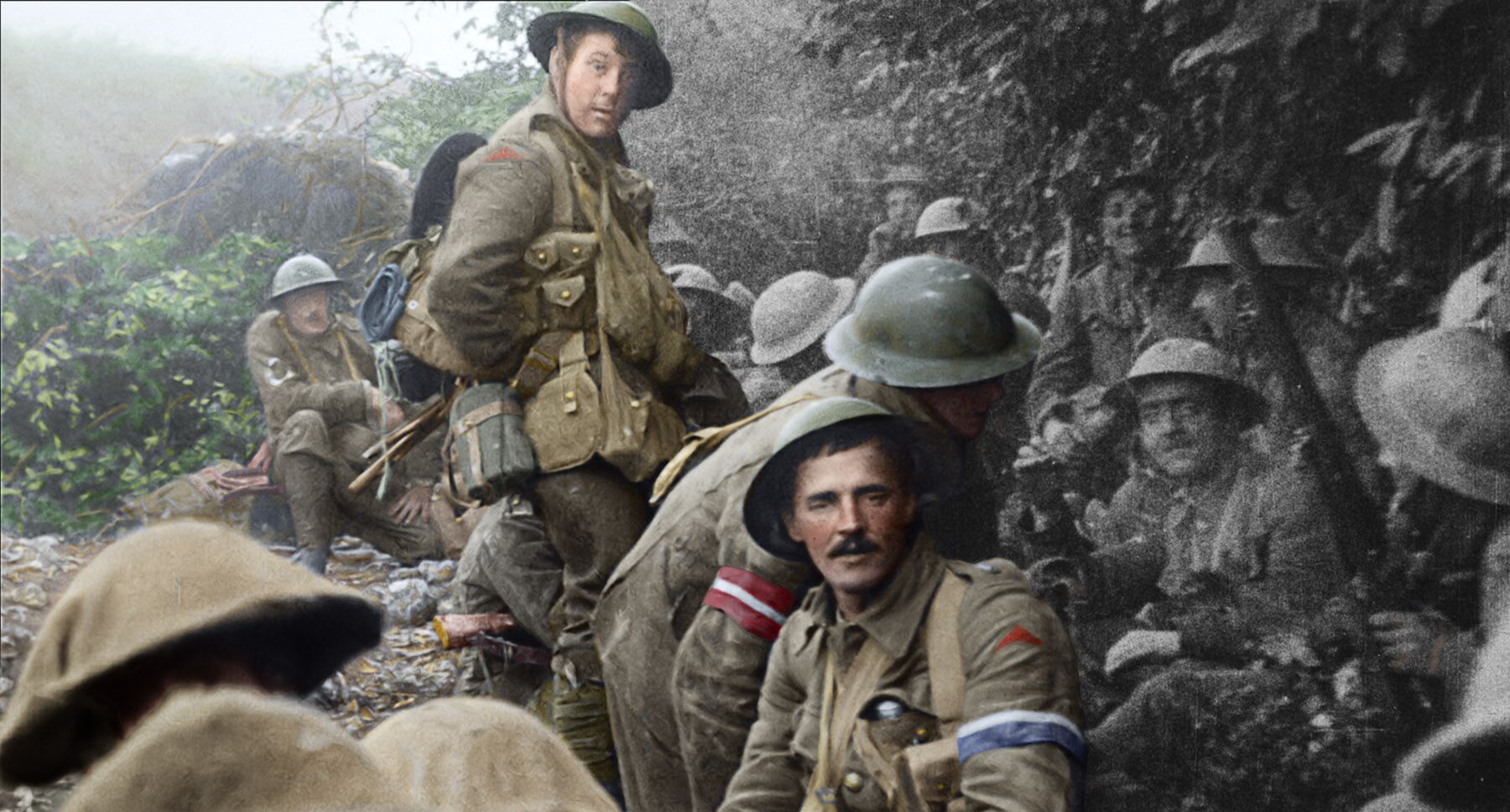 Wayne Stables took the lead in colorizing vintage WWI-era black and white film footage into realistic and accurate color for the Peter Jackson movie They Shall Not Grow Old.
Four Questions for Wayne Stables
"You have to get it right because history demands that we remember it accurately in order to learn from it."
By Chris Isleib
Director of Public Affairs, United States World War One Centennial Commission
Among the most incredible aspects of the ground-breaking new World War I documentary THEY SHALL NOT GROW OLD is the restoration and colorization of the original 100 year-old imagery. The colorization process was supervised by Wayne Stables, who is a towering figure in the world of cinematic post-production. Wayne started working at Weta Digital in 1994 and has worked on projects including The Frighteners, Contact, The Lord of The Rings trilogy, Avatar, The Adventures of Tintin, and Steven Spielberg’s The BFG. He has recently worked as a Visual Effects Supervisor on Game of Thrones; Beyond the Wall, and is currently working on James Cameron's Avatar sequels. Wayne is an active member of the Academy of Motion Picture Arts and Sciences and has been nominated for a BAFTA and numerous Visual Effects Society awards. Wayne kindly spoke to us about his work with the World War I documentary.
WOW -- You colored the film's black & white footage in amazing ways! Tell us about this very central role. What were your thoughts going in to the project? Who helped you?
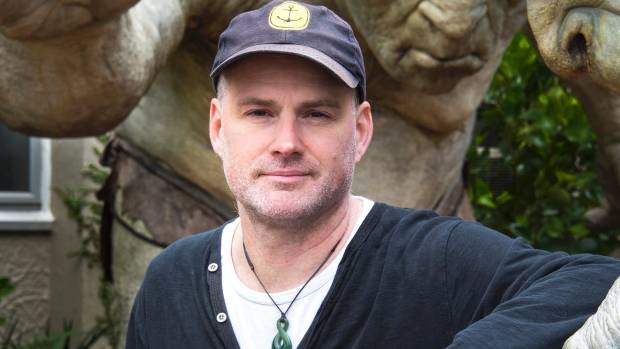 Wayne StablesMy role on the project was to supervise the colourization work that was being done by Stereo-D, ensuring that it was historically correct and that aesthetically the colourization was as natural as we could make it (not always the easiest task with film that 100 years old!). Assisting with this process were Pete Connor who is our resident historian, and Matt Wear a senior colourist at Park Road Post.
We started off with key images, and once I was happy with these we'd pass them on Peter Jackson for his notes. After that we'd just continue to iterate on each shot until he was satisfied with the result.
You go into a project like this very aware that it's incredibly important to get it right, and that to some extent you're pushing into uncharted territory. Film has obviously been colourised in the past but I think that this project pushed it beyond what we had seen before.
 Front Cover of The Dawn of the Red Arrow eBook
The Dawn of the Red Arrow traces history of the Wisconsin National Guard in World War I
By Chris Isleib
Director of Public Affairs, United States World War One Centennial Commission
Those who have been following the WW1CC newsletter and website know that there has been a terrific weekly series of articles appearing in social media, and on our website, entitled THE DAWN OF THE RED ARROW which traces the history of the Wisconsin National Guard in World War I. The series was created by MAJ Brian J. Faltinson, Public Affairs Officer, Wisconsin National Guard, and shows an amazing amount of teamwork, research depth, and insight. Now, the entire series has been edited together into a great comprehensive eBook. The book is available for download from https://www.dvidshub.net/publication/issues/45340. We had a few moments to talk to Major Faltinson about the book, and about his efforts to remember the WWI veterans from Wisconsin.
Tell us about the new book! Tell us about the experiences and history of the Red Arrow Division
This e-book commemorates the 100th Anniversary of the 32nd “Red Arrow” Division and the World War I service of 15,000 Wisconsin National Guardsmen. It consists of a series of historical vignettes and photographs that follow the 32nd Division’s World War I timeline from formation in July 1917 through entering Germany with the Army of Occupation in December 1918. The 32nd Division was formed at Camp MacArthur, Texas, from 15,000 Wisconsin National Guardsmen and 8,000 more from Michigan. It was the sixth American division to arrive in Europe and fought with distinction in the Alsace, Aisne-Marne, Oise-Aisne and Meuse-Argonne. The division pierced every single German line encountered and shot through the Kriemhilde Stellung “like an arrow” during the Meuse-Argonne campaign. As a result, the division commander days after the Armistice made the Red Arrow its official unit insignia.
Read more: Dawn of the Red Arrow traces history Wisconsin National Guard in World War I.
Four Questions for Phil Mazzara
"We'll have about as much time to raise the funds for the Memorial as the U.S. had in the field 'Over There.'"
By Chris Isleib
Director of Public Affairs, United States World War One Centennial Commission
This week, we have the remarkable good fortune to introduce to our new Director of Development, Mr. Phillip Mazzara. He is a seasoned professional in the fundraising community, with a long history of success. He will lead the campaign to raise the money for construction of the National World War I Memorial in Washington, DC. We had the chance to ask Phil a few questions about his background, the challenges of his new position, and why remembering the service of America's World War I veterans is important to him.
Welcome! Tell us about yourself. What is your background?
I have four decades of comprehensive advancement experience with a special focus on capital campaigns for a variety of projects, e.g., endowment, construction, programs, etc. I have worked for a variety of non-profit organizations, including hospitals, medical centers, colleges and universities and NGOs.
 Phillip MazzaraWorking as chief development officer for The Carter Center in Atlanta, GA, gave me a unique opportunity to work with President and Mrs. Carter on planning and implementing a $150 million endowment campaign. Not many fundraising professionals get the opportunity to work with a living former President and First Lady. It was an amazing experience.
During my career I have consulted with numerous other organizations on board development, organizational fundraising effectiveness, and campaign planning studies.
I contributed a chapter in a publication of the Association of Governing Boards on The Trustees Role in Capital Campaigns.
I am a graduate of Lynchburg (VA) College and served as president of its Alumni Association and on its Board of Trustees for 12 years. I attended the Henry W. Grady Graduate School of Journalism after a two-year stint in the Naval Security Group.
Read more: Welcome to new Director of Development Phil Mazzara
WWI Centennial Reflections: Randy Gaulke
"There remains a lot to be seen on the American battlefields, if one knows where and how to look."
By Chris Isleib
Director of Public Affairs, United States World War One Centennial Commission
Note: Our friend Randy Gaulke is a legendary battlefield tour guide, with particular expertise in World War I. He has been providing living history and tour services for several decades, to audiences here in the United States, and in Europe. He spent some time with us, to talk about his background, his efforts -- and about how our followers can best work with professional battlefield tourguides, on their own trips to World War I sites.
2018 was an amazing year for the WWI Battlefield Guides. Tell us about it. What did you do, overall?
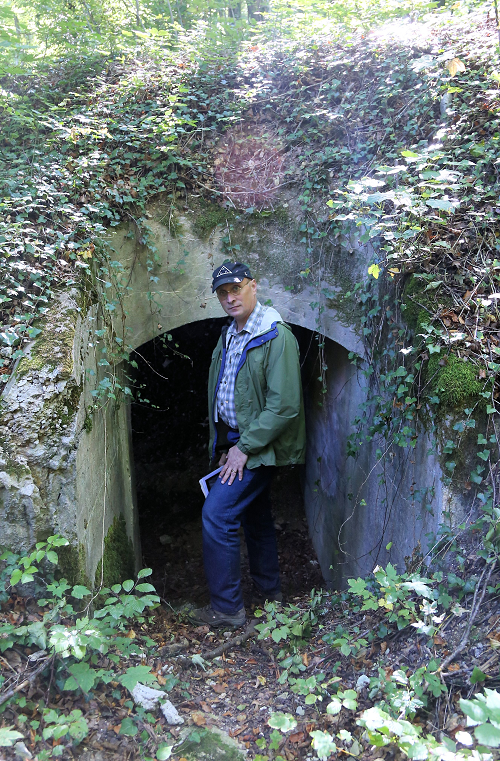 Tour guide Randy Gaulke stands in front of a bunker entrance in the Bois de Consenvoye. (Photo by Dave Gaddis.)I lived in Boureuilles, France for two months in 2018, working as a freelance tour guide for the American battlefields. During the 61 days I led thirty days of tours—ten days of small-group tours with two well-known historians and twenty days of personal tours. It does not sound like much, but that was a very aggressive tour schedule, considering reconnaissance and preparation time.
My typical client was an American with traveling partners who wanted to see where his or her relative had fought in WW1. On average, I was hired for two to three days; and we would be “in the field” from 09h00 to about 18h00. Sometimes I would also dine with clients.
We visited the cemeteries, memorials and museums in a sector; but it was also my philosophy to take clients “into the field” as much as possible. There remains a lot to be seen on the American battlefields, if one knows where and how to look. I use the ABMC Summary of Operations, then and now photos, first-person accounts and similar resources to bring the location back to life.
How did you plan your approach to the year? How did you map out & coordinate your efforts related to the various major chronological anniversaries/commemoration events, tours, etc.?
After six months in France in 2017, my amazingly-supportive wife asked me to limit 2018 to two months. Thus, I chose 17 September to 17 November; which covered the entire Meuse-Argonne Offensive and the Armistice.
Working with German historian and author, Markus Klauer (http://www.weltkriegsbuch.de/pages/ueber_mich.htm), we designed a small group tour timed around the mid-September ABMC Commemoration at the St. Mihiel American Cemetery and the Luminary Event at the Meuse-Argonne Cemetery. This six-day tour included two days in the St. Mihiel Salient and four days in the Meuse-Argonne. The morning portion was a “monuments tour,” while the afternoon portion consisted of one or more hikes. For example, our I Corps (Meuse-Argonne) hikes included: the Pocket (77th Div.), le Chene Tondu (28th Div.) and Underground Vauquois Hill (35th Div.)
Markus and I also hosted a Meet-and-Greet dinner on Friday, 21 September at a local hotel.
Lost Battalion expert, Robert Laplander, and I organized a four-day small group tour covering the Lost Battalion and I Corps from 3 – 7 October. Of course, it was timed to coincide with the Centennial of the Lost Battalion saga. Again, we focused on hikes in the field.
Personal tours were scheduled in the remaining days.
"The Brand of Brancy" in Classical Singer magazine
"We aligned our performance with the WWICC’s mission of remembrance and recognition of the war that changed the world."
By Mary Claire Curran
via Classical Singer Magazine
Director of Public Affairs Note: Our friend, famed vocalist John Brancy, was featured this month in a new interview article in Classical Singer magazine. In the brilliant piece by interviewer Mary Claire Curran, Brancy opens up about his unique style, his remarkable commitment to World War I material, and his next efforts.
 Cover of the Classical Singer magazine cover, featuring John BrancyJohn Brancy’s intense musicality and communicative power places him in the front ranks of baritones of his generation. Hailed by the New York Times as “a vibrant, resonant presence,” Brancy won first prize in the Art Song Division of the 2018 Concours musical international de Montréal, a win that recognizes him as a premiere interpreter of art song repertoire in our time. The New Jersey native also won first prize in the 2018 Lotte Lenya Competition in New York, second prize at the 2017 Wigmore Hall/Kohn Foundation International Song Competition in London, and prior to that won the media prize in the 2017 Belvedere International Singing Competition in Moscow and first prize in the Jensen Foundation Vocal Competition in 2015. He is also a past winner of the Marilyn Horne Song Competition and the Sullivan Foundation grand prize.
In between his final performances of Opera Frankfurt’s new adaptation of Lost Highway, Brancy found time to write to me about his career since winning the 2007 Classical Singer Vocal Competition in the Classical High School Division.
From September 28 to November 12, 2018, you embarked on a nationwide recital tour entitled “A WWI Memorial in Song.” What are some insights surrounding your creative conception and inspiration for the recital?
It was inspired when pianist Peter Dugan and I were asked to put together our first official recital program for our 2014 Kennedy Center debut, which was our professional debut as a duo. We wanted to perform music that needed to be heard and we decided that since it was the 100th anniversary of World War I, we would consider the repertoire of that time in our history. What we uncovered was a treasure of music in varying styles from composers who fought in the war. We have spent the past four years uncovering more and more of this forgotten music and have grown incredibly close to the stories and themes that are present in this dynamic repertoire.
Read more: "The Brand of Brancy" in Classical Singer magazine
Names on a Wall: Documenting Ohio's World War I Deaths in Service
By Paul LaRue, Ohio WWI Centennial Committee
Special to the United States World War One Centennial Commission web site
Most Ohio counties honor their community's World War I service members with a list of those who made the ultimate sacrifice. My county, Fayette, is no different. On the Fayette County Courthouse lawn is a monument with two plaques containing the names of Fayette County's World War I dead.
 The Fayette County, Ohio Court House with World War I Memorial in the foregroundThe United States number of deaths in World War I was approximately 116,000. Ohio's eighty-eight counties contributed more than 260,000 soldiers, sailors, and marines to the war effort. Sadly, more than 6,500 of these service members never made it home. I became curious about the sources available to locate or identify my community’s WWI deaths in service.
These sources and data will vary from state to state, county to county. Here are the sources I used to develop a database of Fayette County's WWI deaths in service.
First, I started with the names on our local WWI memorial. Consult your county's veteran organizations and County Veterans Services for plaques and lists of WWI service members. Your local historical society can be helpful in locating local plaques, and/or memorials. Our local plaques (Fayette County) were dedicated May 27, 1919 and list the names of forty-four service members from our county that died in service. These names would have been collected from available local sources.
Second, local period newspapers are extremely helpful. Your local library or genealogical society can be an excellent source of local newspapers. The Ohio History Connection has an excellent collection of Ohio newspapers (Link: http://catalog.ohiohistory.org/Presto/home/home.aspx?ssid=Newspapers ). I used Fayette County's weekly newspaper of the time, the Ohio State Register. The paper contained an article listing the names of the local deaths in service as of December 6, 1918. The newspaper listed twenty-six names as deaths in WWI service. If you have been following my data, you should quickly see a problem.
There are eighteen more names on the memorial plaques than listed in the newspaper. Following World War I, the United States government went to great lengths to identify and recover the dead in Europe. Initially, a large number of soldiers were classified as missing in action. The December 6, 1918 issue of the Ohio State Register reflects this fact.
Read more: Names on a Wall: Documenting Ohio's World War I Deaths in Service
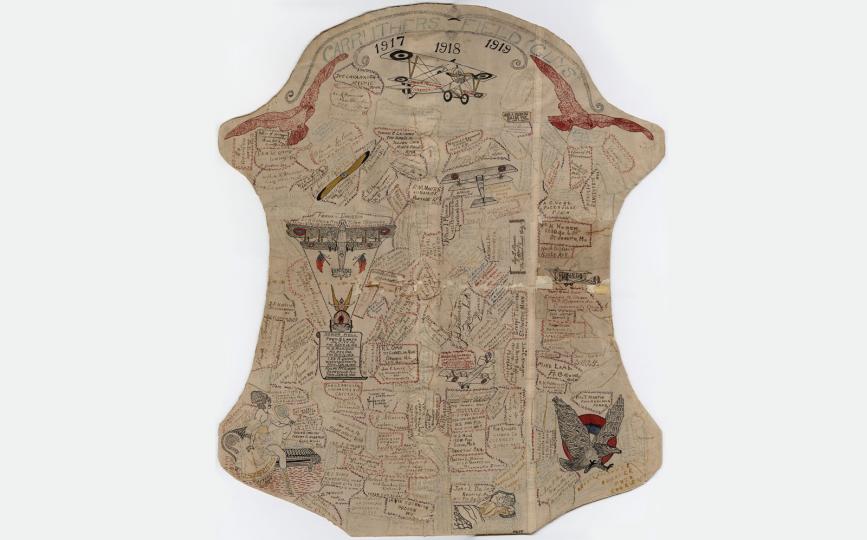 Pen and ink decorated memory plaque of pen and ink decorated airplane fabric from those who served in the U.S. Air service at Carruthers Field, Texas, 1917-1919.
Color of Memory: Fabric Art in WWI exhibit coming to WWI Museum
By Mike Vietti
Director of Marketing, Communications and Guest Services, National World War I Museum and Memorial
KANSAS CITY – “Remember Me.” “Souvenir de France.” “Mother Dear.” “Merci!”
These and countless other sentiments are expressed in the fabric art that came from World War I. Romantic and patriotic scenes were created on silk and cotton and wool felt. Many of the objects were made in direct response to those loved ones going to war from every country. Others were made for commercial purposes to serve the clamor for souvenirs.
"Color of Memory: Fabric Art in WWI" explores expressions of remembrance through striking and moving works from the Museum and Memorial’s collection.
Regardless of initial purpose, the fabric art became a colorful reminder of how deeply the war affected those at home and away. Among others, needlepoint, silk screen, embroidery, quilting, painting and cross-stitch all served an outlet to artistically express love, fear, loss and memory.
Corporal Walter Bullard, Co. F., 603rd Engineers wrote home:
“I am enclosing a handkerchief that I bought for you. It is rather pretty with the French flag and Stars and Stripes together. They sell quite a bunch of them to the boys to send home and there is hardly a town that I have been in that you can’t find hundreds in stores. They have all colors and with different words and such. Some have all the Allied flags worked in the corner.”
Read more: Color of Memory: Fabric Art in WWI exhibit coming to WWI Museum