































World War I Centennial News
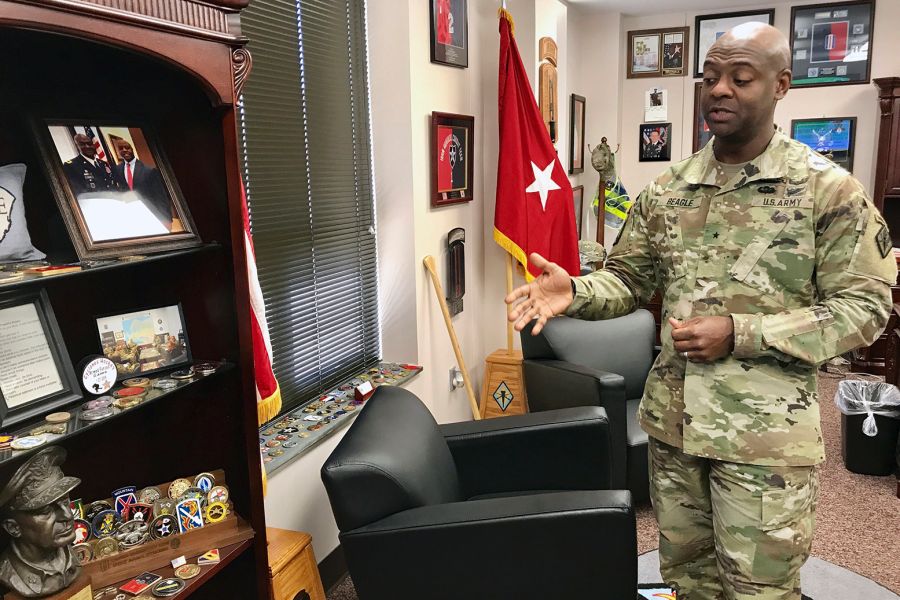 In the office of the 51st Commanding General for Fort Jackson and the U.S. Army Training Center Brig. Gen. Milford H. Beagle, Jr., speaks about his military memorabilia, awards and unit coins for leadership and excellence in military service. Beagle, who now leads the Army's Fort Jackson in South Carolina is descended from a soldier who served there in a segregated military more than a century ago. (Christina Myers, AP)
General's family: From segregation to command in 100 years
By Christina L. Myers
via the Stars and Stripes newspaper web site D
COLUMBIA, S.C. — Pvt. Walter Beagles arrived at Camp Jackson, South Carolina, in 1918, an African American draftee in a segregated Army that relegated black soldiers to labor battalions out of a prejudiced notion that they couldn't fight.
More than 100 years later, his great-grandson now serves as the base's 51st commanding general.
Brig. Gen. Milford Beagle, Jr., a combat veteran who took command last June, admits that it gets to him, knowing he's serving where his ancestor served but under vastly different circumstances.
"It does become pretty surreal to know that the gates my great-grandfather came through are the same gates I come through," Beagle said. "You always reflect back to you're standing on somebody's shoulders. Somebody put that stair in place so you can move one more rung up."
Beagle hails from the same town where his great-grandfather came from: Enoree, South Carolina. The family dropped the "s'' from the end of its name during his grandfather's lifetime.
He says he felt compelled to enter the infantry as a young man at least partly because African Americans once were largely shunted aside — considered inferior and unsuited to combat.
"That was one thing I did reflect on. Somebody at some point in time said your particular race can't do that," Beagle said. "At some point our ancestors fought so we could be in those front-line units and those combat units."
Beagle has served in combat in Iraq and Afghanistan, among his many postings.
Read more: General's family: From segregation to command in 100 years
‘You can feel the history’
World War I letters give Chesterfield students hands-on lesson
By Greg McQuade
via the WTVR-TV Richmond, VA web site
CHESTERFIELD COUNTY, Va. — Some sixth graders at Providence Middle School in Chesterfield County are getting a hands-on history lesson thanks to dozens of century-old letters from World War I.
Every other day Ms. Jennifer Covais’ students arrive to crunch numbers as they immerse themselves in the past using authentic dispatches written from war-torn France during WW I.
The author, Johnny Cawthra, was a disabled clerk with American Express who could not serve in the military because he was blind in one eye.
“They love writing. It's an elective. It is an honors writing class,” Covais said. "I like to make memories with my kids."
Students are transcribing Cawthra’s observations that range from his visits with wounded soldiers in a hospital and watching President Wilson to witnessing the ravages of war.
Student Karina Murcia said Cawthra's letters "describes the places.”
“It's pretty cool because I’ve never held anything this old,” Sterling Brummer said.
Read more: World War I letters give Chesterfield students hands-on lesson
From the World War I Centennial News Podcast
Spotlight on the Media: 'The Hello Girls' Documentary Executive Producer Jim Theres
In March 8th's edition of the World War I Centennial News Podcast, Episode 113, host Theo Mayer spoke with Jim Theres, executive producer of 'The Hello Girls,' about the remarkable history of these women and his acclaimed film highlighting their service. The following is a transcript of the interview, edited for clarity:
Theo Mayer: And for our spotlight on the media segment, the Hello Girls has really become one of the great themes of interest for the WW1 Centennial. In 2017, author and historian Dr. Elizabeth Cobbs wrote a book about how, in 1918, the US Army Signal Corps sent 223 women to France. They were masters of the latest technology, the telephone switchboards. General John J. Pershing, Commander of the American expeditionary force, demanded female wire experts when he discovered that the inexperienced doughboys were unable to keep him connected with the troops under fire. And he was pretty clear that without communications, for even an hour, they would lose the fight. The Hello Girls story spawned the book. There's a stage play that was produced in New York. There was an initiative in the US Congress to honor these women with their own Congressional Gold Medal. And as powerful as anything, there was a documentary film that tells about these women and their struggle not only during the war, but for decades after, as they fought for recognition and their veteran's benefits. Jim Theres is the Executive Producer and Director of that documentary, and he's been on the podcast before. Jim is joining us again today. Jim, welcome back.
Jim Theres: Yes, hi. It's great to be back. Thank you.
“We’re Home—Now What?” Exhibition at National WWI Museum & Memorial
By Mike Vietti
Director of Marketing, Communications and Guest Services, National World War I Museum and Memorial
From the earliest history of armed conflict soldiers have done their duty and returned to their homes and families. In the aftermath of World War I millions of servicemen and women came home from a war that was unprecedented in its impact on those who experienced it. For some who served, the war’s impact on their bodies and minds lasted a lifetime.
 Beyond the dockside homecomings and the main street parades, what was the returning veteran’s experience in being a “civvie” again? Were they able to make this transition smoothly? Return to work or school and get on with their former life? Or, did they find it difficult and require help?
We’re Home—Now What? examines the challenging transition for service personnel from War-time duty to civilian life through archival materials.
The U.S. government offered financial, vocational and social resources to the nearly 5 million servicemen and women who began demobilizing in 1919 after nearly half served overseas in the American Expeditionary Forces (AEF). Finding a job was the first thing on the minds of most veterans, so the government encouraged businesses to hire them.
An article in the April 4, 1919 issue of The Stars and Stripes describes the plan of the American Expeditionary Force’s Department of Citizenship to hold “forums” to address three subjects of importance for US Army officials: “Home,” “Health” and “The Workshop.”
Servicemen were given an opportunity to ask questions about when they could expect to be sent home and discharged, the prospects for finding a job, how to maintain good health and sanitary practices for themselves and their communities and how to be aware of the influence of socialism in the workplace.
Read more: “We’re Home—Now What?” Exhibition at National WWI Museum & Memorial
 Attorney Mark Hough speaks after receiving his award from the U.S. Army Women’s Foundation.
Hough, Cobbs, Theres honored by U.S. Army Women’s Hall of Fame for Hello Girls work
By Amy Baker
via the Army Women’s Hall of Fame
Last week, as our nation celebrates Women’s History Month & International Women’s Day, the U.S. Army Women’s Foundation recognized extraordinary Army Women by inducting the 2019 class of Army women into the Army Women’s Hall of Fame March 7th on Capitol Hill.
Among those inductees were, collectively, the U.S. Army Telephone Operators of World War I -- aka the "Hello Girls".
Representing those female World War I heroes were three special partners to the United States World War I Centennial Commission -- all members of the special Task Force for gaining Congressional Gold Medal recognition for the women:
- Attorney Mark Hough, who succeeded in 1978, in lobbying for Congressional recognition for the women's service, nearly fifty years after their return from WWI
- Elizabeth Cobbs, author of the definitive "Hello Girls" book
- Jim Theres, director of the award-winning documentary, “The Hello Girls,”.
Sculptor Sabin Howard on a mission to effect lasting social progress through art
By Charu Suri
via the Architectural Digest magazine web site
A brand-new “Great Women Sculpture Initiative” (GWSI), which aims to change the way women are portrayed in sculpture, is celebrating female leadership in human rights, civil rights, and women’s rights.
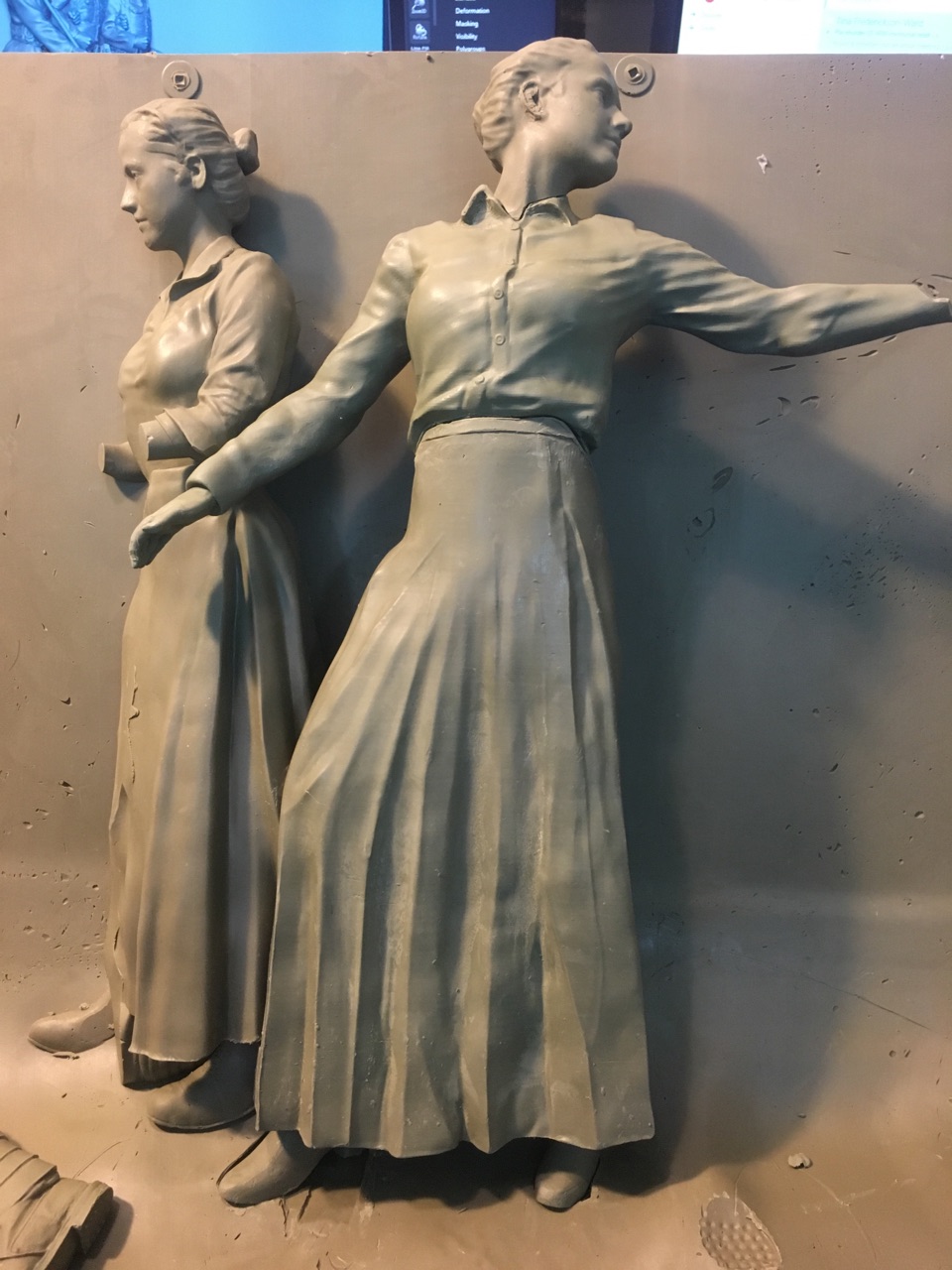 Two female figures from the maquette of the sculpture for the National World War I Memorial in Washington, D, created by Sabin Howard..“Female figures have historically been hidden in a masculine archetype or shell,” sculptor Sabin Howard, who designed the National World War I Memorial, tells Architectural Digest. After having seen some of the photographs of great women like Coretta Scott King and Eleanor Roosevelt, he realized that these women, while they appear powerful on the stage, ended up looking really meek and submissive in sculptural form. Few sculptures show women having the energy or power that the Hellenistic Winged Victory (at the Louvre, Paris) possesses.
“The new GWSI sculptures are meant to embody a visual idea of women—specifically, a new aesthetic of empowerment. They are also intended to create conversation on a cultural level,” he adds.
The initiative is led by Howard as well as two other women: Desiree Watson, and Howard’s wife, Traci Slatton. Howard has spent over 50,000 hours sculpting from life models and has a vision of how he would re-create the figures of Coretta Scott King and Eleanor Roosevelt in bronze, a material he says “will far outlive us all.” With maquettes and drawings, he and his supporters have started the process to create a body of work of female sculptures to be shown as a traveling exhibit to museums. A book and documentary about the process of creation will follow.
This initiative hopes to dissipate a subterranean cultural notion that women are not supposed to take up space. “I want to sculpt women who take up space so confidently that they command the space,” he says. The typical female sculpture is passive, with self-contained gestures. She rarely has the energy of the Winged Victory. “The sternum of this (Hellenistic) sculpture is pitched towards the light; it leads the body and core’s energy forward,” observes Howard. This statue speaks of a universal, mythological female archetype.
Restored memorial in Hudson, OH recognizes 81 veterans of WWI
By Laura Freeman
via the MyTownNEO Northeastern Ohio News web site
Note: This restored memorial in Hudson, Ohio recognizes 81 veterans of Great War, with help from U.S. World War I Centennial Commission partner reenactors Seth and Garrett Moore. The restoration of this memorial was part of the Commission's 100 Cities/100 Memorials program -- Chris Isleib, Director of Public Affairs, United States World War One Centennial Commission
HUDSON, OH — At the 11 hour on the 11th day of the 11th month, the “Victory Bell” tolled 21 times on the southwest green to commemorate the 100th anniversary of the armistice that ended the fighting in World War I.
The 21 tolls, based on the 21-gun salute, symbolize the nation’s highest honor.
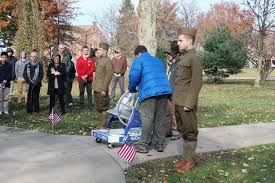 During the ceremony last year, a member of Boy Scout Troop 321 tolled the bell 21 times while WWI reenactors Seth and Garrett Moore stood at attention on each side, at 11am on 11 NOV, to commemorated the 100th Anniversary of the Armistice that ended World War I. Photo by Laura Freeman, MyTownNEO.comThe Nov. 11 ceremony ended with the unveiling of the restored 30-inch by 60-inch bronze tablet displayed on a temporary wood pedestal, containing the names of 80 men and one woman from Hudson who served in World War I. The United States participated from April 6, 1917, to Nov. 11, 1918.
About 150 veterans and visitors gathered at the memorial, located near the the Boy Scout log cabin. A member of Boy Scout Troop 321 tolled the bell while WWI Doughboy reenactors Garrett and Seth Moore of Columbus stood at attention on each side. Bugler Steve Masowick from American Legion Post 685 in Streetsboro played taps.
Inside the cabin, the Rev. Richard Shipley gave the invocation, and Mayor David Basil read a proclamation to recognize “Bells of Peace: A National World War I Remembrance” for the 4.7 million Americans who served.
Western Reserve Academy historian and archivist Tom Vince talked about the 81 people from Hudson who served in World War I.
Word of the end of the war was transmitted by telegraph, and Hudson First Congregational Church of Hudson tolled its bells at 7 a.m. in 1918 to let people know peace had arrived, Vince said.
“We know by noon Nov. 11 all businesses in Hudson closed their doors and people of Hudson rallied on Main Street,” Vince said. “The old bandstand near the clock tower was festooned with flags and bunting.”
Read more: Restored memorial in Hudson, Ohio recognizes 81 veterans of WWI
From the World War I Centennial News Podcast
Remembering Veterans: Writer Elizabeth Foxwell on the Roles, Experiences of Women in the Great War
In March 8th's edition of the World War I Centennial News Podcast, Episode 113, host Theo Mayer spoke with writer Elizabeth Foxwell about stories and experiences of female service in WWI, many of which have been neglected or forgotten. The following is a transcript of the interview, edited for clarity:
Theo Mayer: Our second Remembering Veterans story is a bit more serious and definitely more poignant. Let me set it up this way: World War I did not merely engaged armies. It engaged nations and their populations in an unprecedented scale and scope. And although the gender of the armies was predominantly male, the gender of the world was, and is pretty much 50/50. And so, this cataclysmic event in world history was also a pivot for the 20th century perception and the role of womanhood. As the armies absorbed an ever larger percentage of the adult male population, the other half began to take on new roles and new responsibilities. With us today is Elizabeth Foxwell, a journalist and author focusing on the stories and neglected accounts of and by women who served in various roles in the war. She's the editor of a collection of first-person accounts by US women in the war called In Their Own Words: American Women in World War I. Elizabeth, welcome to the podcast.
Elizabeth Foxwell: Thank you, Theo. It's very nice to be here.
>Theo Mayer: So Elizabeth, before we start talking about the women of World War I, how did you get interested in the subject?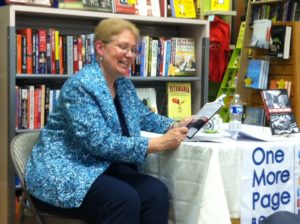 Elizabeth Foxwell is a journalist and author with a particular interest in how WWI affected women
Elizabeth Foxwell: Well, Theo, it's a very simple answer. It was Vera Brittain's Testament of Youth, which was published in 1933 and has never been out of print. Brittain was a British nurse in World War I, and the book, to me, was just so incredibly wrenching, with the number of people she lost, and her experiences. So I actually wrote my Master's thesis at Georgetown on her World War II experiences. She was an ardent pacifist as a result of her World War I experiences, and it made me start looking for equivalent US accounts. And yet, there isn't a sort of book on the same footing as Testament of Youth in the United States, I think. And so that made me set out on the hunt for first-person accounts by US women.
Theo Mayer: Now, you've immersed yourself in first-person accounts of these women. Is there a common theme that motivated them to change their lives at this point in time?
Navy Celebrates 100th Anniversary of the Board of Decorations and Medals
via the U.S. Navy Office of Information
The Navy celebrates the centennial of the Board of Decorations and Medals. Founded March 6, 1919, the board was established by order of then-Secretary of the Navy Josephus Daniels to standardize the awarding of medals to service members for extraordinary acts of heroism or distinguished service.
 The Navy Cross, left, and Purple Heart medals awarded to Ensign George H. Gay, Jr. for his actions of June 4, 1942 during the Battle of Midway as a member of Torpedo Squadron Eight. The Navy Cross is an early World War II "Black Widow" medal, so named for the over-anodized finish on the planchet. (U.S. Navy photo courtesy of the Smithsonian Institution/Released)“Today, the Board of Decorations and Medals makes recommendations to the Secretary of the Navy and the Assistant Secretary of the Navy for Manpower and Reserve Affairs on all military award nominations and all military awards policy matters requiring their approval,” said James Nierle, president of the Board of Decorations and Medals.
“Leveraging its more than eight decades worth of extensive files, the board fulfills a vital function in maintaining awards standards across the Department of the Navy and across time.”
The Board was established following the World War I Armistice, and Congress’ creation in February 1919 of two new decorations: The Navy Cross and the Navy Distinguished Service Medal.
Prior to the establishment of the board, input was sought from the fleet on individuals whose wartime performance of duty merited award of the new Distinguished Service Medal. These recommendations were reviewed by a board chaired by a Navy admiral, and its recommendations were submitted for approval to the secretary of the Navy. Arbitrary designations at times evidenced the need for a largely independent Navy Department Board of Decorations and Medals.
“Equitably and accurately awarding those Sailors and Marines who go above and beyond the call of duty in combat and during a career of distinguished service is critical to honoring their heroics and fostering the esprit de corps that makes the Navy and Marine Corps the most lethal fighting force the world has ever known,” said Assistant Secretary of the Navy for Manpower and Reserve Affairs Greg Slavonic. “The Board of Decorations and Medals guarantees authenticity of the high tributes we bestow on our Nation’s warfighters.”
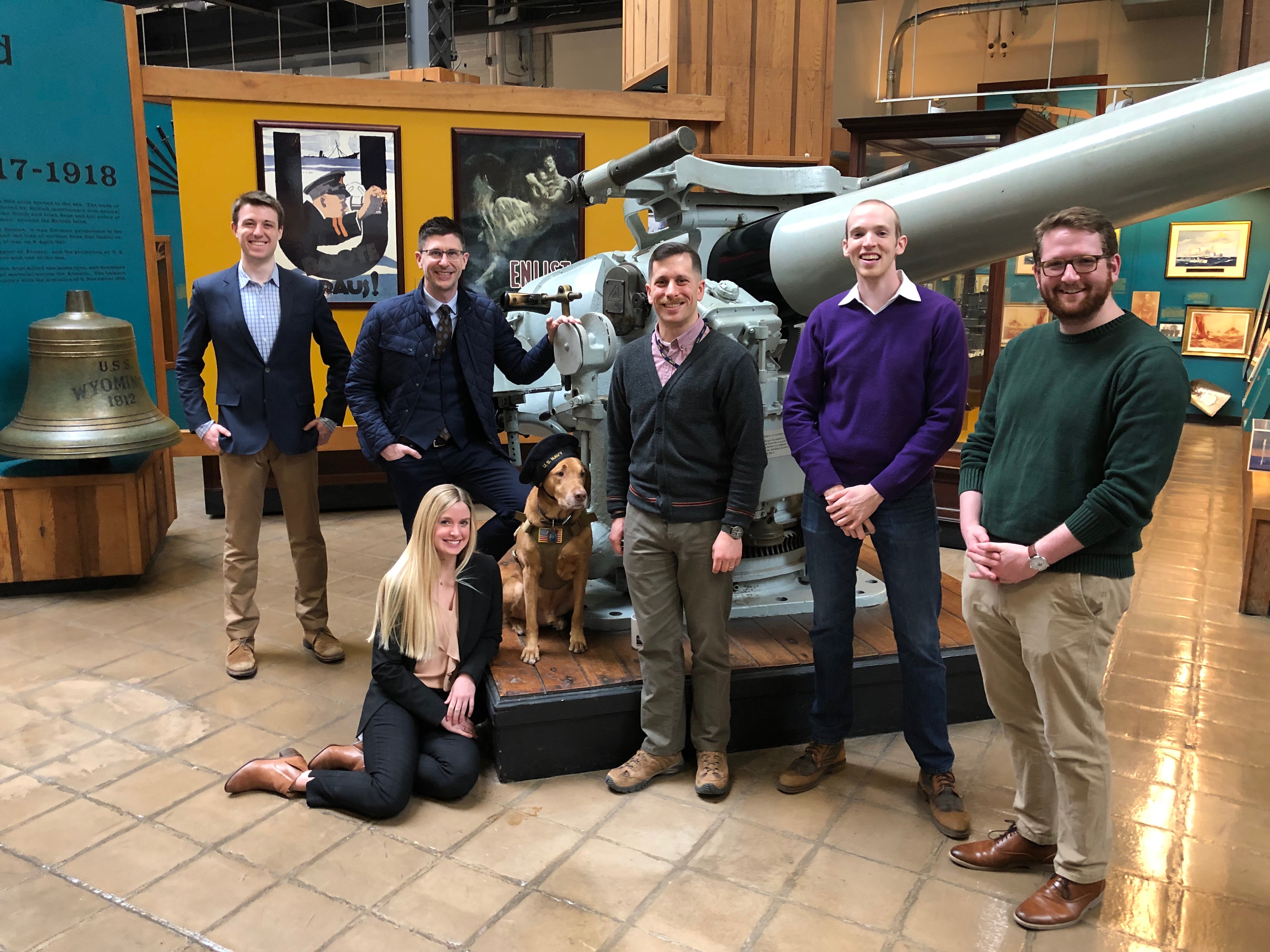 U.S. World War I Centennial Commission staff members visit with Sawyer the Seadog at the National Museum of the United States Navy in Washington, DC. (left to right) Staff members Zack Austin, Dale Archer, and Erin Sliwinski; Sawyer the Seadog and his owner Tom Frezza; staff members Halsey Hughes and James Taub.
WWI Centennial Commission staff pay a visit with Sawyer the Seadog
By Chris Isleib
Director of Public Affairs, United States World War One Centennial Commission
On March 8, the U.S. World War I Centennial Commission staff paid a visit with Sawyer the Seadog, mascot of the National Museum of the U.S. Navy.
Sawyer’s owner, Tom Frezza, manages education programs at the museum, and he showed the staff around the many incredible Exhibits and artifacts from WWI.
Sawyer and the WW1CC will soon be working together in NYC for the annual Fleet Week New York, 22-29 May, which this year will have a World War I theme!
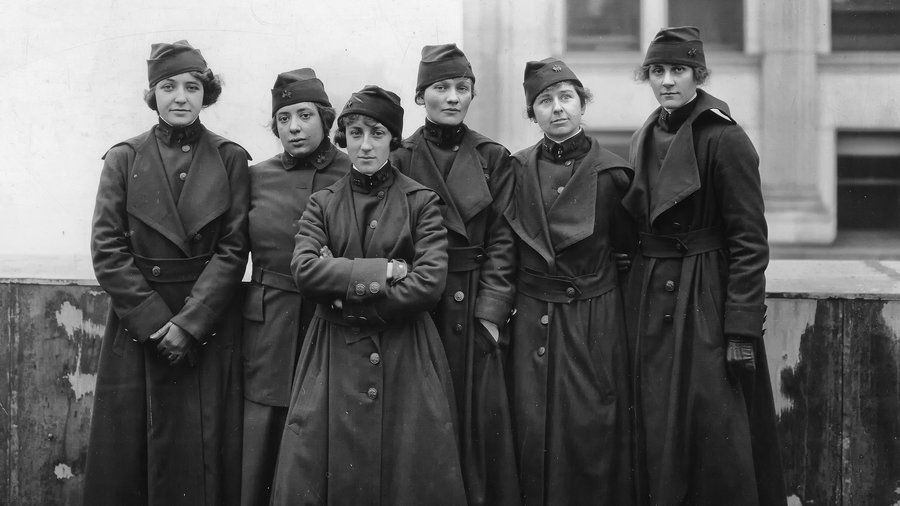 Women of the U.S. Signal Corps who served overseas as telephone operators during World War I. (U.S. Army)
These women were denied veteran status for decades. Congress can’t overlook them again.
By Elizabeth Cobbs
via the Washington Post newspaper web site
Elizabeth Cobbs, a history professor at Texas A&M and a senior fellow at Stanford’s Hoover Institution, is the author of “The Hello Girls.”
Women were among the last U.S. soldiers to return home from World War I. They will also be among the last honored if an overdue but welcome bipartisan bill pending in the Senate passes.
Three years into World War I, the United States rushed to make up for its tardiness in joining the Allied effort by recruiting, equipping, training, shipping and deploying 2 million Doughboys to France. America’s contribution to the Allied victory was inestimably aided by the more than 200 women of the U.S. Signal Corps who operated telephone lifelines that connected combat soldiers with their commanders.
Radios did not yet carry voices, only Morse code, and their wireless signals were notoriously vulnerable to enemy interception. It took three mules to haul a heavy radio field station to the front. By contrast, officers could deliver orders over telephones simply by talking, and the lines were difficult to tap without detection. A single soldier carrying a lightweight spindle could run communication lines into trenches, across battlefields and to captured enemy positions.
The telephone lines transmitted commands to begin bombardments, to launch attacks and to retreat. Infantry officers used telephones to request artillery backup as troops advanced — and sometimes to call off friendly fire when it arrived. Telephones also facilitated military logistics, maintaining supply lines by which wars can be won or lost.
In the second decade of the 20th century, though, the telephone was a relatively rudimentary technology: Telephones didn’t have dials, and human operators were required to connect calls. Parties spoke with an operator who connected them. On the battlefield, when French-speaking and English-speaking commanders wanted to communicate, Signal Corps operators that Stars and Stripes called “bilingual wire experts” acted as interpreters.
Read more: These women were denied veteran status for decades. Congress can’t overlook them again.
Public Invited to Lander University Symposium on World War I
By Jeff Lagrone
via the Lander University web site
On Thursday, March 14, and Friday, March 15, Lander University will host a two-day symposium on the far-reaching effects that World War I had on the American South.
The public is invited to the event, made possible by a grant from South Carolina Humanities.
 A new book, “The American South and the Great War, 1914-1924,” published by LSU Press and co-edited by Lander Associate Professor of History Dr. Ryan Floyd, was instrumental in the obtainment of the grant. Floyd will participate in several panel discussions during the symposium, as will his co-editor, Dr. Matthew Downs, associate professor of history at the University of Mobile, Alabama.
Floyd said that he got the idea for the book while researching his earlier book, “Abandoning American Neutrality: Woodrow Wilson and the Beginning of the Great War, August 1914-December 1915.”
“I was surprised to discover that there were no books on the American South in World War I. There were articles here and there, or a chapter here and there,” but no books, he said.
Floyd called the lack of published material on the topic “a real mistake.” World War I “had a significant effect on the South” in a variety of ways, he said.
Read more: Public Invited to Lander University Symposium on World War I
Bessie Bendt made a name for herself as Sioux Falls' first 'conductorette'
By Eric Renshaw
via the Argus Leader newspaper web site
Bessie Bendt was a trailblazer in Sioux Falls as the city's first 'conductorette' during World War I.
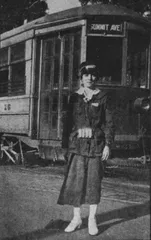 Bessie Bendt in front of her Summit Avenue Trolley in 1918. (Photo: GreetingsFromSiouxFalls.org)Bessie Foster was born in Campbeltown, Scotland in 1894. At the age of 18 she came to the United States and ended up in Sioux Falls. After arriving, she was employed as a nursemaid by T.J. Billion, then went on to work as a housekeeper for two wardens at the State Penitentiary.
She met Otto Bendt around the time the first world war had become inevitable, and the two fell in love. They were married in August of 1917. Otto was working for the city’s electric trolley company, the Sioux Falls Traction System, or SFTS, when he was called to military duty in June of 1918. Bessie needed something to keep her busy and wanted to help keep the city going while so many of its working citizens had been called overseas.
Bessie met with Roger Mills, who was in charge of operating the Sioux Falls Traction System, and suggested that she could become a conductor. Roger said he’d have to think about it, but called her back the next day. He told her, “You’ll have to do a man’s work, but you’ll get a man’s pay.” On September 12, 1918, Bessie made her first run as Sioux Falls’ first "conductorette." Her job was to make sure that everyone who had a ticket got it punched, and that everyone who paid in cash knew to put it in the fare box.
Every day, Bessie would wake up at 5 a.m., have a quick breakfast, then hustle downtown to be at her job by 6 a.m. She wore a uniform she made herself, along with a hat provided by the company. Tucked under the bill of her hat were several spare fuses meant to keep the car going. If the car blew a fuse, Bessie would jump down from the car, pull the arm that connected the car to the overhead electric line, replace the fuse, and reconnect the arm. She would then get back up onto the trolley. Bessie did this job for 12 hours a day, seven days a week for $65 a month. This adjusts to around $1,200 a month in 2019 dollars.
Read more: Bessie Bendt made a name for herself as Sioux Falls' first 'conductorette'
- A Chambersburg soldier and his family write letters through World War I
- Effort underway to restore the World War I Monument at the Mohave County Superior Courthouse
- Not Every Woman Who Served With the U.S. Military During World War I Got the Same Treatment. Here’s Why
- Popular World War I Exhibit Extended at North Carolina Museum of History