





























World War I Centennial News
“The players carried their gas mask cases over their shoulders the whole time in case of an enemy attack.”
Baseball Goes to War – How Doughboys Took America’s Pastime to the front lines in WWI
By Alexander F. Barnes
via the Military History Now web site
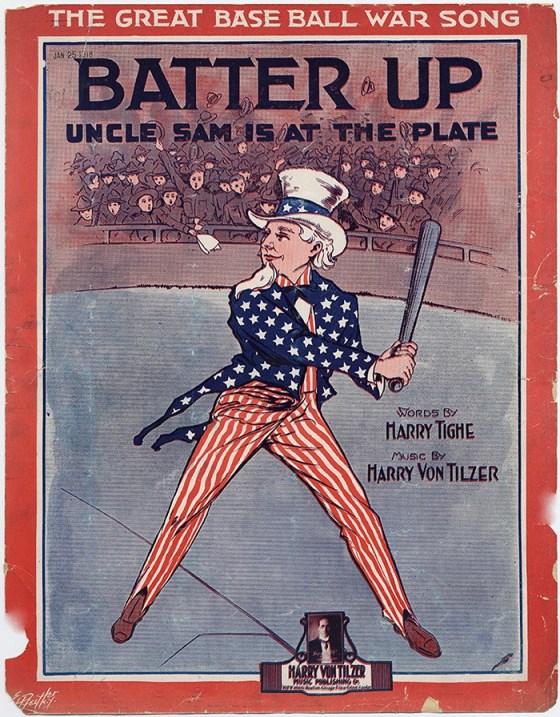 Uncle Sam comes up to bat against the Germans in a patriotic wartime song.Famed American Sportswriter, Jimmy Cannon, wrote: “It is part of our national history that all boys dream of being Babe Ruth before they are anyone else.”
For the American men serving in World War One, Ruth was already on his way to becoming an icon. But most of them had grown up with other baseball players as their heroes. Ty Cobb, Honus Wagner, Walter Johnson, “Home Run” Baker, and others filled their daydreams with baseball exploits.
Other sports of the period drew an audience but only baseball and boxing - to a lesser degree - truly had a grip on the average American male from about 1890 to 1916. And this was the era during which most Doughboys were born or came of age.
In many ways, the makeup of the U.S. military during the First World War mirrored the clubhouses of professional baseball. The Army, Navy, and Marine Corps were filled with country boys, factory workers, shop clerks, cowboys, coal miners, college students, sons of immigrants, and even recently arrived immigrants themselves. And like baseball, where Black ball players were restricted to the “Negro Leagues,” African-Americans were welcome to serve in the military, but only in their own units.
Game called on account of war
The United States declared war against Germany in April 1917. America’s entry into the conflict was followed by the Selective Service Act. The legislation required all males aged 21 to 31 to register for a draft. There were exemptions for family dependency, physical disabilities and work in a war industry. But “playing baseball” wasn’t one. As a result, most major and minor league players registered and were judged eligible to be selected. Later, when the draft ages expanded to 18 to 45, team coaches, front office staff and even umpires were required to register.
The 1917 baseball season was not good one. Bad weather forced many games postponed or cancelled. And more and more, players were being drafted and sent off to military training camps. Worse, those not yet called up faced scorn for not enlisting. Newspaper editorialists were asking why professional baseball was not doing more to support the war effort.
Read more: Baseball Goes to War – How Doughboys Took America’s Pastime to the front lines in WWI
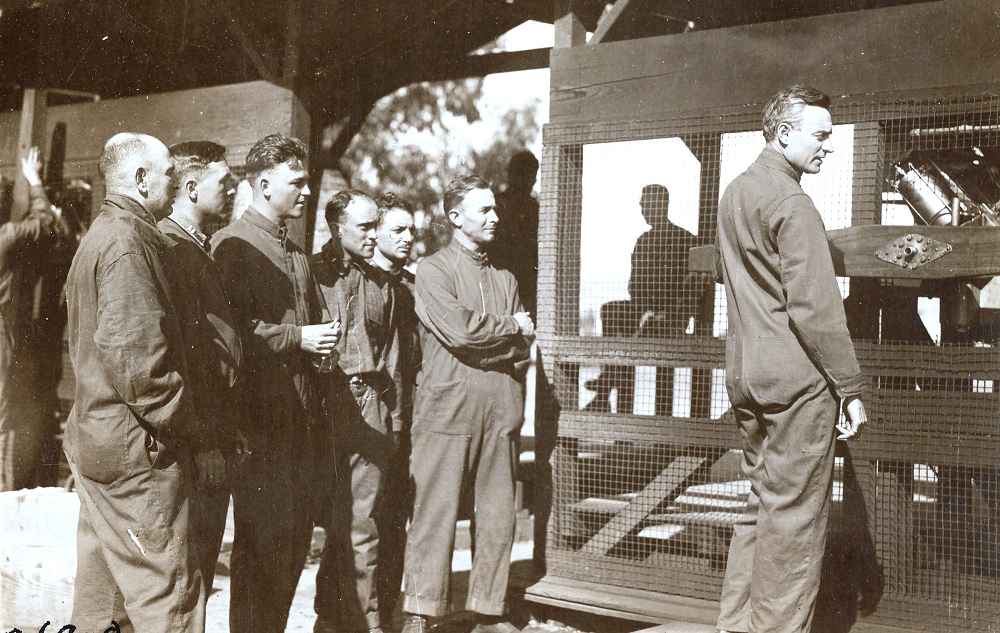 Aviation School, North Island, San Diego, Cal. Picture shows Major John Purroy Mitchel, S.R.C.A.S., Ex-Mayor of New York City and his classmates being instructed on the airplane motor at North Island, San Diego, Cal. (Major Mitchel – is standing on the right near the display) Date: 3/14/1918.
John Purroy Mitchel: The "Boy Mayor" of New York who died in WWI
By Harry Kidd
via the National Archives' Unwritten Record blog web site
This post was written by Harry Kidd. Harry is a volunteer at the National Archives working on textual and photographic digitization projects. Harry is a former Navy photographer himself and came across this story while researching military photographers.
John Purroy Mitchel (1879 – 1918) was a native New Yorker. Trained as a lawyer, he gained wide recognition as a reformer who began investigating corruption, incompetence, waste and inefficiency in the city government in 1906. With the support of the anti-Tammany force, he was elected president of the Board of Aldermen in 1909 where he enacted fiscal reforms.
In 1913, based on his efforts to improve the efficiency of government operations, he was nominated as the Republican candidate for mayor. At the age of 34 he was the second youngest person elected mayor and often referred to as “The Boy Mayor of New York.”
Mitchel served as mayor from 1914 – 1917. After failing to win re-election, he enlisted in the Army Air Service as a flying cadet. He completed training in San Diego and was promoted to major.
On the morning of July 6, 1918, Mitchel was returning from a military training flight to Gerstner Field, Louisiana when his single seater scout plane went into a nose dive and crashed. The former mayor was unfastened in the plane and fell to his death at age 38.
Read more: John Purroy Mitchel: The "Boy Mayor" of New York who died in WWI
New scale-model maquette of the National WWI Memorial
By Chris Isleib
Director of Public Affairs, United States World War One Centennial Commission
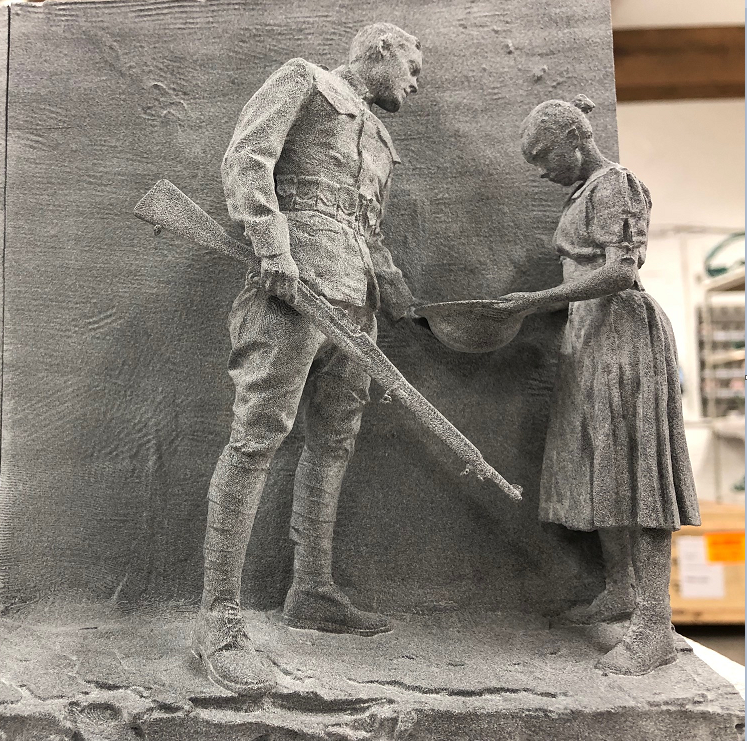 Detail from part of the new sculptural maquette for the National World War I Memorial.Sculptor Sabin Howard has made an important new development on the new National World War I Memorial for Washington DC.
Working with another world-class, high-tech, sculptural imaging team -- this one at Pangolin Editions Foundry in the UK -- Sabin has been able to create a new, smaller, highly-detailed sculptural maquette of the final WWI Memorial design that is being developed to restore and enhance DC's Pershing Park.
This maquette will be part of the Centennial Commission's progress-update presentation for the next regulatory review meeting with the U.S. Commission of Fine Arts (CFA) in April.
Video of the new maquette can be seen here: https://www.facebook.com/sabinhowardsculpture/videos/413070856119665/
Centennial Commission Chair Terry Hamby expressed his enthusiasm for Sabin's work. "I’m very excited to see the new maquette, and am looking forward to the April meeting with the Commission of Fine Arts. We are really close to making America’s WWI Veteran’s Memorial a reality."
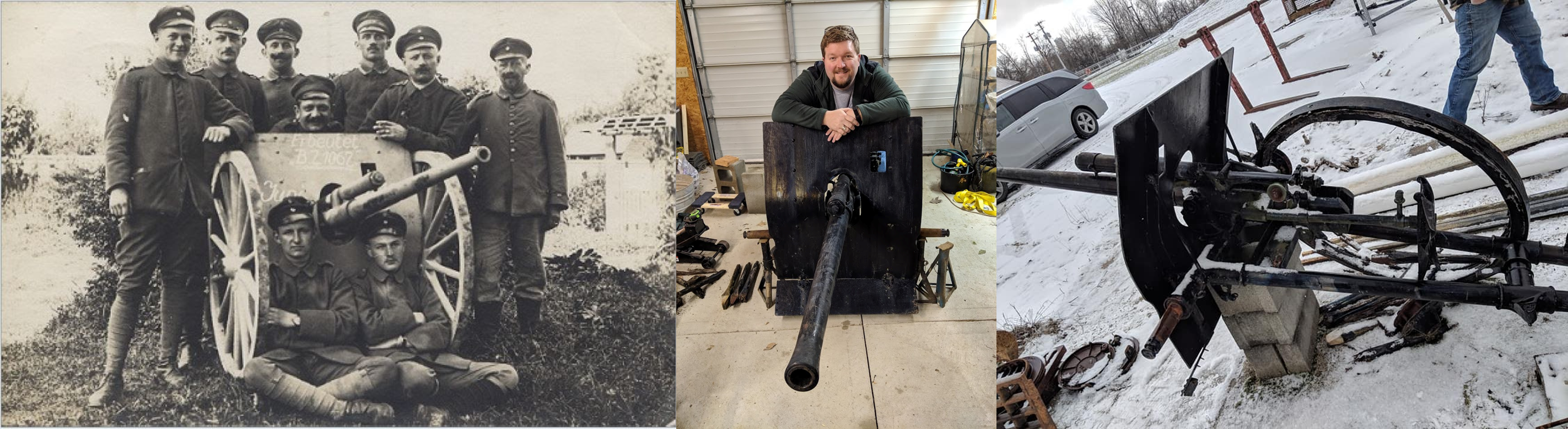 (Left) This is the only picture on the cannon in theater and likely the only picture that proves it was used (though it got captured!) in combat. It was captioned with a date of June 11th, 1918. (Right) The cannon in sad condition in the village of Saint Paris, Ohio before being picked up for the restoration project. (Center) Restoration project leader Jared Shank behind the cannon undergoing restoration. Shank is an Army field artillery veteran who served in in Afghanistan with the 3rd battalion 319th Airborne Field Artillery Regiment of the 82nd Airborne Division.
14 Questions for Jared Shank
"I feel a direct personal connection to our Doughboys"
By Chris Isleib
Director of Public Affairs, United States World War One Centennial Commission
Over the years, we have met several members of our WWI community who have gotten personally involved in hands-on projects, projects that help them to really embrace our WWI history. They include trench work restorations, tabletop diorama creations, reenactor impersonations, restorations of trains/tanks/ trucks/artillery pieces/ambulances/warships, etc. We love these projects -- and we always find interesting stories behind those people who undertake them. Our latest such project is being done by our friend Jared Shank, of Ohio. Jared is an Army veteran, and he only just started working on an incredible find -- a WWI-era light artillery piece, with a remarkable history. We were luck to share some time with Jared, and to hear his story.
Where did the artillery piece come from?
This artillery piece came from a war memorial display located in Saint Paris, Ohio.
What is its known history?
 Jared ShankI’m still actively researching this. The common consensus seems to be that is was donated by the local American Legion Post (Keith Cretors Post 148). However, I have not been able to 100% confirm that. More than a decade ago that Legion post went defunct and I haven’t been able to find any historical records of their events. I have been talking to local historians and searching local newspapers for anything that mentioned this cannon, but have turned up very little. My most accurate guess is that it was placed on display sometime between 1922 and 1930. I’ve narrowed it down to those dates based on conversations with locals.
How did it come to you?
The village of Saint Paris has a Facebook page that I follow. At the beginning of the year (2019) they posted about the cannon and its poor condition since it’s been in storage for numerous years and what ideas residents had. They also cited that as a village with a small budget, funds to restore this cannon were non-existent. A high school classmate of mine is on the village council so I started a conversation with him informing him that I was interested in restoring the cannon so that it could be returned to its place amongst the war memorial in town. I also said I would take on the project at no-cost to the village, but might do some fundraising activities.
What research on it did you do?
I have done extensive research on this particular model cannon. It is known most commonly as the Bethlehem Steel 37mm Cannon. Its official designation is the “37mm US Gun (Bethlehem) Model 1 Carriage Mark A Semi-Automatic”. However, it never became a “mainstream” artillery piece and thus printed materials about it are severely lacking.
 Hello Girls was the colloquial name for American female switchboard operators in World War I, formally known as the Signal Corps Female Telephone Operators Unit. During World War I, these switchboard operators were sworn into the U.S. Army Signal Corps.
Congressman Cleaver Introduces Bipartisan Bill to Award Congressional Gold Medal to the ‘Hello Girls’ of WWI
via the House.gov web site
(Washington, D.C.) – Congressman Emanuel Cleaver, II (D-MO) on March 28 introduced H.R. 1953, the “Hello Girls” Congressional Gold Medal Act of 2019, a bipartisan bill that would honor over 220 American women who served as phone operators with the U.S. Army Signal Corps in France during World War I. As phone operators, these women played a pivotal role in connecting American and French forces on the front lines of battle, helping to translate and efficiently communicate strategy. H.R. 1953 would award these women, the Hello Girls as they came to be known, with the Congressional Gold Medal—the highest civilian award bestowed by Congress—for their service and subsequent sixty-year fight for veteran status and the benefits that are earned with it.
“When I was first told the story of the Hello Girls, it really hit home,” said Congressman Cleaver. “As the nephew of a Tuskegee Airman who went to Europe in defense of freedom during WWII, only to return home with less benefits and recognition than his white counterparts, I can understand how these women must have felt after bravely serving their country only to be told they couldn’t qualify as veterans simply because of their gender.”
Formally known as the Signal Corps Female Telephone Operators, the Hello Girls were recruited by General John J. Pershing in 1917 as the first group of women to hold non-medical positions in the U.S. Army. Considering telecommunication in battle was still relatively new at the time, General Pershing was looking for experienced individuals that could improve communication on the front lines. As the telephone operator field was dominated by women, General Pershing made the decision to form the specialized unit comprised solely of women. It was required that the women be bilingual in both French and English so that they could effectively communicate and coordinate with French and American forces. By the end of the war, the Hello Girls had connected over 26 million calls in support of the war effort, and even continued to serve in Europe to organize the return of American forces following the armistice.
1919: Peace? Exhibition at the NWWIMM
"The war transformed the world, but left a legacy of unresolved issues and conflict."
By Mike Vietti
Director of Marketing, Communications and Guest Services, National World War I Museum and Memorial
The Armistice on Nov. 11, 1918 ended fighting on the Western Front, but the war—nor its lasting effects—did not end even with the signing of the Treaty of Paris at Versailles on June 28, 1919.
The "1919: Peace?" exhibit at the National World War I Museum and Memorial explores the aftermath and the legacy of the Versailles treaty signing. The exhibit opens April 2, and runs through March 1, 2020.
Men and women still lost their lives either directly from continuing hostilities or from lingering wounds and diseases. The influenza epidemic continued unabated until the summer of 1919. From the dark hostile woods of North Russia to the uneasy peace along the Rhine in occupied Germany, death and the threat of war reigniting continued.
Global volunteers’ efforts did not cease with the Treaty of Paris at Versailles. Although most fighting was over, relief efforts against famine, agricultural failures, destruction of environments and religious persecution continued. In large areas of Russia, torn by revolutions and civil war, famine and disease required a massive volunteer turnout, again led by Herbert Hoover. U.S. President Woodrow Wilson’s urgent appeals to Americans for help in the Near East grew.
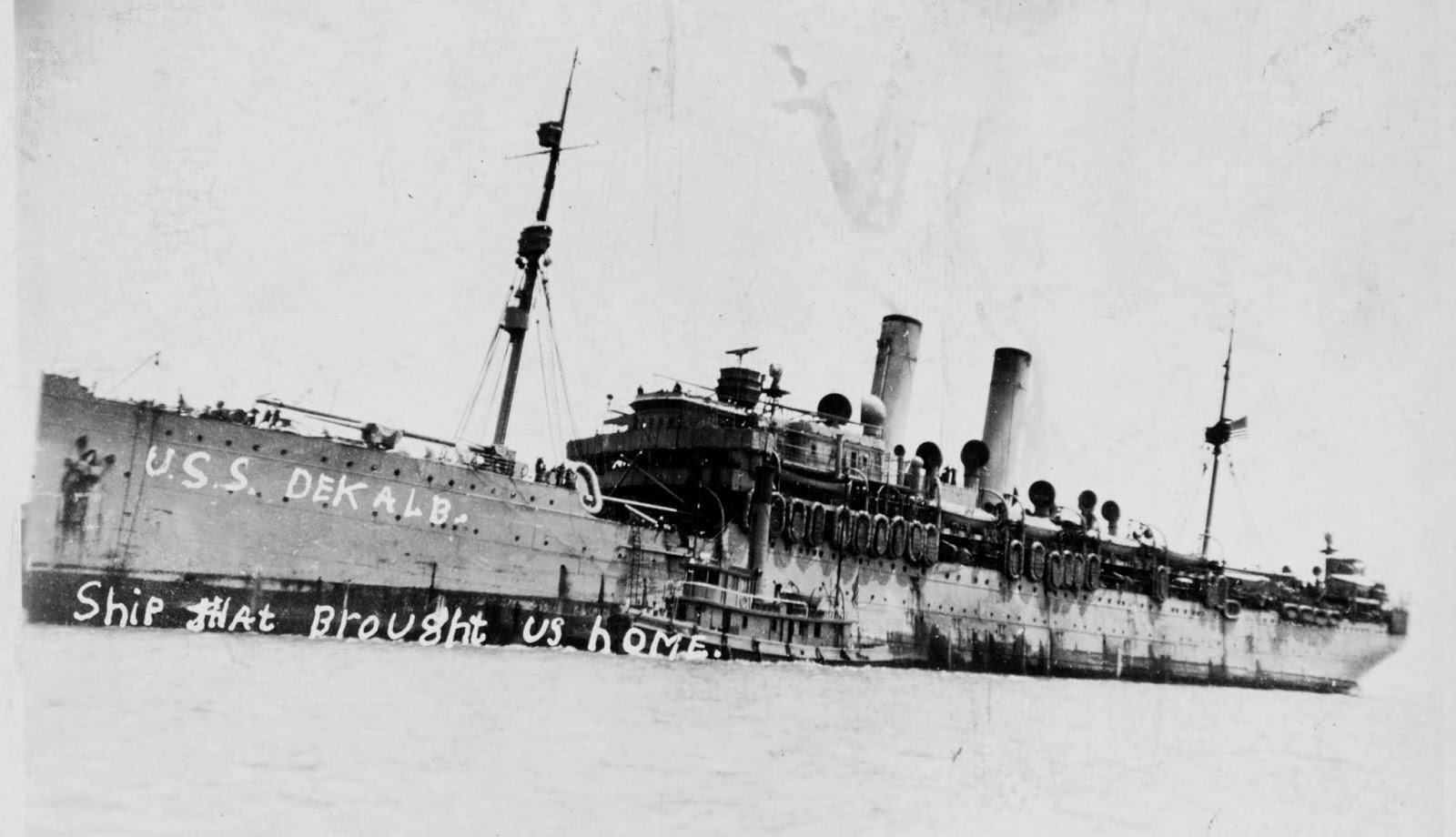 Postcards for virtually every troopship in the Cruiser and Transport Force were produced by enterprising entrepreneurs in 1919 for returning members of the American Expeditionary Force (AEF), plus the warships that were also pressed into service to bring soldiers back to America. USS DeKalb, which brought 8,949 AEF personnel back to America after the Armistice, served as the German auxillary cruiser Prinz Eitel Friedrich, sinking 11 vessels before its crew sought refuge at Norfolk Naval Shipyard in 1915. (Donation of Dr. Mark Kulikowski/ Naval History and Heritage Command image)
One Century Ago: Bringing 'Em Back after "The Navy Put 'Em Across"
via the Hampton Roads Naval Museum web site
Naval historians of the First World War tend to gravitate towards great battles such as Jutland and the ferociously frustrating Dardanelles campaign, but these dramatic naval and littoral actions had nothing to do with the U.S. Navy's most decisive contribution to the war: delivering the two-million-man American Expeditionary Force (AEF) to Europe. By this time one hundred years ago, what was then known as the Great War had been over for months, but many of the American Soldiers and Marines who fought its final, bloody campaigns were still coming home.
Although many different kinds of American surface combatants played important roles in containing the German submarine threat and saving Great Britain from potential starvation, the U.S. Atlantic Fleet's Cruiser and Transport Force, consisting of 45,000 U.S. naval personnel manning 24 cruisers and 42 transport vessels (many of which were German passenger liners confiscated after the American entry into the war) put an entire American army across the Atlantic, a feat inconceivable to European leaders on all sides of the conflict before the Navy actually accomplished it.
Even after American troops irrevocably tipped the balance against Germany and the Central Powers and the war was ostensibly over, the Navy had much more to do. Even battleships and cruisers were pressed into the effort to bring home the Soldiers and Marines as quickly as possible, which stretched into the summer of 1919.
"After the signing of the Armistice," wrote Vice Admiral Albert Gleaves, Cruiser and Transport Force commander, "the United States Transport Fleet expanded still more, and developed into a fleet of 149 ships manned by 4,238 officers and 59,030 men, with the gratifying result that 86.7 per cent[sic] of our overseas army was brought home under the Stars and Stripes."
Read more: One Century Ago: Bringing 'Em Back after "The Navy Put 'Em Across"
Immigrants swell US troops in World War I
By Marlene Gantt
via the East Moline, IL Dispatch-Argus newspaper web site
When America entered WWI in 1917, American men between the ages of 15 and 45 were required to register for the draft. This included not only U.S. citizens, but also resident aliens who had filed a declaration of intent to become a citizen.
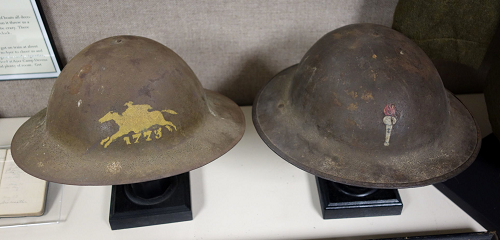 World War I Helmets with insignia for the 26th Yankee Division on display at the Fort Devins museum.This presented a problem since many had immigrated, in part, to escape the long military service required by many European nations, according to the National Park Service.
“Registrants for the draft who claimed exemption on the ground of being aliens,” said the Daily Dispatch Nov. 18, 1918, “and there were many in this country, will now have a long time in which to ponder the advisability of their claims. Such persons are forever barred from becoming citizens of the U.S.”
Aliens were divided into several classes in consideration under draft regulations. “Subjects of neutral countries who claimed exemption because of being aliens are barred now from citizenship,” said the Dispatch.
Subjects of a neutral country who had declared intention of becoming citizens of the U.S. were given the privilege of withdrawing such declaration. If they did, and claimed exemption because of being aliens, they were barred from citizenship.
A male immigrant who had not yet become an American citizen, a process that normally took at least five years, found he could be drafted into the armed forces of his homeland.
“Some immigrants even volunteered to serve in their native country’s military when war broke out,” said the National Park Service. “More than 500,000 German Americans and some 90,000 Italian Americans left the United States to enlist in the armies of their respective homelands.”
About 500,000 immigrants from 46 nations served in America’s armed forces during WWI, making up 18 percent of the troops. One reason for this is that military service had offered a “fast track” to citizenship since the time of the Civil War.
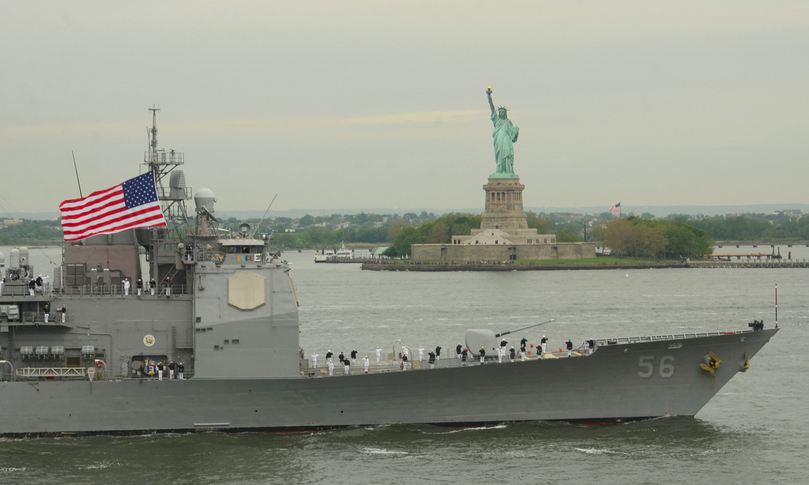 Fleet Week 2019 in New York City will celebrates the centennial of the return of the World War I soldiers of the American Expeditionary Force (AEF) from Europe to America in 1919. The vast majority of AEF personnel left from and returned to the United States in World War I via New York City and its neighboring port facilities.
2019 Fleet Week NYC will have a World War I Theme
By Chris Isleib
Director of Public Affairs, United States World War One Centennial Commission
 The Fleet is coming to NYC -- and World War I will be a part!
The much-loved annual U.S. Navy Fleet Week NYC will descend on the greater New York area from May 22-28, 2019.
Events will kick off with the traditional parade of ships past the Statue of Liberty, and will blossom into an incredible series of activities, exhibits, displays, tours, concerts, and appearances.
This year, there will be added excitement, as the Secretary of the Navy has declared that "World War I" will be included as a special theme. The U.S. World War I Centennial Commission is taking the lead on its own series of activities, aimed at teaching people about the American men and women who served.
Among the World War I-related events will be exhibits of era equipment and uniforms by living-history reenactors, as well as commemorative events, and displays of the sculpture for our new National World War I Memorial. in Washington DC
Read more: 2019 Fleet Week NYC will have a World War I Theme
WWI Memorial Designer Joe Weishaar to Share War Stories
By Kendall Curlee
Director of Communications, Honors College, University of Arkansas
via the University of Arkansas web site
FAYETTEVILLE, Ark. – Joe Weishaar was a 25-year-old architecture intern with a Chicago firm when late-night and weekend design work paid off big. He beat out more than 350 applicants from around the world to design the national World War I Memorial in Washington, D.C. But the dream project has stirred up a fair amount of controversy.
Weishaar, a native of Fayetteville and a 2013 graduate of the Fay Jones School of Architecture and Design and the Honors College, will return to campus to present a free public lecture, “To End All Wars: The Fight for the National WWI Memorial,” at 6 p.m. Wednesday, April 3, in Gearhart Hall Auditorium. A light reception will follow in the Honors Student Lounge, room 130, Gearhart Hall. The lecture is part of the Honors College Invites series, which brings thinkers and doers to campus to share their experiences.
“We’re delighted to welcome Joe back to campus, and eager to see the updated designs for the national World War I Memorial, which will connect visitors with a critical moment in world history,” said Lynda Coon, dean of the Honors College.
Waging a Beltway Battle
Weishaar’s initial plan for the memorial called for a dramatic change to the proposed site, Pershing Park, located just a block from the White House. The jury praised his proposal, The Weight of Sacrifice, as “elegant and absolute,” and a “deceptively simple concept” that remediated a problematic site. His design centered around replacing the park’s litter-strewn, dried-up sunken pool with a lawn at street level, and inserting an 87-foot-long bronze wall, featuring the work of sculptor Sabin Howard, that would invite passersby to touch.
Two years later, the project has hit a few road bumps, centered chiefly on a reconsideration of Pershing Park, which was designed by M. Paul Friedberg and completed in 1981, as an “exceptional example of a landscape design of the modern period,” according to the National Park Service. The park is now being considered for the National Register of Historic Places, and that changes things, Weishaar said.
“Some of the things we wanted to do early on were met with great resistance,” Weishaar said. “Now, the design calls for roughly 96 percent restoration of the existing park.” His current proposal reduces the bronze relief wall to 57 feet in length and inserts it into the western edge of the existing water feature. An elevated path through the water will allow visitors to interact with the sculpture, which has evolved from bas relief to high relief. “The figures really stand out from the ground and are more dynamic, so there is a bit of a gap; we don’t want someone to walk too close, and get stabbed with a bayonet,” he said jokingly.
Read more: WWI Memorial Designer Joe Weishaar to Share War Stories
From Woman’s Suffrage Leader to Government Agent in World War I
By Edward Lengel
via the A Storyteller Hiking Through History web site
Vira Boarman Whitehouse was among the most outspoken and successful leaders of the campaign for women’s suffrage in the United States. Her leadership and hard work played major roles in securing votes for women in New York State in November 1917. Little did she expect the United States government to ask her to serve as a diplomatic agent in Europe, with responsibilities that included fencing with German spies–but she happily took on the challenge.
Suffrage Leader–Victorious
 Vira Whitehouse. Frontispiece photo to her memoir, A Year as a Government AgentBorn in New Orleans in 1875, Vira Boarman attended Newcomb College and married New York stockbroker Norman Whitehouse–later a member of the Men’s League for Woman’s Suffrage–in 1898. As a popular society woman, she learned early on about living in the public eye; and as a lifelong advocate for women’s rights, she recognized the power of the media in defining public perceptions.
In 1913 she began working for the Women’s Political Union, earning plaudits for her abilities as a public orator. Two years later she became Chairman of the New York State Woman’s Suffrage Party, showing her strength as a publicist and manager by, for example, organizing one of the first ever political telephone polling campaigns. Most important from the standpoint of her colleagues, Vira Whitehouse was a phenomenally successful fundraiser. By early 1917 she had through her own efforts raised several hundred thousand dollars to support the suffrage campaign in New York.
When the United States entered World War I in April 1917 Whitehouse, like Alice Paul of the National Woman’s Party, refused to abandon the campaign for woman’s suffrage. Unlike Paul, though, Whitehouse cultivated friendly relations with President Woodrow Wilson, meeting with him just before New York State voted to extend suffrage in November 1917 and campaigning in support of the war effort.
Government Agent
For Vira Whitehouse, public service in support of the war effort offered an opportunity for women to take responsibility and authority in new roles throughout government and society. “One of the great stumbling-blocks to the advance of women is our very general reluctance to accept responsibility,” she wrote. “Since the beginning of the world we have been hypnotized and have hypnotized ourselves into a doubt of our ability.” War work–especially in unconventional fields–could help break the spell.
Whitehouse was attending a National American Woman Suffrage Convention in Washington, D.C., when George Creel, head of the Committee on Public Information (CPI), asked her to go to Switzerland as an American diplomatic agent. Her job in that neutral country would be to oversee the flow of pro-Allied information–actually, propaganda–in the midst of very active efforts from the opposite side by agents of the Central Powers. Creel believed that the skills Whitehouse had demonstrated as a suffrage leader would prove effective in this new environment. He was right.
Read more: From Woman’s Suffrage Leader to Government Agent in World War I
 The return of the World War I Unknown Soldier: the USS Olympia (Cruiser #6) arrives with the of body of The Unknown Soldier, at the Washington Navy Yard, November 9, 1921.
USS Olympia and the World War I Unknown Soldier
By Chris Isleib
Director of Public Affairs, United States World War One Centennial Commission
2021 is the 100th anniversary of the Tomb of the Unknown Soldier. In an April 3 lunchtime lecture at the U.S. Capitol Historical Society in Washington, DC, John Brady, president of the board of directors, Flagship Olympia Foundation, will share information about the USS Olympia‘s role in transporting the Unknown Soldier home from Europe and his subsequent lying in state at the U.S. Capitol prior to being buried at Arlington National Cemetery.
Brady will talk about the USS Olympia's service as Admiral Dewey's flagship at the Battle of Manila; her service at the USNA training ship in early 1900's; and the Navy personnel who served aboard her during WWI. These men included Charles Bolden, son of jazz founder Buddy Bolden, and Albert Nicholas and Zutty Singleton, African-American sailors who became famous jazz musicians after the war.
Brady will also talk about General Erskine who as a young Marine led the Honor Guard that accompanied the Unknown Soldier. Two decades later, General Erskine led the invasion of Iwo Jima during World War II.
Lastly, Brady will talk about the new Sig Sauer pistols that the Tomb of the Unknown Soldier Sentinels are carrying. These pistols are inlaid with wood from the USS Olympia.
Click here for more information and find out how to register to attend this U.S. Capitol Historical Society event.
An Oregonian's place in the Legion's birth
By Ken Olson
via the American Legion web site
He was a beloved soldier, family man, Oregonian and visionary co-founder of The American Legion. And George A. White’s legacy infused a gathering of veterans, families and dignitaries who packed American Legion Post 10 in Albany, Ore., March 15 to mark the 100th birthday of the nation’s largest veterans service organization.
“He was there from the very beginning,” Oregon Alternate National Executive Committee member Andy Millar said. “He was a true Legionnaire.”
 “I get choked up because of my dad,” added Steve Adams, first vice commander of the Department of Oregon, who began accompanying his father on visits to American Legion posts when he was 6 years old. “He made me promise to never forget World War I because that’s when The American Legion was born.”
The centennial celebration drew veterans from across the state. Their service spanned generations, from David Russell – who survived the sinking of USS Oklahoma during the Japanese attack on Pearl Harbor – to Don Weber and Rick Dominguez, whose long military careers included deployments to Afghanistan and Iraq, respectively. But the event that brought them together at Post 10 last week started when four American officers met in Paris in January 1919.
Lt. Col. Theodore Roosevelt Jr. had invited White, William Donovan – future founder of U.S. intelligence services – and engineer and architect Eric Fisher Wood to dinner to discuss low morale among American troops. The war-weary soldiers were apprehensive about returning home to an uncertain future after enduring brutal combat along the Western Front. At a meeting of 20 officers a month later, it was White who proposed a large gathering of American service members to discuss these perplexing issues. As many as 1,000 American troops attended what became known as the Paris Caucus beginning on March 15, 1919, that formed The American Legion.
When Roosevelt and White first sat down in a restaurant in Paris in January that year to discuss launching an organization to represent U.S. veterans of the Great War, “the question was, ‘Who is going to take care of the boys when they all get home? Who is going to care about them and their jobs?’ Because at that juncture, there was no Veterans Administration,” American Legion Past National Commander Charles Schmidt said during the centennial celebration.