































World War I Centennial News
Hero in WWI and baseball to receive overdue honors from PA hometown
By Brian Brehm
via the Winchester Star (PA) newspaper web site
WINCHESTER, PA — If Spottswood Poles had been born a century later, he would have been a superstar.
Instead, most people in his hometown of Winchester have no idea who he was or what he did.
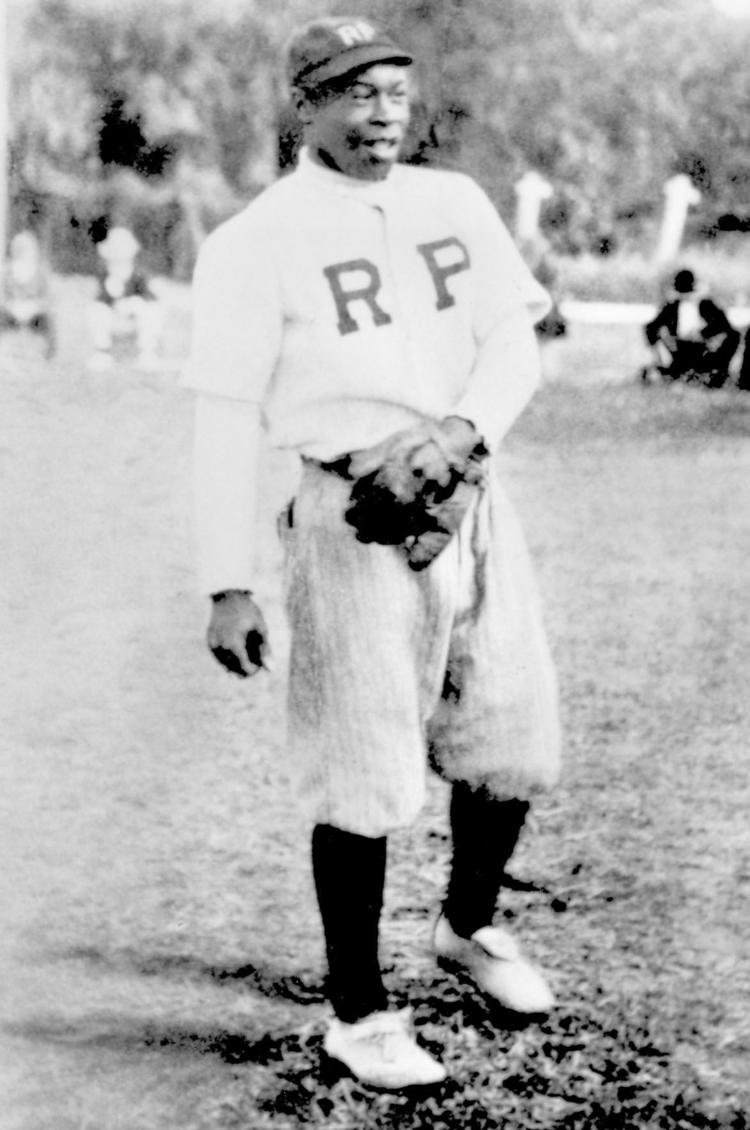 Winchester native Spottswood Poles was a Negro League baseball player who became a decorated World War I soldier. After many efforts to recognize Poles, city officials and the Valley League’s Winchester Royals baseball team on June 14 will unveil an interpretive historical marker and the naming of a road for him in Jim Barnett Park.That’s about to change.
Poles, an African-American who became a hero on ballfields and battlefields alike, will be recognized by city officials and the Valley League’s Winchester Royals baseball team on June 14 with the unveiling of an interpretive historical marker and the naming of a road for him in Jim Barnett Park.
“A lot of folks are working different areas to bring that night together,” Winchester Planning Director Timothy Youmans said. “We recognized a few years ago this guy was pretty significant.”
That may be an understatement. Poles was a decorated hero in World War I, and many of today’s sports aficionados argue he should be in the National Baseball Hall of Fame.
Poles was born Dec. 9, 1887, and honed his baseball skills with a broomstick and tennis ball outside his house at 530 Fremont St. He went on to play in the Negro leagues.
In 1906, he joined the Harrisburg Colored Giants baseball team in Pennsylvania. Poles became a professional player in 1909 with the Philadelphia Giants, then signed with the New York Lincoln Giants when the Philadelphia team folded in 1911.
Poles enjoyed his best years in New York, batting .440 in his first season with the Lincoln Giants, .398 in his second, .414 in his third and, in his final season with the team, a stunning .487.
“He was the black Ty Cobb,’” said Winchester-Frederick County Convention and Visitors Bureau Executive Director Justin Kerns, comparing Poles to the legendary Major League Baseball player who is ranked third in Sporting News’s list of “Baseball’s 100 Greatest Players.”
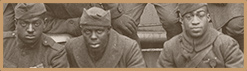
After leaving the Lincoln Giants, Poles played for the New York Lincoln Stars, Brooklyn Royal Giants and Hilldale Daisies before enlisting in the Army’s 369th Infantry Regiment — the legendary Harlem Hellfighters — during World War I.
The Hellfighters were an infantry unit primarily comprised of African-American soldiers. Many white soldiers at that time refused to fight alongside blacks, so in April 1918 the regiment was attached to the French army.
During his year of military service, Poles earned five battle stars and a Purple Heart.
He resumed his baseball career in 1919 with the Lincoln Giants and stayed with the team until retiring in 1923.
Read more: Hero in WWI and baseball to receive overdue honors from PA hometown
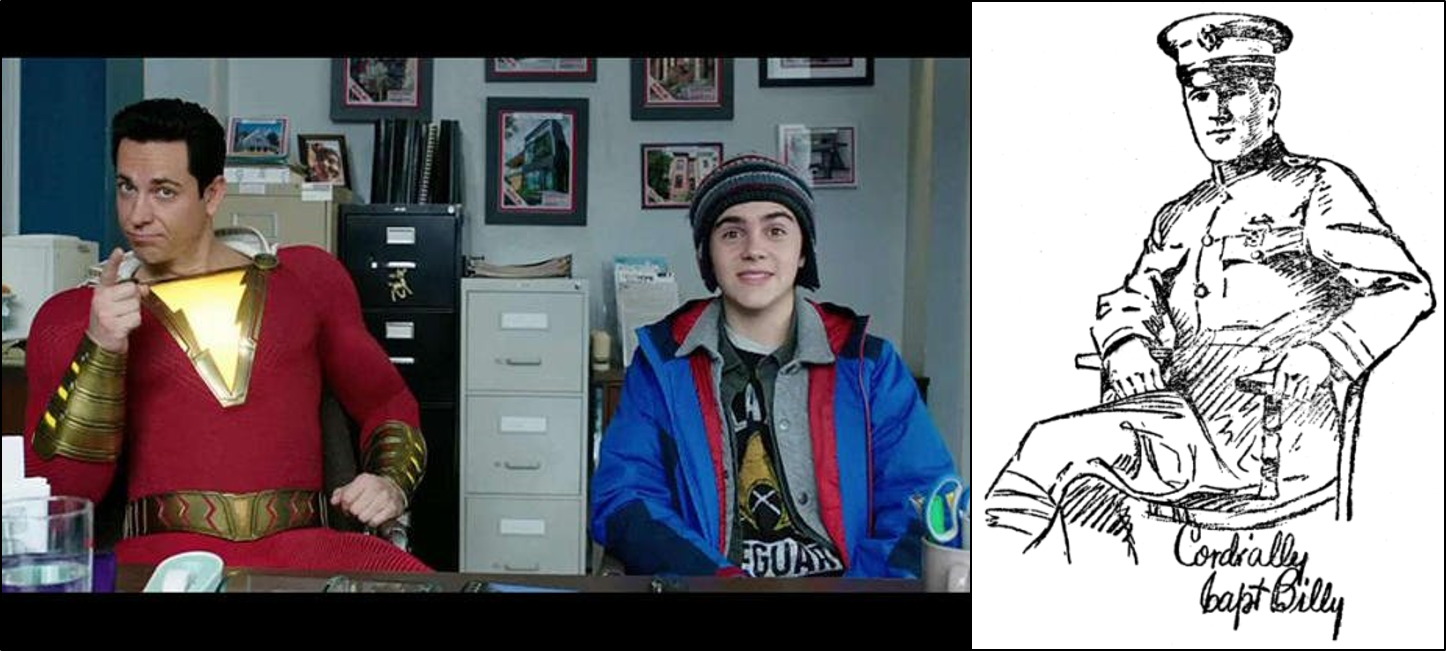 Zachary Levi and Jack Dylan Grazer in the movie "Shazam!" (left). The hit Warner Brothers movie is based on a character whose origins begin with Army veteran Wilford Hamilton Fawcett, also known as "Captain Billy" (self-portrait at right) and his little-known struggle a century ago to adjust to life after World War I.
How One WWI Veteran’s Struggle to Adjust After Army Service Led to the Birth of ‘Shazam!’
By Chad Garland
via the Military.com web site
The hit Warner Bros. superhero film “Shazam!” is based on a character whose origins begin with an Army veteran’s little-known struggle a century ago to adjust to life after war.
The world’s mightiest mortal — a character so much like Superman that his only real weakness was copyright law — was introduced by Fawcett Publications as Captain Marvel, the alter ego of kid reporter Billy Batson, in a comic published from 1940 to 1953.
But before the fictional captain, there was Captain Billy, a real-life former soldier and newspaper reporter whose racy, pocket-sized humor magazine for World War I veterans shocked 1920s America and launched a publishing empire spanning magazines, comics and paperbacks.
One of his sons, who inherited the business, took credit for creating the comic book hero, who may have been a subtle homage to the Depression-era publishing magnate.
Born Wilford Hamilton Fawcett, Captain Billy would go from a struggling veteran to “one of Minneapolis’ lustiest characters” after WWI, remembered as “an adventurer [who] packed a lifetime of thrills into his 57 years,” the Minneapolis Tribune would say in a 1940 obituary, though he wasn’t quite 55 when he died.
Some elements of Fawcett’s early life story appear to have been embellished over the years, said Britt Aamodt, who researched him for her book “Superheroes, Strip Artists, & Talking Animals: Minnesota’s Contemporary Cartoonists.” Like other notable men of his day, he could spin a good tale.
A military veteran herself, Aamodt was drawn to Fawcett’s story partly by his efforts to adjust to civilian life after the military — twice. He served as a teenager in the early 1900s and again in his 30s during WWI.
Read more: How One WWI Veteran’s Struggle to Adjust After Army Service Led to the Birth of ‘Shazam!’
From the World War I Centennial News Podcast
Remembering Veterans:
Senator Jon Tester on the Hello Girls Congressional Gold Medal Act of 2019
In April 12th's edition of the World War I Centennial News Podcast, Episode 118, Senator Jon Tester of Montana joined the show to discuss a new bill, S206, otherwise known as The Hello Girls Congressional Gold Medal Act of 2019, that would finally give the Hello Girls the formal recognition they deserve. The following is a transcript of the interview, edited for clarity:
Theo Mayer: For Remembering Veterans, there are bills moving through both houses of Congress to honor the Hello Girls. In the Senate, Senator Jon Tester, Democrat from Montana, and Senator Marsha Blackburn, Republican from Tennessee, are cosponsoring a bipartisan bill called the Hello Girls Congressional Gold Medal Act of 2019. We're very honored to have Senator Tester with us today to talk about the bill, what it is, and explore how you, our listeners, can help get this properly deserved honor bestowed on these pioneering women who served so successfully and then struggled to be recognized and to receive veteran's benefits. Senator, welcome to the podcast.
Jon Tester: It is great to be here. Thanks for having me Theo.
Theo Mayer: So Senator, you're a ranking member of the US Senate Veteran's Affairs Committee. How did this story come to you and how did it come to light for you?
Jon Tester: Well look, as with most the good ideas I get, I usually get them from Montanans, and this is no exception. A fellow who served this country in the military by the name of Ed Saunders who's a bit of a history buff did some research, and there have been a number of documentaries made about the Hello Girls. He approached me and asked if we could do something to recognize these women who performed incredible services during World War I, and as you said really were able to connect the American troops with the French troops and made a difference in battle. And so, we came up with the idea of getting in a Congressional Gold Medal to the folks who were Hello Girls. There's not many of them left quite frankly now. This should've been done 50, 60 years ago. But the fact of the matter is we are where we are, and I thought it was the right thing to do to give recognition, one of the highest civilian medals in fact, to women who served in our military during World War I and who did an incredible job connecting every outpost between the Americans and the French. It's one of those things that's better late than never, and we need to get these folks the honors that they deserve so that we can remember our history and learn from our history as we move forward.
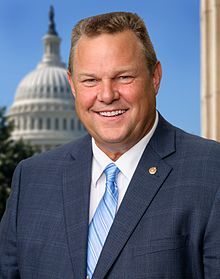
 Senators Jon Tester (D-MT) and Marsha Blackburn (R-TN) are cosponsors of S206
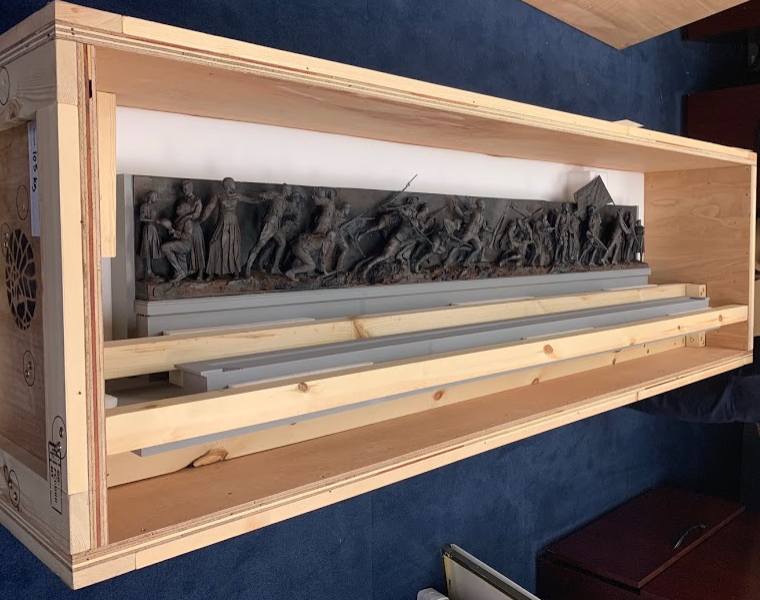 The new maquette in its shipping crate at the U.S. World War I Centennial Commission office in Washington, DC.
New WWI Memorial sculpture maquette arrives in DC
By Chris Isleib
Director of Public Affairs, United States World War One Centennial Commission
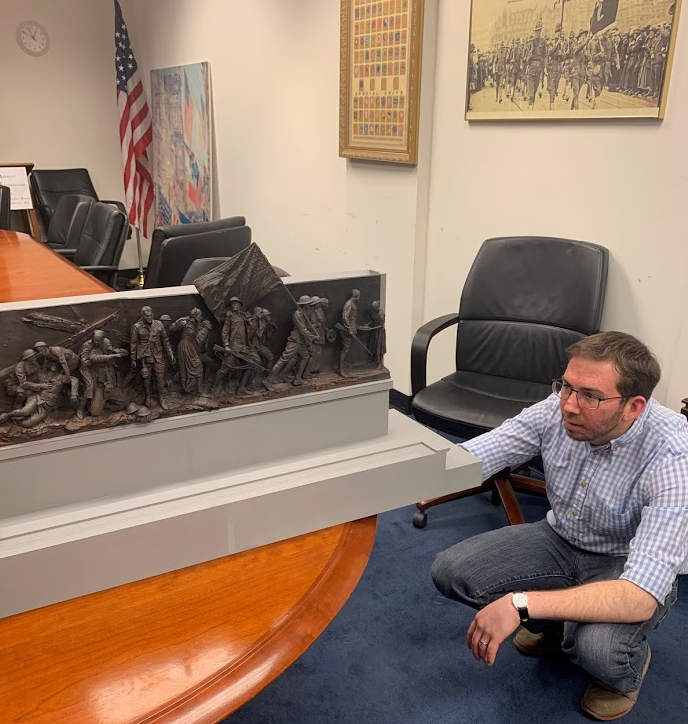 National World War I Memorial architect Joe Weishaar takes a close look at sculptural details on the new maquette.It was an exciting day in the U.S. World War I Centennial Commission office on Friday, April 12! We took delivery of the beautiful new updated sculptural maquette, created by sculptor Sabin Howard.
This new scale-model maquette was crafted at the Pangolin Foundry in the UK, and incorporates a number of updates to the design for the National World War I Memorial in Washington, DC.
This maquette also includes new details like the surround wall -- along with a suggested Archibald MacLeish quote. This will help greatly with finalizing detail planning and closing in on the final look of the project.
Response was unanimous -- the new maquette is, itself, a work of art. WW1CC Executive Director Dan Dayton called it "Amazing". Staffer Erin Sliwinsky said "It really looks sharp!".
Chief of Staff Dale Archer, the long-term project manager for the Memorial, said "It's very exciting to see this second maquette, which incorporates additional historical and sculptural design updates."
You can read previous articles on the work being done on the sculpture at Pangolin here and here.
Keep an eye here for updates, as we move forward on our efforts to create the new National World War I Memorial for the Nation's Capital.
Actor from Newburyport, MA will be part of WWI memorial
By Jim Sullivan
via The Daily News of Newburyport (MA) newspaper web site
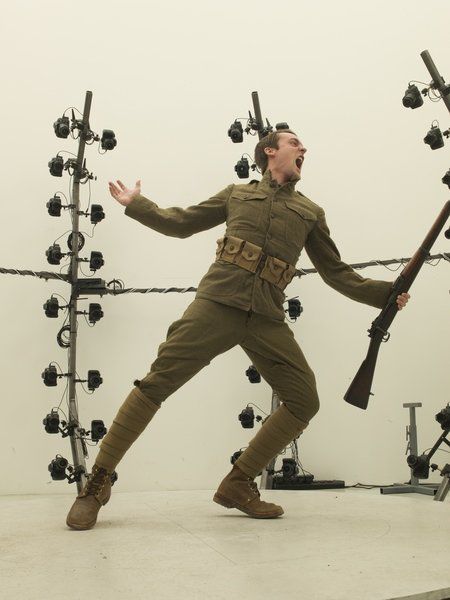 Newburyport, CT native Paul Emile Cendron, portraying a Doughboy, in a scene photographed by scores of cameras for a project by sculptor Sabin Howard to create a national World War I Memorial in Washington, DC.NEWBURYPORT — A city native has found himself at the center of a living history of World War I.
The United States World War I Centennial Commission has been working to produce projects and activities commemorating the Great War’s centennial anniversary ever since it was created by an act of Congress in 2013.
Sculptor Sabin Howard has been commissioned to create Washington, D.C.’s first WWI memorial and has been using a first-of-its-kind, 160-camera “photogrammetry” rig to do so.
Howard has been working along with roughly 35 actors who are portraying Word War I soldiers for the project and Newburyport native Paul Emile Cendron is one of those Doughboys.
“The World War I Commission chose (Howard’s) design which was something that I modeled for along with some other actors,” Cendron said. “We would go to his studio and put on these World War I uniforms. We had guns or we had sticks which stood in for guns.
"Sabin would take around 1,000 pictures with his iPhone and he would send them to someone who did Photoshop.”
Cendron said he has spent much of the past four years working with Sabin and his fellow actors to portray the story of a soldier’s journey through World War I as he leaves his family for the battlefront, his battles and eventual return home.
“I’m not sure you can say I was playing any one particular character but I’m playing a soldier’s journey,” Cendron said. “It’s a soldier leaving and coming home and what happens in the middle as well.”
Cendron said his face and body have been used to create 10 different characters and he expects audiences to see his face “six or seven times.”
Read more: Actor from Newburyport will be part of WWI memorial
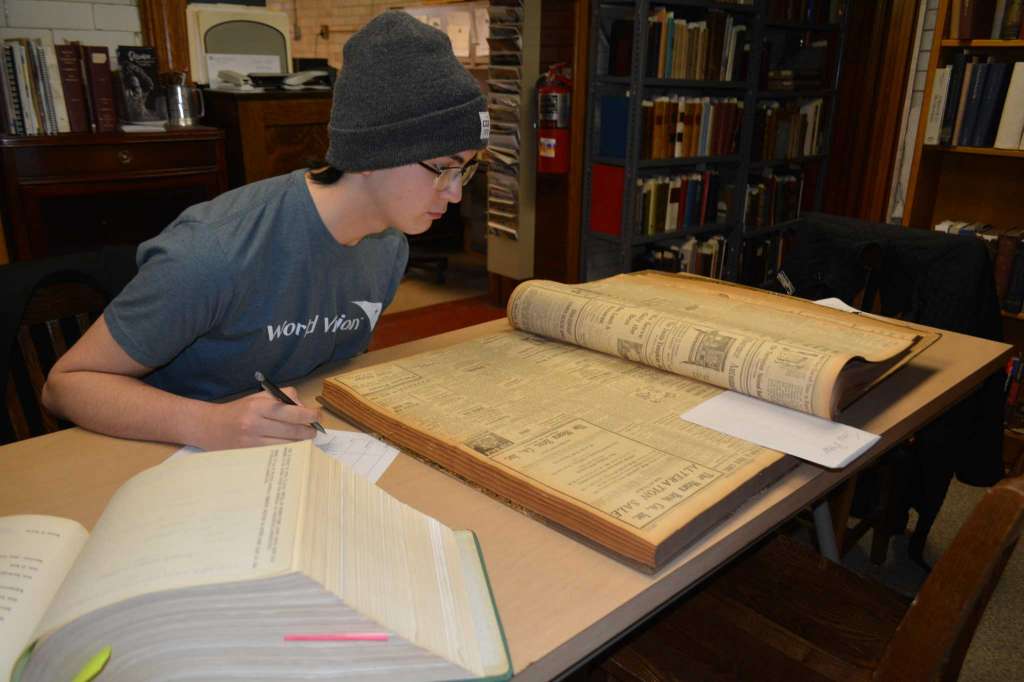 History scholar Lucas Rodriguez of Torrington was one of 15 teenagers in the state chosen to participate in an international project in France this summer to help restore trenches built by American soldiers during WWI.
Torrington teen to travel to France to study CT’s role in WWI
By Leslie Hutchison
via the Register Citizen newspaper (CT) web site
TORRINGTON — A soldier from the city who died in WWI will be honored this summer by a local high school student as part of the Connecticut State Library’s “Digging Into History“ project.
Lucas Rodriguez, 16, will join a group of other teenagers from the state who will travel to France where certain American soldiers faced the German army for the first time.
The group will volunteer in the village of Seicheprey where the troops dug trenches into the forest soil in April 1918 as a measure of protection.
As part of the history project, Rodriguez is researching the military history of John Ryan, of Torrington, with the help of the Torrington Historical Society.
He found out that many soldiers from Connecticut died in the attack, including Ryan.
A key find about the local solider was discovered in a July, 1918 newspaper article with the help of the historical society curator, Gail Kruppa. It shows that Ryan “was the first Torrington soldier to be killed with the American army in France.”
Rodriguez will compile the information he’s gathered into a detailed essay about Ryan as part of a requirement for the project.
“Quite a few residents from Torrington served in the war,” Kruppa said. “It was over 1,350 (residents) and 25 percent were immigrants.” She said the city had a population of about 20,000 at the time of the war.
The teen’s interest in military history was kindled by stories he heard from his family.
“Both of my grandfathers served, one in the army and one in the navy. My dad was a marine,” Rodriguez said. “I grew up hearing all of these stories.”
Read more: Torrington teen to travel to France to study CT’s role in WWI
From the World War I Centennial News Podcast
WWI Remembered:
Alan Axelrod on George Creel, America's Chief Propagandist- Part 2
In April 12th's edition of the World War I Centennial News Podcast, Episode 118, author Alan Axelrod returned to finish an expansive interview on George Creel, the publisher of the government's Official Bulletin and one of the most powerful war-time Americans. The following is a transcript of the interview, edited for clarity:
Theo Mayer: So, with us to explore this character is Allen Axelrod, the author of Selling the Great War: The Making of American Propaganda. It's the bio of George Creel, and this is part two of our conversation. You'll find part one in episode 117. Alan, to kick off part two let's talk about the post-armistice period. You know, we've republished every issue of the Official Bulletin on the website at the Commission. And one day, at the end of May, it just stops. So, on April 1st, suddenly there's nothing in the last issue that says we're stopping. It's just all of a sudden it goes away. Did the whole committee just evaporate all of a sudden?
 Alan Axelrod is the author of over 150 books on topics such as history, management, and businessAlan Axelrod: It evaporated all of a sudden. Congress cut it off and Congress went after it with almost literally a hatchet. They threw everything away that they could get their hands on, they destroyed all the records they could get their hands on. The only things that were saved were what Creel himself managed to salvage. He rented trucks and men to load them, and took stuff away and stored it at his own expense. And any of this vast amount of material that he didn't save was destroyed. There was a real revulsion in Congress against everything he had done. It was very strange.
Theo Mayer: Well, revulsion of just him, or him and Wilson both?
Alan Axelrod: After the armistice and ultimately after the defeat of the League of Nations in the US and the Treaty of Versailles, there was a real collective political effort at group national amnesia. There was almost an effort to erase most of what the war had been about, and Creel's effort was part of it.
I actually think that part of the animus against Creel was that he had done his job too well, that the propaganda and the mindset it created were considered dangerous, and that the incoming Republican wave that swept in after Wilson, beginning with the midterm elections that transformed the balance of Congress, wanted to disengage the nation from the global orientation that it was shifting to under Wilson. It was the closest thing we ever had to a book burning.
Theo Mayer: So, we get to the end of the war and suddenly all of this just sort of disappears, evaporates, goes away. And over the next number of years, this stuff starts to reemerge as Germany regains power. We've talked about that in the past. Why don't you talk about that a little bit?
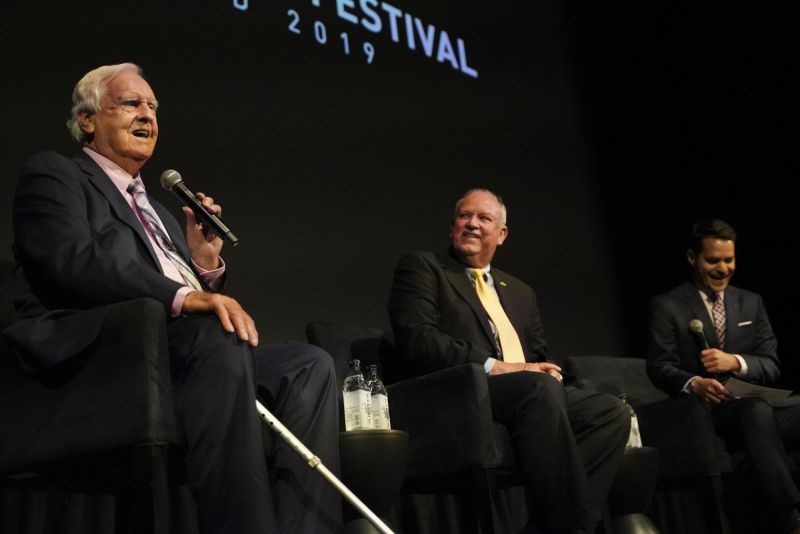 Gerald York (center) and Andrew Jackson York (left) attend the opening night of the Turner Classic Film TCM Classic Film Festival at American Legion Post 43 in Hollywood, Calif., on Thursday, April 11, 2019. (Photo by Schelly Stone/The American Legion.)
American Legion Post 43 renovation completed
"A culmination of the history of the military in Los Angeles."
By Steven B. Brooks
American Legion Post 43
Note: Our friends at the legendary American Legion Post 43 in Los Angeles have great reason to celebrate. They recently completed a multi-million dollar top-to-bottom renovation of their landmark clubhouse -- not the least of which was their spectacular 1920's era theater space. To kick things off right, they agreed to host, as their first major event, the multi-day annual Turner Classic Movies TCM Classic Film Festival. The film that was picked to introduce this year's film festival was none other that SGT YORK, the classic Gary Cooper film produced in 1941. And of course, to introduce this great film, the film festival picked none other than our friend, Colonel Gerald York, grandson of Sgt Alvin York, and his uncle, Andrew Jackson York -- son of the WWI hero.—Chris Isleib, Director of Public Affairs, United States World War One Centennial Commission
As The American Legion project manager, Hollywood Post 43 member Bill Steele saw what was once an aging multipurpose room within the post undergo an amazing transformation into a top-level movie theater.
But the culmination of the multi-million dollar project wasn’t the final product. It came April 11 on the opening night of the Turner Classic Movies (TCM) Film Festival, when The Legion Theater served as one of the festival’s six venues.
“This is a dream come to true,” said Steele, who serves in the U.S. Navy Reserve. “To be able to be a part of the Turner Classic (Movies) Film Festival, which is a world-renowned film festival, it’s a very high bar to clear. Just to be considered to be a part of that is really incredible. The fact that we’re doing it is amazing.”
Post 43 is no stranger to Hollywood, able to call Clark Gable, Gene Autry, Mickey Rooney, Red Buttons, Ronald Reagan, Charlton Heston and Stan Lee among its former members. The post has served as a backdrop in movies such as “The Shining” and the J.J. Abrams’ 2009 reboot of “Star Trek,” as well as in television series “Veep” and “Scandal.”
But the renovation of an unused room into a nearly 500-seat theater featuring state-of-the-art digital projection and sound systems, and 35mm and 70mm capabilities, has taken Post 43 to another level.
“It’s really a culmination of the history of the military in Los Angeles,” Post 43 Commander Michael Hjelmstad said. "This (post) was started by filmmakers in 1919, and now we’re kind of back around to that relevance in the entertainment industry that we used to have.
“It makes my heart race and my hair stand up to be a part of something this big now. It’s like the field of dreams: We build it and they come. And they did. They’re here.”
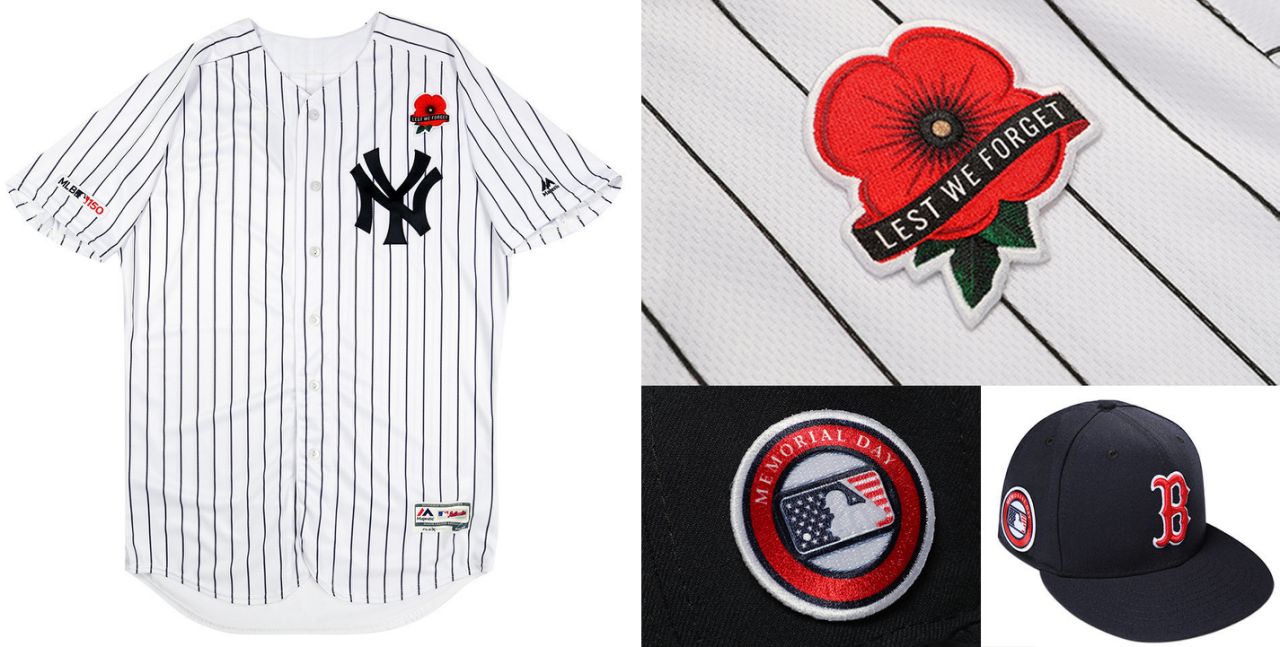 Major League Baseball's new uniforms for Memorial Day in 2019 evoke World War I with a poppy theme.
Bye, Camo: MLB changes its approach to Memorial Day uniforms
By Mike Oz
via the Yahoo! Sports web site
Major League Baseball has changed the way it is approaching Memorial Day uniforms for 2019, heeding criticism from the past and hoping to strike a subdued tone that’s more in line with the true meaning of the holiday.
Gone are the camouflage caps and camouflage accents on jerseys. Instead, MLB is adding a poppy to its Memorial Day uniforms — a symbol that has been used since the 1920s to honor those who died in war — with the phrase “Lest We Forget.” These will appear on teams’ regular uniforms. The caps will feature a special stars-and-stripes Memorial Day patch.
Neither the Memorial Day jerseys or the caps will be sold at retail stores, another change in MLB’s approach. The camo uniforms fans are used to seeing on Memorial Day will instead be worn May 17-19. The league is shifting that look to Armed Forces Day, the annual holiday that celebrates the military and falls on May 18 this year.
The difference between the two holidays is important: Armed Forces Day is about celebrating the military and its members, while Memorial Day is a solemn occasion to mourn soldiers who died in combat.
“We wanted to make sure we were sticking to the true meaning [of Memorial Day],” Melanie LeGrande, MLB’s vice president of social responsibility, told Yahoo Sports. “It’s really about observing all those who were lost.”
Read more: Bye, Camo: MLB changes its approach to Memorial Day uniforms
 Members of the USS Tampa's crew sometime between 1913 and 1915. The Coast Guard cutter served in World War I. On Sept. 26, 1918, a German submarine sank the ship, killing all 130 men on board.
Coast Guard to award Purple Hearts to USS Tampa crew killed during WWI
By Rose L. Thayer
via the Stars and Stripes newspaper web site
Anna Bonaparte was 4 years old when her father James Wilkie died on board the USS Tampa on Sept. 26, 1918. Though she didn’t have many memories of her father, she constantly spoke about him and his service in the Coast Guard, said her son Wallace Bonaparte.
Next month, Bonaparte, a former Army captain, will travel from his home in Charleston, S.C., to Washington to receive a Purple Heart in honor of his grandfather, as part of an initiative to recognize the 115 servicemembers who died more than 100 years ago on board the ship.
Anna Bonaparte died in 2012, and Wallace can only imagine how proud she would have been to see her father receive a medal for his service.
“Being ex-military, I do know that it is an honor to be a recipient and it is an exceptional honor,” said the 77-year-old Vietnam War veteran.
Wilkie was a 29-year-old cook on the Tampa, a Coast Guard cutter, when a German submarine sank it off the coast of England during the final months of World War I. All 131 men aboard died. The event was the single largest loss of life for the service branch during World War I, and accounted for more than half of all Coast Guard deaths during the war.
Read more: Coast Guard to award Purple Hearts to USS Tampa crew killed during WWI
Eagle Scout beautifies spot where iconic Doughboy statue stands
A new look for Petersburg's ‘Old Soldier’
By Kristi K. Higgins
via the Progress Index (Petersburg, VA) newspaper web site
 Nicholas Riggs (left) receives a certificate of recognition from Petersburg Mayor Samuel Parham for his Eagle Scout work sprucing up the area of the Doughboy monument on South Sycamore Street. PETERSBURG — The road to Nicholas Riggs’ Eagle Scout designation includes a stretch of South Sycamore Street known for its iconic Doughboy statue.
Riggs, a member of Scout Troop 900 in Prince George County, formally unveiled his Eagle Scout project last weekend. It was a makeover of the Doughboy triangle at the intersection of Sycamore and North Boulevard that included reseeding, weeding, and other general maintenance, and was topped off with a new stone bench and 25-foot flagpole.
He hosted a rededication ceremony at the World War I memorial and also presented the city of Petersburg with a check in excess of $1,000 from donations he raised for the project.
“It is with great pride and pleasure that I received more than enough donations for the project to be used for ongoing maintenance of the Doughboy Memorial Park,” Riggs said in handing the check to Mayor Sam Parham.
The copper-colored statue, officially known as “The Spirit of the American Doughboy” but also informally dubbed the “Old Soldier,” has stood its ground since 1928, when it was presented to Petersburg by the American Legion. It honors the memory of World War I soldiers who were called “doughboys” becaise the rain-soaked mud of Europe often covered their uniforms like bread dough.
It is one of a series of doughboy statues in 39 states designed by sculptor E.M. Viquesney. Its last renovation was in 1997.
On the statue’s base are the names of 91 area World War I veterans who died in service.
On the new bench next to the new flag, Riggs had the following inscribed: “This flag and bench have been dedicated in lasting gratitude to all the men and women who served in the Armed Forces of the United States of America during World War I with honor and sacrifice.”
Members of American Legion Post 2 in Petersburg were on hand for Riggs’ ceremony. Post commander Mark Winecoff saluted the young man for his undertaking.
“After 91 years on duty the Old Soldier started showing his age,” Winecoff said. “A young Scout, looking for an Eagle Scout Service Project, took notice and decided to do something about it. Not for personal recognition did he do this, but rather out of a sense of obligation and service to his community."
Effects of World War I on restaurant-ing in the US
By Jan Whitaker
via the Restaurant-ing Through History web site
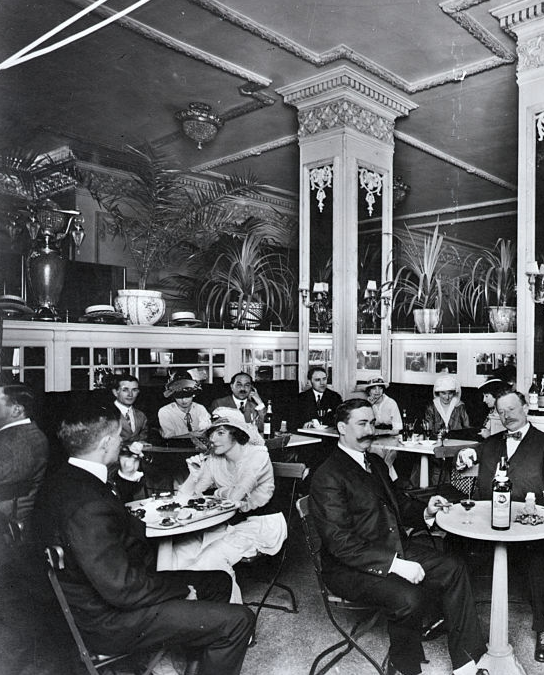 Pre-WWI restaurant in New York hotel● The effects of World War I were felt before the US declared war against Germany in spring of 1917. Americans living abroad, such as artists in Paris, returned to the U.S. Some of them returned to Greenwich Village to develop and nurture something quite foreign here, namely café culture.
● In Washington DC, wartime bureaucracy required more office workers, increasing the ranks of working women, a new and lasting restaurant clientele. As the female workforce grew nationwide, women’s restaurant patronage from 1917 to 1927 went from 20% of all customers to 60%, and became foundational to the future growth of modern restaurants. Around the country low-priced restaurants accustomed to male patronage were forced to add women’s restrooms.
● Many foreign nationals who had worked as cooks, kitchen help, and waitstaff in restaurants left to join armies of their native lands. The restaurant labor shortage worsened when the draft began in 1917 and foreign immigration ceased. Immigrants were replaced by Afro-American and white women who migrated to cities. Serving in restaurants became female dominated.
● The war brought women to the forefront of food service. Home economists rallied to the cause by opening restaurants. In Washington DC, a graduate of Cornell’s home economics program began a cafeteria for war workers nicknamed the “Dom Econ Lunchroom.”
● Wartime prohibition followed by national prohibition in 1919 dealt a blow to fine dining. The culinary arts of European-trained chefs fell into disuse as many elite restaurants closed after a few lean years.
● Immigrant tastes were reworked by WWI. Those who served in the US military became accustomed to the American diet of beef and potatoes, white bread, and milk, as did Southerners used to “hogs and hominy.” Meanwhile on the homefront, certain “foreign” foods, such as pasta and tomato sauce, were admitted into the mainstream middle-class diet, in this case because Italy was an ally.
● Wartime also stimulated a more business-like attitude on the part of restaurants which now had to work smarter to produce profits. They adopted principles of scientific management — for example, they began keeping books! And they standardized recipes to turn out consistent food despite changes in personnel.
 Virginia students involved in the “ReSounding the Archives” World War I music project took a a behind-the-scenes tour of the Library of Congress, guided by music librarians, in Washington, DC.
Virginia students bring 100-year-old World War I sheet music back to life
By Caroline Newman
via the University of Virginia UVAToday web site
Note: The University of Virginia was in the national spotlight this month for becoming the National Champions of the NCAA Basketball Tournament. We are thrilled for them -- and we were also thrilled to find out that they have a special World War I-related project underway at their campus!—Chris Isleib, Director of Public Affairs, United States World War One Centennial Commission
The World War I-era sheet music housed in the University of Virginia’s Albert and Shirley Small Special Collection Library should feel old, by most measures.
It was composed more than 100 years ago for a massive war fought not with nuclear power or cyberweapons, but in the trenches, with bullets, bombs and millions of men. It was heard not through earbuds or stereo speakers, but in parlor music concerts and over the radio, a new technology that was only just beginning to make its way into American homes. Some of the music’s themes – including the songs’ characterizations of women and references to white supremacy – now appear out-of-touch, troubling or offensive.
And yet, students in assistant dean and assistant professor of music Elizabeth Ozment’s “ReSounding the Archives” course – most of them born more than 80 years after the war began – found plenty to relate to as they listened to, analyzed and help recreate the century-old songs.
“I was expecting the music to feel a bit foreign to the students, but they really searched out pieces that reflected their own personalities and intellectual interests, and made so many connections to contemporary politics and culture,” Ozment said.
Ozment and her students were part of an ongoing collaborative project, also called “ReSounding the Archives,” between UVA, Virginia Tech and George Mason University, funded by 4-VA, a collaborative partnership among six Virginia universities. Students from each school researched and analyzed World War I songs from UVA’s archives, and George Mason students recorded studio versions and even traveled to UVA to perform in a live “parlor concert” in front of a packed house in UVA’s Garden Room.
Read more: UVA students bring 100-year-old World War I sheet music back to life